Equation For Cellular Respiration Explained For IB Students » Tiber Tutor
The equation for cellular respiration is one of those topics that looks deceptively simple on the surface. Most students memorise the overall formula and assume that is the whole story. It is not. Behind that single balanced equation lies a multi-stage biochemical process that unfolds across different compartments of the cell, generates varying amounts of ATP, and behaves very differently depending on whether oxygen is present. Understanding each layer of this process is what separates a good biology student from a great one, and it is exactly what IB examiners test.
Table of Contents
- Key takeaways
- The chemical equation for cellular respiration
- The stages of cellular respiration and ATP yields
- Aerobic respiration vs fermentation
- Common misconceptions about the equation
- My perspective on teaching this topic
- Master cellular respiration with Tibertutor
- FAQ
Key takeaways
| Point | Details |
|---|---|
| The overall equation | The balanced cellular respiration formula is: C₆H₁₂O₆ + 6O₂ → 6CO₂ + 6H₂O + energy. |
| Three distinct stages | Glycolysis, the citric acid cycle, and oxidative phosphorylation each produce ATP in different amounts and locations. |
| Oxygen’s critical role | Oxygen acts as the terminal electron acceptor in oxidative phosphorylation, enabling the majority of ATP production. |
| Aerobic vs anaerobic | Aerobic respiration yields approximately 30 to 32 ATP per glucose; fermentation yields only 2 ATP. |
| Exam accuracy matters | Confusing stage-specific ATP totals or misreading the overall equation is one of the most common IB Biology errors. |
The chemical equation for cellular respiration
The balanced overall equation for aerobic cellular respiration is:
C₆H₁₂O₆ + 6O₂ → 6CO₂ + 6H₂O + energy
In words: glucose plus oxygen yields carbon dioxide, water, and energy. This is the glucose respiration equation you will see across every IB Biology textbook, and it represents the complete aerobic oxidation of one glucose molecule.
Each component of this equation tells a story. Glucose is the primary fuel, derived from the food you eat. Oxygen is consumed as the process oxidises glucose fully. Carbon dioxide and water are the waste products released. The energy released is captured mostly as ATP, with some lost as heat. This makes cellular respiration an exergonic process, meaning it releases more energy than it requires to get started.
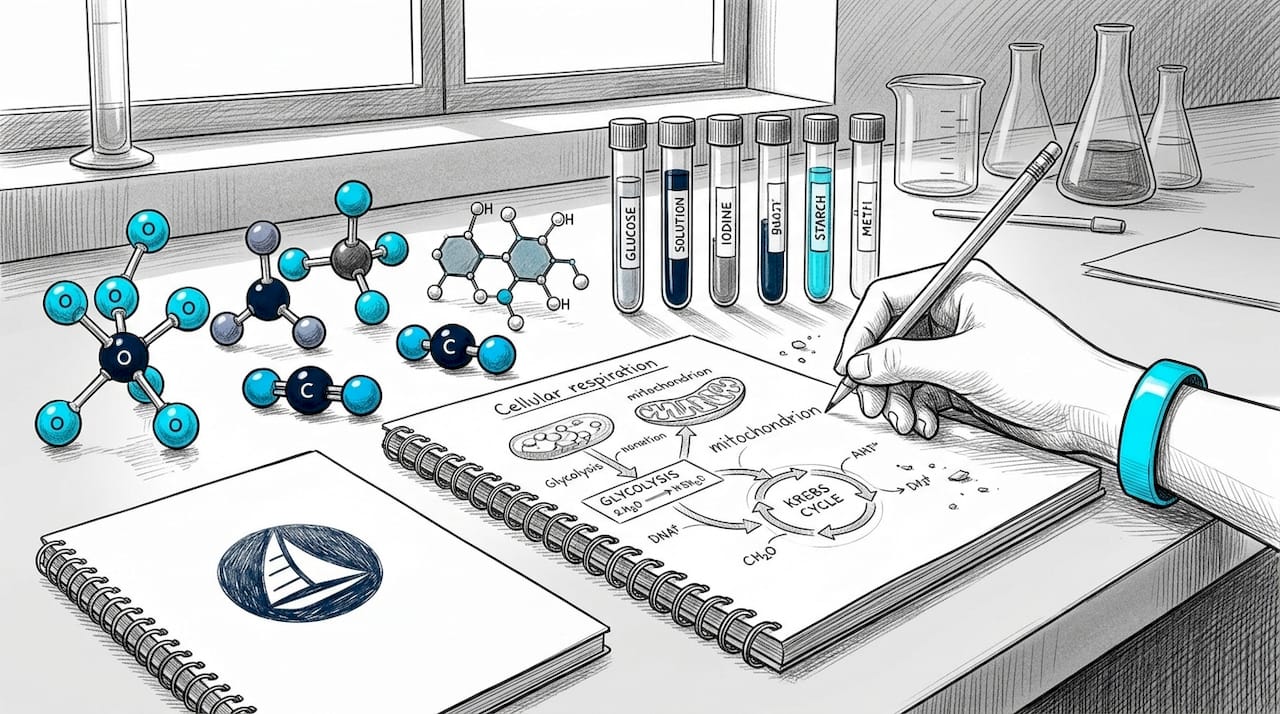
Here is a quick overview of the equation’s components:
| Component | Role | Where it goes |
|---|---|---|
| C₆H₁₂O₆ (glucose) | Primary fuel source | Broken down through multiple stages |
| 6O₂ (oxygen) | Terminal electron acceptor | Consumed in oxidative phosphorylation |
| 6CO₂ (carbon dioxide) | Waste product | Released from the cell |
| 6H₂O (water) | Waste product | Released or used within the cell |
| Energy (ATP + heat) | Usable cellular energy | ATP used for cellular work; heat dissipated |
The cellular respiration formula is elegant in its simplicity. But it does not show how energy is extracted. That requires looking at the individual stages.
The stages of cellular respiration and ATP yields
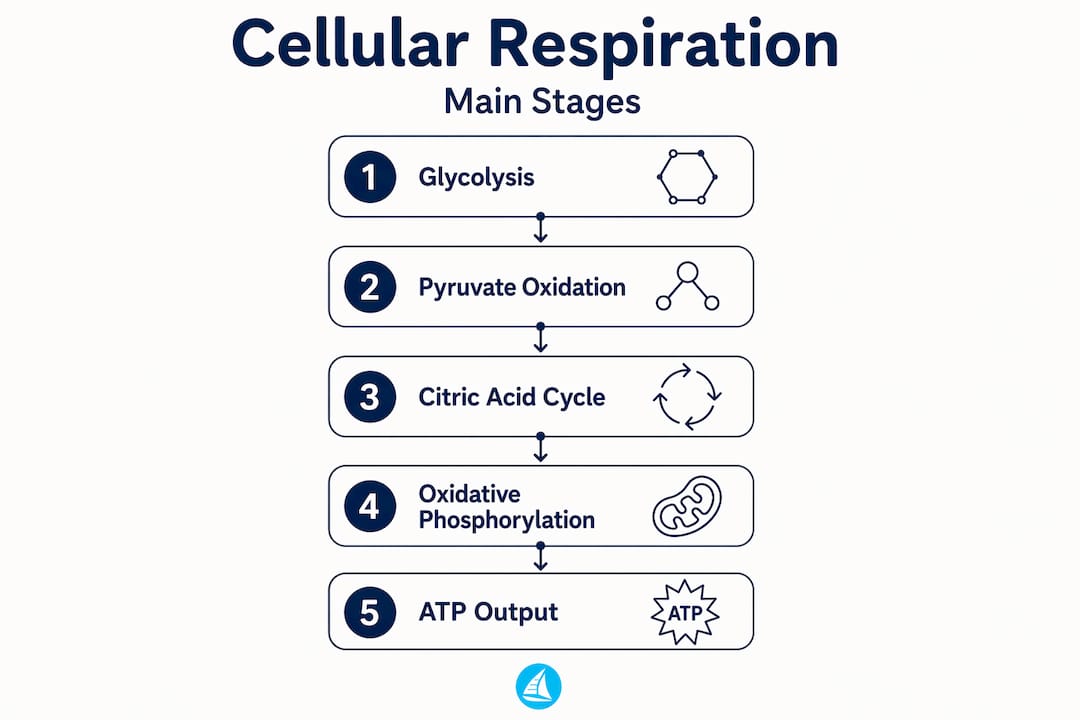
The cellular respiration process unfolds in three sequential stages. Each has its own biochemical equation, location within the cell, and ATP contribution. Each stage occurs in a specific cellular location, which affects how efficiently energy is generated.
-
Glycolysis takes place in the cytosol and requires no oxygen. Glycolysis converts one glucose into two pyruvate molecules, yielding a net gain of 2 ATP and 2 NADH. It is the starting point for all forms of respiration, aerobic and anaerobic alike.
-
Pyruvate oxidation is the bridge step. Each pyruvate molecule is converted into acetyl-CoA as it enters the mitochondrial matrix. Carbon dioxide is released, and NADH is produced. No ATP is generated directly here, but this step is essential for feeding into the next stage.
-
The citric acid cycle (also called the Krebs cycle) runs twice per glucose molecule since two acetyl-CoA molecules are produced. The citric acid cycle oxidises acetyl-CoA fully to CO₂ and generates NADH, FADH₂, and a small amount of ATP through substrate-level phosphorylation.
-
Oxidative phosphorylation is where the bulk of ATP is made. Most ATP is produced here as electrons from NADH and FADH₂ pass through the electron transport chain embedded in the inner mitochondrial membrane. This process drives the synthesis of approximately 26 to 28 ATP molecules per glucose, depending on cellular conditions.
The total ATP yield per glucose through aerobic respiration typically ranges from 30 to 32 ATP. This figure varies because the cost of transporting molecules across mitochondrial membranes is factored differently in various models.
Pro Tip: Never simply add 2 + 2 + 32 and assume you have the definitive ATP total. IB examiners know that incorrect ATP totals come from ignoring membrane transport costs and counting mechanisms. Write “approximately 30 to 32 ATP” and briefly explain why the figure varies. This shows genuine understanding.
Aerobic respiration vs fermentation
When oxygen is available, cells run the full aerobic pathway and produce ATP efficiently. When oxygen runs out, the process changes significantly. In the absence of oxygen, cells undergo fermentation to regenerate NAD⁺, which is needed for glycolysis to continue.
Fermentation is not a continuation of aerobic respiration. It is an alternative anaerobic pathway that produces very little ATP. There are two main types:
- Lactic acid fermentation: occurs in animal muscle cells and some bacteria. Pyruvate is converted to lactate, regenerating NAD⁺. This is why muscles burn during intense exercise.
- Ethanol fermentation: occurs in yeast. Pyruvate is converted to ethanol and carbon dioxide, again regenerating NAD⁺.
Here is how aerobic respiration and fermentation compare:
| Feature | Aerobic respiration | Fermentation (anaerobic) |
|---|---|---|
| Oxygen required | Yes | No |
| ATP yield per glucose | ~30 to 32 ATP | 2 ATP |
| End products | CO₂ and H₂O | Lactate or ethanol + CO₂ |
| Location | Cytosol and mitochondria | Cytosol only |
| NAD⁺ regeneration | Via electron transport chain | Via reduction of pyruvate |
The efficiency difference is dramatic. Aerobic respiration oxidises biological fuels using oxygen to produce far more ATP than fermentation can. This is precisely why sustained physical activity depends on oxygen delivery to working muscles.
Common misconceptions about the equation
The equation for cellular respiration causes more exam errors than almost any other topic in IB Biology. Here are the most frequent misconceptions and how to address them:
- The overall equation shows the full process. It does not. The cellular respiration formula is a summary of what goes in and what comes out. It says nothing about the intermediate steps, electron carriers, or enzyme activity involved.
- ATP is produced in one step. Students often treat ATP production as a single event. In reality, ATP is produced at multiple stages through both substrate-level phosphorylation (glycolysis and the citric acid cycle) and oxidative phosphorylation.
- Fermentation is a type of cellular respiration. This is a grey area. Students frequently confuse fermentation with cellular respiration. Fermentation regenerates NAD⁺ and produces a small amount of ATP, but it does not involve the electron transport chain or oxygen.
- The ATP count is always 36 or 38. These older figures are no longer considered accurate. Modern biochemistry places the figure closer to 30 to 32, accounting for membrane transport costs.
Pro Tip: When writing exam answers, always specify which stage you are describing and where it occurs in the cell. Writing “glycolysis occurs in the cytosol and produces 2 net ATP” will score more marks than a vague reference to “the first step.”
Using the equation in your studies and exams
Once you understand the full cellular respiration process, you can use that knowledge strategically in exams and assignments. Here is a simple checklist to guide your preparation:
- Memorise the overall balanced equation: C₆H₁₂O₆ + 6O₂ → 6CO₂ + 6H₂O + energy
- Know the ATP yield and location for each stage
- Be able to compare aerobic respiration and the anaerobic respiration process in a table
- Link cellular respiration to photosynthesis since the products of one are the reactants of the other
- Practise writing balanced equations for individual stages, not just the overall reaction
| Stage | Location | ATP produced |
|---|---|---|
| Glycolysis | Cytosol | 2 net ATP |
| Pyruvate oxidation | Mitochondrial matrix | 0 ATP directly |
| Citric acid cycle | Mitochondrial matrix | 2 ATP (per glucose) |
| Oxidative phosphorylation | Inner mitochondrial membrane | ~26 to 28 ATP |
My perspective on teaching this topic
I have seen a lot of students arrive at this topic feeling genuinely confident, only to discover that what they memorised as “the equation” is just the opening line of a much longer story. In my experience, the biggest shift in understanding happens when students stop treating the overall equation as the destination and start seeing it as a summary of something far more intricate.
What I find particularly effective is teaching the equation for aerobic respiration alongside the stage-specific reactions from the very beginning. When learners can see that glycolysis, the citric acid cycle, and oxidative phosphorylation each contribute differently, the overall equation starts to make sense on a mechanical level. It stops being a formula to memorise and becomes something they genuinely understand.
My strongest advice: do not wait until revision to untangle the ATP counts. Work through each stage carefully, connect it to its cellular location, and practise explaining it out loud. If you can explain oxidative phosphorylation to someone who has never heard of it, you are ready for the exam.
— Oliver
Master cellular respiration with Tibertutor
If you are preparing for IB Biology and want more than just notes, Tibertutor is built for exactly that. The platform offers animated video explanations, exam-style questions, and detailed mark scheme breakdowns covering the full cellular respiration process and every other core biology topic on the IB syllabus.
Whether you are a student working through difficult concepts or an educator looking for structured resources, the IB Biology question bank gives you targeted practice with performance analytics so you can see exactly where to focus your effort. You can explore tailored resources through student-specific support designed with IB exam success in mind. Tibertutor is used by students and schools globally, and it is trusted by those aiming for the highest IB scores.
FAQ
What is the overall equation for cellular respiration?
The balanced equation for cellular respiration is C₆H₁₂O₆ + 6O₂ → 6CO₂ + 6H₂O + energy. This represents the complete aerobic oxidation of one glucose molecule using oxygen to produce carbon dioxide, water, and ATP.
How many ATP does cellular respiration produce?
Aerobic cellular respiration produces approximately 30 to 32 ATP per glucose molecule. This figure accounts for contributions from glycolysis (2 net ATP), the citric acid cycle (2 ATP), and oxidative phosphorylation (approximately 26 to 28 ATP), minus membrane transport costs.
What is the difference between aerobic and anaerobic respiration?
Aerobic respiration uses oxygen and produces around 30 to 32 ATP per glucose. The anaerobic respiration process (fermentation) does not use oxygen and produces only 2 ATP, generating lactic acid or ethanol as by-products instead.
Where does each stage of cellular respiration occur?
Glycolysis occurs in the cytosol, whilst pyruvate oxidation, the citric acid cycle, and oxidative phosphorylation all occur within or on the mitochondria. This cellular compartmentalisation is directly relevant to how efficiently ATP is produced.
Why does the overall equation not show ATP production clearly?
The overall cellular respiration formula is a simplified summary of reactants and products. It does not represent the multi-step biochemical pathway or the electron carriers (NADH and FADH₂) involved in transferring energy to ATP synthesis.