How to build an effective IB study schedule for science
Balancing three IB sciences, Internal Assessments, and the pressure of approaching exams can feel genuinely overwhelming. Many students find themselves staring at a mountain of content with no clear idea where to begin, and before long, cramming becomes the default strategy. It does not have to be that way. A well-structured study schedule gives you clarity, control, and the confidence to walk into each exam fully prepared. This guide walks you through every step of building a personalised IB science revision timetable, from setting your targets to refining your approach using real feedback.
Table of Contents
Clarify your IB science exam targets and timeline
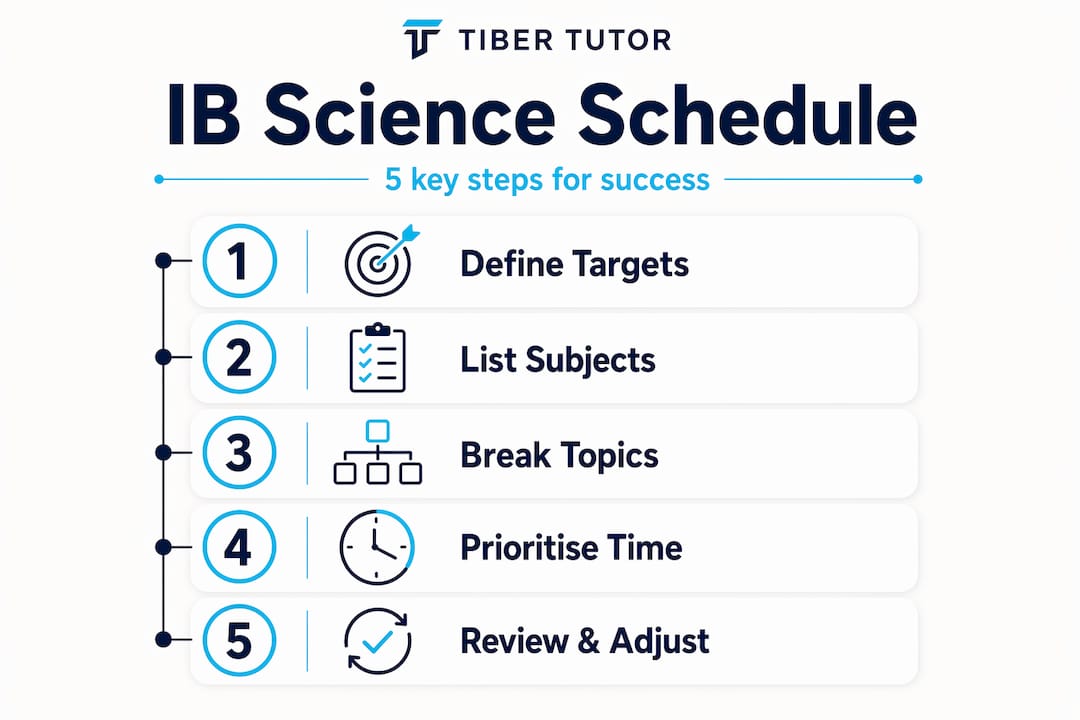
To bring order to the chaos, first clarify exactly what, when, and how much you need to prepare for.
Before you write a single revision session into your calendar, you need a clear picture of your full science workload. This sounds obvious, but many students skip this step and end up with a lopsided schedule that over-prepares them for one subject while neglecting another.
Start by listing every IB science subject you are studying. For most students, this means some combination of Biology, Chemistry, and Physics. Next to each subject, note whether it is Higher Level (HL) or Standard Level (SL). This distinction matters enormously because HL courses cover additional topics and demand significantly more revision time. As a general rule, building your timetable starts with listing each subject by level, breaking them into topics, and then prioritising based on your personal strengths, weaknesses, and exam dates.
Once you have your subject list, write down your official exam dates for each paper. Include any Internal Assessment deadlines as well. This gives you a concrete timeline to work backwards from, which is the foundation of any effective revision plan.
Here is an example of how to capture this information clearly:
| Subject | Level | Exam date | Current confidence (1 to 5) |
|---|---|---|---|
| Biology | HL | 8 May | 3 |
| Chemistry | SL | 12 May | 4 |
| Physics | HL | 15 May | 2 |
Finally, do a brief, honest self-assessment. Rate your confidence in each subject from 1 to 5. This is not about being hard on yourself. It is about giving your schedule a clear direction from the very start.
Key things to record before you build your schedule:
-
All IB science subjects and their HL or SL status
-
Official written exam dates for each paper
-
Internal Assessment submission deadlines
-
Your personal confidence rating for each subject
-
Any upcoming school tests or mock exams
You can also explore suggested study session priorities to help you decide how to weight your time across subjects. If you are a parent helping to support this process, parent support in IB planning offers practical guidance on how to assist without adding pressure.
Break subjects into topics and allocate focused study blocks
Once you know your targets, the next step is to make your workload manageable by breaking down big subjects into focused blocks.
IB Biology, Chemistry, and Physics each contain a substantial number of topics. Trying to revise “Chemistry” as a single block is far too vague. Instead, list every core topic and sub-topic for each subject. For Biology, this might include Cell Biology, Genetics, Ecology, and Evolution. For Chemistry, you would list topics such as Stoichiometry, Bonding, Energetics, and Organic Chemistry. For Physics, think Mechanics, Waves, Electricity, and Quantum Physics.
Once you have your topic lists, you can begin allocating weekly study blocks. An effective weekly schedule for IB Group 4 sciences combines focused content review with regular practice questions, with HL courses requiring noticeably more weekly time than SL. Use the following as a starting guide:

| Level | Recommended weekly hours per subject | Session length |
|---|---|---|
| SL | 2 to 3 hours | 45 to 60 minutes |
| HL | 3 to 5 hours | 60 to 90 minutes |
| HL (final 8 weeks) | 4 to 6 hours | 60 to 90 minutes |
Here is a practical approach to structuring your weekly blocks:
-
Write out all your science topics in a list for each subject.
-
Estimate how many sessions each topic needs based on its complexity and your confidence level.
-
Assign specific topics to specific days rather than leaving sessions open-ended.
-
Rotate your science subjects across the week so you are not studying the same one every day.
-
Build in at least one rest day per week to allow your brain to consolidate what you have learnt.
Rotating subjects is more important than it sounds. Studying Biology on Monday, Chemistry on Tuesday, and Physics on Wednesday, then repeating the cycle, keeps each subject fresh in your mind and prevents the fatigue that comes from too many hours in a single discipline.
Pro Tip: Fixed time blocks with clear topic goals are far more productive than open-ended “study Chemistry for a bit” sessions. Write the specific topic at the top of each block before you sit down to revise.
You can find subject-specific practice resources to complement your topic revision and ensure you are covering the right content at the right depth.
Prioritise strengths, weaknesses and exam deadlines
With your subjects and schedules outlined, it is time to add strategic prioritisation to your revision for maximum impact.
Not all topics deserve equal time. The topics you find most difficult are the ones most likely to cost you marks in the exam, so they should receive the most attention early in your revision period. Go back to your topic lists and mark each one as strong, average, or weak. Then build your schedule so that weak topics appear earlier and more frequently in your weekly blocks.
Here is how to prioritise effectively:
-
Tackle your weakest topics in your first study session of each week, when your energy is highest.
-
Schedule stronger topics towards the end of the week as lighter, confidence-building sessions.
-
Protect dedicated time for Internal Assessment work, but keep this separate from your exam revision blocks.
-
As your exam dates draw closer, shift the balance firmly towards written paper topics.
-
Revisit weak topics at least once every two weeks to reinforce learning through spaced repetition.
Students aiming for top IB grades typically study 2 to 3 hours per subject per week across the two-year course, then increase to 4 to 5 focused hours per subject during the final eight weeks before exams. This phased approach prevents burnout and ensures that intensity builds at exactly the right time.
It is also worth adjusting your schedule dynamically, not just at the start of term. If you have a school quiz on Genetics next week, shift your Biology block earlier in the week and reduce the time on a stronger topic temporarily. Your schedule should respond to your real academic life, not exist as a rigid document you ignore.
Pro Tip: Keep a simple traffic light system on your topic list. Green means confident, amber means needs work, and red means urgent attention needed. Update it every two weeks as your revision progresses.
If you are managing IA deadlines alongside exam preparation, parental strategies for IB deadlines can help families create a supportive home environment that reduces stress and keeps revision on track.
Move from topic review to exam practice
Once you have priorities set, it is essential to know when to switch gears from learning topics to full exam mode.
Many students make the mistake of spending too long in “content review” mode and not enough time practising under exam conditions. The IB rewards students who can apply their knowledge quickly, accurately, and in the specific format the examiners expect. That skill only develops through deliberate practice.
Here is a phased approach that works well for IB science students:
-
Eight weeks before exams: Focus on topic consolidation. Use your notes, flashcards, and cram sheets to make sure you understand every topic on your list. Spaced repetition works particularly well here.
-
Five weeks before exams: Begin integrating past-paper questions into every session. Start with individual topic questions rather than full papers. Switch from topic-focused study to exam-style practice as the exam date approaches, using mark schemes to self-assess honestly.
-
Three weeks before exams: Move to full past papers under timed conditions. For IB Physics in particular, spaced review of definitions and ideas alongside timed paper-style work should increase in frequency as the exam nears.
-
Two weeks before exams: Simulate real exam conditions. Sit full papers at the correct time of day, with no notes, and mark them strictly using the official mark scheme.
-
Final days: Keep revision light. Review your error log, revisit your strongest topics to build confidence, and prioritise sleep and wellbeing over last-minute cramming.
Near the end, timed practice is your best friend for exam readiness.
This phased approach stops you from peaking too early or leaving exam technique too late. It also makes the exam room feel familiar rather than frightening, because you have already sat dozens of practice papers in similar conditions.
Access a well-organised past paper questionbank to make this phase of your revision as efficient as possible.
Refine your schedule with an error log and review loop
The final ingredient for your IB science revision success is learning from your mistakes, and here is how to ensure you never repeat them.
Completing practice papers is only half the work. The real learning happens when you analyse where you went wrong and act on it. An error log is a simple but powerful tool that transforms your revision from passive repetition into active improvement.
Here is how to build and use one effectively:
-
After every practice question set or mock exam, go through each question you lost marks on.
-
Record the topic, the type of error (conceptual misunderstanding, calculation mistake, or exam technique), and what the correct answer required.
-
Categorise your errors so you can spot patterns. If you keep losing marks on data analysis questions in Chemistry, that is a technique issue, not a content gap.
-
Within 48 hours of identifying an error, schedule a targeted re-practice session on that specific topic or skill. Research into memory consolidation shows that revisiting material quickly after a mistake dramatically improves retention.
-
Review your error log weekly and use it to update your study plan. Topics that appear repeatedly in your log should move up your priority list immediately.
Using an error log for mistake review is one of the most effective strategies for improving IB science exam performance, particularly in Chemistry where command terms and calculation steps are easy to misapply under pressure.
Pro Tip: Keep your error log in a single document or notebook that you review at the start of every study week. It takes five minutes but keeps your revision pointed in exactly the right direction.
Pairing your error log with a structured questionbank for mistake review lets you target the precise topic areas where you are losing marks, rather than re-reading content you already understand well.
Our perspective: the schedule is a tool, not a promise
Here is something we see often at Tiber Tutor. Students spend a long time building a beautiful, colour-coded revision timetable, and then feel guilty when life gets in the way and they miss a session. The schedule becomes a source of stress rather than a source of calm.
The most effective IB students treat their schedule as a flexible tool, not a binding contract. If you miss a Biology session on Monday, you move it to Wednesday. You do not abandon the whole week. The goal of a study schedule is not perfection. It is direction.
There is also a tendency to overload the schedule at the start, particularly for HL students who feel the pressure of the additional content. Filling every evening with three-hour sessions sounds impressive on paper, but it leads to exhaustion within two weeks. Start with a schedule that feels almost too light. You can always add more. It is much harder to recover from burnout than to gradually build intensity.
The students who achieve top IB science grades are rarely the ones who studied the most hours. They are the ones who studied the right things, at the right time, and kept refining their approach based on real feedback. A good schedule, combined with honest self-assessment and consistent error review, is what separates confident exam performance from anxious guesswork.
Take your IB science revision further with Tiber Tutor
Building a study schedule is the first step. Filling it with the right resources is what makes the difference between a plan that looks good and one that actually improves your grades.
Tiber Tutor is built specifically for IB Biology, Chemistry, and Physics students who want to study smarter. The platform offers exam-style questions, animated videos, detailed notes, flashcards, cram sheets, topic tests, and full mock exams, all mapped directly to the IB syllabus. Advanced analytics help you track your progress and identify exactly where to focus next, so your revision time is never wasted. Whether you are eight weeks out or in the final countdown, explore Tiber Tutor’s resources and give your revision the structure and quality it deserves.
Frequently asked questions
How many hours a week should I study for IB HL sciences?
Aim for 3 to 5 hours per week per HL subject during the main study period, increasing to 4 to 5 hours per subject in the two months leading up to exams.
Should I study all three sciences every day?
It is far better to rotate subjects throughout your week rather than studying the same science every day, as rotation maintains focus and prevents cognitive overload.
When should I start doing past papers for IB science exams?
Begin integrating past-paper questions around five weeks before your exams, then move to full timed exam simulations approximately two weeks before the real thing.
What is the error log and how does it help?
An error log is a record of every mark you lose in practice, organised by topic and error type, and using an error log for review ensures you address weak spots before they cost you in the actual exam.
How can I balance IA and final exam revision?
Schedule regular, protected sessions for your Internal Assessment early in the year, but as written exam dates approach, shift focus to exam topics so your IA work does not crowd out the content that carries the majority of your final grade.