IB courses explained: biology, chemistry and physics
Choosing the right IB courses can feel overwhelming. Many students and parents assume that Higher Level simply means more homework, or that online science courses are somehow less rigorous. Neither is true. The IB diploma programme is built on a carefully structured framework, and understanding how it works in Biology, Chemistry, and Physics is one of the most practical steps you can take towards strong exam results. This guide cuts through the confusion, explains what IB course requirements actually look like in science subjects, and shows you how to use that knowledge to prepare with confidence.
Table of Contents
- Understanding IB diploma programme courses and levels
- The structure and assessment of IB biology, chemistry and physics courses
- Online IB courses: expanding access to diploma programme science subjects
- IB educator certificates and their role in maximising science exam success
- Practical strategies for IB science students and parents to maximise exam success
- Why deeper understanding and educator expertise outweigh sheer study hours in IB sciences
- Maximise your IB science exam readiness with Tiber Tutor
- Frequently asked questions
Key Takeaways
| Point | Details |
|---|---|
| IB diploma course levels | IB Higher Level and Standard Level differ in teaching hours and depth but use the same grading criteria. |
| Online course options | Authorized IB online courses ensure access to science subjects when unavailable at your school without compromising exam standards. |
| Educator training importance | Teachers with IB educator certificates better align instruction with IB expectations, improving exam outcomes. |
| Internal assessments matter | Scientific investigations within the curriculum require significant time and impact overall IB science grades. |
| Study quality over quantity | Deep understanding guided by skilled educators is more effective than simply increasing study hours. |
Understanding IB diploma programme courses and levels
The DP curriculum is built around six subject groups plus the DP core, which includes Theory of Knowledge, the Extended Essay, and Creativity, Activity, Service. Students select subjects across these groups and choose some at Higher Level (HL) and others at Standard Level (SL).
The most important distinction between HL and SL is not difficulty in the abstract sense. It is depth and teaching time. HL courses are allocated 240 teaching hours, while SL courses receive 150 hours. In science subjects like Biology, Chemistry, and Physics, those extra 90 hours translate into additional content, more complex applications, and a greater expectation of analytical thinking.
Here is what that means in practice:
- HL science goes beyond surface understanding. Students are expected to evaluate data, construct arguments, and apply concepts in unfamiliar contexts.
- SL science builds solid foundational knowledge. It is genuinely rigorous, but the content range is narrower.
- Both levels share the same 1 to 7 grading scale, so the grade descriptors are consistent.
- Choosing HL is not just about ambition. It should reflect your intended university pathway and your genuine interest in the subject.
For parents supporting their child through IB, understanding this distinction early helps you have more informed conversations with your child’s school and set realistic expectations about workload.
The structure and assessment of IB biology, chemistry and physics courses
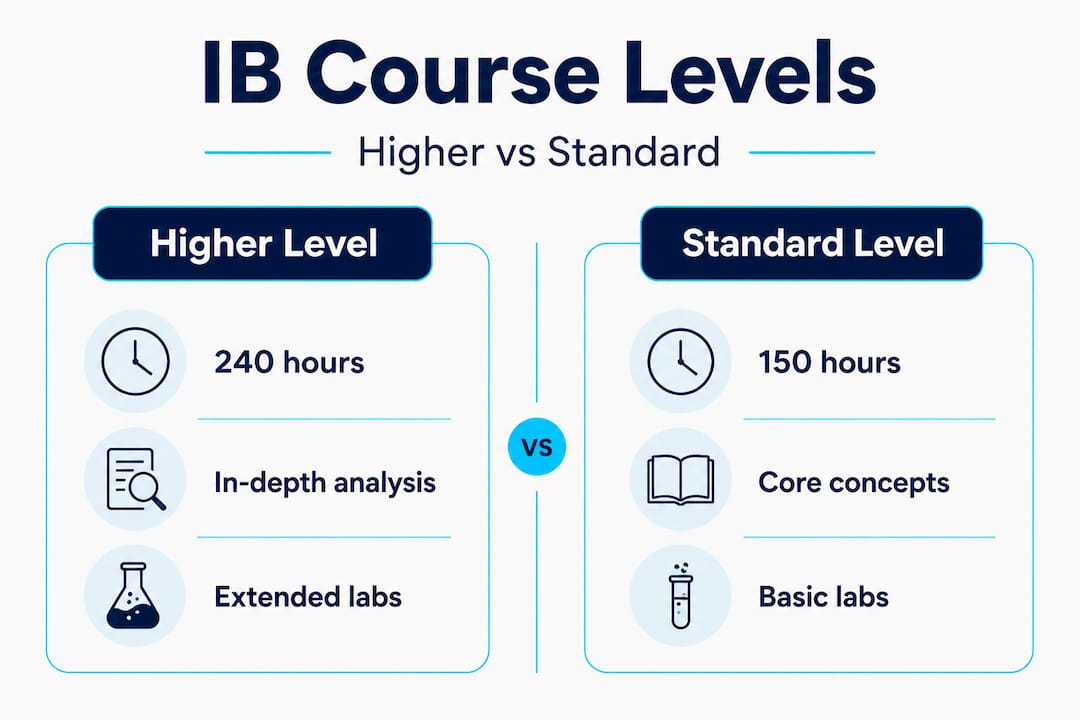
IB science courses follow the SL and HL teaching hours model as a core planning reference. But teaching hours are only part of the picture. Assessment in IB sciences has two main components: external examinations and internal assessments (IA).
| Component | Format | Contribution to final grade |
|---|---|---|
| External exams | Written papers (Paper 1, 2, and 3) | Approximately 80% |
| Internal assessment | Individual scientific investigation | Approximately 20% |
The IA is a scientific investigation that students design and carry out themselves. It requires roughly 10 hours of focused work, embedded within the teaching hours for each course. This is not a minor task. It demands genuine scientific thinking, data collection, and written analysis at a level that mirrors early undergraduate research.
The IB teaching-hours framework guides both content coverage and assessment planning across all science subjects. SL students cover the core material with a broad understanding. HL students add additional topics and are assessed on more complex questions in Paper 3.
Pro Tip: Do not leave your IA until the final term. Students who integrate their investigation planning into the first year of study consistently produce stronger work and reduce end-of-year pressure significantly.
Using the Tiber Tutor science questionbank alongside your classroom learning is one of the most effective ways to build the exam-style thinking that both papers and IAs demand.
Online IB courses: expanding access to diploma programme science subjects
Not every IB World School offers every science subject. This is where online IB courses become genuinely valuable, not as a shortcut, but as a real solution to a real access problem.
The IB offers two online options for diploma programme students: individual authorised online DP courses and a fully online DP pilot. The key point is that these exist for accessibility, not convenience. If your school does not offer HL Chemistry, for example, an authorised online course gives you a curriculum-aligned, assessment-ready alternative.
Key things to know about online IB science courses:
- Online courses are delivered by authorised providers, such as Pamoja Learning, ensuring they meet IB standards.
- Lab components in science subjects are carefully managed within online models to maintain assessment integrity.
- The fully online DP pilot allows students without access to an IB World School to complete the entire diploma remotely.
- Choosing an unauthorised provider risks your exam eligibility and academic standing. Always verify authorisation.
Pro Tip: If you are considering an online science course, ask the provider directly how they handle the internal assessment and laboratory components. A credible provider will have a clear, structured answer.
For students and families exploring options, Tiber Tutor’s revision resources complement both school-based and online IB science courses, helping you stay on track regardless of your learning environment.
IB educator certificates and their role in maximising science exam success
The quality of teaching you receive has a direct impact on your exam results. This is not a vague claim. IB educator certificates (IBEC) are university-level qualifications that prepare teachers and school leaders to teach and lead IB programmes effectively.
IB educator certificates demonstrate that a teacher has been trained specifically in IB pedagogy and assessment, reducing the gap between what is taught and what is examined. In science subjects, where assessment criteria can be nuanced, that alignment matters enormously.
Here is why this matters for students and parents:
- Teachers with IBEC training understand exactly how IAs are marked, which means better guidance for students.
- They are more likely to design lessons that build the analytical skills tested in Paper 2 and Paper 3.
- Schools that invest in IBEC-qualified staff tend to produce more consistent results across Biology, Chemistry, and Physics.
- As a parent, asking whether your child’s science teachers hold IB-recognised credentials is a fair and useful question.
“Educator preparedness influences how well IB curriculum and assessment expectations are translated into classroom success.”
For families wanting to understand how teaching quality connects to exam outcomes, the parent guidance on Tiber Tutor offers practical context on what to look for and how to support your child’s learning at home.
Practical strategies for IB science students and parents to maximise exam success
Understanding the structure of international baccalaureate classes is only useful if you act on it. Here are concrete steps for students, parents, and educators to apply right now.
- Map your teaching hours early. Know whether you are studying SL or HL and plan your revision schedule to reflect the difference in content volume. HL students need more time for additional topics, not just longer revision of the same material.
- Start your internal assessment in Year 1. The IA contributes around 20% of your final grade. Aligning your IA timeline with teaching hours from the start prevents last-minute stress and improves quality.
- Use exam-style questions from the beginning. Practising with questions that mirror the actual paper format builds the specific thinking skills IB examiners reward.
- Parents: encourage balance, not just effort. Respecting the practical and theory components of science courses means not pushing for pure revision at the expense of lab preparation.
- Seek IB-aligned support. Whether from a teacher with IBEC credentials or a trusted revision platform, the quality of your resources matters as much as the hours you put in.
- Supplement gaps with technology. If your school’s resources are limited in a particular topic, online study tools for IB students can fill those gaps effectively.
Pro Tip: Build a simple revision tracker that separates HL-only content from shared SL and HL content. This stops you from spending equal time on unequal material.
For parents looking for structured guidance on supporting your child’s IB journey, clear communication with your child’s school about their HL and SL choices is one of the highest-impact steps you can take early on.
Why deeper understanding and educator expertise outweigh sheer study hours in IB sciences
Here is something most guides will not tell you directly. The students who struggle most in IB science exams are rarely the ones who studied the least. They are often the ones who studied the most, but without the right alignment.
More hours without aligned understanding leads to burnout, not better grades. This is the uncomfortable truth that sits behind many disappointing IB results. A student who spends 300 hours on HL Chemistry using poorly matched resources will likely underperform compared to a student who spends 200 hours with materials that reflect the actual assessment criteria.
The HL and SL distinction is fundamentally about depth of thinking, not volume of content. HL Biology, for instance, does not just ask you to know more. It asks you to do more with what you know: evaluate, compare, and apply in unfamiliar scenarios. That kind of thinking is developed through quality practice, not repetition of facts.
Educator expertise plays a central role here. A teacher who has completed IBEC training understands the nuances of IB marking schemes. They know which command terms carry weight, how to structure a Paper 2 response, and what examiners are actually looking for in an IA. That knowledge, passed on clearly to students, is worth far more than an extra month of self-directed revision.
The most effective families we see are those who ask questions early: What level is my child studying? Does their teacher have IB-specific training? Are the revision resources they are using actually aligned to the current syllabus? These questions, asked at the start of the two-year programme, shape everything that follows.
Supporting your school’s investment in educator expertise is not just a nice idea. It is one of the most practical things a parent can do to improve their child’s IB science outcomes.
Maximise your IB science exam readiness with Tiber Tutor
Knowing how IB courses are structured is a strong start. Putting that knowledge into practice is where Tiber Tutor comes in.
Tiber Tutor is built specifically for IB Biology, Chemistry, and Physics students, covering both SL and HL with resources that align directly to the IB syllabus. The IB science questionbank gives students access to thousands of exam-style questions, animated videos, detailed notes, and mock exams, all mapped to current IB assessment standards. Progress tracking and analytics help identify exactly where to focus revision, so time is spent where it matters most. Parents and educators will find structured guidance and tools that complement classroom teaching and keep students on track. And for students ready to take control of their preparation, dedicated student resources make confident, targeted revision genuinely achievable.
Frequently asked questions
What is the difference between Higher Level and Standard Level IB science courses?
HL courses involve 240 hours of teaching and go deeper into content and analysis, while SL courses cover core concepts across 150 hours. Both use the same 1 to 7 grading scale.
Can IB students take science courses online if their school does not offer them?
Yes. Students can follow individual DP courses online through authorised providers if a subject is unavailable at their school, with full curriculum and assessment alignment maintained.
How do IB educator certificates benefit students in science subjects?
IB educator certificates show that a teacher has been trained in IB pedagogy and assessment, which leads to more accurate exam preparation and better student outcomes in Biology, Chemistry, and Physics.
What role does the internal assessment play in IB science courses?
The IA is a student-led scientific investigation that contributes approximately 20% to the final grade, requiring around 10 hours of focused work embedded within teaching time.