IB exam-style questions practice workflow guide
Most IB science students practise exam questions the wrong way. They work through a past paper, check the markscheme, feel reassured if they were roughly right, and move on. That approach fills time but builds very little real exam technique. A structured IB exam-style questions practice workflow changes everything. It shifts your focus from checking answers to training specific analytical skills, one command term at a time. This guide will show you exactly how to build that workflow, avoid the most common pitfalls, and measure your progress so every session counts.
Table of Contents
- Key takeaways
- Setting up your practice resources
- Step-by-step practice workflow for IB exam technique
- Common pitfalls in exam question practice
- Measuring progress and refining your workflow
- My perspective on what actually works
- Practise smarter with Tibertutor
- FAQ
Key takeaways
| Point | Details |
|---|---|
| Command terms drive scoring | Understanding IB command terms precisely is the single most direct way to stop losing marks on questions you understand. |
| Deliberate practice beats volume | Focused drilling on command terms and reasoning moves builds transferable exam skills faster than working through high volumes of questions. |
| Mark immediately, every time | Immediate marking and reflection after each question helps you identify reasoning gaps while your thought process is still fresh. |
| Error logs target weak spots | A concise error log turns repeated mistakes into targeted practice, accelerating improvement in your weakest areas. |
| Quality surpasses quantity near exams | Practice quality matters more than question volume, especially in the final weeks of IB exam preparation. |
Setting up your practice resources
Before you write a single answer, you need the right materials in place. This is not about gathering resources for the sake of it. Each item serves a specific function in your IB exam preparation workflow.
Here is what you need:
- IB syllabus for your subject. Every question maps to a syllabus point. Keep this open when you practise so you can cross-reference.
- Past papers and markschemes. These are your most reliable source of authentic IB question format practice. Download them from the IBO website or access them through your school.
- Examiner reports. These tell you what real students got wrong and why. They are underused and genuinely revealing.
- A question bank filtered by topic, paper, and command term. Broad past paper sets make it hard to target weaknesses. Filtered question sets let you practise one skill at a time.
- An error log. A notebook or document where you record each mistake, the command term involved, and the reasoning flaw.
Understanding IB command terms is non-negotiable. Words like “evaluate,” “discuss,” “deduce,” and “outline” are not interchangeable. IB examiners mark against precise command terms, and misreading them costs marks even when your scientific knowledge is correct. Study the command term definitions in your subject guide until they feel automatic.
Finally, set up a distraction-free environment for every practice session. Even 25 minutes of properly focused work outperforms an hour of half-attention.

Step-by-step practice workflow for IB exam technique
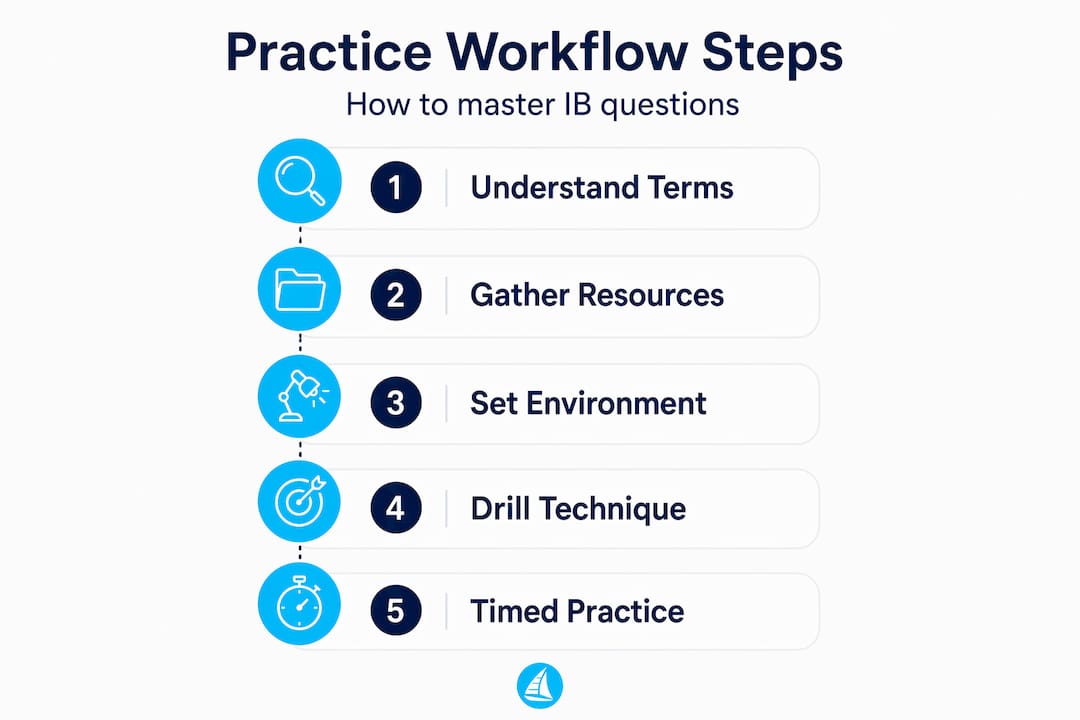
This is the core of your IB exam-style questions practice workflow. Follow these steps for every focused session.
-
Read the question and identify the command term. Before you write anything, name the command term and what it demands. “Explain” requires a mechanism. “Evaluate” requires judgement with evidence for and against. Naming it takes ten seconds and reorients your answer immediately.
-
Plan your answer structure. Jot a brief outline. For a four-mark question, plan four distinct points. Break your answer down into layers: claim, mechanism, application, and where required, evaluation. Each step must be clear to meet markscheme criteria.
-
Focus on one analytical skill per session. Do not try to practise everything at once. Choose a single move: building a chain of reasoning, anchoring a claim to data in a stimulus, or writing a precise evaluation. Drill that move across three to five questions in one sitting.
-
Practise untimed before you practise timed. Technique comes first. Speed comes second. Once you can consistently hit the markscheme criteria on untimed attempts, start applying time pressure. Timed practice under exam conditions builds the endurance and pacing you need on exam day.
-
Mark your answers immediately after writing. Do not batch your marking for later. Mark answers straight after writing to connect each error with the exact thought process that caused it. Use the markscheme as a diagnostic, not a punishment.
-
Log every error with its command term and flaw. Write down the question reference, the command term, and one sentence explaining the gap. Did you forget to apply the concept to data? Did you confuse “deduce” with “suggest”? This log becomes your personalised revision guide.
-
Rotate between drills and full papers. Once your technique on individual question types is developing, start running full timed papers to build stamina and practise shifting between question styles.
Pro Tip: Drill a single analytical move until you can perform it correctly three times in a row before moving to timed conditions. This threshold test tells you when technique has genuinely stuck.
Common pitfalls in exam question practice
Even students with the right resources fall into habits that limit their progress. Recognising these patterns is the first step to correcting them.
- Treating questions as knowledge tests. If you answer a question and think “I knew that” or “I did not know that,” you are missing the point. The real question is: did you structure your answer in the way the markscheme rewards?
- Ignoring command term demands. A common reason students underperform is answering with the wrong depth or approach. “Describe” does not ask you to explain. “Evaluate” asks you to go beyond description.
- Practising without marking. Completing questions and not checking the markscheme is one of the most common and costly errors in IB exam preparation.
- Failing to reference stimulus data. On data-based questions, answers that reference specific data consistently earn higher marks than answers that state theory in the abstract. Always tie your reasoning to the numbers or graph provided.
- Prioritising volume over reflection. Working through 40 questions with no review is far less effective than working through 15 questions with careful analysis of each error. Active recall with focused review strengthens mastery in ways passive question completion cannot.
Pro Tip: After identifying a recurring error in your log, write one model answer for that question type without looking at the markscheme. Then compare. The gap you find is your actual learning target.
Measuring progress and refining your workflow
Tracking your improvement does not need to be complex. It needs to be honest and consistent.
Use this framework to monitor your IB exam strategy development over time:
| Progress measure | How to track it | When to adjust |
|---|---|---|
| Command term accuracy | Tally correct vs. incorrect responses by command term in your error log | When one command term has 3+ logged errors, design a targeted drill session |
| Mark allocation hit rate | Record marks achieved vs. marks available per question type | If below 70%, return to untimed technique work before timed practice |
| Timing per question | Note time taken on timed attempts | If consistently over time allocation, practise planning steps more tightly |
| Error recurrence | Check if the same flaw reappears across different topics | Recurring errors signal a technique gap, not a knowledge gap |
Set small, measurable goals for each week. For example: practise five “evaluate” questions and score at least three marks on each. This is far more useful than a goal like “do more past papers.”
When your error log shows consistent improvement on a particular command term, shift your attention to the next weakest area. The workflow becomes self-directing once your tracking is in place.
My perspective on what actually works
I have watched students put in hundreds of hours of practice and still underperform in their exams. The pattern is almost always the same. They practise questions as if they are completing homework rather than training a specific skill.
What changed outcomes consistently was deliberate practice. Not more questions. Targeted questions, marked carefully, with the error logged and a short reflection written immediately after. Error logs transformed weak spots into areas of genuine strength for the students who used them with discipline.
The students who scored 6s and 7s were not always the ones who had read the most. They were the ones who understood what examiners were looking for and had trained themselves to deliver it under pressure. That comes from quality feedback cycles, not from accumulating question attempts.
My honest advice: do fewer questions, mark them better, and reflect longer. You will see more progress in four focused weeks than in twelve weeks of passive paper-completing.
— Oliver
Practise smarter with Tibertutor
Building a structured IB exam-style questions practice workflow becomes far easier when your resources are designed specifically for that purpose.

Tibertutor’s IB science question bank is built by examiners and aligned to the current syllabus for Biology, Chemistry, and Physics. You can filter questions by topic, paper type, and command term, which makes it straightforward to design the targeted drills this article describes. The platform also tracks your performance automatically, so your error patterns become visible without needing to maintain everything manually. Whether you are working through untimed technique drills or running full mock exams, Tibertutor supports each stage of your workflow. Explore subscription options and see how structured, exam-focused practice can build your confidence before exam day.
FAQ
What is an IB exam-style questions practice workflow?
An IB exam-style questions practice workflow is a structured process for practising exam questions with deliberate focus on command terms, analytical techniques, and immediate markscheme feedback, rather than simply completing papers and checking answers.
How do IB command terms affect exam scores?
Misinterpreting command terms causes students to lose marks even when their scientific knowledge is accurate. Learning the precise demands of each command term is one of the most direct ways to improve your score.
When should I move from untimed drills to timed practice?
Move to timed practice once you can consistently meet the markscheme criteria on untimed attempts. A reliable threshold is performing a specific analytical move correctly three times in a row before adding time pressure.
How do I use an error log effectively?
Record the question reference, the command term, and a one-sentence explanation of the reasoning flaw after each mistake. Review your log weekly to identify recurring patterns and design focused drills around your weakest command terms.
How many practice questions do I need before IB exams?
Quality matters more than quantity. Prioritising clear explanation and addressing unclear concepts produces better outcomes than working through high volumes of questions without reflection, especially in the final weeks of preparation.