
IB Photoelectric Effect: Equations, Graphs and Exam Tips
The photoelectric effect is the moment IB Physics asks you to accept that light can act as particles. Shine light on a metal and electrons can be ejected, but only if each photon carries enough energy. Brightness does not change that. Once you see why, the equations, the graph and the exam questions all follow from one idea. This guide walks through each in turn, and shows how to practise them in exam conditions with Tiber Tutor, where the quantum physics questions are written by IB examiners.
TL;DR
- Light of high enough frequency ejects electrons from a metal at once. Below a threshold frequency, nothing is ejected, however bright the light.
- Core equation: Kmax = hf − φ, where φ is the work function, the minimum energy needed to free an electron.
- Intensity changes the number of electrons per second. Frequency changes their maximum kinetic energy.
- On a Kmax against f graph, the gradient is h, the horizontal intercept is the threshold frequency and the vertical intercept is −φ.
- Practise with exam-style questions and mark schemes, then let your results show which parts of the topic need more work.
Table of Contents
- What actually happens at the metal surface
- Why the wave model fails
- Work function, threshold frequency and Kmax
- Reading the graph
- What the photoelectric current depends on
- How to practise this topic
- Perspective
- Put it into practice with Tiber Tutor
- FAQ
- Sources
What actually happens at the metal surface
When light strikes a clean metal surface, electrons can leave it. These are called photoelectrons. A simple classroom demonstration shows the catch: short-wavelength, high-frequency ultraviolet light discharges a charged zinc electroscope, while long-wavelength, low-frequency light does not. Red light of any brightness releases no photoelectrons from potassium, but yellow light does.
That result is strange if you think of light as a wave. A brighter wave carries more energy, so you would expect it to eventually free electrons whatever its colour. It does not.
Why the wave model fails
The examiners want you to name the evidence. OpenStax University Physics lists three observations that classical wave theory cannot explain:
- No time lag. Electrons appear almost instantly. They were emitted within 10⁻⁹ s of the light arriving, whereas a wave spreading its energy over the metal would predict a delay while an electron gathers enough energy.
- Kinetic energy does not depend on intensity. Brighter light does not make the fastest electrons faster.
- A cut-off frequency. Below a certain frequency for each metal, there is no emission at all.
Einstein’s 1905 answer used Planck’s quantum idea. He proposed that light itself arrives in packets, photons, each carrying energy E = hf, with h = 6.6 × 10⁻³⁴ J·s. The transfer is all or nothing: one photon gives its whole energy to one electron, or gives nothing.
This also explains the missing time lag. Dimming the light only reduces the number of photons arriving each second. Each photon still delivers its energy in one go, so even very dim light of high enough frequency produces immediate emission.
Work function, threshold frequency and Kmax
Three terms carry most of the marks.
- Work function (φ): the minimum energy needed to remove an electron from the metal surface. It is usually quoted in electronvolts (eV). OpenStax calls the same quantity binding energy, sometimes the work function.
- Threshold frequency (f₀): the lowest frequency that can eject an electron. It satisfies φ = hf₀, so f₀ = φ/h.
- Maximum kinetic energy (Kmax): the energy of the most energetic emitted electron.
Energy conservation gives the photoelectric equation:
hf = φ + Kmax, so Kmax = hf − φ
Why “maximum”? Electrons sit at different depths and energies in the metal. The one that needs only the minimum energy to escape keeps the most. The stopping potential measures this: raise the opposing voltage until even the fastest electron fails to reach the collector. Then Kmax = eV₀, where V₀ is the stopping potential.
Using wavelength instead of frequency, photon energy is hc/λ. In electronvolts and nanometres, hc is about 1240 eV nm, which saves a lot of unit conversion. Check the IB data booklet for the constants you are given.
A worked example
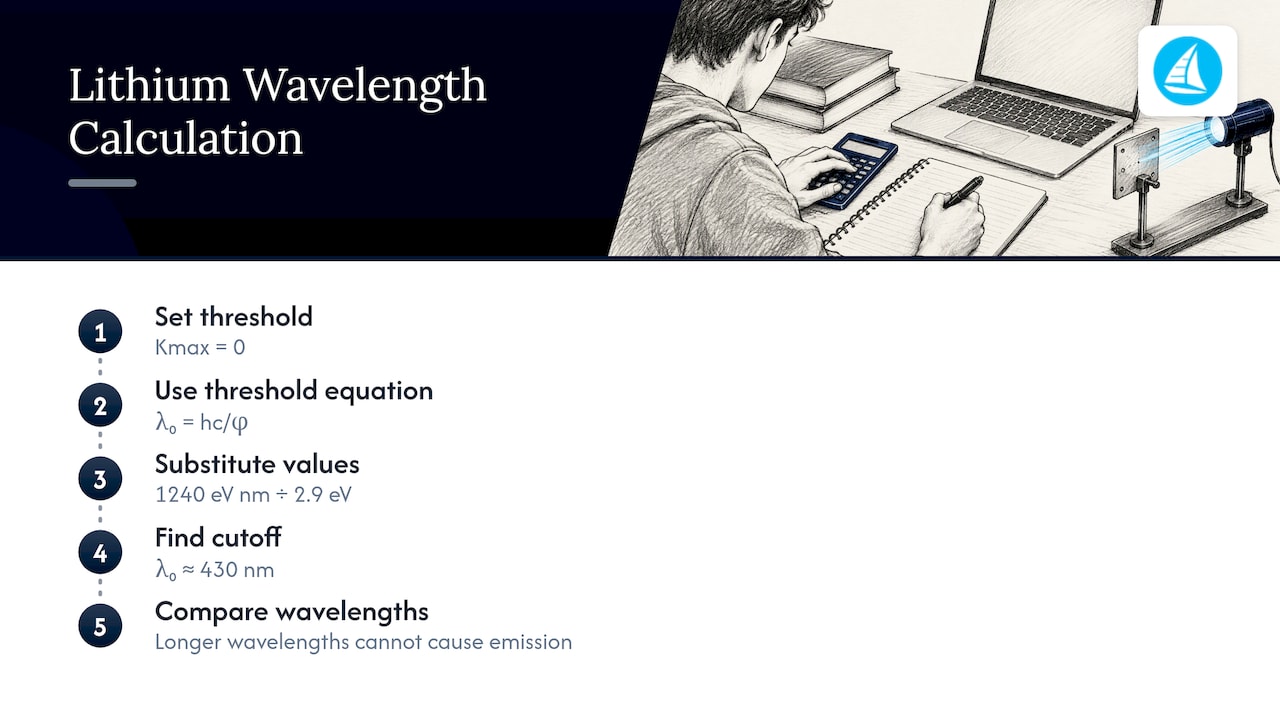
A typical exam question gives lithium with a work function of 2.9 eV and asks for the longest wavelength of light that can cause emission.
At the threshold, the photon energy equals the work function, so Kmax = 0.
λ₀ = hc/φ = 1240 eV nm ÷ 2.9 eV ≈ 430 nm
Any wavelength longer than this, such as red light, has too little energy per photon. Shorter wavelengths, such as violet and UV, will eject electrons. Write the reasoning in one line: “photon energy must be at least equal to the work function”. That sentence is usually what the mark scheme wants.
Reading the graph
Graph questions are very common. Plot Kmax on the y-axis against frequency on the x-axis and you get a straight line from Einstein’s equation.
| Feature | Meaning |
|---|---|
| Gradient | Planck’s constant, h, the same for every metal |
| Horizontal intercept | Threshold frequency, f₀ |
| Vertical intercept | −φ (the work function, negative) |
For any metal, the slope equals Planck’s constant and the intercept reflects the metal’s work function. If you plot stopping potential instead, the gradient becomes h/e and the vertical intercept becomes −φ/e. Different metals give parallel lines, shifted along the frequency axis. A larger work function moves the line to the right.
Two traps cost marks:
- The line below f₀ is extrapolation. No electrons are emitted there, so real data starts at f₀ and runs rightwards. The negative section only helps you find the intercept.
- Do not read the vertical intercept as a positive number. It is −φ.
What the photoelectric current depends on
This is a frequent exam wording, and the two variables do different jobs.
| Change | Effect |
|---|---|
| Increase intensity (frequency above f₀) | More photons per second, so more electrons per second and a larger current. Kmax is unchanged. |
| Increase frequency (above f₀) | Each photon carries more energy, so Kmax increases. |
| Frequency below f₀ | No emission, whatever the intensity. |
OpenStax states that the number of ejected electrons per unit time is proportional to intensity alone. If a question asks what happens to the stopping potential when intensity doubles, the answer is that it stays the same.
How to practise this topic
Understanding the idea is half the job. The other half is applying it to unfamiliar numbers under time pressure. A routine that works:
- Learn the three observations that the wave model cannot explain, and the photon explanation, so you can write them in two or three sentences.
- Solve calculations in both energy and wavelength form until the unit handling is automatic.
- Sketch graphs for different metals and for different intensities, and label every intercept.
- Review each answer against an examiner mark scheme and note which command word and which wording earned the marks.
Our IB Physics quantum physics questions are written to mirror the exam, and the wider nuclear and quantum physics question set lets you link the photoelectric effect to atomic structure and energy levels. If you are ever unsure of a wave idea behind the contrast, the wave behaviour questions are close by.
Perspective
Students rarely struggle with the equation. They struggle with the explanation: why does brightness not matter, and why is the graph a straight line? Those are the questions examiners reward.
We built Tiber Tutor around that gap. Our resources are written by IB examiners, and our claim is that it is the only IB STEM platform that connects exam-style questions, student-led answer review against examiner mark schemes, syllabus monitoring and performance analytics in one place. After a set of photoelectric questions, you can see how you did on this topic compared with the rest of the syllabus, then move straight to the notes, videos or tests that fit.
For us, confidence comes from that loop: practise, review honestly, see the pattern, improve. It is also why we believe a single membership with examiner-written content gives the best value for money in IB sciences.
Oliver
Put it into practice with Tiber Tutor
Tiber Tutor covers IB Biology, Chemistry, Physics and Maths with exam-style questions, animated videos, detailed notes, flashcards, cram sheets, topic tests, mock exams, IA exemplars and examiner mark schemes. Every membership starts with a free 7-day trial. The All-Access Plan is $19 per month, and the Per-Subject Plan is $9 per month. You can see both on the pricing page. Students can start from the student page, and parents can see how it supports a teenager’s revision on the parents page.

Because the resources are linked, a photoelectric question that exposes a weak spot in energy units or graph reading leads you directly to the material that fixes it.
FAQ
What is photoelectric current dependent on?
For light above the threshold frequency, the current depends on intensity, because more photons per second free more electrons per second. The maximum kinetic energy of each electron depends on frequency and the metal’s work function, not on intensity.
Why does red light fail where ultraviolet light works?
Each red photon carries less energy than the metal’s work function, and an electron absorbs one photon at a time. Making the red light brighter only sends more photons that are each too weak. Ultraviolet photons carry enough energy individually.
How do I find Planck’s constant from the graph?
Plot Kmax (or eV₀) against frequency and find the gradient. For Kmax it equals h directly. For stopping potential it equals h/e, so multiply by the electron charge. A real data fit gives h close to 6.634 × 10⁻³⁴ J·s.
What is the difference between work function and threshold frequency?
The work function is an energy, the minimum needed to free an electron. The threshold frequency is the matching light frequency, found from f₀ = φ/h. They describe the same limit in two ways.
Sources
- University of Washington Department of Chemistry: Photoelectric Effect demonstration
- OpenStax University Physics Volume 3: 6.2 Photoelectric Effect
- LibreTexts: Light as a Stream of Particles
- NSTA: The Photoelectric Effect
- OpenStax Physics: 21.2 Einstein and the Photoelectric Effect
- OpenStax College Physics 2e: 29.2 The Photoelectric Effect
- University Physics Volume 3 (UCF Pressbooks): Photoelectric Effect
- Washington University Physics: problem set key