IB science grading explained for students and parents
Many students and parents find IB science grading explained in contradictory ways online, leading to real confusion about what scores actually mean. The system is more nuanced than a simple percentage. It rewards critical thinking, precise scientific reasoning, and structured argumentation. Understanding how the grading works gives you a genuine advantage, because you can direct your efforts exactly where they count. This guide covers everything: the 1–7 scale, assessment criteria, grade boundaries, and how HL and SL grades compare.
Table of Contents
- Key takeaways
- How IB science grading works: the 1–7 scale
- IB science assessment criteria and the IA
- Understanding grade boundaries in IB science
- HL vs SL grading in IB sciences
- Practical implications for students and parents
- My perspective on mastering IB science grading
- How Tibertutor helps you master IB science grades
- FAQ
Key takeaways
| Point | Details |
|---|---|
| Grading uses a 1–7 scale | All IB science subjects are scored from 1 to 7, with 7 as the highest achievable grade. |
| Internal assessment carries real weight | The IA accounts for roughly 20% of your final science grade and is scored against four criteria. |
| Grade boundaries shift each session | Boundaries are not fixed. They adjust to reflect exam difficulty and maintain global standards. |
| HL and SL use the same scale | Both levels are graded 1–7, but universities value HL grades more due to greater content depth. |
| Criteria mastery beats percentage chasing | Focusing on meeting each assessment criterion consistently is the most reliable route to a high grade. |
How IB science grading works: the 1–7 scale
The IB grading system is built around a 1–7 scale applied to every subject, including Biology, Chemistry, and Physics. Grade 7 represents exceptional achievement. Grade 4 is the minimum considered satisfactory. A grade 1 indicates very limited performance.
Here is how the scale maps to achievement levels:
| Grade | Descriptor | Typical raw mark range (%) |
|---|---|---|
| 7 | Excellent | 80–100 |
| 6 | Very good | 70–79 |
| 5 | Good | 55–69 |
| 4 | Satisfactory | 45–54 |
| 3 | Mediocre | 35–44 |
| 2 | Poor | 20–34 |
| 1 | Very poor | Below 20 |
The percentages above are illustrative. Actual cut-offs vary by session and subject, which we cover in the grade boundaries section below.
For the full IB Diploma, students take six subjects graded 1–7 plus up to 3 bonus points from the Core (Theory of Knowledge and Extended Essay). The maximum diploma score is 45 points. To pass, students need at least 24 points overall, must not score a grade 1 in any subject, and must meet minimum point totals across HL and SL subjects. Science grades feed directly into this total, which makes understanding the IB science grading system genuinely important for diploma planning.
IB science assessment criteria and the IA
IB science is not graded on exam performance alone. The IB science evaluation process splits your final grade between external assessments (written examinations) and the Internal Assessment (IA), a personally designed practical investigation.
The IA accounts for approximately 20% of your final grade and is marked out of 24. It is assessed using four equally weighted criteria, each worth up to 6 marks:
- Personal engagement: Does your report show genuine curiosity and independent thinking beyond standard textbook procedures?
- Exploration: Is your research question focused, your methodology well-designed, and your variables clearly identified and controlled?
- Analysis: Have you processed data appropriately, applied relevant calculations, and interpreted results with scientific accuracy?
- Evaluation: Do you discuss strengths, weaknesses, and improvements with specific, scientifically grounded reasoning?
The IB uses a criterion-related approach rather than norm-referencing. This means your grade reflects how well you meet defined standards, not how you compare with other students in your cohort. That is genuinely good news. A high mark is always available if you meet the criteria, regardless of how others perform.
The IB assessment philosophy places emphasis on students building well-validated arguments rather than recalling single correct answers. High-scoring students show balanced, integrated thinking. They justify claims with evidence and engage with counterarguments honestly.
Pro Tip: Read the IB Science IA marking guidelines before you begin your investigation, not after you have written it. Mapping your draft sections directly to the four criteria will show you exactly where marks are being left on the table.
Understanding grade boundaries in IB science
Grade boundaries are the raw mark thresholds that separate one grade from another. They are not fixed. The boundaries adjust each exam session based on how difficult that particular paper was and how students performed globally. This is a deliberate part of the IB science marking guidelines and exists to maintain fairness.

Here is a simplified comparison of how boundaries can shift across sessions for a hypothetical Biology HL paper:
| Grade | Session A (easier paper) | Session B (harder paper) |
|---|---|---|
| 7 | 82% | 76% |
| 6 | 72% | 65% |
| 5 | 58% | 52% |
| 4 | 45% | 40% |
The figures above illustrate the principle rather than quoting specific published results. The key point is that a harder exam lowers the grade boundary, protecting students from being penalised unfairly.
The IB uses moderation and standard-setting processes to apply this internationally and consistently. IA marks submitted by teachers are moderated against examiner standards to remove discrepancies between schools.
What does this mean for you in practice? Do not aim for a percentage. Aim to demonstrate your understanding of the criteria as thoroughly as possible. Students who chase “getting to 80%” often study less purposefully than students who focus on producing genuinely excellent scientific reasoning.
Pro Tip: Rather than asking “What percentage do I need?”, ask “Have I addressed every part of this criterion?” That shift in focus consistently produces better outcomes.
HL vs SL grading in IB sciences
One of the most common areas of confusion in understanding IB science grades is the relationship between Higher Level and Standard Level. The reassuring news is that the grading scale is identical. Both HL and SL use the same 1–7 scale with the same grade descriptors. A grade 7 means excellent performance at either level.
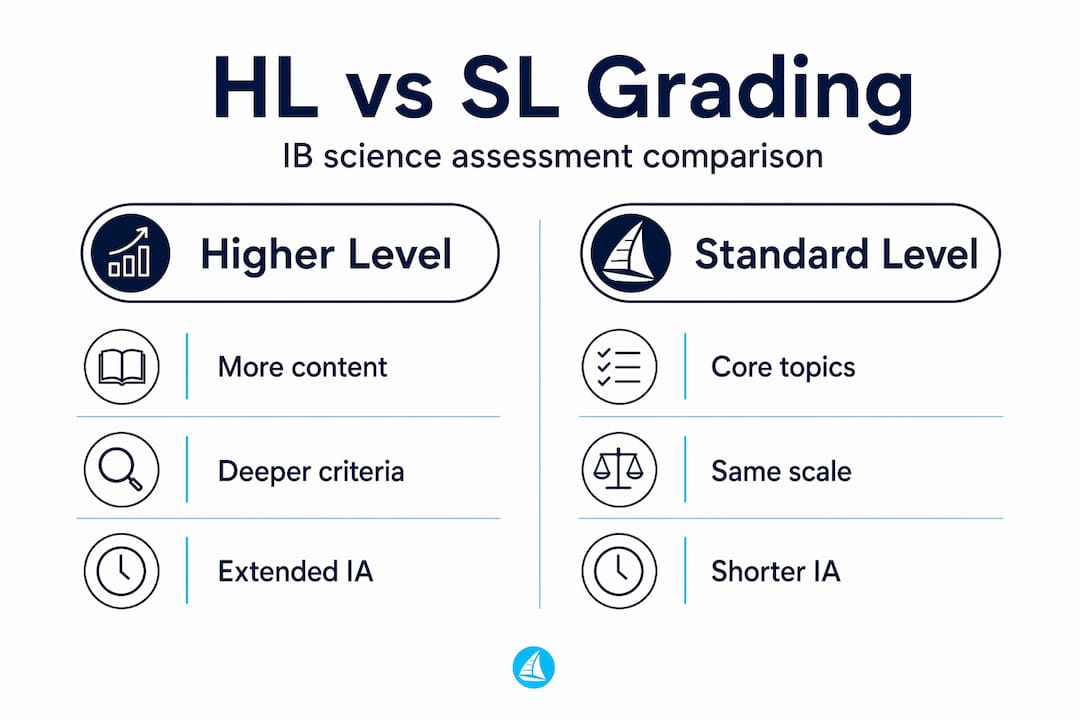
The difference lies in depth and volume. HL sciences require approximately 240 teaching hours compared to around 150 for SL, covering significantly more content and involving more complex exam questions.
Key differences and their implications:
- University recognition: Most selective universities treat HL grades as carrying more rigour. A grade 6 at HL in Chemistry is weighted more favourably than a grade 6 at SL for competitive science courses.
- Exam structure: HL papers include additional topics and often a third exam paper testing deeper analytical skills.
- Same IA process: Both HL and SL students complete the same type of Internal Assessment, scored against identical criteria.
- Course choice impact: If you are targeting medicine, engineering, or physical sciences at university, most admissions requirements specify HL Biology, Chemistry, or Physics with a minimum grade of 5 or 6.
Choosing HL is a commitment to significantly more content. Understanding this from the outset helps students and parents make informed, strategic decisions rather than discovering the difference mid-course.
Practical implications for students and parents
Once you understand the IB science grading system, you can use it constructively rather than anxiously. Here is what that looks like in practice.
For students, the most impactful shift is moving from passive revision to criterion-focused study. Instead of re-reading notes, practise writing responses that directly address command terms. “Evaluate” requires balanced argument. “Explain” requires mechanistic reasoning. These distinctions matter enormously for marks.
For parents, interpreting a grade requires context. A grade 5 in HL Physics is a strong result. The same grade in SL Physics carries different weight. Knowing which level your child is studying before drawing conclusions about their performance is genuinely useful.
- Prioritise the IA early: The IA is worth roughly a fifth of the final grade. Treating it as a formality is one of the most common and costly mistakes students make.
- Practise exam-style questions regularly: The IB science grading scale rewards precise, structured scientific writing. Practising with real exam questions builds this skill more than content review alone.
- Use formative feedback actively: Teacher comments on IA drafts and mock exams are a direct window into the marking guidelines. Treat every piece of feedback as a marking guide in disguise.
Pro Tip: When reviewing a marked piece of work, identify which criterion cost you the most marks. Focus your next practice session specifically on that criterion. Targeted improvement beats general revision every time.
My perspective on mastering IB science grading
I have worked with IB students across Biology, Chemistry, and Physics for many years, and one pattern stands out clearly. Students who understand the criteria before they start working almost always outperform students who work hard without that clarity.
The IB is not testing whether you can recall information. It is testing whether you can build well-validated scientific arguments, evaluate evidence honestly, and reason with nuance. Once students genuinely internalise that, their approach to both the IA and written exams changes completely.
What I see most often is students writing long, detailed answers that miss the criterion entirely. They know the content. They just have not connected it to what the examiner is actually looking for. That is not a knowledge problem. It is a grading literacy problem. And it is entirely solvable.
My advice to both students and parents: invest time early in understanding the marking guidelines. It is not gaming the system. It is understanding what excellence actually looks like and working towards it deliberately.
— Oliver
How Tibertutor helps you master IB science grades
Getting to grips with the IB science assessment criteria is one thing. Putting that knowledge into consistent practice is another. Tibertutor is built specifically for this. The platform offers thousands of IB science practice questions mapped directly to the syllabus, alongside animated video explanations, detailed notes, and full mock exams. Every resource is designed by IB examiners and experienced educators who know exactly how marking guidelines are applied.
For parents seeking to support their child’s progress, the dedicated parents section on Tibertutor explains how grading works, what to look for in your child’s results, and how to have productive conversations about preparation. Flexible pricing plans make the platform accessible for students at every stage of the IB course. Whether your child is beginning their IA or revising for final exams, Tibertutor gives them the tools and confidence to perform at their best.
FAQ
What is the IB science grading scale?
IB science subjects are graded on a 1–7 scale, where 7 is the highest grade and 4 is considered satisfactory. This scale applies to all sciences at both HL and SL.
How is IB science graded overall?
The final grade combines external exam performance with the Internal Assessment. The IA accounts for approximately 20% of the final grade, with the remainder from written examinations.
Why do grade boundaries change each year?
Grade boundaries adjust each session to reflect the difficulty of that year’s exam papers. This maintains fairness and global consistency in the IB science grading system.
What are the IB science IA assessment criteria?
The four IA criteria are Personal Engagement, Exploration, Analysis, and Evaluation. Each is worth up to 6 marks, giving a total of 24.
Does HL science give a higher grade than SL?
No. The 1–7 grading scale and descriptors are identical for HL and SL. However, universities generally regard HL grades as more rigorous due to the greater volume of content and teaching hours involved.