IBDP Biology exam prep: 7 strategies that work
Studying for IBDP biology can feel like trying to drink from a fire hose. The syllabus spans cell biology, genetics, ecology, human physiology, and more. Two years of dense content, three exam papers, and an internal assessment all competing for your attention. The students who perform best are not the ones who study the most hours. They are the ones who study most deliberately. This article gives you seven tried-and-tested strategies and resources to help you do exactly that, from flashcards to full mock exams, each chosen with your exam success in mind.
Table of Contents
- Key takeaways
- 1. What makes an IBDP biology study resource worth your time
- 2. Flashcards and active recall for IBDP biology concepts
- 3. Concise revision notes that actually help you learn
- 4. Practice papers and exam technique
- 5. Internal assessment planning and execution
- 6. Comparative overview of top IBDP biology study methods
- My honest take on what actually makes the difference
- Take your IBDP biology prep further with Tibertutor
- FAQ
Key takeaways
| Point | Details |
|---|---|
| Syllabus alignment matters | Every resource you use should map directly to the IB Biology syllabus to avoid wasted effort. |
| Active recall beats passive reading | Techniques like flashcards and self-testing build deeper, longer-lasting understanding. |
| Practice papers are non-negotiable | Paper 2 is worth 44% of your final grade, so timed exam practice is critical. |
| IA planning saves marks | Early topic selection and understanding the assessment criteria directly improve your IA score. |
| Consistent revision beats cramming | Short, regular sessions spread across two years retain far more than last-minute study sprints. |
1. What makes an IBDP biology study resource worth your time
Before you open a new app or buy another textbook, it helps to know what you are actually looking for. Not all study resources are created equal, and the wrong choice costs you something you cannot afford to waste: time.
The best resources for IBDP biology share a few key qualities:
- Syllabus alignment. The resource should be built around the current IB Biology syllabus, not a general A-level or AP equivalent. The IB has specific command terms, assessment objectives, and topic boundaries that matter enormously in exams.
- Active learning focus. IB encourages networked, conceptual learning rather than rote memorisation. Resources that ask you to apply, analyse, and evaluate will serve you far better than those that simply ask you to recall.
- Exam relevance. A good resource prepares you for the actual questions you will face. That means data analysis practice, extended response writing, and multiple-choice technique all need to feature.
- Flexibility. You might prefer visual diagrams, detailed notes, or rapid-fire question practice. The best toolkit includes a mix that suits how you actually learn.
Pro Tip: When evaluating any new study resource, open your IB Biology syllabus document alongside it and check that the content matches topic by topic. If it does not align, set it aside.
2. Flashcards and active recall for IBDP biology concepts
There is a reason active recall is backed by decades of learning research. Active recall with tools like Anki is consistently more effective for biology concept mastery than re-reading notes or highlighting textbooks.
Flashcards work because they force your brain to retrieve information rather than simply recognise it. That retrieval effort is what builds lasting memory. For IBDP biology specifically, you have a lot of definitions, processes, and diagrams to commit to memory. Flashcards are the most efficient way to do it.
Here is how to make them work properly:
- Write one concept per card. Keep the front a clear question: “What is the role of mRNA in protein synthesis?” or “Define osmosis.”
- Use your own words on the reverse. Copying a textbook definition verbatim is passive. Paraphrasing it is active.
- Use Anki for spaced repetition. The software schedules cards so you review them just before you are likely to forget them. It is extraordinarily efficient over a two-year course.
- Include diagram prompts. Draw or label a diagram from memory, then check it against your notes.
Pro Tip: Colour code your flashcard decks by syllabus theme. For example, use green for ecology topics and blue for cell biology. This visual organisation helps your brain build stronger connections between related ideas.
3. Concise revision notes that actually help you learn
Most students write too many notes. Pages and pages of detailed summaries that they never look at again. The goal is not to transcribe your textbook. The goal is to distil it.
Good revision notes for IBDP biology have a few distinguishing features. They are short. Each topic fits on one or two pages maximum. They use your syllabus as a scaffold, working through each learning objective and noting the key term, the key process, and one concrete example. They integrate labelled diagrams wherever a diagram communicates something better than words can.
The critical step most students skip is turning their notes into a launching pad for active recall rather than a destination. Write your notes once, carefully. Then close them and try to reproduce the key points from memory. That gap between what you remembered and what you actually wrote is where your real learning happens.
Avoid the trap of rewriting your notes in slightly different colours or fonts. That feels productive. It is not. Instead, build summary sheets that get shorter over time as your understanding grows.
4. Practice papers and exam technique
This is where preparation meets performance. Practice papers under timed conditions build the two things that decide your grade on exam day: knowledge and confidence.

IBDP biology exams test you across three papers. Paper 1 is multiple-choice, requiring you to eliminate incorrect options carefully and interpret data diagrams accurately. Question bank practice improves accuracy and familiarity with the style of MCQs the IB uses. Paper 2 is the heaviest hitter. It is worth 44% of your final grade and focuses on data analysis and extended response questions that demand application rather than recall.
One change worth knowing: from May 2027, Paper 2 Section B marks will be redistributed into subparts rather than awarded as separate structure marks. That means every subpart of an extended response needs detailed, precise content. You cannot rely on picking up marks for simply organising your answer.
When you practise past papers, do not just check your answers. Analyse why you got something wrong. Was it a knowledge gap? A misreading of the question? A failure to use IB command terms correctly? Each error is a specific thing to fix.
Pro Tip: Practise Paper 2 data questions with a timer set for roughly one minute per mark. If a question is worth four marks, you have four minutes. This trains the pacing instinct you need under real exam pressure.
5. Internal assessment planning and execution
The IA accounts for 20% of your final grade. That is not a small number. Yet many students treat it as an afterthought until Year 2, when the pressure of exams is already mounting.
The IA has a strict 3,000-word individual write-up requirement. You can collect data collaboratively with classmates, but your written report must be entirely your own. The IB’s plagiarism rules are strict here. Two students submitting similar reports, even from shared data, risk serious consequences.
Here is how to approach the IA wisely:
- Choose your topic early. An IA topic you find genuinely interesting is one you will research more deeply and write about with more clarity.
- Understand the criteria before you start. The IA is marked against specific criteria: personal engagement, exploration, analysis, evaluation, and communication. Read them carefully and keep them in front of you throughout.
- Plan your timeline. Split your IA work across three phases: planning and background research, data collection, and write-up. Rushing any phase shows in the final product.
- Avoid overly complex experiments. Reliable, clean data from a simple, well-designed experiment scores better than messy data from an ambitious one.
Clear IA planning with early topic choice and solid understanding of the assessment criteria can significantly improve your final mark.
6. Comparative overview of top IBDP biology study methods
| Method | Key features | Best for | Timing |
|---|---|---|---|
| Flashcards and active recall | Spaced repetition, self-testing, definition mastery | Students who struggle to retain definitions and processes | Throughout both years |
| Concise revision notes | Syllabus-structured, short summaries with diagrams | Visual learners building conceptual frameworks | After each topic unit |
| Practice papers | Timed conditions, past IB questions, exam technique | All students, especially in final six months | From Year 1 onwards |
| IA planning | Topic selection, timeline, criteria-focused writing | Every student, starting in Year 1 | Year 1, term two onwards |
| Digital question banks | Tagged exam questions, instant feedback, progress tracking | Students targeting specific topic weaknesses | Regular throughout Year 2 |
My honest take on what actually makes the difference
I have worked with hundreds of IBDP biology students, and the pattern is always the same. The students who improve most dramatically are not the ones who discovered a secret resource. They are the ones who committed to consistent spaced revision rather than cramming, and who spent the majority of their study time actively testing themselves rather than reading passively.
What I have also learned is that the IA is genuinely undervalued as a learning experience. When students take it seriously and choose a topic they care about, it reshapes how they understand biological investigation. That curiosity carries into the exams.
My honest advice: build your study routine around retrieval practice first. Use notes as a reference, not a crutch. Sit full mock papers earlier than you think you need to. And treat every wrong answer as useful data, not a failure.
The biology syllabus is wide. But with the right habits, it is absolutely manageable.
— Oliver
Take your IBDP biology prep further with Tibertutor
You now have a clear picture of the strategies that work. The next step is putting them into practice with resources built specifically for IB science students.
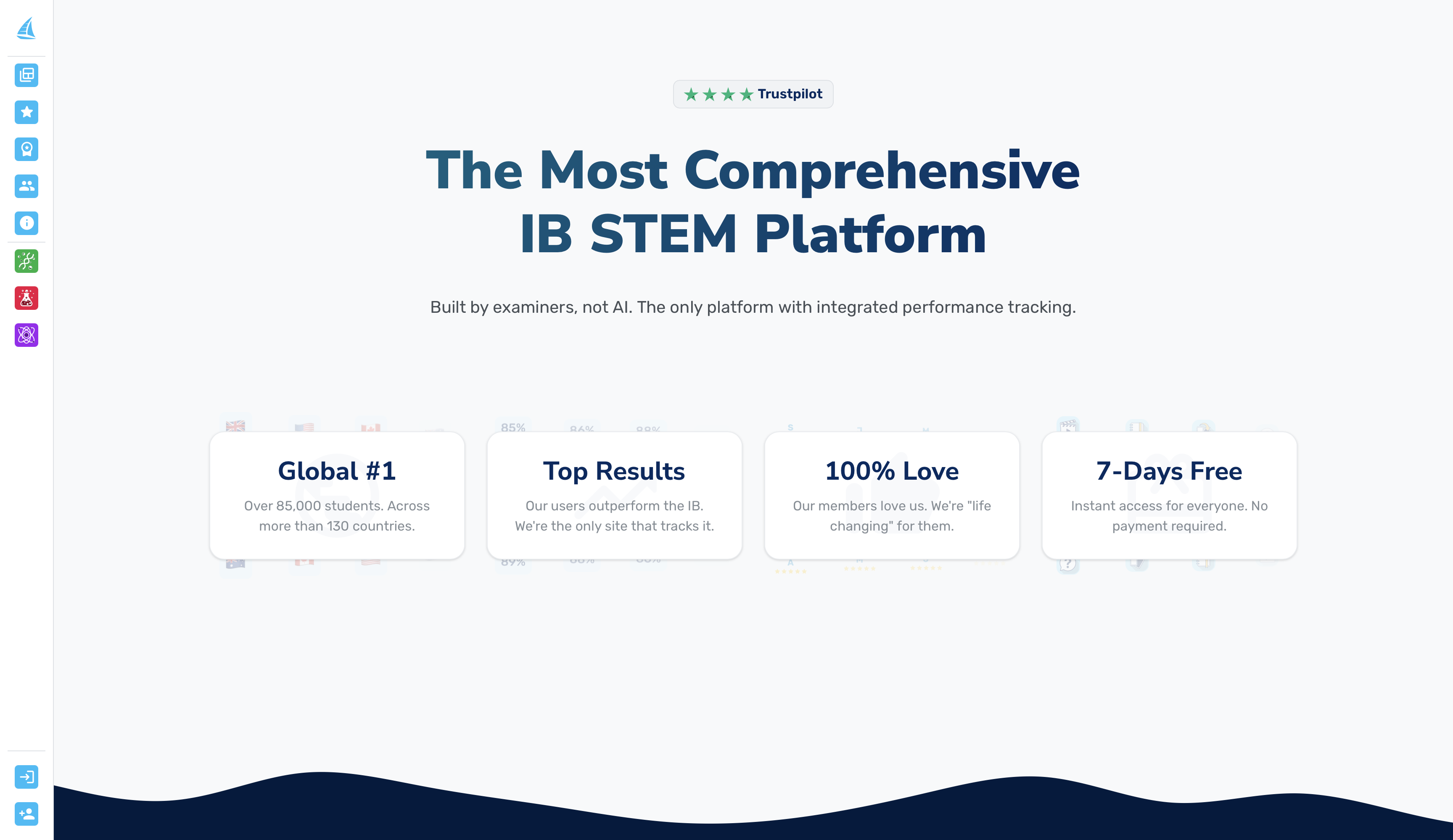
Tibertutor offers an extensive IB Science question bank with thousands of exam-style biology questions, all tagged to the syllabus and paired with detailed mark schemes. You get animated instructional videos, cram sheets, topic tests, and full mock exams, plus progress tracking that shows you exactly where your knowledge needs work. Everything is built by experienced IB examiners. Whether you are targeting a 6 or pushing for a 7, explore Tibertutor’s student resources to find the support that fits your goals.
FAQ
What is the hardest part of IBDP biology to study?
Most students find human physiology and genetics the most content-heavy topics, requiring both strong memorisation and the ability to apply concepts to unfamiliar data scenarios in exams.
How much does the IA count towards the final grade?
The IB Biology Internal Assessment accounts for 20% of your final grade, making early and careful planning an important part of your overall exam strategy.
How should I prepare for Paper 2?
Focus on practising data analysis questions under timed conditions. Paper 2 emphasises applied knowledge and unfamiliar contexts, so rote memorisation alone is not sufficient preparation.
Are flashcards really effective for IB biology?
Yes. Active recall using spaced repetition tools like Anki is one of the most evidence-backed methods for retaining complex biological terminology and processes over a two-year course.
What changed in IB biology Paper 2 for 2027?
From May 2027, Section B structure marks are redistributed into question subparts, meaning students must deliver detailed, content-rich answers throughout every part of their extended responses.