The real role of past papers in IB exam prep
Most IB science students treat past papers as something to do the week before exams. That is a costly mistake. The role of past papers in exam prep goes far beyond last-minute practice. Used well, they are training tools that reshape how your brain stores and retrieves scientific knowledge under pressure. Research shows that just 10% of study time spent on past papers can disproportionately improve retention and exam performance. This article explains exactly how to use them strategically, from memory science to timing, marking, and building the confidence that IB sciences demand.
Table of Contents
- Key takeaways
- Why past papers build memory better than revision alone
- Reading exam patterns across multiple years
- Building exam technique through timed practice
- Marking your work like an examiner
- Fitting past papers into a balanced revision plan
- My honest take on using past papers
- Strengthen your past paper practice with Tibertutor
- FAQ
Key takeaways
| Point | Details |
|---|---|
| Past papers boost retention | Spending just 10% of study time on past papers can significantly improve memory and exam performance. |
| Patterns reveal priorities | Reviewing 3 to 5 years of past papers shows which topics and question types appear most frequently. |
| Timing and conditions matter | Practising under timed, exam-like conditions builds pacing, stamina, and confidence for the real thing. |
| Marking schemes are learning tools | Using mark schemes to understand examiner logic transforms self-marking into deep revision. |
| Scaffold your approach | Begin with topic questions and move to full timed papers 4 to 6 weeks before exams to avoid burnout. |
Why past papers build memory better than revision alone
Reading your notes again feels productive. It rarely is, at least not on its own. Passive review creates a false sense of familiarity. You recognise the information, but recognising and retrieving are very different things in an exam hall.
Past papers force active recall. Your brain must retrieve information without the safety net of your textbook, which is precisely what the IB exam demands. This retrieval process strengthens the neural pathways associated with that knowledge, making it far more accessible under pressure.
There is also the problem of the Recency Effect, where students tend to remember only the most recently studied material. Repetition through past papers counteracts this by bringing earlier content back into working memory at regular intervals. Spaced practice through past paper questions is one of the most evidence-backed revision techniques available.
The time investment is smaller than students expect. Integrating past papers into your routine at just 10% of total study time yields gains that far outpace spending those same hours re-reading notes. That is a meaningful shift in how revision time should be allocated.
Pro Tip: Do not wait until you feel “ready” to try past papers. Attempting questions before you feel fully prepared is uncomfortable but highly effective. The gaps you reveal are exactly the gaps you need to fill.
Reading exam patterns across multiple years
IB examiners do not reinvent questions from scratch each year. Certain topics, command terms, and question structures appear with striking regularity. If you know where to look, past papers become a roadmap.
Reviewing 3 to 5 years of past papers reveals which topics receive consistent mark allocation and which question formats dominate each paper. For IB Biology, questions on cell biology, genetics, and ecology appear in virtually every paper. For Chemistry, organic chemistry and stoichiometry questions are near-constant features.
Here is an example of what pattern analysis might reveal across papers:
| Question type | Typical mark allocation | Frequency across years |
|---|---|---|
| Short-answer recall | 1 to 3 marks | Very high |
| Data-based analysis | 4 to 8 marks | High |
| Extended response | 6 to 9 marks | Moderate to high |
| Experimental design | 4 to 6 marks | Moderate |
This kind of analysis allows students to prioritise study efforts deliberately rather than spreading revision equally across every topic. Targeted study reduces anxiety. It gives you a clear sense of where your time will deliver the greatest return.
Key actions for pattern analysis include:
- Note which topics appear in at least 4 out of 5 papers reviewed
- Identify which command terms (state, explain, evaluate, discuss) appear most frequently
- Flag question types where you consistently lose marks
- Highlight topics that carry the highest mark allocations per question
Building exam technique through timed practice
Knowledge is only part of the IB science challenge. Speed, clarity, and structure under pressure are equally decisive. A student who understands stoichiometry perfectly but cannot work through a Paper 2 in 75 minutes will still underperform.

Practising under timed exam conditions teaches pacing, focus, and stamina in ways that no amount of content revision can replicate. Students learn how long a six-mark extended response actually takes, where they tend to overthink, and which question types slow them down most.
A scaffolded approach works best. Here is a practical progression:
- Begin with topic-specific questions from past papers, untimed, to consolidate knowledge
- Move to timed topic sections once you feel reasonably confident in the content
- Attempt individual paper components (Paper 1, Paper 2) under timed conditions
- Transition to full timed past papers approximately 4 to 6 weeks before your exam date
Starting full-length papers too early often leads to burnout and discouragement rather than growth. The scaffolded approach builds confidence gradually and ensures that timed practice feels challenging but not overwhelming.
Pro Tip: After completing a timed paper, resist the urge to check answers immediately. Wait 30 minutes, then attempt to self-mark before looking at the official mark scheme. This extra retrieval step deepens learning further.
Marking your work like an examiner
The most common mistake students make with past papers is checking answers superficially. They tick a correct response and move on. The real learning happens when answers are wrong, and especially when students understand why they are wrong.
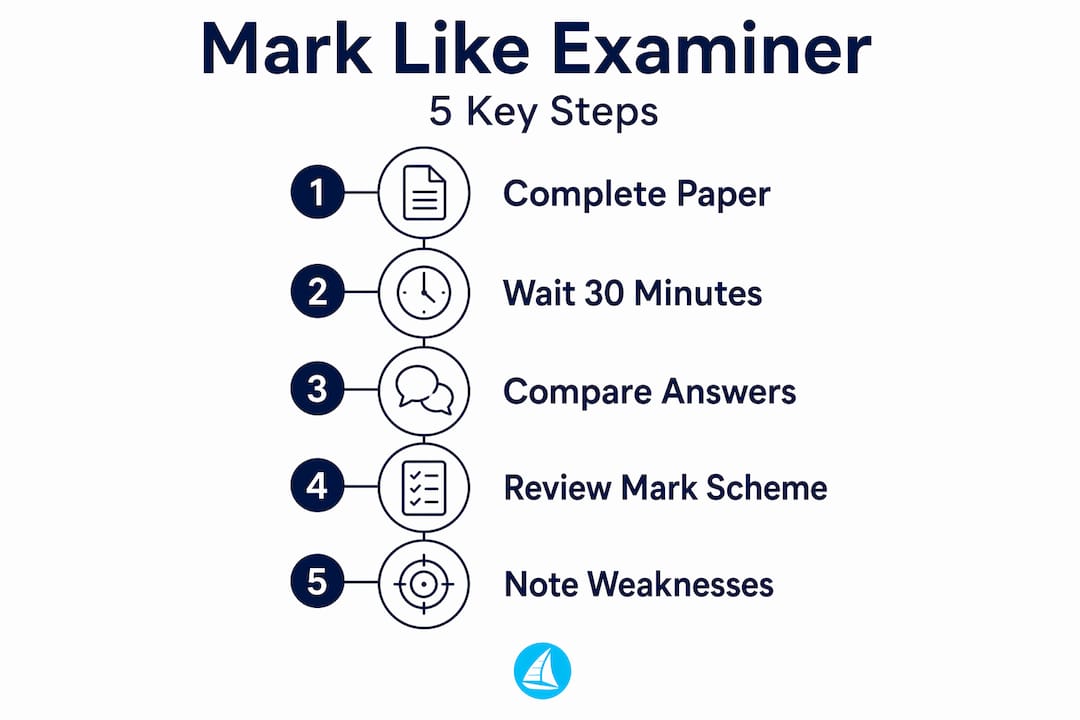
Mark schemes reveal examiner logic rather than simply confirming right or wrong answers. For IB sciences, they show exactly how marks are distributed across knowledge, evidence, and analysis. Reverse-engineering this structure teaches you to build answers that hit each mark point precisely.
Effective post-paper review habits include:
- Keeping an error log or mistake journal, noting every question answered incorrectly and the reason why
- Categorising errors as either knowledge gaps, command term misunderstandings, or timing issues
- Revisiting flagged questions one week later to confirm the gap has been addressed
- Paying particular attention to command term misunderstandings, such as confusing “explain” with “state” in extended responses
Many students use past papers passively, reviewing answers without truly engaging with examiner expectations. This approach misses the deeper gains. The mistake journal, in particular, is a powerful tool. Over several weeks, patterns in your errors become visible, and those patterns tell you exactly where to focus revision.
Fitting past papers into a balanced revision plan
Past papers are most effective as part of a broader revision plan, not as a replacement for content learning. Students still need their notes, textbooks, and conceptual understanding firmly in place before past paper practice can reach its full potential.
A balanced approach might look like this: spend the early weeks of revision on content consolidation using notes, flashcards, and topic summaries, then introduce topic-based past paper questions from week three or four onwards. Full timed papers belong in the final four to six weeks before exams.
Parents can support this process meaningfully. Encouraging a structured study timetable, helping create a calm revision space, and acknowledging progress without adding pressure all contribute to your child’s readiness. Stress and overexposure to exam conditions too early can undermine confidence rather than build it.
Pro Tip: If your child seems overwhelmed after a full past paper, that is normal and productive. Sit with them briefly, celebrate what went well, and help them identify one or two specific things to work on. Progress feels more manageable in small steps.
My honest take on using past papers
I have worked with IB science students for a long time, and I have seen the same pattern repeatedly. Students who use past papers strategically, starting early and reviewing carefully, consistently outperform students who simply know the material better.
What surprises most students is how much a poor first attempt at a past paper can actually help them. Those early, humbling results are not evidence of failure. They are a precise diagnostic. I have seen students score 4 marks on a Paper 2 in October and achieve a 7 in May, precisely because those early papers showed them clearly what to fix.
My honest advice to parents: do not measure progress by early past paper scores. Measure it by how thoughtfully your child analyses their mistakes and returns to the same question type later. That process, repeated consistently, is what past paper practice is genuinely about.
— Oliver
Strengthen your past paper practice with Tibertutor

Past papers become significantly more powerful when you combine them with high-quality, syllabus-aligned questions and instant feedback. That is exactly what Tibertutor is built for.
The IB science questionbank at Tibertutor gives students access to thousands of exam-style questions across Biology, Chemistry, and Physics, organised by topic and syllabus point. Built by examiners, the platform tracks your errors automatically, so your mistake journal is generated for you. Students can move from targeted topic practice to full mock exams within one platform, with performance analytics that show exactly where revision effort is needed most.
For parents wanting to understand how to support your child’s preparation, the resources for IB parents page offers clear, practical guidance. Explore Tibertutor today and give your child’s revision the structure and confidence it deserves.
FAQ
How much time should IB students spend on past papers?
Research suggests that just 10% of total study time dedicated to past papers can produce significant improvements in retention and exam performance, making them one of the highest-return revision activities available.
When should students start doing full past papers?
Scaffolded revision recommends beginning with topic-specific questions before transitioning to full timed papers approximately 4 to 6 weeks before exams. Starting full papers too early can cause burnout and reduce their effectiveness.
Why are mark schemes so important for past paper practice?
Mark schemes reveal examiner expectations and show precisely how marks are allocated across knowledge, evidence, and analysis. Understanding this logic helps students structure answers that meet each mark point rather than simply writing what they know.
How many years of past papers should IB students review?
Reviewing 3 to 5 years of papers is enough to identify recurring topics, question formats, and command terms that consistently appear. This analysis allows students to prioritise high-frequency areas rather than revising every topic equally.
What is the most common mistake students make with past papers?
Many students review past papers passively, simply checking whether answers are correct without analysing why errors occurred or how mark schemes allocate points. Keeping a structured error log and revisiting missed questions is what transforms past paper practice into genuine learning.