What is IB core syllabus: a complete guide
The IB core syllabus is one of the most misunderstood parts of the International Baccalaureate Diploma Programme. Many students and parents assume it refers to the six subject groups, but the core is something quite different. Understanding what is IB core syllabus means looking beyond individual subjects at the three compulsory components that bind the entire programme together. These components shape how students think, research, and engage with the world around them. Get to grips with the core early, and the whole IB course structure becomes far clearer.
Table of Contents
- Key takeaways
- The three components of the IB core syllabus
- How the core fits the wider IB curriculum
- IB core versus other academic programmes
- Managing the IB core syllabus successfully
- Core syllabus at a glance
- My experience with the IB core
- How Tibertutor supports IB students
- FAQ
Key takeaways
| Point | Details |
|---|---|
| Three core components | The IB core comprises Theory of Knowledge, Extended Essay, and Creativity, Activity, Service. |
| Points contribution | TOK and the Extended Essay together can contribute up to 3 bonus diploma points. |
| CAS is compulsory | CAS carries no points but must be authentically completed or the diploma cannot be awarded. |
| Core connects subjects | The core links skills and thinking across all six subject groups, not just one discipline. |
| Early planning matters | Starting CAS and the Extended Essay early reduces stress and improves quality significantly. |
The three components of the IB core syllabus
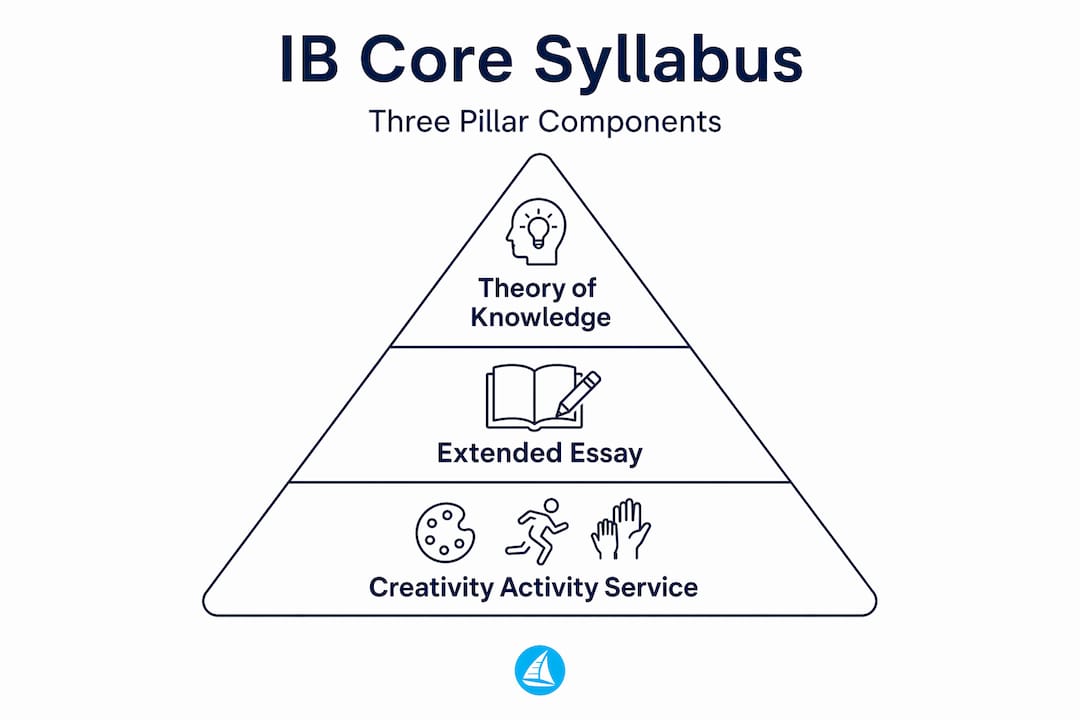
The DP core consists of three required components: Theory of Knowledge (TOK), the Extended Essay (EE), and Creativity, Activity, Service (CAS). Each one serves a distinct purpose, and together they give the IB Diploma Programme its character.

Theory of knowledge (TOK)
TOK is unlike any class most students have encountered before. Rather than teaching a subject, it asks students to reflect on knowledge itself. How do we know what we know? What counts as evidence in science versus in history? These are the kinds of questions explored throughout the course. TOK is assessed through a written essay and an oral presentation, and it contributes to diploma points alongside the Extended Essay. A strong performance in both can earn up to 3 additional points toward the final diploma score, which can make a meaningful difference at the top end of grading.
Extended essay (EE)
The Extended Essay is a 4,000-word research paper on a topic of the student’s choosing within an approved IB subject. It is externally assessed and rewards genuine academic curiosity. Students who treat the EE as a burden tend to produce weak work. Those who choose a question they actually care about often find it one of the most rewarding parts of the programme. The EE builds skills in research, argument structure, and source evaluation that are directly useful at university level.
Creativity, activity, service (CAS)
CAS is where the IB course structure steps furthest beyond the classroom. It requires students to engage in creative pursuits, physical activity, and community service throughout the two years. Importantly, CAS does not contribute to the diploma points tally at all. However, it is entirely mandatory. Fail to complete CAS authentically, and the diploma cannot be awarded, regardless of exam scores. This surprises a significant number of parents each year.
- CAS must be documented with regular reflection entries
- Activities should show genuine challenge and personal growth, not just hours logged
- Service must involve real community benefit, not token gestures
- Students are expected to set their own goals and evaluate their progress honestly
Pro Tip: Start logging CAS activities from the very first term. Students who leave documentation to the second year often find themselves rushing to fill gaps, which affects the quality of reflection and raises red flags with coordinators.
How the core fits the wider IB curriculum
Students normally study six subjects from six groups alongside the DP core, with three or four taken at higher level and the rest at standard level. The core is not an add-on to these subjects. It is woven into the fabric of the whole programme.
Think of it this way. The six subject groups deliver content knowledge. The core develops the thinking habits and personal qualities that let students use that knowledge well. The IB core connects academic disciplines and encourages intercultural understanding and open-mindedness, which is a goal no single subject group can achieve alone.
Here is how the integration works in practice:
- The Extended Essay is written in a chosen subject, so it deepens subject-specific knowledge while building research skills.
- TOK draws on examples from science, history, and the arts, encouraging students to see patterns across disciplines.
- CAS often connects with subjects. A student studying Biology might volunteer at a conservation project, linking service to scientific understanding.
- The holistic approach of the core develops university readiness in ways that purely exam-driven study cannot replicate.
- Both TOK and the EE carry diploma eligibility implications. Failing either component can prevent a student from earning the diploma even if all subject scores are strong.
The IB core assessment requirements therefore sit at the heart of diploma eligibility, not at the edges.
IB core versus other academic programmes
Many families comparing options want to know how the IB core syllabus differs from the requirements in other systems.
| Feature | IB Diploma Programme | A-Level system |
|---|---|---|
| Compulsory core | TOK, EE, and CAS for all students | No universal compulsory core element |
| Research project | Extended Essay, 4,000 words, externally assessed | Optional in some schools, not universal |
| Personal development | CAS mandatory across two years | No equivalent structured requirement |
| Points contribution | Core can add up to 3 bonus points | All points from subject exams only |
| Philosophy focus | TOK examines the nature of knowledge explicitly | No equivalent philosophical enquiry course |
A-Level programmes concentrate almost entirely on subject content and final examinations. The IB core philosophy is built around something broader. The holistic focus of the IB explicitly fosters skills and personal growth beyond academic content, which is why many universities look favourably on IB graduates.
Pro Tip: When comparing programmes with your child, look beyond total points. Ask whether the programme builds independent research skills and self-management. These matter as much as grades when students arrive at university.
Managing the IB core syllabus successfully
The core is manageable with good habits. The students who struggle are almost always those who treat it as secondary to their six subjects.
- Begin the Extended Essay topic search in the first term of Year 1. Changing direction halfway through costs valuable time.
- Keep a CAS portfolio updated monthly. Brief, honest reflections are far better than long entries written from memory six months later.
- Students often misunderstand CAS’s role, believing it affects points directly. Clarify this early so no misplaced priorities develop.
- Treat TOK exhibitions and essays as genuine intellectual exercises, not boxes to tick. The skills practised here improve performance in science and humanities subjects too.
- Talk to your IB coordinator regularly. They see every student’s core progress and can flag problems before they become serious.
For parents, the most useful thing you can do is ask open questions. Ask your child what their CAS project is teaching them, not just whether they have completed the hours. Genuine engagement shows in the reflection quality, and coordinators notice the difference.
Core syllabus at a glance
The IB core syllabus is three components working as one. TOK sharpens thinking. The EE builds research confidence. CAS develops the whole person. Higher level subjects require 240 teaching hours each, and the core sits alongside that considerable workload. The demands are real, but so are the rewards. Students who engage authentically with all three components arrive at university better prepared than their peers in most other systems. The core is not the hardest part of the IB. It is the part that makes the hardest parts worthwhile.
My experience with the IB core
I have worked with IB students and parents across many years, and the same misunderstanding comes up repeatedly. Families treat the core as an administrative requirement to be completed in the background while the “real work” happens in the six subjects. That framing causes unnecessary stress and genuinely weaker outcomes.
In my experience, students who invest early in their Extended Essay topic and write with genuine curiosity produce work that surprises them. They also tend to perform better in science exams because they have practised sustained analytical thinking. TOK is not separate from Biology or Chemistry. It is the layer underneath them.
My honest advice: sit down with your child at the start of Year 1 and map out all three core components on a calendar alongside subject deadlines. Visibility removes the anxiety. You will see that the core is demanding but absolutely achievable when planned from the start.
— Oliver
How Tibertutor supports IB students
Navigating the IB core syllabus while keeping on top of six subjects is a significant challenge. Tibertutor is built specifically to help IB science students manage exactly that pressure.
The platform offers exam-style questions, detailed notes, animated videos, and mock exams for IB Biology, Chemistry, and Physics, all mapped directly to the current syllabus. Whether your child is preparing for Higher Level exams or needs targeted practice on specific topics, Tibertutor’s IB science question bank provides structured, examiner-quality resources at every stage. Parents can also explore the dedicated resources for IB parents section for guidance on supporting your child’s academic journey. Visit Tibertutor pricing to find a plan that fits your needs.
FAQ
What is the IB core syllabus?
The IB core syllabus refers to three compulsory components of the IB Diploma Programme: Theory of Knowledge, the Extended Essay, and Creativity, Activity, Service. These sit alongside the six subject groups and are required for diploma award.
Does CAS affect IB diploma points?
No. CAS carries no points but must be authentically completed. Failing to complete CAS prevents the diploma from being awarded regardless of exam performance.
How many bonus points can the IB core contribute?
TOK and the Extended Essay together can contribute up to 3 additional points to the diploma score, based on combined performance grades in both components.
Is the IB core the same as the six subject groups?
No. The six subject groups deliver academic content across disciplines. The core is a separate layer requiring critical thinking, independent research, and personal development through three distinct components.
When should students start working on the Extended Essay?
Students should begin identifying an Extended Essay topic in the first term of Year 1. Starting early allows time for genuine research, proper supervision meetings, and multiple drafts before the submission deadline.