Why IB science exams are hard and how to master them
Most students assume IB Science exams are difficult simply because the content is vast. Memorise enough facts, revise enough diagrams, and you should be fine. That assumption is where many students go wrong. Application over recall is the true engine of IB Science assessment, with data-heavy questions demanding analysis of novel graphs, tables, and experiments under real time pressure. This guide breaks down exactly why these exams are so demanding, what skills actually earn marks, and how you can build the confidence to tackle them strategically.
Table of Contents
Key Takeaways
| Point | Details |
|---|---|
| Application-focused exams | IB Science exams consistently test your ability to handle new scenarios, not just recall information. |
| Maths and analysis matter | Strong data and calculation skills are essential, especially in Physics and Chemistry. |
| Time is your biggest rival | Effective time management is as important as subject knowledge to maximise marks. |
| Practical reasoning required | Evaluating experiments and justifying methods are vital for exam and IA success. |
| Method conquers memory | Students who approach problems methodically outperform those who rely on memorisation alone. |
What sets IB science exams apart
IB Science exams are not simply harder versions of GCSE or A-level papers. They are structured around a fundamentally different philosophy. Where many assessments reward students who can recall and reproduce, IB exams are designed to test whether you can think like a scientist when faced with something you have never seen before.
Take Paper 1B in Biology or Chemistry. These papers present entirely unfamiliar experimental scenarios. You are given data, graphs, or tables from a study you have never encountered, and you are asked to analyse, evaluate, and draw conclusions. No amount of rote learning prepares you for that. What prepares you is practice with varied, unfamiliar contexts.
The core expectation of IB Science: application over memorisation.
This distinction matters enormously. Students who spend all their revision time reading notes and making flashcards often hit a wall in the exam. They know the content, but they struggle to apply it when it appears in an unexpected format. That gap between knowing and applying is where marks are lost.
There are also structural features of IB Science exams that catch students off guard:
-
Data-based questions appear across all three sciences and require you to extract meaning from unfamiliar sources
-
Command terms such as “evaluate,” “deduce,” and “justify” demand specific types of answers, not just factual recall
-
Linked questions build on each other, meaning a misread in part (a) can cascade into errors in parts (b) and ©
-
Compulsory sections mean you cannot skip a topic you find difficult, unlike some other qualifications
The IB Science questionbank at Tiber Tutor is built specifically to address these features, giving you targeted practice with the question types that actually appear in exams. Practising with exam-style questions is one of the most effective ways to close the gap between content knowledge and exam performance.
| Feature | IB Science exams | Typical school exams |
|---|---|---|
| Question style | Unfamiliar context, data analysis | Familiar scenarios, recall-based |
| Command terms | Precise and varied | Often straightforward |
| Paper structure | Multi-section, linked data questions | Usually independent questions |
| Assessment focus | Application and evaluation | Knowledge and understanding |
Understanding these structural differences is the first step. Once you see what the exam is actually asking for, you can revise with purpose rather than just volume.
The role of mathematical and analytical skills
Understanding the structure is just one part. Let us dig into the mathematical foundation that often surprises IB students, particularly those who chose Biology expecting to avoid heavy calculation work.
Across all three IB sciences, mathematical and analytical skills are non-negotiable. Strong mathematical skills integrated with conceptual understanding are essential, especially in Physics and Chemistry, where calculations, graph interpretation, and data analysis are woven into every paper.
Here is a breakdown of the key skills required across the three sciences:
| Skill | Biology | Chemistry | Physics |
|---|---|---|---|
| Graph interpretation | High | High | Very high |
| Calculations | Moderate | High | Very high |
| Error analysis | Moderate | High | Very high |
| Experimental evaluation | High | High | High |
| Statistical reasoning | High | Moderate | Moderate |
What surprises many students is that knowing an equation is not enough. In Physics, for example, you might need to rearrange a formula, identify which variables are relevant from a description, apply unit conversions, and then comment on the reliability of your result. That is four separate cognitive steps before you even write your final answer.
Here is a step-by-step approach to breaking down a data-heavy question:
-
Read the question stem carefully. Identify the command term. “Deduce” is not the same as “state.”
-
Examine the data source. Note axes, units, scales, and any anomalies before drawing conclusions.
-
Identify the relevant concept. Ask yourself what topic area this question connects to.
-
Apply the concept to the data. Do not just describe what you see. Explain what it means.
-
State your conclusion with evidence. Reference specific values from the graph or table to support your answer.
-
Check your units and significant figures. These are easy marks to lose and easy marks to keep.
Pro Tip: When showing calculations, write out every step of your reasoning, not just the final answer. Examiners award method marks. Even if your arithmetic is slightly off, a clearly communicated method can still earn you full credit.
This structured approach transforms a daunting question into a manageable sequence of decisions. It also reduces the anxiety that comes from staring at an unfamiliar graph and not knowing where to begin.
Time pressure and exam format: the invisible hurdle
Having explored the intellectual demands, it is crucial to see how exam logistics impact real student outcomes. Even students who understand the content deeply can underperform when time pressure enters the equation.
IB Science exams are not leisurely. Paper 2 in Chemistry, for instance, combines structured short-answer questions with extended response questions, all within a tight time window. The data-based and structured questions in Papers 1B and 2 require sustained analytical thinking, not quick recall. Sustaining that level of focus across a full paper is genuinely demanding.

The statistics back this up. Sciences group average grades sit at around 4.4 across 20,542 students, noticeably lower than language groups which average between 4.9 and 5.2. Chemistry SL averages approximately 4.0. To achieve a grade 7, students typically need between 67% and 77% of raw marks, depending on the session. These are not impossible targets, but they require precision and efficiency under pressure.
Common pitfalls that arise specifically from time pressure include:
-
Rushing the data question. Students skim graphs and miss key details, leading to inaccurate conclusions
-
Misreading command terms. Under pressure, “explain” and “describe” start to look the same. They are not
-
Spending too long on one question. Getting stuck on a 2-mark question and losing time for a 6-mark one is a costly mistake
-
Leaving sections incomplete. Running out of time in the final section means leaving marks on the table
-
Skipping the re-read. A quick review of your answers can catch errors, but only if you leave time for it
The solution is not just to “work faster.” It is to practise under realistic conditions. Practising under timed conditions regularly is one of the highest-value activities you can do in the final weeks before your exams. It trains your brain to make decisions efficiently and builds the mental stamina needed to sustain quality across a full paper.
Building a pacing strategy also helps. For example, allocating a fixed number of minutes per mark and sticking to it gives you a clear framework during the exam. If a question is taking too long, move on and return later.
Practical skills, evaluation and the nature of science
Beyond tackling questions and managing your time, there is the extra hurdle of practical science and critical evaluation. This is an area that many students underestimate until they sit down in the exam and realise they are being asked to think like a researcher, not just a student.
The IB Diploma Programme places significant emphasis on practical skills. According to the DP curriculum for sciences, students must be able to evaluate methods, identify limitations, and apply scientific reasoning to real-world contexts. This is tested both in written exams and in the Internal Assessment (IA).
In exams, this often appears as questions asking you to:
-
Identify a source of error in a described experiment
-
Suggest an improvement to a method and explain why it would reduce uncertainty
-
Evaluate whether a conclusion is supported by the data provided
-
Discuss ethical or environmental implications of a scientific application
Here is a structured approach to answering evaluation questions:
-
Identify what is being evaluated. Is it the method, the data, the conclusion, or the application?
-
State a specific limitation or strength. Be precise. “The sample size was small” is weaker than “Only 10 participants were tested, which limits the reliability of the trend.”
-
Explain the impact. Why does this limitation matter? How does it affect the conclusion?
-
Suggest an improvement. Offer a realistic modification and explain how it addresses the limitation.
-
Link back to the question. Make sure your evaluation directly addresses what was asked.
Pro Tip: Examiners reward specificity. Vague evaluations such as “the experiment was not very accurate” earn no marks. Practise naming the exact variable, the exact limitation, and the exact consequence. This is a skill that improves rapidly with deliberate practice.
For parents supporting students through this process, Tiber Tutor offers dedicated guidance for IB parents to help you understand what your child is working towards and how to support their revision effectively.
A fresh angle: why mastering IB science is about method, not memory
With the demands laid out, here is what conventional advice misses, and what actually leads to breakthroughs.
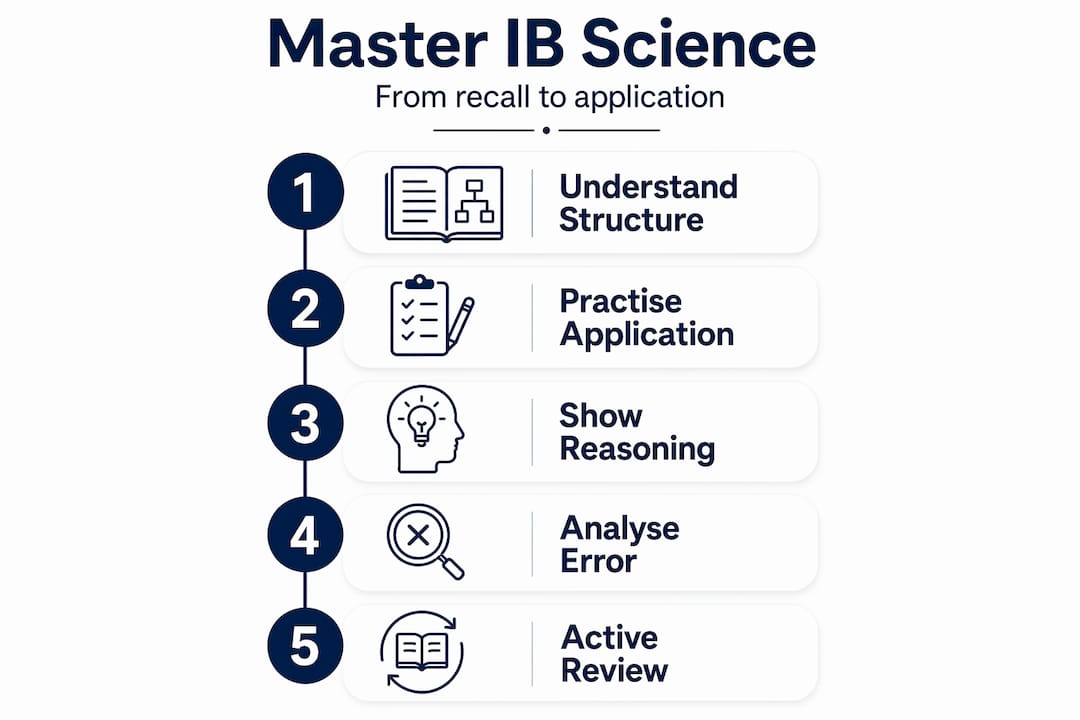
Most revision guides tell you to make flashcards, revise topic by topic, and do past papers at the end. That approach is not wrong, but it is incomplete. The students who consistently achieve 6s and 7s in IB Science are not necessarily the ones who know the most. They are the ones who have learned how to think through a problem clearly and communicate their reasoning precisely.
IB Physics learning research confirms this: the IB prioritises scientific reasoning over computation. Success comes from structured communication, clear error analysis, and the ability to adapt knowledge to new situations. Flashcards have a role, but they hit a ceiling quickly. Once you know the definition of osmosis, knowing it more thoroughly does not help you score higher. What helps is practising how to use that definition in an unfamiliar experimental context.
“Success in IB science is less about what you remember and more about how you think.”
Top scorers share a few habits worth noting. They practise explaining their reasoning out loud, as if teaching someone else. They annotate mark schemes to understand not just what the correct answer is, but why the examiner is looking for it. They treat every past paper question as a chance to rehearse their communication, not just test their knowledge.
Uncertainty and error analysis is another area where this mindset pays off. Rather than hoping experimental questions do not appear, confident students anticipate them and practise stating limitations with precision. This transforms a traditionally feared question type into a reliable source of marks.
The shift from memory-focused to method-focused revision is not always easy. It requires more active engagement and more honest self-assessment. But it is the shift that makes the real difference. You can access support resources for parents who want to understand how to encourage this kind of thinking at home.
Next steps: how to get the edge in IB science
Ready to move from understanding to action? Here is a practical way to apply this knowledge and strengthen your IB science performance.
Tiber Tutor is built by examiners and experienced IB educators who understand exactly what earns marks in Biology, Chemistry, and Physics. Every resource is designed to close the gap between content knowledge and exam performance.
You can explore our IB Science Questionbank to access thousands of exam-style questions with model answers, covering data analysis, application questions, and evaluation tasks across all three sciences. Each question is mapped to the current IB syllabus, so you are always practising what is relevant. For a full overview of what is available, visit our resources for IB students page, or check out our pricing and packages to find the right plan for your needs. Whether you are aiming for a 6 or pushing for a 7, Tiber Tutor gives you the tools, the structure, and the confidence to get there.
Frequently asked questions
What is the hardest part of IB science exams?
Interpreting unfamiliar data and applying concepts to new scenarios under time pressure is the primary challenge, not the difficulty of the content itself.
How are IB science grades different from other subjects?
Sciences average around 4.4 compared to 4.9 to 5.2 in language groups, with grade 7 boundaries typically requiring 67 to 77% of raw marks.
What practical skills are tested in IB science exams?
You must evaluate methods, identify limitations, and apply scientific reasoning to real-world contexts, both in written exams and in your Internal Assessment.
Can you pass IB science with memorisation alone?
No. IB exams are designed to reward application over rote recall, and students who rely solely on memorisation typically struggle with data-based and unfamiliar-context questions.
How can parents support IB science students?
Parents can help most by encouraging regular timed practice with exam-style questions and helping students access structured revision resources that target the specific skills examiners look for.