Why mock exams improve performance: IB guide
Passive revision feels productive. Re-reading notes, highlighting textbooks, watching revision videos. Yet when exam day arrives, many IB science students find that what they thought they knew does not translate into marks on the page. Understanding why mock exams improve performance changes everything. Mock exams are not simply a rehearsal. They are one of the most evidence-backed tools in education, and for IB Biology, Chemistry, and Physics students facing some of the most demanding assessments in secondary education, using them strategically can make a measurable difference to your final grade.
Table of Contents
- Key takeaways
- Why mock exams improve performance: the science
- Identifying gaps with targeted revision
- Building exam technique and reducing anxiety
- Best practices for using mocks in IB revision
- Evidence on mock exams and IB performance
- My take on the overlooked power of mocks
- Practise smarter with Tiber Tutor
- FAQ
Key takeaways
| Point | Details |
|---|---|
| Retrieval beats re-reading | Active recall during mocks retains significantly more information than passive revision methods. |
| Mocks diagnose, not just score | Their real value is revealing knowledge gaps so revision becomes targeted and efficient. |
| Anxiety reduces with repetition | Repeated exposure to exam conditions lowers stress responses on the actual exam day. |
| Feedback drives score gains | Students who analyse errors in detail improve scores by up to 25%. |
| Realistic conditions matter | Timed, format-matched mocks produce greater performance gains than untimed practice. |
Why mock exams improve performance: the science
Most students revise passively. They re-read their notes, review flashcards, and feel a sense of familiarity with the content. The problem is that familiarity is not the same as recall. When you sit an IB exam, you are not asked to recognise information. You are asked to retrieve it, apply it, and explain it under pressure.
This is where the testing effect becomes so powerful. The testing effect describes how the act of retrieving information from memory strengthens the neural pathways associated with that knowledge. Every time you attempt to recall a concept, you are reinforcing it more deeply than any amount of re-reading could achieve. Research shows that retrieval practice improves retention by 50% one week after study compared to passive methods.
There is also a metacognitive benefit that is easy to overlook. Mock exams help students accurately judge what they know versus what they merely recognise when prompted. This distinction matters enormously in IB science, where students often believe they understand a topic until they attempt an exam-style question and realise the gaps. The testing effect also strengthens neural pathways and promotes long-term learning far more effectively than highlighting or rereading.
“Students who practise retrieving information perform significantly better in final assessments than those who spend the same time reviewing material passively.”
The implication for IB students is clear. Sitting a timed mock on cellular respiration or organic chemistry is not just practice. It is a learning event in itself.
Identifying gaps with targeted revision
One of the most common mistakes in IB science revision is spending equal time on everything. Students revise what they already know because it feels comfortable, and they avoid the topics that feel uncertain. Mock exams break this pattern.
Mock exams’ primary value lies in exposing gaps rather than confirming strengths. A score of 62% on a mock is not a judgement of your ability. It is a map showing you exactly where to focus next. Typical errors revealed by mocks include misreading command terms (describe vs explain vs evaluate), poor time allocation across questions, and surface-level answers that miss the depth IB markschemes reward.
Here is a comparison of how mock-driven revision differs from general revision approaches:
| Revision approach | Strengths | Limitations |
|---|---|---|
| Re-reading notes | Builds familiarity with content | Low retention, no active recall |
| Flashcards | Good for definitions and facts | Does not replicate exam conditions |
| Watching videos | Accessible and engaging | Passive; limited transfer to exam performance |
| Mock exams | Identifies gaps, builds recall, simulates pressure | Requires time and honest self-assessment |
| Mock exams with error logs | All of the above plus targeted, efficient revision | Requires structured follow-up to be effective |
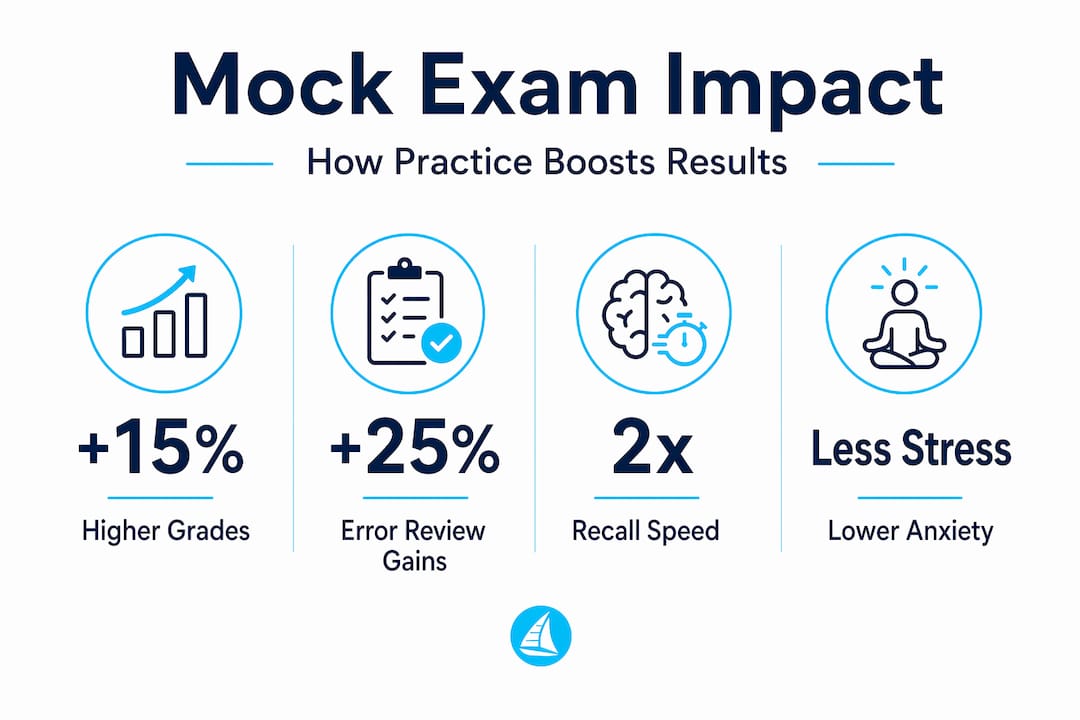
Students who deeply analyse their mistakes after a mock improve their scores by up to 25%. That improvement does not come from doing the mock. It comes from what happens after.
Pro Tip: Keep a dedicated error log after every mock. Write down each question you lost marks on, the reason you lost them, and the correct approach. Review this log weekly. Over time, you will notice patterns that show you exactly where to direct your revision.
Building exam technique and reducing anxiety
There is a reason experienced IB teachers say that knowing the content is only half the battle. The other half is performing under pressure. Time management, question prioritisation, and staying calm when a question looks unfamiliar are all skills. And like any skill, they require practice.
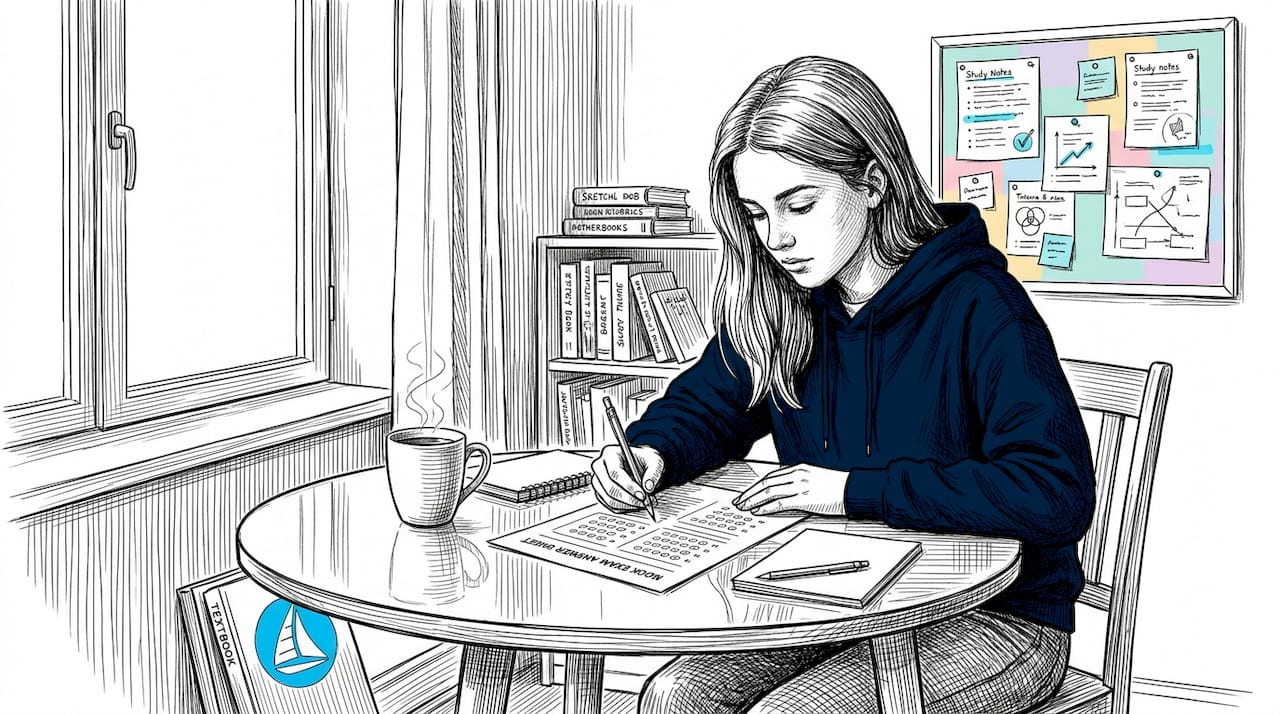
Mock exams serve as what researchers describe as a vaccine against exam anxiety. Repeated exposure to exam conditions reduces the fight-or-flight response that causes students to freeze, rush, or second-guess themselves on the day. Familiarity with the format, the timing, and the pressure makes the real exam feel far less threatening.
Here are the key exam technique skills that mock exams develop:
- Time awareness. Knowing instinctively how long to spend on a 4-mark question versus a 9-mark extended response.
- Command term recognition. Responding to “evaluate” differently from “state” or “outline.”
- Strategic question order. Starting with questions you are confident in to build momentum.
- Handwriting and spatial management. IB science papers require diagrams, calculations, and structured written answers. Paper-based mock practice develops the motor skills and timing needed for written conditions.
Repeated exposure to exam-like pressure also builds psychological resilience and reduces imposter syndrome. Students who sit multiple mocks arrive on exam day with a sense of preparedness, not dread.
Pro Tip: Replicate exam conditions as closely as possible. Sit at a desk, remove your phone, set a timer, and do not pause. The discomfort you feel during a strict mock is exactly the discomfort you are training yourself to manage.
Best practices for using mocks in IB revision
Doing a mock exam is straightforward. Using it well requires a plan. Here is a structured approach that works for IB science students:
- Schedule mocks at strategic intervals. Do not save them for the week before exams. Sit your first mock after completing a full topic or unit, so you have time to act on what it reveals.
- Match the format exactly. Use past IB papers or exam-style questions that mirror the real assessment. Format-matched mocks produce better performance gains than loosely structured practice.
- Time yourself strictly. IB papers have precise time limits. Practise working within them every time.
- Review against the markscheme. Do not just check whether your answer is right. Understand why the markscheme awards points and where your phrasing fell short.
- Update your error log. Record every mark lost, the topic it relates to, and the type of error (knowledge gap, misread question, poor structure).
- Follow up with targeted revision. Use your error log to guide the next round of study before sitting another mock.
Combining digital practice with at least some paper-based mock exams optimises preparation for actual IB exam conditions, where everything is handwritten.
Evidence on mock exams and IB performance
The data on mock exams is consistent and compelling. Students who use practice tests outperform passive revision students by 15 percentage points on average, with final score improvements ranging from 10% to 25%.
| Study finding | Improvement |
|---|---|
| Practice tests vs passive revision | 15 percentage point average advantage |
| Final score range improvement | 10% to 25% |
| Pass rate with two mocks vs none | 81% vs 63% |
| Retention improvement (retrieval practice) | 50% higher one week post-study |
| Score gain from detailed error analysis | Up to 25% |
Students who took two mock exams showed an 81% pass rate compared to 63% for those who did not sit any mocks. That is a 78% greater likelihood of passing. For IB students aiming for a 6 or 7, those numbers are not abstract. They represent a real and achievable shift in outcomes.
“Mock exams are not a measure of where you are. They are a tool for getting where you want to be.”
My take on the overlooked power of mocks
I have worked with IB science students for years, and I see the same pattern repeatedly. Students who struggle in their final exams are rarely those who lacked knowledge. They are the ones who never practised performing under pressure.
In my experience, the biggest mistake is treating a mock as a verdict. A poor mock score does not mean a student is not capable. It means they have found something worth fixing, and they still have time to fix it. That reframe changes everything. Students who embrace mocks as learning tools rather than tests of intelligence approach their revision with more focus, more honesty, and ultimately more confidence.
The other pitfall I see constantly is sitting a mock and moving on without reviewing it properly. The mock itself is only half the work. The hour spent going through every lost mark, understanding why, and adjusting revision accordingly is where the real gains happen. Start early. Be honest. Use every mock as a compass, not a report card.
— Oliver
Practise smarter with Tiber Tutor
If you are looking to put these principles into practice, Tiber Tutor is built precisely for this. Designed by IB examiners and experienced educators, Tiber Tutor offers IB science students access to a structured IB science question bank covering Biology, Chemistry, and Physics, alongside full mock exams, detailed markscheme reviews, and performance analytics that show exactly where marks are being lost.
For parents supporting their child through IB sciences, the resources for IB parents section offers guidance on how to track progress and support revision at home. Every resource is aligned to the current IB syllabus and designed to replicate real exam conditions. It is the structured, exam-focused preparation that the evidence consistently points to.
FAQ
Do mock exams actually improve grades?
Yes. Students who sit mock exams outperform those who revise passively by an average of 15 percentage points, with final score improvements of 10% to 25% reported across multiple studies.
How many mock exams should an IB student sit?
Research shows that sitting at least two mock exams raises pass rates significantly, from 63% to 81%. For IB science students, sitting one mock per major topic and at least two full paper mocks before the final exam is a strong target.
Why are mock exams better than re-reading notes?
Mock exams require active retrieval, which strengthens memory far more than passive review. Retrieval practice improves information retention by 50% compared to re-reading, and also reveals knowledge gaps that passive revision cannot expose.
When should IB students start sitting mock exams?
Start after completing each major topic, not just in the final weeks before exams. Early mocks give you time to act on what they reveal, making your revision more targeted and efficient.
How should students use mock exam feedback?
Review every lost mark against the markscheme, identify the type of error (knowledge gap, misread question, or poor structure), and record it in an error log. Students who follow this process improve by up to 25% in subsequent assessments.