IB Biology topic-specific test approach: 2026 guide
An effective IB Biology topic-specific test approach is defined as aligning your revision and exam technique with the precise demands of each individual biology topic and exam paper. The IB Diploma Programme Biology course assesses students across Paper 1, Paper 2, and Paper 3, each requiring a distinct set of skills. Paper 1 tests breadth through multiple choice, Paper 2 demands structured extended answers, and Paper 3 focuses on data-based questions and experimental reasoning. Mastering this approach means you stop revising biology as one subject and start treating each paper as its own challenge. The IB Mark Scheme, command terms, and the P-E-E/S-E-E answer structure are the three foundations you build everything else upon.
What do you need before applying a topic-specific approach?
Effective targeted biology test preparation begins with gathering the right tools before you open a single past paper. Without the correct resources, revision becomes unfocused and inefficient.
The core resources every student needs are:
- Past papers and mark schemes. These show you exactly what examiners reward. Read the mark schemes as carefully as the questions.
- Examiner reports. These documents identify the most common student errors per topic. Examiner reports highlight common misconceptions and rewarded answer styles, making them one of the most efficient revision tools available.
- A glossary of key biological terms per topic. The IB Mark Scheme requires precise biological terminology for full marks. Terms like “phospholipid bilayer” or “allele” must appear correctly and consistently in your answers.
- Topic tests. Short, focused tests on individual syllabus areas reveal gaps far faster than re-reading notes.
- Command term reference sheet. The IB publishes a defined list of command terms. Print it and keep it visible during every revision session.
Mastering IB Biology vocabulary is not optional. Substituting plain English for technical terms costs marks directly, regardless of how well you understand the underlying biology.
Data interpretation is a skill that requires separate, deliberate practice. Set aside time each week to read graphs, identify trends, and write conclusions using precise units and biological reasoning. Pair this with structured note-taking that separates factual content from practical skills.

Pro Tip: Organise your notes and topic tests by syllabus topic rather than by date. When you return to a topic after two weeks, you activate spaced repetition naturally, which strengthens long-term recall far more effectively than massed revision sessions.
How does each IB Biology paper demand a different strategy?
Each IB Biology paper rewards different skills: quick recall, structured reasoning, or data interpretation. Treating all three papers identically is one of the most common reasons students underperform.
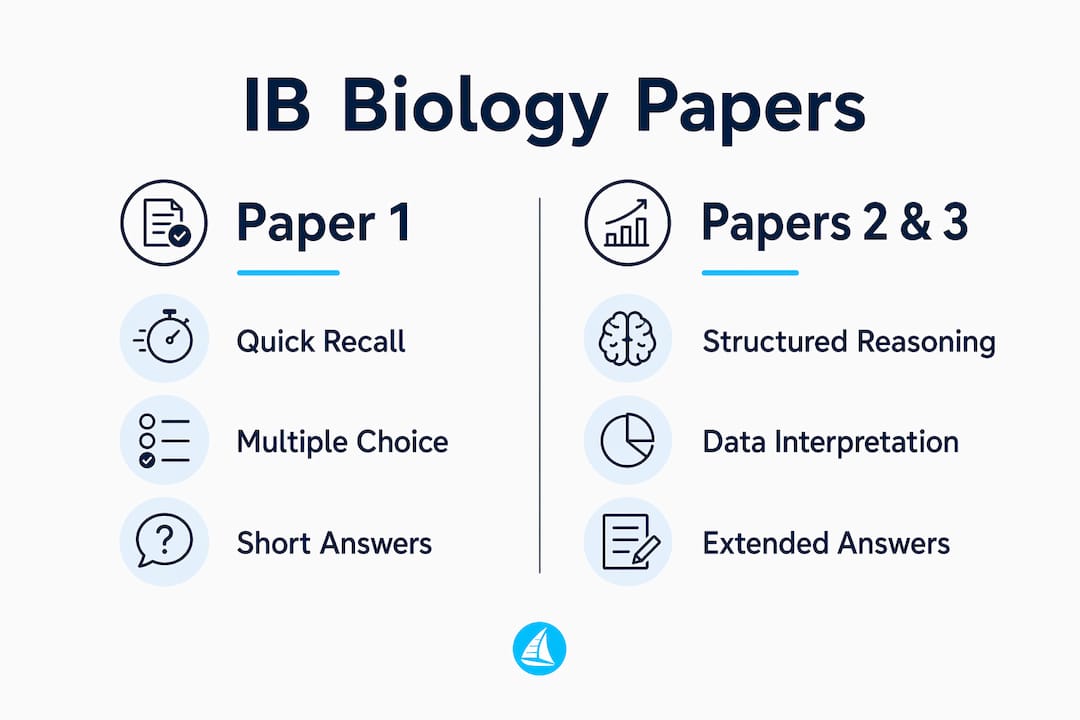
| Paper | Question type | Core skill required | Key exam technique |
|---|---|---|---|
| Paper 1 | Multiple choice | Breadth of recall | Eliminate wrong answers; flag and return to uncertain questions |
| Paper 2 | Short and extended answer | Depth and structure | Use P-E-E/S-E-E; allocate time by mark value |
| Paper 3 | Data-based questions | Analysis and experimental reasoning | Annotate graphs; reference data precisely in answers |
A paper-wise exam strategy works as follows:
- Paper 1. Work at pace. You have limited time per question, so trust your first instinct on recall questions. Flag any question that requires calculation or careful elimination and return to it after completing the rest.
- Paper 2. Allocate time proportionally. Approximately 20 minutes for a 10-mark question gives you enough time for depth without sacrificing other sections. Write a brief plan for extended responses before you begin.
- Paper 3. Read the data before reading the questions. Annotate the graph axes, note units, and identify the trend. Only then read what the question asks.
Pro Tip: Before each exam, write the time allocation per section on the top of your paper. Checking the clock against your plan every 20 minutes prevents the single biggest cause of lost marks: running out of time on high-value questions.
For students who want structured practice across all three paper types, IB Biology exam tests on Tibertutor provide targeted question sets built to match each paper’s format.
How do you decode questions and write high-scoring answers?
Command term mastery is mandatory. Recognising the difference between “state” and “explain” saves time and secures marks. “State” requires a single correct fact. “Explain” requires a mechanism or reason. Confusing the two either wastes time or loses marks.
Annotation is the habit that separates top scorers from the rest. Before writing a single word of your answer:
- Underline the command verb. This tells you how much to write and at what depth.
- Circle the topic focus. This keeps your answer on the correct biological concept.
- Bracket graph axes and units in data-based questions. Annotating graphs with trendlines, error bars, and precise units demonstrates strong data analysis skills that examiners reward directly.
The P-E-E structure (Point, Evidence, Explanation) works for most extended answers in Paper 2. State your biological claim clearly, cite the evidence from the data or your knowledge, then explain the mechanism. The S-E-E variant (Statement, Evidence, Explanation) applies equally well to shorter structured responses. Structured answers using P-E-E/S-E-E improve clarity and match IB mark schemes directly.
Time management within a question matters as much as time management across the paper. A “state” question worth one mark needs one sentence. Do not write a paragraph. Save that time for the six-mark extended response that follows.
Before moving on from any answer, run a quick mental checklist: Have you used the correct technical term? Have you answered the command verb? Have you referenced the data if it was provided?
Pro Tip: Practise writing P-E-E answers under timed conditions from the start of your revision, not just in the final weeks. The structure needs to feel automatic by exam day, not deliberate.
For a deeper look at how mark schemes reward specific phrasing, the IB Science Mark Scheme guide on Tibertutor is worth reading carefully.
What mistakes do IB Biology students make most often?
The most common errors in IB Biology exams fall into four clear categories. Each one is avoidable with the right corrective habit.
- Imprecise vocabulary. Writing “the cell membrane” when the question requires “the phospholipid bilayer” loses the mark. Using precise technical terms aligned with mark schemes is one of the simplest ways to boost scores.
- Ignoring command terms. Students who write lengthy explanations for “state” questions waste time they cannot recover later in the paper.
- Poor data interpretation. Describing a graph as “increasing” without quoting specific values or units fails to meet the standard examiners expect.
- Time mismanagement. Spending 30 minutes on a 4-mark question and rushing a 10-mark question is the most damaging pattern in Paper 2.
Corrective habits that work:
- Flashcard drills for topic-specific vocabulary, reviewed three times per week.
- Command term quizzes at the start of each revision session.
- Timed data-based question practice using past Paper 3 sections.
Examiner reports consistently show that students who read and act on feedback from previous exam sessions improve their mark conversion significantly. The reports are free, specific, and written by the people who set the marks. Using them is the highest-return revision habit available to you.
Pro Tip: After each practice paper, read the examiner report for that year before checking your mark scheme. This trains you to think like an examiner, not just a student.
Which resources best support topic-focused biology revision?
The most effective resources for a topic-focused biology review combine content knowledge with exam-style practice. Passive re-reading of notes does not build the skills Paper 2 and Paper 3 reward.
- Past papers. The primary resource. Using past papers and examiner reports for targeted topic practice improves exam technique and boosts scores consistently.
- Topic tests. Short assessments focused on one syllabus area at a time. These pinpoint weak areas faster than full mock exams.
- Mock exams. Full-length simulations build time management and exam stamina. Tibertutor’s IB Biology mock exams replicate real exam conditions and provide structured feedback.
- Guided tutoring. For students who need feedback on written answers, working with an experienced tutor accelerates improvement. Providers such as Linda Mandarin offer IB-focused support for students who benefit from guided instruction.
Balancing content review and data-based question practice weekly prevents overload and builds both knowledge and analytical skill in parallel. A weekly schedule that rotates between topics and question types is more effective than spending an entire week on one area.
What I have seen change everything for IB Biology students
Students who commit to a topic-specific approach stop feeling anxious about the exam as a whole. They start seeing it as three separate, manageable assessments. That shift in perspective is not trivial. It changes how they revise, how they allocate time, and how confident they feel walking into the exam room.
The biggest improvement I consistently observe comes when students master command terms and apply P-E-E/S-E-E without thinking about it. The structure becomes a reflex. When that happens, students stop worrying about how to write an answer and start focusing entirely on the biology itself.
Data analysis is the skill most students underestimate. Integrating graph interpretation with core biological knowledge is what separates a 5 from a 7. Students who practise this weekly, rather than leaving it to the final month, arrive at the exam with genuine confidence in Paper 3.
Consistency matters more than intensity. Thirty minutes of focused, topic-specific practice every day builds more exam readiness than a six-hour session once a fortnight. Active recall, spaced repetition, and timed practice are not revision techniques. They are the habits that turn knowledge into marks.
— Oliver
Tibertutor’s topic tests for IB Biology preparation
Tibertutor builds its IB Biology resources with one goal: to give you the clearest possible picture of where you stand and what to do next. Every question is constructed by experienced IB examiners, so the style, depth, and command term usage match what you will face in the real exam.

The IB Biology topic tests on Tibertutor let you focus on one syllabus area at a time, identify gaps quickly, and track your progress as you improve. If you want to practise across the full paper format, the IB Biology exam tests provide complete paper-style practice with instant feedback. Structured, targeted, and built for the 2026 exams.
FAQ
What is a topic-specific test approach in IB Biology?
A topic-specific test approach means tailoring your revision and exam technique to the individual demands of each biology topic and paper. It replaces generic revision with focused, paper-aware practice.
How do command terms affect IB Biology exam answers?
Command terms dictate the depth and format of your answer. Misreading “explain” as “state” causes students to write too little; the reverse wastes time and loses marks on other questions.
Why is P-E-E structure important for IB Biology?
The P-E-E structure (Point, Evidence, Explanation) matches the IB mark scheme format directly. Structured answers improve clarity and make it easier for examiners to award full marks.
How should I practise data-based questions for Paper 3?
Annotate graph axes and units before reading the questions, then reference specific data values in every answer. Regular timed practice with past Paper 3 sections builds this as an automatic habit.
How do examiner reports help with IB Biology revision?
Examiner reports identify the most common errors per topic and describe the answer styles that earn full marks. Reading them before practising a topic is one of the most efficient revision strategies available.
Key takeaways
A topic-specific test approach in IB Biology requires matching your revision method, answer structure, and time allocation to the precise demands of each paper and topic.
| Point | Details |
|---|---|
| Treat each paper separately | Paper 1, 2, and 3 reward different skills; adapt your technique for each one. |
| Master command terms | Knowing the difference between “state” and “explain” saves time and secures marks directly. |
| Use P-E-E/S-E-E structure | Structured answers match IB mark schemes and make it easier for examiners to award full marks. |
| Practise data interpretation weekly | Annotating graphs and quoting precise values is a skill built through regular, timed practice. |
| Use examiner reports | They identify the most common errors per topic and show exactly what earns full marks. |