
IB science mark scheme explained: your complete guide
The IB science mark scheme is a scoring guide that tells examiners exactly how to award marks based on command terms, criteria bands, and specific answer features. It is not a model answer. Understanding how it works gives students, parents, and teachers a direct route to higher grades. The mark scheme shapes every IB science exam response, from a one-mark definition in Biology to a six-mark evaluation in Chemistry. Getting to grips with IB science grading criteria is one of the most effective things you can do before exam season.
How IB science mark schemes structure the scoring system
IB science external assessments are split across three papers, each with a fixed format. Paper 1 is multiple choice with no calculator permitted. Paper 2 is free-response with a calculator and formula booklet allowed. Paper 3 covers options-based questions at both Higher Level and Standard Level. Each paper carries a different weighting, and the mark scheme for each reflects that structure.
The overall grade split matters here. Internal Assessment counts for around 24% of the final IB science grade. External papers account for the remaining 76%, divided across Papers 1, 2, and 3. That means the vast majority of your marks come from written exams where mark scheme literacy is non-negotiable.

IB science does not use simple point totals to produce a final grade. Markers use criterion-related grading, assessing work against fixed achievement bands rather than ranking students against each other. This approach improves fairness across thousands of students sitting exams globally. It also means a student who understands the bands can target the right level of response deliberately.
The mark scheme itself lists bullet points of acceptable content, not full paragraphs. Examiners look for specific facts, reasoning steps, or evaluative statements. Partial credit is possible when a student hits some but not all required points.
Pro Tip: Download the official IB mark schemes for past papers from the IB’s subject resource centre and read the examiner reports alongside them. The reports explain why students lost marks, which is more instructive than the mark scheme alone.
| Component | Approximate weighting |
|---|---|
| Internal Assessment | 24% |
| Paper 1 (multiple choice) | 20% |
| Paper 2 (free response) | 32–36% |
| Paper 3 (options based) | 20–24% |
Why command terms are the key to IB science scoring
Command terms are the single most important feature of any IB science exam question. Terms like “describe”, “explain”, “analyse”, and “evaluate” each require a different answer structure. The mark scheme is built around them. An examiner awarding marks for “explain” expects a cause-and-effect link. An examiner marking “evaluate” expects a judgement supported by evidence.
Students regularly lose marks despite having correct knowledge, simply because they respond to the wrong command term. Writing a description when the question asks for an evaluation will not score well, even if every fact is accurate. The knowledge is there; the structure is not.
Here is what each major command term demands in practice:
- Describe: State the key features or steps. No explanation needed. Example: “Describe the process of osmosis” requires you to state the movement of water molecules across a partially permeable membrane from high to low water potential.
- Explain: Give a reason or mechanism. Use “because” or “therefore” to link cause and effect. Example: “Explain why enzyme activity decreases above the optimum temperature” requires you to state that the active site denatures and substrate molecules can no longer bind.
- Analyse: Break the topic into components and examine each. Show how parts relate to the whole.
- Evaluate: Weigh up evidence, discuss strengths and limitations, and reach a supported conclusion. Phrases like “on balance” or “therefore” signal to examiners that you are meeting this criterion.
Pro Tip: Circle the command term before you write a single word. Write it at the top of your answer as a reminder. This one habit prevents the most common mark-losing mistake in IB science exams.
For a deeper look at command terms in Chemistry specifically, the IB Chemistry command terms guide on Tibertutor breaks down each term with subject-specific examples.
How to read mark scheme language and build high-mark answers
IB mark schemes are scoring guides, not model answers. Each bullet point represents one marking point. You earn credit by hitting those points explicitly in your response. Vague or implied answers do not score.
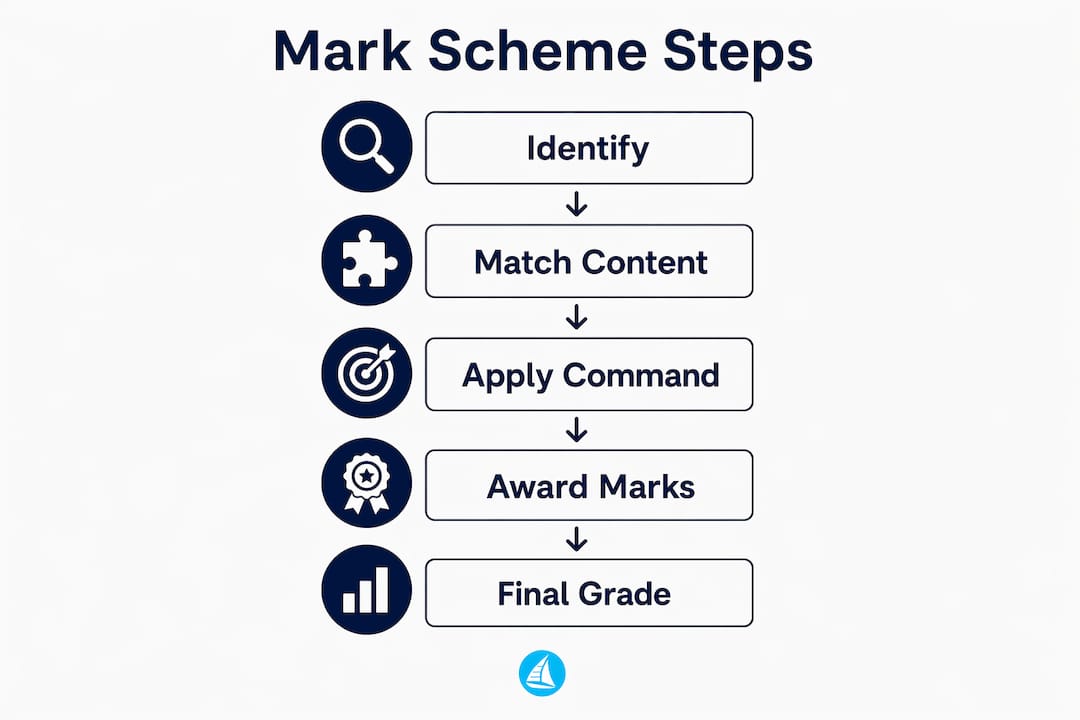
Examiners use specific phrases to signal what they are looking for. “States that” means a bare fact is sufficient. “Links to” means you must connect two ideas. “Uses to support” means you must apply evidence to a claim. Recognising these phrases helps you write answers that match the examiner’s expectations precisely.
Here is a practical process for using mark schemes during revision:
- Attempt a past paper question under timed conditions.
- Open the mark scheme and read each bullet point carefully.
- Highlight every point you addressed in your answer.
- For each point you missed, write a model sentence that would have earned the mark.
- Repeat the question one week later without looking at your notes.
Extended evaluation responses require a balanced argument and supported judgements. Higher mark bands reward answers that weigh evidence and explain both strengths and limitations. A student who writes only positives will not reach the top band, even with accurate content.
Best-fit judgement means teachers and examiners select the achievement band that most closely matches the overall quality of a response. They do not simply add up isolated points. This means a coherent, well-structured answer can score higher than a fragmented one with more raw facts.
Pro Tip: Build an answer bank. After each past paper session, write one polished model answer per question type. Over time, you will have a library of responses that reflect mark scheme language exactly.
How to use IB science mark schemes for exam prep and self-assessment
Mark schemes are not just for examiners. Formative and summative assessments both rely on explicit criteria, which means students and teachers can use mark schemes throughout the year, not only at the end. Teachers who model mark scheme use early in the course give students a significant advantage.
For students, the most effective approach is active self-marking. Attempt a question, then mark your own response against the scheme before checking with a teacher. This forces you to engage critically with your own writing. You quickly learn which command terms you handle well and which ones need more work.
Parents can support this process without needing subject expertise. Encourage your child to explain their mark scheme findings aloud after each practice session. If they can tell you why they lost a mark, they understand the criteria. If they cannot, more review is needed.
- Use mark schemes to identify patterns in lost marks across multiple papers.
- Practise writing answers that use mark scheme language naturally, not just content.
- For the Internal Assessment, review the IA weighting and criteria separately, as the rubric differs from exam papers.
- Achieving a 7 in IB science requires precise data analysis, awareness of experimental errors, and well-argued conclusions. The mark scheme maps exactly what that looks like.
Pro Tip: After self-marking, colour-code your errors. Use one colour for missing content, another for wrong command term responses, and a third for incomplete links. Patterns become visible within three or four papers.
Key takeaways
Understanding the IB science mark scheme means knowing that marks are awarded for explicit content matched to command terms, not for general knowledge or effort.
| Point | Details |
|---|---|
| Mark schemes are scoring guides | They list bullet points of required content, not model answers, so match each point explicitly. |
| Command terms define the structure | “Describe”, “explain”, and “evaluate” each require a different answer format to earn full marks. |
| Best-fit grading rewards coherence | Examiners select the achievement band that best fits overall quality, not a simple point total. |
| Internal Assessment carries 24% | IA quality contributes significantly to the final grade and uses a separate rubric from exam papers. |
| Self-marking builds mark scheme fluency | Regularly marking your own answers against the scheme is the fastest way to improve exam scores. |
What I have learned from watching students decode mark schemes
Students consistently underestimate how much the mark scheme rewards structure over knowledge. I have seen students with strong subject understanding score in the mid-range because they wrote descriptions when the question asked for evaluations. The knowledge was there. The command term response was not.
The other pattern I notice is that students treat mark schemes as a post-exam tool rather than a revision resource. Reading a mark scheme before you attempt a question type gives you a mental template. You start to internalise what “evaluate” looks like in Chemistry versus Biology. That internalisation is what separates a 5 from a 7.
My honest advice: spend as much time reading mark schemes as you do reading your notes. The IB science assessment guide is public and detailed. Use it. Parents, ask your child to walk you through one mark scheme per week. Teachers, build mark scheme analysis into every class that involves past paper work. The students who engage with assessment criteria early are the ones who arrive at the exam with genuine confidence, not just hope.
— Oliver
How Tibertutor helps you master IB science mark schemes
Tibertutor is built by IB examiners and experienced educators who understand exactly how mark schemes work. Every exam-style question on the platform is aligned to IB grading criteria, so you practise answering in the format examiners reward.

Students get access to animated videos, detailed notes, and mock exams that mirror the real paper structure. Progress tracking shows you which command terms and topic areas need more attention. Parents can monitor their child’s development and see where marks are being lost. Whether you are aiming for a 6 or pushing for a 7, explore Tibertutor’s IB student resources to start practising with mark scheme-aligned content today. For parents looking to support their child’s preparation, the Tibertutor parents page explains how the platform works alongside your child’s school programme.
FAQ
What is an IB science mark scheme?
An IB science mark scheme is a scoring guide used by examiners to award marks based on specific content, command terms, and criteria bands. It lists acceptable answers as bullet points rather than full model responses.
How do command terms affect my IB science score?
Command terms define the structure your answer must follow to earn marks. Using the wrong structure, such as describing when asked to evaluate, will cost you marks even if your content is correct.
What is criterion-related grading in IB science?
Criterion-related grading means students are assessed against fixed achievement bands, not ranked against each other. Examiners select the band that best fits the overall quality of your response.
How much does the Internal Assessment count in IB science?
The Internal Assessment counts for approximately 24% of the final IB science grade. The remaining 76% comes from external exam papers.
Can students use mark schemes to revise?
Yes. Practising past paper questions and self-marking against the official mark scheme is one of the most effective revision methods. It builds familiarity with examiner language and highlights gaps in command term responses.