IB chemistry explained: your guide to exam success
IB chemistry is one of the most rewarding science courses in the Diploma Programme, and also one of the most misunderstood. Many students arrive expecting a subject built on memorising equations and periodic table facts. The reality is quite different. Structure and reactivity are the two organising concepts that run through every topic, asking you to reason, interpret evidence, and apply understanding across unfamiliar contexts. Whether you are a student building your study plan, a parent trying to understand what your child is taking on, or an educator looking for sharper strategies, this guide covers everything that matters.
Table of Contents
- Key takeaways
- Chemistry IB syllabus: structure, topics, and levels
- Practical skills: why they matter beyond the lab
- How to study IB chemistry effectively
- Supporting IB chemistry students: advice for parents and educators
- IB chemistry assessment: what to expect
- My honest take on what actually works
- Prepare smarter with Tibertutor
- FAQ
Key takeaways
| Point | Details |
|---|---|
| Conceptual framework, not memorisation | IB chemistry is built around structure and reactivity, requiring reasoning from evidence rather than rote learning. |
| Practicals count significantly | Internal assessment and practical skills directly influence your final grade and sharpen exam reasoning. |
| The data booklet is your ally | Knowing how to use the chemistry IB data booklet efficiently during exams reduces pressure and improves accuracy. |
| SL and HL differ meaningfully | HL covers additional content and demands deeper analytical skills, affecting how you should prioritise study time. |
| Quality resources make the difference | Exam-style practice, revision notes, and video tutorials accelerate progress far more than re-reading textbooks. |
Chemistry IB syllabus: structure, topics, and levels
The IB chemistry syllabus is built around two overarching concepts. Structure covers atomic theory, bonding, periodicity, and the physical properties of matter. Reactivity covers chemical change, energy, kinetics, and equilibrium. These two strands are not taught in isolation. They constantly refer back to each other, which means your understanding compounds as you progress through the course.
Both Standard Level (SL) and Higher Level (HL) students study the same core framework, but HL demands broader content and a deeper level of analytical thinking. HL students encounter additional sub-topics within each theme and are expected to make more sophisticated connections between concepts. If you are aiming for a science-related university course, HL is almost always the more relevant choice.
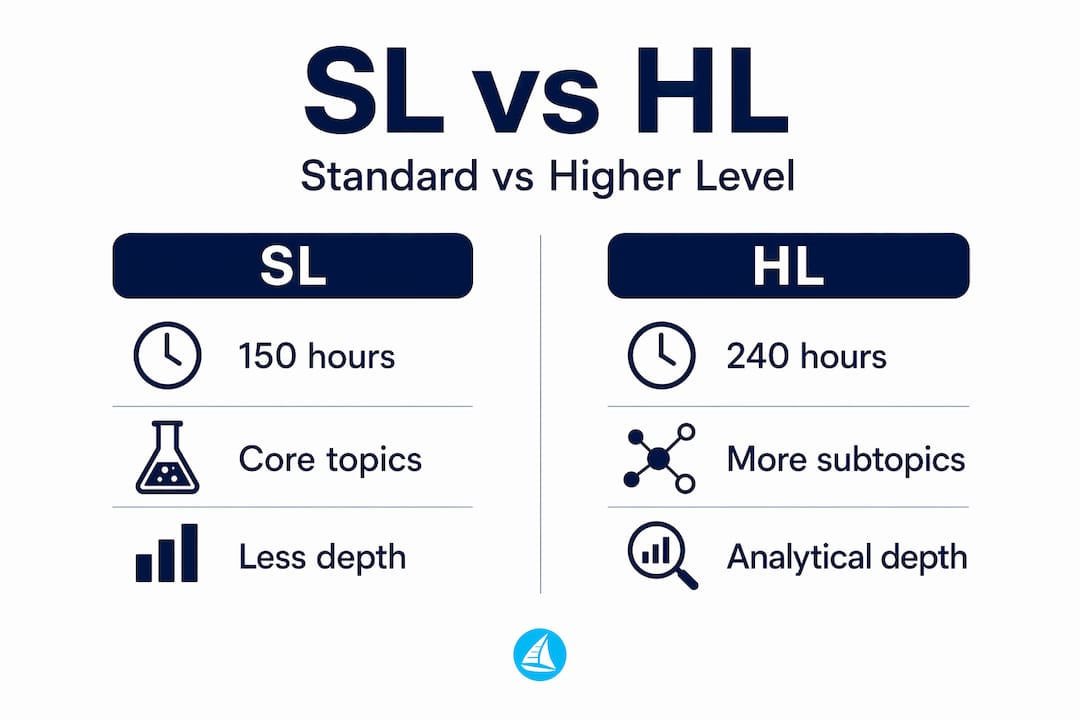
Here is a quick comparison of what SL and HL students can expect:
| Aspect | Standard level (SL) | Higher level (HL) |
|---|---|---|
| Teaching hours | 150 hours | 240 hours |
| Content depth | Core concepts | Core plus additional HL topics |
| Exam papers | Papers 1, 2, and 3 | Papers 1, 2, and 3 (harder questions) |
| Internal assessment | Scientific investigation | Scientific investigation |
| Data booklet use | Yes | Yes |
The chemistry data booklet is provided in all external exams. It contains constants, formulae, standard electrode potentials, spectral data, and more. Students who learn to navigate it fluently gain a real advantage.
Key topic areas across the course include:
- Atomic structure and the periodic table
- Bonding and structure of matter
- Energetics and thermochemistry
- Chemical kinetics
- Equilibrium and acid-base chemistry
- Redox processes and electrochemistry
- Organic chemistry
Practical skills: why they matter beyond the lab
Many students underestimate how central practical work is to IB chemistry. It is not a side component. Practical work includes hands-on experiments, computer simulations, and data modelling activities, all of which build the analytical habits that examiners reward.
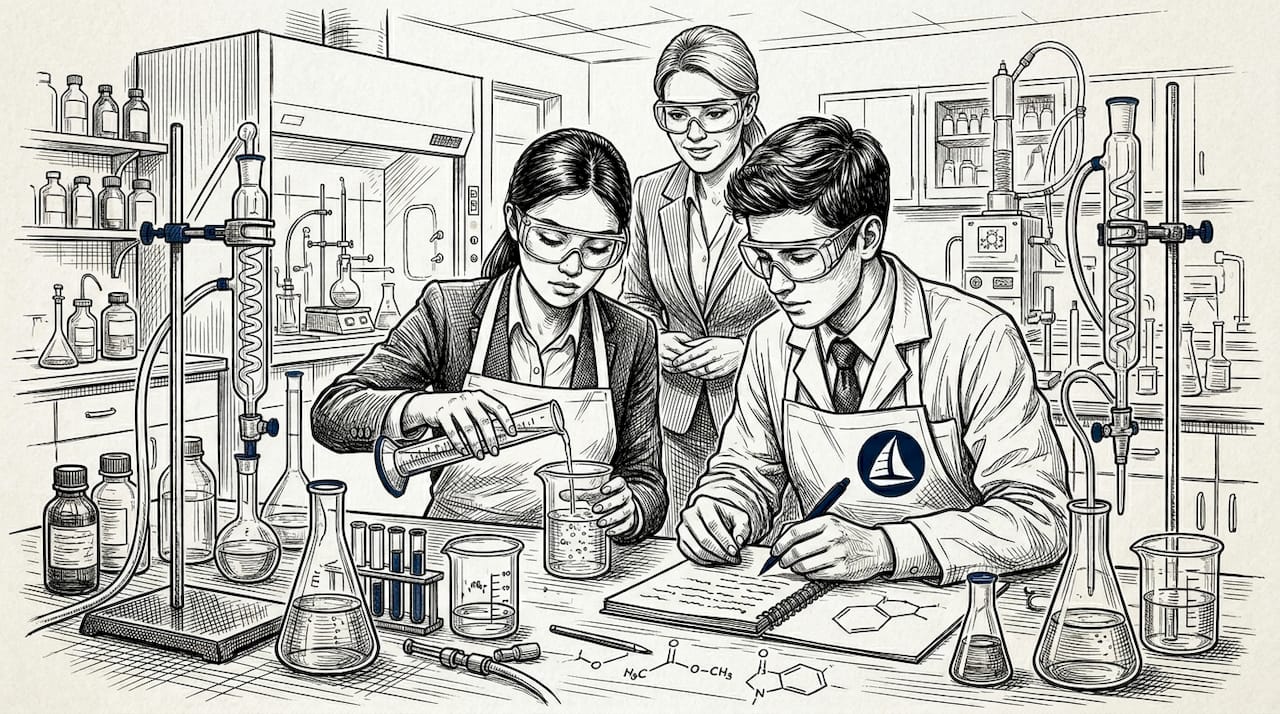
The internal assessment is a scientific investigation you design and carry out independently. You collect data, analyse it, and write a formal report. This is not just a school project. It is assessed by your teacher and moderated externally, and it contributes meaningfully to your final grade.
Students who treat practical sessions as genuine skill-building opportunities rather than interruptions to theory study perform better overall. Why? Because exam questions in Papers 2 and 3 regularly ask you to interpret data sets, evaluate experimental methods, and draw evidence-based conclusions. If you have practised doing exactly that in the lab, those questions feel familiar.
Practical work also develops skills that are harder to teach from a textbook:
- Designing controlled experiments with clear variables
- Recognising sources of error and suggesting improvements
- Communicating findings with scientific precision
- Collaborating on interdisciplinary science projects
Pro Tip: Keep a running lab journal throughout the year. Note what went wrong in each experiment and why. When exam questions ask you to evaluate a method or suggest improvements, you will have a bank of real examples to draw from.
How to study IB chemistry effectively
Effective study for IB chemistry exams is not about reading your notes until they feel familiar. It is about training yourself to apply knowledge under exam conditions. Here is a proven approach:
- Understand the syllabus structure first. Download the official IB Chemistry syllabus and map every topic you have studied to it. Gaps become visible immediately.
- Practise exam-style questions from the start. Do not wait until the end of the course. Working through exam-style questions weekly forces you to apply concepts rather than passively recognise them.
- Master the IB chemistry data booklet. Spend time learning what is in it and where to find things quickly. The chemistry IB data booklet covers formulae and constants you do not need to memorise, which frees mental energy for reasoning.
- Build a topic-by-topic revision schedule. Space your revision across weeks, not days before the exam. A structured study schedule with clear targets per session is far more effective than marathon cramming sessions.
- Use video explanations for difficult concepts. Some topics, like organic reaction mechanisms or electrochemical cells, are easier to grasp when you can see them animated step by step.
- Review mark schemes, not just answers. Mark schemes reveal exactly what examiners are looking for. Studying them teaches you the language of a high-scoring response.
The nature of science theme woven through the course asks you to think critically about how scientific knowledge is constructed and its limitations. Students who engage with this tend to write stronger answers in Paper 3 in particular.
Pro Tip: When you get a question wrong, do not just note the correct answer. Write one sentence explaining the concept behind it. This turns errors into learning moments rather than forgotten mistakes.
Supporting IB chemistry students: advice for parents and educators
Understanding the demands of the course is the first step for anyone supporting a student through IB chemistry. This is not a course where hard work alone guarantees success. Conceptual understanding and the ability to reason scientifically both need to be actively developed.
Practical guidance for parents and educators includes:
- Learn the assessment structure. Understand the difference between the internal assessment and external exams. Knowing how IB science grading works helps you ask the right questions and set realistic expectations.
- Encourage regular, short study sessions. Consistent daily engagement with chemistry content is more effective than occasional long sessions. Help your student build a routine.
- Support access to quality materials. Textbooks are a starting point. Question banks, video tutorials, and practice papers make a measurable difference to exam readiness.
- Monitor stress and workload balance. IB chemistry is challenging alongside five other subjects. Watch for signs of burnout and support healthy boundaries around study time.
- Communicate with the teacher. Teachers can identify specific gaps in understanding early. Staying in contact, especially around the internal assessment, helps your student stay on track.
IB chemistry assessment: what to expect
The assessment in IB chemistry combines internal and external components. Assessment tasks integrate both theoretical knowledge and practical application, and examiners reward scientific reasoning and clear communication.
| Assessment component | What it involves | Weighting |
|---|---|---|
| Paper 1 (SL and HL) | Multiple choice questions on core topics | 20% (SL), 20% (HL) |
| Paper 2 (SL and HL) | Short and extended response questions | 40% (SL), 36% (HL) |
| Paper 3 (SL and HL) | Data analysis and experimental questions | 20% (SL), 24% (HL) |
| Internal assessment | Scientific investigation report | 20% |
Paper 3 is where practical skills feed most directly into exam marks. Questions ask you to interpret unfamiliar data, critique experimental design, and apply the structure-reactivity framework to new scenarios. Knowing the chemistry data booklet inside out is particularly useful here.
The internal assessment is your opportunity to direct your own learning. Choose a question that genuinely interests you. Students who are curious about their investigation topic consistently produce stronger reports.
My honest take on what actually works
I have worked with a lot of IB chemistry students, and the pattern I see repeatedly is this: the ones who struggle most are usually the ones trying hardest to memorise everything. They colour-code their notes, they rewrite definitions, and then they freeze when an exam question presents data in an unfamiliar format. Chemistry IB does not reward recognition. It rewards reasoning.
What I have found works is teaching students to read a question as a scientist would. Start with what the data is showing you, then ask what chemical principle explains it, then construct your answer from evidence outward. That process, practised consistently, is what separates a 6 from a 7.
Practical work is also underestimated. Students treat it as separate from exam prep. It is not. Every time you design an experiment and think about variables, you are building exactly the analytical habits that Paper 3 tests. Treat the lab as exam training, and it starts to feel purposeful rather than disruptive.
My most consistent advice to parents is this: confidence comes from familiarity with exam conditions, not from feeling ready. Get your student doing past papers early and often. It is the single most reliable preparation strategy I know.
— Oliver
Prepare smarter with Tibertutor
If you are ready to move from understanding the course to actively preparing for it, Tibertutor is built for exactly this stage. The platform offers thousands of IB science practice questions written by examiners and organised by topic, so you can target the areas that need the most work. Animated videos, detailed notes, and cram sheets complement the question bank, giving you multiple ways into difficult concepts.

Students using Tibertutor can track their performance by topic, review their answers with model responses, and build the kind of exam-condition familiarity that makes a real difference on results day. Explore the full range of student resources and start practising with purpose today.
FAQ
What are the two main concepts in IB chemistry?
IB chemistry is organised around structure and reactivity. These two concepts are interconnected and run through every topic in both SL and HL.
How is the chemistry IB data booklet used in exams?
The chemistry IB data booklet is provided in all external exams. It contains formulae, constants, and data tables, which means you do not need to memorise these. Learning to navigate it quickly is a key exam skill.
What is the internal assessment in IB chemistry?
The internal assessment is an independently designed scientific investigation. You collect and analyse data, then write a report. It is teacher-assessed and externally moderated, contributing 20% of your final grade.
How does HL differ from SL in IB chemistry?
HL students cover additional sub-topics and are expected to demonstrate deeper analytical thinking. HL also involves more teaching hours (240 versus 150) and more demanding exam questions.
What is the best way to revise for IB chemistry exams?
Consistent exam-style question practice, combined with thorough understanding of the syllabus and confident use of the data booklet, is the most effective preparation approach. Reviewing mark schemes carefully helps you learn exactly how to phrase high-scoring answers.