IB biology: your complete guide for 2026 success
IB biology is one of the most rewarding yet demanding subjects in the IB Diploma Programme. It asks you to think like a scientist, not just memorise facts. The course has a distinct conceptual structure that catches many students off guard, and the exam format rewards those who understand why things work, not just what they are. Whether you are studying at Standard Level or Higher Level, this guide covers everything you need: the syllabus, the exam breakdown, the HL versus SL distinction, and the study strategies that actually produce results.
Table of Contents
- Key takeaways
- Understanding the IB biology syllabus
- Exam format and how marks are distributed
- SL versus HL: what actually changes
- Study and exam preparation strategies
- Practical work and the internal assessment
- My honest take on succeeding in IB biology
- Start your IB biology preparation with Tibertutor
- FAQ
Key takeaways
| Point | Details |
|---|---|
| Four conceptual themes | The syllabus is built around Unity & Diversity, Form & Function, Interaction & Interdependence, and Continuity & Change. |
| HL demands more hours | SL requires 150 hours; HL 240, meaning HL requires a structured long-term approach from the start. |
| Paper 2 carries the most weight | At 44% of the final grade, Paper 2 extended responses are where exams are won or lost. |
| Practical work matters | The Internal Assessment accounts for 20% and rewards independent thinking, not just accurate data collection. |
| Conceptual study beats cramming | Success depends on integrating theory with data interpretation, not rote memorisation. |
Understanding the IB biology syllabus
The 2023 syllabus replaced the old eleven-topic structure with a thematic model built around four interconnected ideas. These are Unity & Diversity, Form & Function, Interaction & Interdependence, and Continuity & Change. Rather than treating topics as isolated units, the course asks you to see how concepts across different biological systems link together.
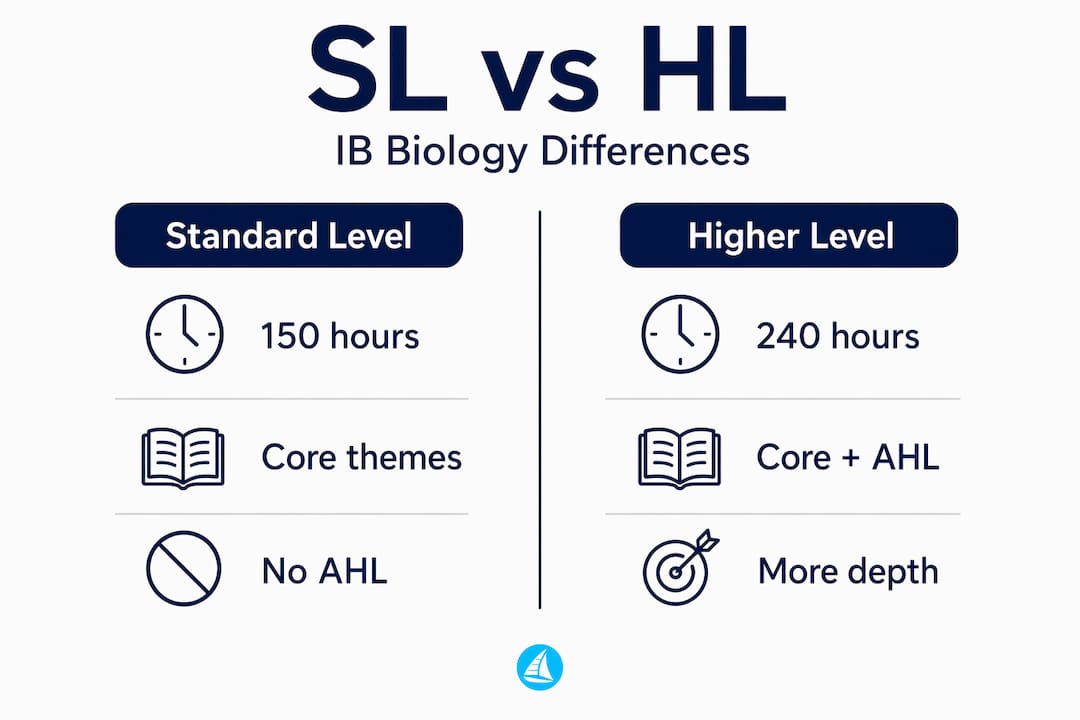
At SL, you study the core content across all four themes. At HL, you extend into Additional Higher Level (AHL) material within each theme. This additional content covers areas such as cladistics, detailed biochemical signalling, and physiological mechanisms that go well beyond SL scope.

| Feature | SL | HL |
|---|---|---|
| Teaching hours | 150 | 240 |
| Paper 1 MCQs | 30 | 40 |
| AHL content | No | Yes |
| Paper 2 weighting | 44% | 44% |
| IA weighting | 20% | 20% |
Pro Tip: When revising each theme, map how subtopics connect across different themes. For example, DNA structure appears in Continuity & Change but links directly to protein synthesis in Form & Function. This cross-theme thinking is exactly what Paper 2 questions test.
Exam format and how marks are distributed
The current exam structure for IB biology comprises Paper 1, Paper 2, and the Internal Assessment. Paper 3 has been removed from the new syllabus.
Paper 1 is split into two sections. The first is a set of multiple-choice questions: 30 for SL and 40 for HL. The second section presents data-based questions requiring short written responses. HL Paper 1 carries 36% of the final grade, and this is where careful interpretation of graphs, tables, and experimental data makes a real difference.
Paper 2 carries 44% and is the highest-weighted component. It includes short-answer questions and extended responses worth between 6 and 15 marks each. These questions regularly link multiple themes, asking you to connect DNA, protein synthesis, genetics, and ecology within a single answer. Both SL and HL sit Paper 2 for 2.5 hours.
The Internal Assessment accounts for the remaining 20% of your final grade. You design and conduct an individual investigation, and while collaboration on methodology is permitted, your report must be entirely your own. The IA rewards students who choose a genuinely interesting research question and who evaluate their results with real scientific rigour.
Key things to know about Paper 2:
- Extended responses require multi-theme synthesis, not single-topic answers
- Command terms matter enormously: “explain” and “evaluate” require very different responses
- Partial marks are awarded, so always attempt every part of a question
- Practice linking concepts from different themes in your written responses
Pro Tip: Learn the IB command terms before you sit a single past paper. “Outline” requires far less detail than “discuss.” Students who miss this distinction often lose marks on questions they actually understand.
SL versus HL: what actually changes
The most common misconception about biology HL IB is that it simply means more content to memorise. It does not. HL Biology requires deeper analysis and longer-term preparation across complex biochemical and physiological areas that SL does not touch. The difference is qualitative, not just quantitative.
AHL content includes areas like the detailed mechanisms of chemical signalling, cladistics and evolutionary relationships, and complex physiological regulation. These topics demand genuine understanding. You cannot get through them by repeating definitions.
From a university perspective, IB Biology HL signals analytical ability to admissions tutors in medicine, veterinary science, and biology-related degrees. Many competitive programmes explicitly require or strongly prefer it. If you are considering any science degree, check entry requirements early.
Here is how the two levels compare practically:
- Time commitment: 240 hours for HL versus 150 for SL. That is 90 additional teaching hours.
- Exam complexity: HL Paper 2 extended responses are longer and require broader conceptual integration.
- AHL topics: HL students cover additional sub-themes within each of the four themes, including content not tested at SL.
- Revision approach: HL students benefit enormously from starting structured revision well before the exam period, not in the final weeks.
For a broader comparison of IB science courses and how workloads differ, the IB courses comparison on the Tibertutor blog is a useful reference.
Study and exam preparation strategies
Strong IB biology exam preparation is built on consistency and the right methods, not last-minute intensity. Here is what actually works:
- Build conceptual maps early. After studying each theme, draw diagrams connecting key ideas. This trains the kind of multi-theme thinking that Paper 2 demands.
- Use past papers strategically. Past papers from the previous syllabus still reflect the biological concepts being tested. Focus on data questions and extended responses. The role of past papers in IB prep is worth understanding properly before you start.
- Practise data interpretation weekly. Paper 1 data questions and Paper 2 both require you to read graphs, tables, and experimental results accurately. This is a skill that develops with practice.
- Plan your revision schedule. Managing HL’s 240-hour requirement means starting early and spreading revision across both years of the diploma. A good IB study schedule prevents the panic that leads to poor exam performance.
- Master command terms. Every exam question is framed around a command term. Knowing what “evaluate,” “deduce,” and “construct” actually require will improve your marks immediately.
Pro Tip: The new syllabus focuses on application over recall. When you revise a topic, ask yourself: “How would an examiner use this concept in a data question?” That shift in perspective changes how you study.
Practical work and the internal assessment
Practical work is central to the course, not a box-ticking exercise. Labs, simulations, modelling exercises, and the Group 4 interdisciplinary project all develop the scientific thinking skills that underpin real exam success.
What to know about the IA and practicals:
- Your IA research question should be specific and testable. Broad questions lead to weak evaluations.
- The Group 4 project is collaborative and cross-disciplinary. It builds skills you will use in university science.
- Simulations and modelling count as valid investigative methods when physical experiments are not possible.
- The IA marking criteria reward honest, detailed evaluation of limitations. Do not hide weaknesses in your data.
- Practical skills support critical thinking that transfers directly into Paper 2 extended responses.
Start your IA question early. The students who leave it until Year 2 consistently struggle with the evaluation criteria because they have not given themselves enough time to reflect properly on their data.
My honest take on succeeding in IB biology
I have worked with IB Biology students for years, and the pattern I see most often is this: students who treat the course as a memorisation exercise struggle in Paper 2 every time. Students who build genuine understanding across the themes, connect concepts, and practise writing extended responses regularly are the ones who achieve the top grades.
What I find most telling is how HL students often underestimate the conceptual leap required. It is not a small step up from SL. The AHL topics require you to think in mechanisms, not just definitions. The students I see succeed at HL are those who start structured revision in Year 1, not six weeks before the exam.
My advice is straightforward. Read widely within the subject. Engage with the practicals as genuine scientific enquiry. When you sit down to revise, close the notes and test yourself. Curiosity and consistency will take you further in IB Biology than any late-night cramming session ever could.
— Oliver
Start your IB biology preparation with Tibertutor
Whether you are studying IB biology SL or tackling the demands of HL, Tibertutor gives you everything you need in one place.
The platform offers thousands of exam-style biology questions, detailed notes, animated videos, flashcards, and mock exams built around the current syllabus. Every resource is designed by examiners who know exactly what the marking criteria reward. Progress tracking and analytics help you identify where to focus your time. Explore subscription options and find the plan that fits your revision goals. Give yourself the preparation you deserve.
FAQ
What are the four themes in the IB biology syllabus?
The four themes are Unity & Diversity, Form & Function, Interaction & Interdependence, and Continuity & Change. These themes replace the old eleven-topic structure and require students to connect concepts across biological systems.
How is IB biology HL assessed?
HL assessment consists of Paper 1 (36%), Paper 2 (44%), and the Internal Assessment (20%). Paper 2 is the highest-weighted component and includes extended responses requiring multi-theme conceptual integration.
What is the difference between IB biology SL and HL?
SL requires 150 teaching hours and covers the four core themes, while HL requires 240 hours and includes Additional Higher Level content with greater depth and complexity. HL is strongly preferred for university entry into medicine, veterinary science, and biology degrees.
How much does the Internal Assessment count?
The IA accounts for 20% of the final grade. Students design and conduct an independent investigation, and reports must be individual even when methodology is developed collaboratively.
Is IB biology mostly memorisation?
No. The new syllabus emphasises conceptual understanding and the application of biological knowledge across themes. Exam questions, particularly in Paper 2, require data interpretation and multi-theme synthesis rather than simple recall.