IB science internal assessment types: a complete guide
The IB science internal assessment is a student-designed scientific investigation worth 20% of the final subject grade for both Standard Level and Higher Level. All three Group 4 sciences, Biology, Chemistry, and Physics, use this same format. What differs is the domain knowledge, experimental expectations, and data demands specific to each subject. Understanding these distinctions gives you a real advantage when planning, writing, and scoring your IA. Platforms like ManageBac and Tibertutor are widely used by students and educators to navigate the process with confidence.
1. What are the IB science internal assessment types?
The IB science internal assessment types are all scientific investigations across Biology, Chemistry, and Physics. There is no separate “lab report type” or “literature review type.” Every Group 4 IA follows the same core task: a student-designed experiment written up to 3,000 words. This shared structure means the skills you build in one subject transfer directly to another.
The assessment criteria cover personal engagement, research design, data analysis, evaluation, and communication. Recent updates have separated conclusion and evaluation into distinct criterion areas, which affects how you structure your write-up. Knowing this distinction before you start saves significant revision time later.

2. What is the IB Biology Internal Assessment?
The IB Biology Internal Assessment is a scientific investigation built around a focused research question that goes well beyond a standard classroom experiment. Biology IA guidelines require a clear research question, thorough scientific context, and genuine personal engagement with the topic. Students who treat it as a “cookbook” lab, following a set procedure without original thought, consistently score lower on the exploration criterion.
Strong Biology IA examples tend to involve ecology, genetics, physiology, or biochemistry. Common formats include enzyme kinetics experiments, plant growth studies, and microbiology investigations. The key is choosing a question you can genuinely investigate with the equipment available to you.
Key features of the Biology IA:
- Research question: Must be specific, testable, and grounded in biological theory
- Personal engagement: Examiners look for evidence of curiosity and independent thinking, not just competent execution
- Data sufficiency: Collect enough trials to allow meaningful statistical analysis
- Exploration criterion: Background theory must connect directly to your experimental design
Pro Tip: Choose a Biology IA topic connected to something you genuinely find interesting. Examiners can tell the difference between forced engagement and authentic curiosity, and it shows in your marks.
3. How does the IB Chemistry Internal Assessment differ?
The IB Chemistry Internal Assessment places far greater emphasis on quantitative analysis than Biology. High marks in Chemistry IA depend on the quality of data processing, uncertainty treatment, and chemical interpretation, not on the impressiveness of the experiment itself. A well-analysed titration will outscore a poorly analysed synthesis every time.
Chemistry IA guidelines require students to demonstrate mathematical modelling, proper use of units, and a clear understanding of error propagation. Graphing conventions, significant figures, and statistical treatment are all assessed. Students who neglect these details risk losing marks on the analysis criterion even when their raw data is strong.
Areas to focus on in Chemistry IA:
- Uncertainty calculations: Include both random and systematic error discussion
- Data processing: Show all working clearly, with correct units throughout
- Chemical theory: Link your results back to established chemistry principles
- Evaluation: Identify specific weaknesses in your method and suggest realistic improvements
Pro Tip: Before submitting your Chemistry IA, check every table and graph for consistent units and significant figures. This single step catches the most common mark losses in the analysis criterion.
4. What makes the IB Physics Internal Assessment distinctive?
The IB Physics Internal Assessment is defined by its demand for precision measurement and rigorous error analysis. Physics IA investigations require careful control of variables, repeatable data collection, and a thorough account of uncertainty at every stage. This is more technically demanding than most students anticipate when they first begin planning.
Typical Physics IA formats include investigations into mechanics, waves, electricity, or thermodynamics. The challenge is not finding an interesting topic but producing data that is precise enough to support a strong evaluation. Instrumentation limitations, reaction time errors, and environmental variables all need to be acknowledged and quantified.
Key demands of the Physics IA:
- Precision: Use appropriate instruments and record readings to the correct number of significant figures
- Controls: Identify and justify which variables are controlled and how
- Uncertainty: Propagate uncertainties through all calculations, not just raw measurements
- Evaluation: Discuss whether your conclusion is supported by the data, with specific reference to your error analysis
5. Comparison of IB science IA types: similarities and differences
All three IB science internal assessment formats share a common scientific investigation framework. The differences lie in subject-specific knowledge demands and the complexity of data processing expected. Understanding this helps you see the IA not as three separate tasks but as one transferable skill set applied in different scientific contexts. You can read more about how the three sciences compare in terms of course structure and expectations.
| Feature | Biology IA | Chemistry IA | Physics IA |
|---|---|---|---|
| Word limit | Up to 3,000 words | Up to 3,000 words | Up to 3,000 words |
| Data emphasis | Biological patterns, statistics | Quantitative analysis, uncertainty | Precision measurement, error propagation |
| Common challenge | Personal engagement, sufficient data | Uncertainty treatment, chemical theory links | Instrumentation limits, variable control |
| Typical experiment types | Ecology, physiology, biochemistry | Titrations, kinetics, electrochemistry | Mechanics, waves, thermodynamics |
| Shared criteria | Exploration, analysis, evaluation, communication | Exploration, analysis, evaluation, communication | Exploration, analysis, evaluation, communication |
The assessment criteria focus on scientific investigation skills rather than topic complexity across all three subjects. This means a well-executed simple experiment will always outscore a poorly executed complex one. Students selecting topics should prioritise what they can investigate thoroughly over what sounds impressive.
6. Which IA type suits your strengths and how to excel?
Choosing the right IB science IA approach starts with honest self-assessment. Students who enjoy open-ended biological questions and qualitative observation tend to find the Biology IA more natural. Those who are confident with mathematics and enjoy precise quantitative work often perform better in Chemistry or Physics IAs. There is no universally “easier” option. Each rewards different skills.
Regardless of subject, success depends on targeting the assessment criteria directly: design quality, data analysis, and evidence-based evaluation. Students who read the latest rubric carefully before writing, rather than after, consistently produce stronger work. The IB science grading system rewards criterion alignment above all else.
Tips for excelling across all IA types:
- Read the rubric first: Know exactly what each criterion requires before you design your experiment
- Collaboration rules: Limited collaboration is permitted in early planning phases, but your final submission must be entirely your own work
- Academic honesty: All data must be your own. Fabricated or borrowed results carry serious consequences
- Time management: Allow at least two full drafts before submission. The first draft reveals gaps in your analysis
Pro Tip: Use the IB’s published mark schemes and sample IAs to benchmark your own work before submission. Seeing what a top-scoring IA looks like in your subject is one of the most effective preparation strategies available.
Key takeaways
All IB science internal assessment types are scientific investigations assessed by the same criteria, with subject-specific differences in data demands, experimental focus, and domain knowledge.
| Point | Details |
|---|---|
| Shared IA format | Biology, Chemistry, and Physics IAs all follow the same 3,000-word scientific investigation structure. |
| Subject-specific demands | Chemistry prioritises uncertainty and quantitative analysis; Physics demands precision and error propagation; Biology emphasises personal engagement and biological context. |
| Criteria over topic | Marks come from design quality, data analysis, and evaluation, not from choosing a complex or impressive topic. |
| Updated criteria | Recent IB changes split conclusion and evaluation into separate criteria, affecting how students structure their write-up. |
| Collaboration rules | Early-phase collaboration is permitted, but the final submission must demonstrate individual ownership and personal engagement. |
What I have learnt from watching students approach their IAs
Students consistently overestimate the importance of topic choice and underestimate the importance of criterion alignment. I have seen beautifully designed experiments score poorly because the student never explicitly addressed the evaluation criterion. I have also seen straightforward titration investigations score near-perfectly because every criterion was met with precision and clarity.
The most common misconception is that the IA “type” changes depending on the subject. It does not. What changes is the scientific vocabulary, the data processing complexity, and the domain knowledge required. The underlying task is identical. Students who grasp this early stop worrying about whether their topic is “good enough” and start focusing on whether their methodology, analysis, and evaluation are strong enough.
My honest advice: treat the rubric as a checklist, not a vague aspiration. Read it before you design your experiment, during your data collection, and again before you submit. The students who do this consistently outperform those who read it only at the end. Trusted resources like Tibertutor’s support guides and the IB’s own published exemplars are worth consulting at every stage of the process.
— Oliver
How Tibertutor supports your IB science IA preparation
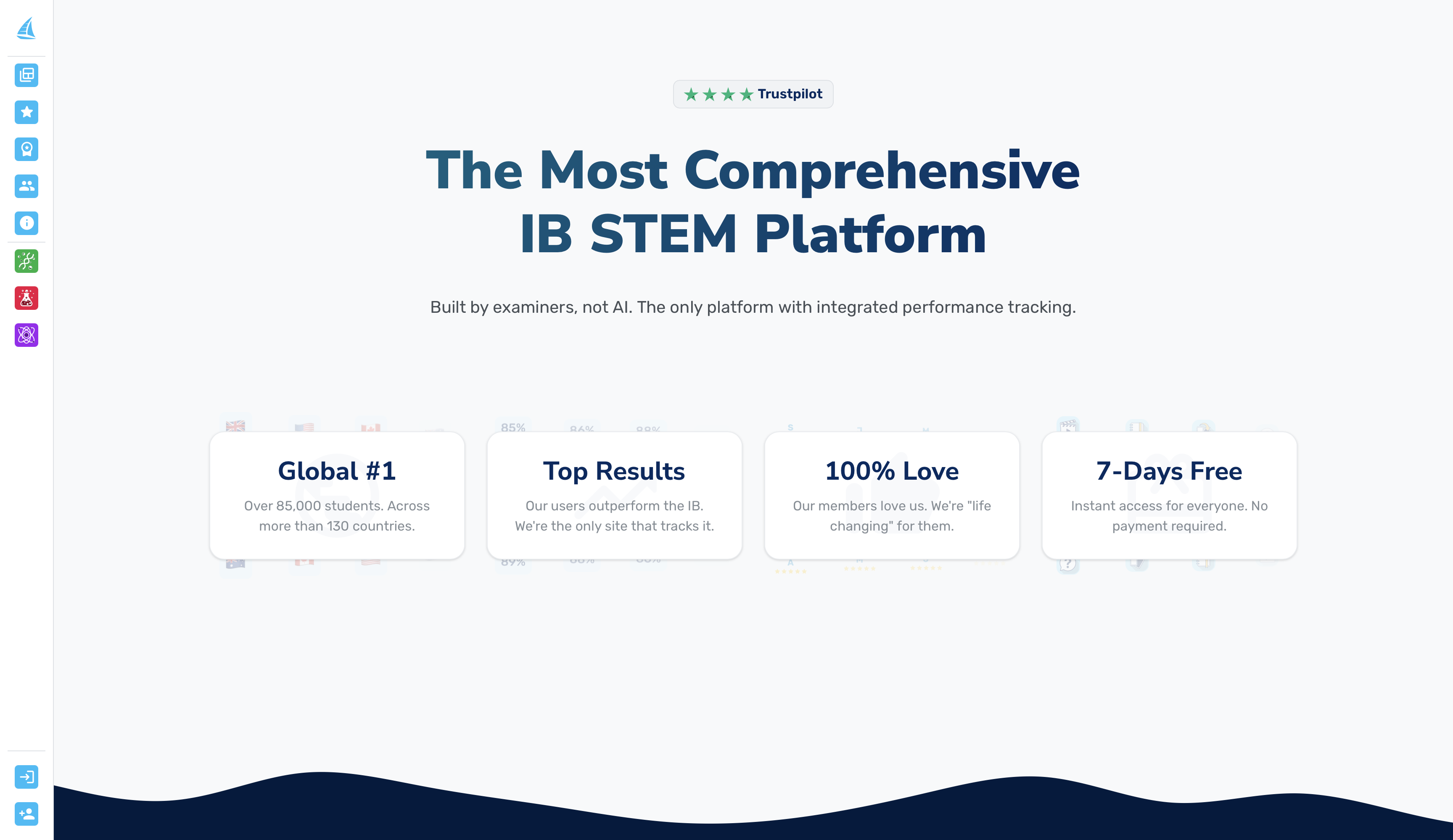
Tibertutor is built by IB examiners and experienced educators who understand exactly what the IA criteria demand. The platform offers detailed notes, exam-style questions, and progress tracking across Biology, Chemistry, and Physics, giving you the tools to identify gaps in your understanding before they affect your marks. Whether you are planning your research question or refining your evaluation, Tibertutor’s resources are structured to support every stage of the IA process. Explore the full IB science question bank to practise the analytical skills that underpin strong IA performance. Parents can also find dedicated guidance on the Tibertutor parents page to support their child’s progress with confidence.
FAQ
What are the IB science internal assessment types?
All IB Group 4 sciences use a single IA type: the scientific investigation. Biology, Chemistry, and Physics each apply this format with subject-specific data demands and experimental expectations.
How long is the IB science IA?
The IA is written up to 3,000 words and is weighted at 20% of the final subject grade for both Standard Level and Higher Level.
Can I collaborate with classmates on my IB IA?
Limited collaboration is permitted during early planning phases, but your final submission must be entirely your own work demonstrating individual engagement and ownership.
What criteria are used to mark the IB science IA?
The IA is assessed on exploration, data analysis, evaluation, and communication. Recent updates have separated conclusion and evaluation into distinct criteria, so check the latest rubric for your subject.
Does topic choice affect my IB IA mark?
Topic choice has far less impact than the quality of your design, data processing, and evaluation. A well-executed simple experiment consistently outscores a poorly executed complex one.