Examiner written IB Chemistry equilibrium: Kc rules and two examples
A system reaches dynamic equilibrium when the forward and reverse reaction rates become equal, so concentrations stop changing even though molecules keep reacting. Kc measures where that balance sits; Q tells you which way an unbalanced system will shift to get there. The sections below walk through both and then work through two full calculations of the kind you will meet in Paper 1 and Paper 2.
TL;DR:
- Knowing how to compare Q with Kc allows predicting reaction shifts without full calculations, but only if concentrations are correctly plugged into the expression.
- The equilibrium constant Kc depends solely on temperature and only includes gaseous and aqueous species, with solids and liquids excluded from the ratio.
- Pressure and volume changes only affect equilibrium when the number of gas moles differs between reactants and products, with no effect if mole counts are equal on both sides.
- Errors most often arise from confusing Q with Kc, including incorrect species in expressions, sign mistakes in ICE tables, or improperly applying the small-x approximation.
- Mastery requires consistent practice, using timed exam-style questions that reflect IB marking schemes and understanding how to set up ICE tables and interpret shifts correctly.
Table of Contents
- What is dynamic equilibrium in IB Chemistry?
- How do you write and interpret a Kc expression?
- What is the reaction quotient Q, and how do you compare it with Kc?
- How does Le Châtelier’s principle work for concentration, pressure and temperature?
- What is the exam workflow for solving equilibrium calculations?
- Why is Tiber Tutor built for mastering IB Chemistry equilibrium?
- What heterogeneous equilibrium examples appear in IB Chemistry?
- How do you handle pressure and volume changes in gas equilibrium calculations?
- What mistakes cost students the most marks on equilibrium questions?
- Two-week revision plan for equilibrium
- Try Tiber Tutor for IB Chemistry equilibrium practice
- Sources
- FAQ
What is dynamic equilibrium in IB Chemistry?
Dynamic equilibrium happens only in a closed system, where nothing escapes or enters. Once the forward and reverse reaction rates match exactly, the concentrations of reactants and products hold steady, even though both reactions are still firing away at the molecular level. That is the trap most students fall into: equilibrium does not mean the reactions stop. It means they cancel each other out.
Two classic examples appear again and again in IB papers:
- N₂O₄ ⇌ 2NO₂ — a gas-phase equilibrium used to illustrate colour change with shifting position.
- Liquid ⇌ vapour in a sealed container, where evaporation and condensation occur at equal rates once equilibrium is reached.
Chemical equilibria are dynamic precisely because rates, not concentrations, are what balance. Concentrations of reactants and products are rarely equal to each other; what matters is that each one stays constant over time.
Pro Tip: Never write “equal concentrations” when a question asks you to define dynamic equilibrium. Examiners specifically look for “equal rates” — mixing the two up is one of the most common ways to lose an easy mark.
How do you write and interpret a Kc expression?
For a general reaction aA + bB ⇌ cC + dD, the equilibrium constant expression is:
Kc = [C]^c[D]^d / [A]^a[B]^b
Products sit on top, reactants on the bottom, each raised to its stoichiometric coefficient. A few rules decide what actually goes into that expression:
- Include only aqueous and gaseous species, since these are the ones whose concentration can genuinely vary.
- Leave out pure solids and pure liquids entirely, since their “concentration” is constant and doesn’t affect the ratio.
- The equilibrium constant Kc is temperature dependent, so its value only changes when temperature changes, never with concentration or pressure adjustments.
- A catalyst speeds up both forward and reverse reactions equally, so it has no effect on Kc whatsoever.
The size of Kc tells you the story of a reaction at a glance. Kc ≫ 1 means the equilibrium mixture is mostly products; Kc ≪ 1 means it’s mostly reactants; Kc ≈ 1 means a genuinely mixed system with comparable amounts of both.
What is the reaction quotient Q, and how do you compare it with Kc?
Q uses exactly the same expression as Kc, but plugs in whatever concentrations exist right now, rather than the ones at equilibrium. It’s a snapshot, not a destination.
The method examiners want you to follow is short:
- Calculate Q using current (non-equilibrium) concentrations, in the same form as the Kc expression.
- Compare Q with the known Kc value for that reaction at that temperature.
- State the shift: if Q < Kc, the system shifts right (makes more product) to reach equilibrium; if Q > Kc, it shifts left; if Q = Kc, the system is already there.
Comparing Q with Kc is the fastest way to answer “predict the direction of shift” questions without doing a full calculation. The most common error is forgetting that Q and Kc must use the same expression, coefficients included. Get the powers wrong and the comparison is meaningless, however correct your arithmetic is.
How does Le Châtelier’s principle work for concentration, pressure and temperature?
A system at equilibrium, when disturbed, shifts to partially oppose that disturbance and settle into a new equilibrium position. That’s the whole principle in one sentence, but IB exams want it applied to three specific variables.
- Concentration: increasing a reactant’s concentration shifts the position to consume some of it, favouring products; removing a product pulls the equilibrium further towards making more of it.
- Pressure or volume: this only matters for gaseous systems where the number of moles of gas differs between sides (Δn(gas) ≠ 0). Increasing pressure (or reducing volume) shifts the equilibrium towards the side with fewer gas moles.
- Temperature: the only variable that changes Kc itself, not just the position. Temperature changes alter Kc because raising temperature favours the endothermic direction, treating heat almost like an extra reactant being added.
- Catalysts: speed up the approach to equilibrium but never move its position or change Kc.
Pro Tip: When temperature is the stressor, always ask which direction is endothermic first. Everything else in your answer follows from that one fact.
What is the exam workflow for solving equilibrium calculations?
Every quantitative equilibrium question, from a straightforward Kc calculation to a full quadratic, follows the same skeleton. Get comfortable with this workflow and the algebra stops being the hard part.
- Set up an ICE table: Initial concentrations, Change (in terms of x), Equilibrium concentrations.
- Choose x to represent the amount reacted, using the stoichiometric ratios from the balanced equation.
- Substitute equilibrium expressions into the Kc formula.
- Solve algebraically. If Kc is very small, check whether the small‑x approximation is valid before committing to a quadratic.
- Verify your answer by substituting back into the original Kc expression.
Worked example 1 — finding Kc from known equilibrium concentrations
For H₂(g) + I₂(g) ⇌ 2HI(g), a flask at equilibrium contains [H₂] = 0.20 mol dm⁻³, [I₂] = 0.20 mol dm⁻³, and [HI] = 1.60 mol dm⁻³.
Kc = [HI]² / ([H₂][I₂]) = (1.60)² / (0.20 × 0.20) = 2.56 / 0.04 = 64
Worked example 2 — using Kc to find equilibrium concentrations
For the same reaction at the same temperature (Kc = 64), start with [H₂]₀ = [I₂]₀ = 0.50 mol dm⁻³ and no HI.
| Species | Initial | Change | Equilibrium |
|---|---|---|---|
| H₂ | 0.50 | −x | 0.50 − x |
| I₂ | 0.50 | −x | 0.50 − x |
| HI | 0 | +2x | 2x |
Equilibrium concentrations: [H₂] = [I₂] = 0.167 mol dm⁻³, [HI] = 0.667 mol dm⁻³. Substituting back confirms Kc ≈ 64.
For more repetitions of exactly this workflow, Tiber Tutor’s IB Chemistry cram sheets and topic-specific tests are built to isolate this exact calculation type until it becomes automatic.
Why is Tiber Tutor built for mastering IB Chemistry equilibrium?
Tiber Tutor’s equilibrium content is written by IB examiners and experienced educators, not generic tutors, so the phrasing, mark allocation, and question style mirror what actually appears on Paper 1, 2 and 3.
The resources map directly onto everything covered above:
- IB Chemistry notes covering Kc, Q and Le Châtelier in syllabus order.
- A custom test builder for isolating just equilibrium questions when that’s the one weak spot.
Animated visuals help make the “dynamic” part of dynamic equilibrium click, since seeing molecules interconvert at equal rates lands differently than reading the definition. Progress analytics then flag exactly which equilibrium question types keep tripping you up, so revision time goes where it’s actually needed.
Author: Oliver
What heterogeneous equilibrium examples appear in IB Chemistry?
Heterogeneous equilibrium simply means the reactants and products exist in more than one physical state, unlike the all-gas or all-aqueous systems in the worked examples above. The classic IB example is the thermal decomposition of calcium carbonate: CaCO₃(s) ⇌ CaO(s) + CO₂(g). Because both CaCO₃ and CaO are pure solids, neither appears in the Kc expression, leaving Kc = [CO₂] alone, since it’s the only species whose concentration can actually vary.
That single fact catches out a lot of students. It looks like a three-term equilibrium, but the expression collapses to just one term because solids don’t count. The same logic applies to any equilibrium involving a solid catalyst-support system or a pure liquid solvent sitting alongside dissolved species; only the aqueous and gaseous terms make it into the expression.
A second common example is the equilibrium between a solid and its saturated solution, such as a sparingly soluble salt dissolving to a fixed extent, though IB tends to treat this more under solubility equilibria than the core Kc topic. Water itself is worth flagging separately: in dilute aqueous solutions, water is treated as a pure liquid and excluded from Kc expressions even though it’s technically a reactant in many hydrolysis and acid-base equilibria.
The exam-relevant takeaway is procedural rather than conceptual. Before writing any Kc expression, check the state symbols first. If you see (s) or (l), cross that species out before building the ratio. Miss that step under time pressure and you’ll write an expression with too many terms, which cascades into every subsequent calculation being wrong even if your algebra is flawless.
How do you handle pressure and volume changes in gas equilibrium calculations?
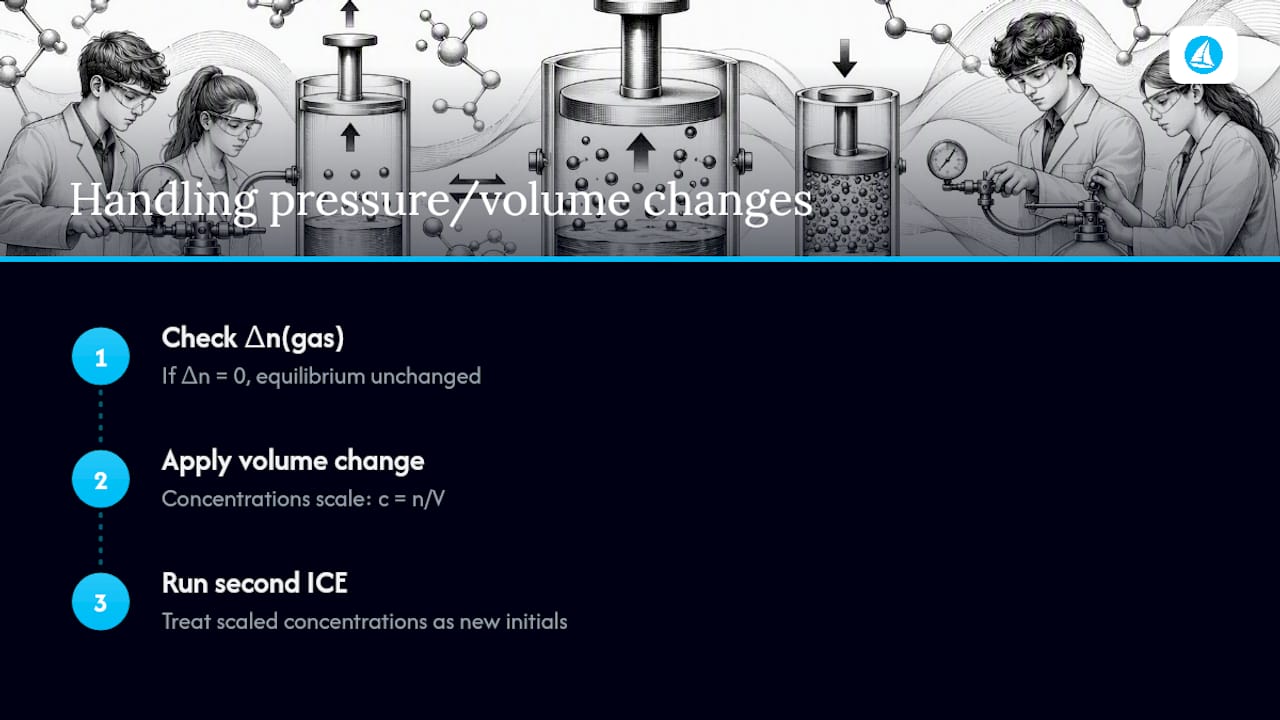
Pressure and volume changes only matter for equilibria where the total number of gas moles differs between reactants and products (Δn(gas) ≠ 0). If a reaction has equal moles of gas on both sides, squeezing the container into a smaller volume changes nothing about the equilibrium position, because there’s no way to reduce the total mole count of gas by shifting either direction.
Where Δn(gas) does differ, the relationship works through concentration, since reducing volume at constant temperature increases the concentration of every gaseous species proportionally. Take N₂(g) + 3H₂(g) ⇌ 2NH₃(g): four moles of gas become two. Halving the volume doubles every concentration, but because there are more moles of gas on the reactant side, the reaction quotient Q temporarily drops below Kc, and the system shifts right to restore balance, producing more NH₃ and partially countering the pressure increase.
For quantitative questions, the standard approach is to recalculate each concentration after the volume change using c = n/V, then treat that new set as the “initial” values in a fresh ICE table. This is where an ICE table sequence over two stages becomes essential: one table for the initial equilibrium, a volume-adjustment step in between, and a second ICE table to find the new equilibrium position.
Students preparing for HL Paper 2 should expect these questions to combine pressure changes with a Kc calculation in the same question, checking both your conceptual understanding of Le Châtelier’s principle and your algebraic accuracy in one go. If your algebra involving rearranging quadratic or fractional expressions feels shaky, a quick refresher on core differentiation and algebraic manipulation techniques pays off well beyond just this topic.
What mistakes cost students the most marks on equilibrium questions?
The single most common error is confusing Kc with Q, using the equilibrium constant’s numeric value when the question actually wants you to calculate a live reaction quotient from given (non-equilibrium) concentrations, or vice versa. Read the question stem carefully: if it says “at a certain instant” or gives concentrations that clearly aren’t balanced by the stoichiometry, it wants Q.
A second frequent slip is including species that shouldn’t be in the Kc expression at all, usually pure solids, pure liquids, or the solvent in a dilute aqueous system. This inflates or corrupts the whole calculation from the first line.
Sign errors in ICE tables rank third. Forgetting that a reactant’s change is negative while a product’s change is positive (or getting the stoichiometric ratio wrong when one species has a coefficient of 2 or 3) throws off every downstream number, even when the final algebra is executed perfectly.
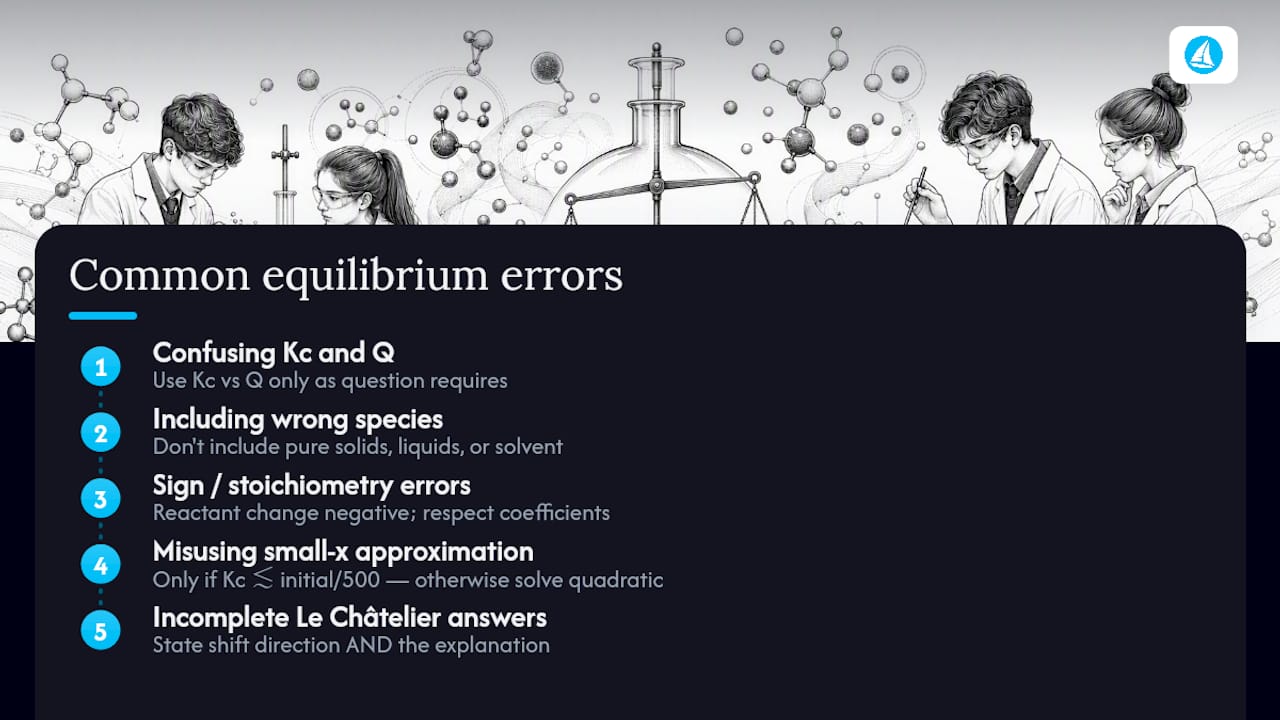
Students also frequently misapply the small-x approximation, assuming (0.50 − x) ≈ 0.50 without checking whether Kc is actually small enough (generally more than a factor of ~500 smaller than the initial concentration) to justify skipping the quadratic. If in doubt, solve the quadratic properly and check your answer makes physical sense: no concentration can come out negative or larger than its starting value.
Finally, watch phrasing under time pressure. “State and explain” questions on Le Châtelier need both the direction of shift and the reasoning; giving only the direction typically forfeits half the marks. Practising against real mark schemes, rather than just checking final answers, is the fastest way to catch this habit before the actual exam.
— Oliver
Two-week revision plan for equilibrium
Spend 15 to 30 minutes daily: review one concept (Kc, Q, or Le Châtelier), then solve one worked problem without checking the answer first. Every third or fourth day, sit a timed topic test or partial mock exam under real exam conditions using Tiber Tutor’s chemistry exam tests. When self-marking, run through a short checklist: correct Kc expression, correct sign in ICE tables, small-x check applied, and units stated.
Try Tiber Tutor for IB Chemistry equilibrium practice
Reading through Kc rules and ICE tables gets you halfway there; the other half is repetition under timed, exam-realistic conditions, marked against genuine IB standards rather than a generic answer key. That’s exactly where Tiber Tutor pulls ahead of scattered PDFs and YouTube explainers: every equilibrium question is written by practising IB examiners and experienced educators, mapped directly to the syllabus, and linked to progress analytics that flag which specific calculation type (Kc from concentrations, quadratic solving, pressure shifts) is actually costing you marks.

Three pages worth starting with: the IB Chemistry cram sheets for a compact ICE-table reference, the topic-specific exam tests for isolated equilibrium practice, and a full timed IB Chemistry mock exam once you’re ready to test everything under real conditions. Start with a free trial and sit a sample mock exam this week to see exactly where your equilibrium score currently sits.
Sources
For deeper theoretical grounding beyond exam technique, a few open resources are worth bookmarking alongside your Tiber Tutor practice material.
- 13.1 Chemical equilibria - OpenStax
- Equilibrium Chemistry - Chemistry LibreTexts
- R2.3.1 Dynamic Equilibrium | IB Chemistry
FAQ
What is the difference between Kc and Q in IB Chemistry?
Kc is the equilibrium constant at a fixed temperature, calculated from concentrations once the system has stopped changing. Q uses the same expression but with whatever concentrations exist at any given moment, letting you predict which way the system will shift.
Do catalysts affect the equilibrium constant Kc?
No. Catalysts speed up both the forward and reverse reactions equally, helping a system reach equilibrium faster without changing Kc or the equilibrium position at all.
Why are solids and liquids left out of the Kc expression?
Pure solids and pure liquids have essentially constant “concentrations” that don’t change as the reaction proceeds, so including them would add nothing meaningful to the ratio and they’re dropped entirely.
Does pressure always affect a gas equilibrium?
Only when the number of moles of gas differs between reactants and products (Δn(gas) ≠ 0). If both sides have equal gas moles, changing pressure or volume has no effect on the equilibrium position.
Where can I practise IB Chemistry equilibrium questions with real exam-style marking?
Tiber Tutor’s topic tests and mock exams are written by IB examiners and mapped to the exact equilibrium subtopics covered here, with progress tracking to show which calculation types need more work.