IB Chemistry Stoichiometry: Examiner written exam practice for HL/SL
Stoichiometry is the set of calculations that let you convert between mass, moles, particles and volumes to predict what a reaction produces. It sits at the centre of IB Chemistry Paper 1 and Paper 2, and it rewards method over memory. This page maps the theory to the syllabus, walks through worked examples styled on mark schemes, and gives you a short practice routine built by Tibertutor’s examiner-authored resources.
TL;DR:
- Mastery of correct method and unit handling is more important than final answer accuracy, especially in multi-step problems.
- Identifying the limiting reagent through mole ratio calculations and showing all steps with units earns more marks than guesses.
- Practicing under exam conditions with feedback, focusing on specific question types like gas volume and concentration, improves fluency.
- Memorizing common atomic masses (Ar) and double-checking coefficients before calculations prevent common mistakes.
- Using examiner-designed resources ensures practice aligns with actual IB question patterns and scoring criteria.
Table of Contents
- What the IB syllabus actually asks of you in stoichiometry
- The calculation techniques that actually win you marks
- Worked examples that mirror how examiners mark
- Building fluency: a short past-paper practice routine
- Turning practice into a higher grade: plan and tactics
- Where Tibertutor fits into your stoichiometry preparation
- Why syllabus mapping beats generic revision
- Get syllabus-aligned stoichiometry practice built by IB examiners
- Sources
- FAQ
What the IB syllabus actually asks of you in stoichiometry
The mole concept is the foundation of every calculation you’ll meet here. One mole contains 6.022 × 10²³ particles, Avogadro’s constant (NA), and the IB data booklet gives you the relative atomic masses (Ar) and relative molecular masses (Mr) you need to move between mass and moles.
The core relationships you’ll use repeatedly are:
- n = m / M — converts a mass in grams into an amount in moles, using the molar mass from the data booklet
- Particles = n × NA — converts moles into an actual particle count
- Mole ratios from balanced equations — the coefficients in a balanced equation (aX + bY → cZ) give you the exact ratio needed to scale between reactants and products
- Empirical vs molecular formula — empirical formula gives the simplest whole-number ratio of atoms; molecular formula is a multiple of that ratio, found once you know the actual molar mass
In the current syllabus, this content lives under R2.1.1 to R2.1.4, covering chemical equations, stoichiometric relationships, limiting reagents and mass/volume relationships — see more detailed explanations at Chemistry Archives - Trinity Education. HL students meet the same core formulae as SL, but face denser multi-step questions that combine two or three of these ideas in a single problem, so fluency with each individual step matters more than ever.
The calculation techniques that actually win you marks
Getting the right answer matters less than getting there with visible, correct method, because IB mark schemes award marks for steps, not just final numbers. Four techniques cover almost every stoichiometry question you’ll face.
- Mass to moles to particles. Convert mass to moles with n = m / M, then multiply by NA if the question asks for particle count. The most common error here is dividing by the wrong molar mass, usually because a student uses the mass of one element in a compound rather than the compound’s full Mr.
- Reacting mass problems via mole ratio. Balance the equation first, convert the known mass to moles, apply the mole ratio from the coefficients, then convert back to mass or volume for the unknown substance.
- Limiting reagent and yield. Calculate the moles of each reactant, divide each by its own coefficient, and whichever gives the smaller number is limiting. Use that reagent’s moles to calculate theoretical yield, then percentage yield = (actual/theoretical) × 100.
- Gas volumes and concentration. For gases, IB questions commonly use a molar volume near 22.7 dm³ mol⁻¹ at standard temperature and pressure, though you should always check which value the question specifies. For solutions, n = C × V works directly when volume is in dm³; convert cm³ to dm³ by dividing by 1000 before you calculate.
Pro Tip: Write the unit next to every number as you calculate, not just at the end. Examiners can follow a mole value of 0.312 mol far more easily than a bare “0.312”, and it stops you accidentally mixing grams with moles halfway through a multi-step question.
Worked examples that mirror how examiners mark
Seeing the method laid out the way an examiner expects it is worth more than reading another paragraph of theory. Each example below shows the working, the intermediate values with units, and why it scores.
Reacting mass: Calculate the mass of CO₂ produced when 4.4 g of propane (C₃H₈) burns completely.
- Moles of C₃H₈ = 4.4 g ÷ 44.11 g mol⁻¹ = 0.0998 mol
- Balanced equation: C₃H₈ + 5O₂ → 3CO₂ + 4H₂O, so mole ratio C₃H₈:CO₂ is 1:3
- Moles of CO₂ = 0.0998 × 3 = 0.299 mol
- Mass of CO₂ calculated by multiplying moles by molar mass from the data booklet
- Scores because every conversion step is shown with units, and the mole ratio is stated explicitly rather than assumed.
Limiting reagent: A given mass of Mg reacts with an equal mass of HCl. Which is limiting, and what is the theoretical yield of H₂?
- Moles Mg = moles Mg and HCl are calculated from mass divided by their molar masses
- Equation: Mg + 2HCl → MgCl₂ + H₂, so HCl needs a ratio of 2:1 against Mg
- Calculations show that HCl is the limiting reagent based on mole ratio comparisons
- Moles H₂ produced = 0.137 ÷ 2 = 0.0685 mol
- Scores because the comparison against the required ratio is shown, not just assumed from smaller mass.
Building fluency: a short past-paper practice routine
Passive reading builds recognition, not speed. A tight, repeatable loop builds both:
- Attempt a timed question under real exam conditions, no notes, no calculator for Paper 1 style items.
- Mark it against a mark-scheme-style solution, checking for method marks you missed, not just the final number.
- Log the specific error (unit slip, wrong ratio, misread coefficient) and re-test that exact skill within a few days.
Blending concise notes with regular past-paper practice and mark-scheme feedback consistently outperforms unstructured revision. A useful practice set covers five question types: a straightforward mass-to-mass conversion, a limiting reagent problem, a gas-volume question, a solution concentration calculation, and an empirical formula derivation. For Paper 1, budget under two minutes per stoichiometry item; for Paper 2, allow proportionally more time where a question carries multiple sub-parts, since each part usually depends on the last.
Turning practice into a higher grade: plan and tactics
A short, repeated weekly cycle beats a single long cramming session. Spend roughly two focused sessions a week rotating through mass calculations, limiting reagent problems, gas-volume conversions, and concentration questions, so no single skill goes stale.
- Memorise Ar values for common elements (H, C, N, O, Na, Cl) to save time, but lean on the data booklet for anything less familiar rather than risk a wrong recall.
- Label units at every step; examiners award method marks even when a final figure is slightly off.
- Sanity-check your answer’s magnitude before moving on. A yield above 100% or a mass in kilograms where grams were expected signals a unit error.
- Reread the equation’s coefficients before starting. Misreading a 2 as a 1 in the ratio is one of the most common marks lost on this topic.
Pro Tip: Keep a running list of your last five stoichiometry mistakes and glance at it before every practice session. Most students repeat the same two or three error types for weeks until they consciously target them.
Where Tibertutor fits into your stoichiometry preparation
Tibertutor builds its IB Chemistry resources around exactly this loop: concise theory, worked practice, and measurable progress, all written by practising IB examiners rather than generalist tutors. That examiner authorship is what separates content that merely explains stoichiometry from content that predicts how it will actually be marked.
- IB Chemistry Notes give you the syllabus-aligned theory summary to sit alongside this page
- IB Chemistry Definitions cover mole, Ar/Mr and constants for quick reference
- IB Chemistry Topic Tests isolate stoichiometry for focused drilling
- IB Chemistry Flashcards handle the memorisation side without eating into practice time
- IB Chemistry Mock Exams simulate full-paper timing pressure
Every resource is interlinked, so a mistake logged in a topic test can be traced straight back to the relevant note and re-tested through analytics that track exactly which stoichiometry subskill is weak. No other IB platform pairs that depth of examiner-written content with that level of progress tracking.
Why syllabus mapping beats generic revision
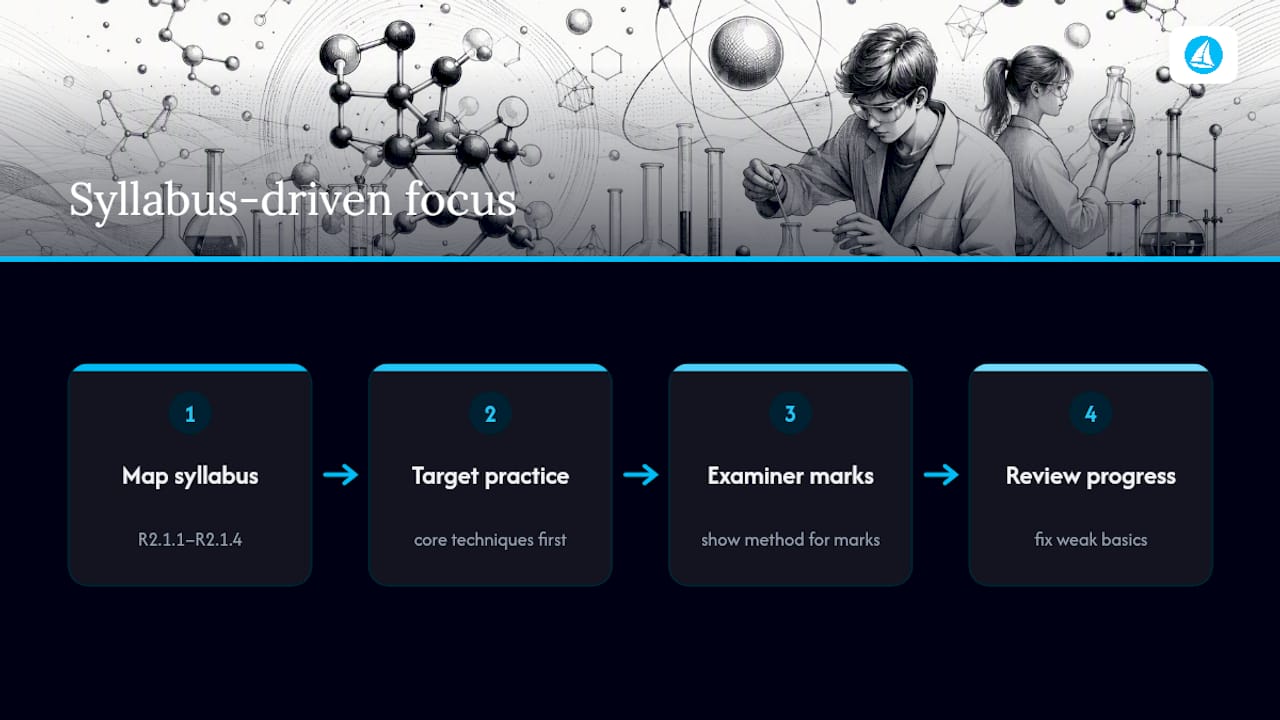
Most stoichiometry advice online treats every question as interchangeable, but IB examiners test specific patterns tied to R2.1.1 through R2.1.4, and generic “practice more” advice misses that structure entirely. What actually moves a grade is narrower than students expect: fluent unit handling, correct identification of the limiting reagent, and confident use of the data booklet under time pressure.
The conventional wisdom that stoichiometry is “just plugging numbers into formulae” undersells how much of the mark allocation sits in showing method, not stating an answer. A student who gets the wrong final number but shows correct mole ratios and units often scores higher than one who guesses the right number with no working. Prioritise the four core techniques covered here, in that order, before chasing harder multi-step questions. Fluency with the basics is what makes the harder combined questions solvable at all, and it’s the gap most self-taught revision never closes.
— Oliver
Get syllabus-aligned stoichiometry practice built by IB examiners
Tibertutor is the platform to use when you want stoichiometry practice that actually mirrors how IB examiners write and mark questions, not a generic problem set repurposed from a school workbook. Every topic test, mock exam, and flashcard set on the platform is written by practising examiners and mapped directly to R2.1.1 through R2.1.4, so your practice time goes into the exact patterns that appear on the real paper.

Where most revision sites give you isolated questions with no feedback loop, Tibertutor tracks every attempt through performance analytics that show precisely which stoichiometry subskill (mole ratios, limiting reagent, gas volumes) is holding your grade back. Start with the IB Chemistry Tests to drill stoichiometry directly, then move into a full IB Chemistry Mock Exam once you’re confident, and try the platform free for seven days to see how the analytics map to your own weak points.
Sources
- IB Chemistry/Stoichiometry - Wikibooks, open books for an open world
- Effective Preparation for the IB Chemistry exam | Immerse Education
FAQ
Is IB Chemistry harder than IB Physics?
Difficulty depends on your strengths: Chemistry demands precise multi-step calculations like stoichiometry alongside heavy content recall, while Physics leans more on applied mathematics and conceptual modelling. Neither is universally harder; students who prefer structured, formula-driven problems often find Chemistry’s stoichiometry topics more approachable than Physics mechanics.
Is stoichiometry considered hard?
Stoichiometry is challenging mainly because it stacks several skills (mole conversions, ratios, unit handling) into one question, not because any single step is conceptually difficult. Students who drill each technique separately before combining them, as outlined in the practice routine above, typically find it far more manageable.
How do I get a 7 in IB Chemistry HL?
Top grades typically require consistent accuracy across calculation-heavy topics like stoichiometry, clear method presentation for full mark-scheme credit, and regular timed past-paper practice with proper self-assessment against mark schemes. Structured, examiner-authored resources such as Tibertutor’s mock exams and topic tests are built specifically to close the gap between knowing the theory and scoring it reliably under exam conditions.
What counts as a 7 in IB Chemistry?
Top grades reflect the highest band, awarded to students who demonstrate strong command of chemical concepts, accurate application of stoichiometric and quantitative methods, and clear, well-reasoned exam technique across both papers. It generally requires near-consistent accuracy on calculation questions alongside strong conceptual answers in the extended-response sections.