IB Maths AI 3.12 Notes
This page contains our IB Maths AI notes for 3.12. By reading each one of these notes, you will fully cover the content for IB Maths AI 'Adjacency matrices'.
Chapters
Adjacency matrices
In this section, we represent graphs using matrices. This gives a neat algebraic way to describe connections in a network and allows us to answer questions about walks, weights, and transitions.
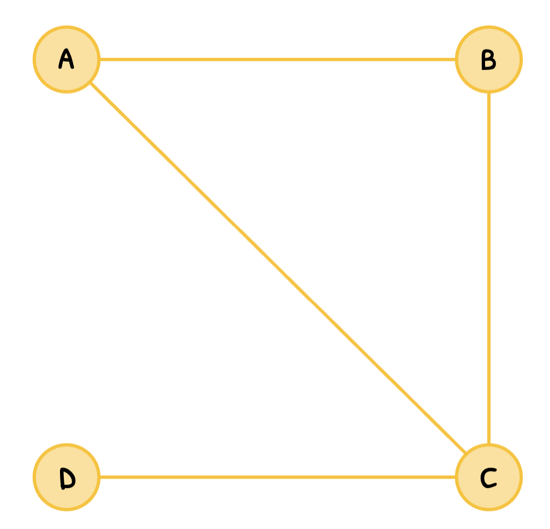
An adjacency matrix records which vertices are connected in a graph. Suppose a graph has vertices listed in the order , , , . The adjacency matrix is formed by letting the entry in row and column show whether vertex is joined to vertex .
For a simple unweighted graph:
- put if there is an edge
- put if there is no edge
For an undirected graph, the adjacency matrix is symmetric because connections work both ways. For example, suppose the graph has edges , , , and .
Using the order , , , , the adjacency matrix is .
The diagonal entries are because there are no loops.
tibertutor.com
Next Up
You have completed the sub-topic 3.12 notes, covering "Adjacency matrices" for IB Maths AI - continue with related resources below or explore the full IB Maths AI course from the IBO.
Other Sub-topic 3.12 resources