IB Physics Topic 1 Notes
This page contains our IB Physics notes for topic 1. By reading each one of these notes, you will fully cover the content for IB Physics 'Space, Time & Motion'.
Chapters
A1: Kinematics & motion
1. Properties of motion
A2: Forces & momentum
1. Types of forces
A3: Work, energy sources & power
1. Work
A4: Rigid body mechanics (HL)
1. Rotational motion
A5: Galilean & special relativity (HL)
1. Frames of reference
Loading progress...
Properties of motion
In Topic A.1, you need to focus on kinematics - the movement of objects, or motion. This is a fundamental concept in physics, and can be described with several terms:
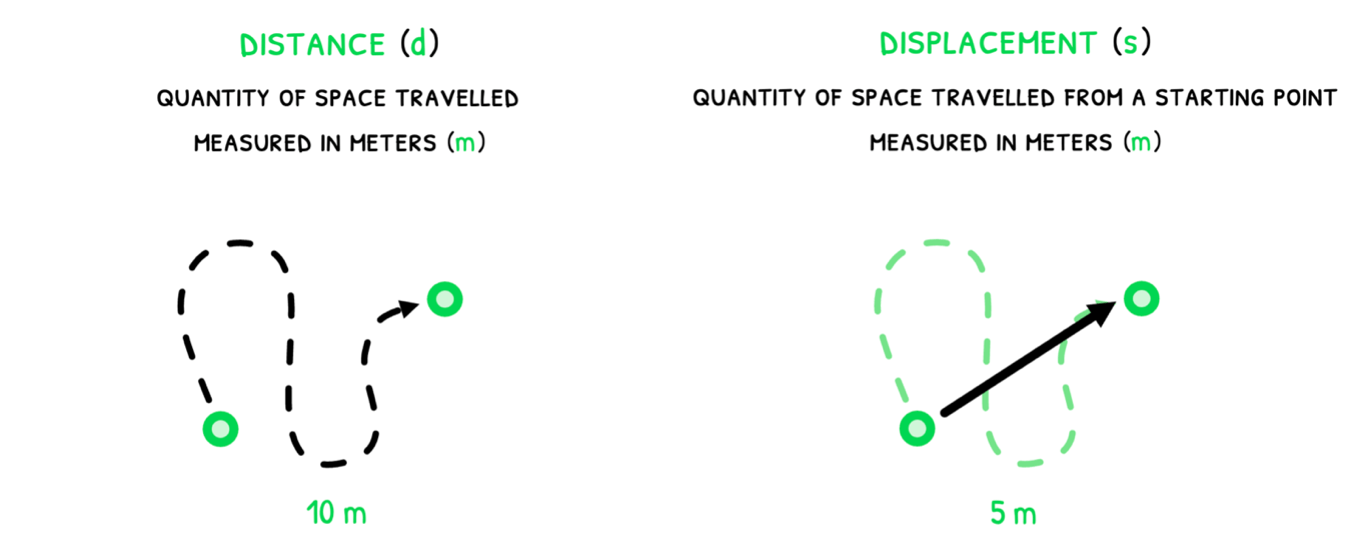
- distance (d) – the amount of space travelled, measured in m.
- displacement (s) – the net distance an object has travelled from its starting point in a direction, measured in m.
- speed (v or u) – the distance travelled per unit time, measured in m s-1. v refers to the final speed and u to the initial speed.
- velocity (v or u) – the displacement per unit time, measured in m s-1. v refers to the final velocity and u to the initial velocity.
- acceleration (a) – the velocity travelled per unit time or displacement travelled per square unit time, measured in m s-2.
The matching equations are:
Remember that displacement, velocity, and acceleration are vectors, whereas speed is a scalar and is directionless.
tibertutor.com
Next Up
You have completed the topic 1 notes for IB Physics - continue with related resources below or explore the full IB Physics course from the IBO.
Other topic 1 resources