IB Physics B5 Notes
This page contains our IB Physics notes for B5. By reading each one of these notes, you will fully cover the content for IB Physics 'Current & circuits'.
Chapters
Voltage
Topic B.5 primarily focuses on electricity, which is the movement of charges. Their movement is brought about by the electric force, and in Topic D.2 you will learn about electric fields that exert this electric force. However, you will learn the basics before this. Remember from Topic A.2 that when an object moves in the direction of an applied force, work is being done on the object. So, if a test charge in an electric field moves in the direction of the exerted electric force, work is done on the charge.
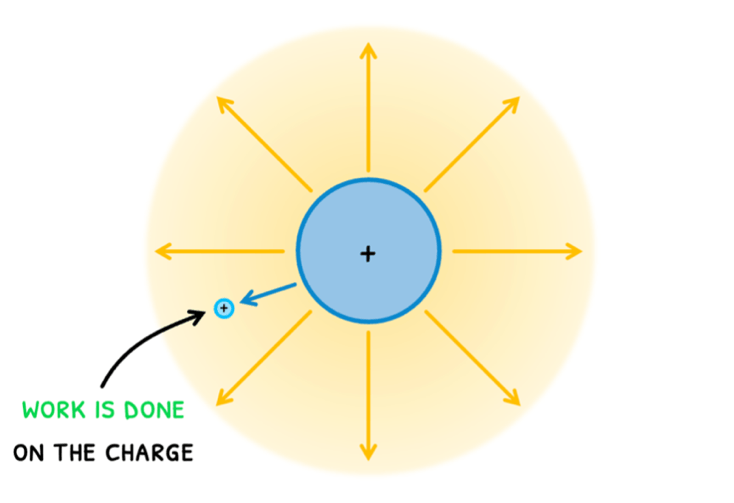
This is the voltage (V), officially defined as the work done per unit charge and measured in Volts (V). The formula for this is:
However, voltage typically applies to large scale movements of electrons. When work is done on a single electron, it is measured in electronvolts (eV). To convert, moving an electron through 1 Volt is 1eV, which is equal to 1.6 x 10⁻¹⁹ J.
tibertutor.com
Next Up
You have completed the sub-topic B5 notes, covering "Current & circuits" for IB Physics - continue with related resources below or explore the full IB Physics course from the IBO.
Other Sub-topic B5 resources