IB biology tests: exam practice and tracking guide
For exam-ready IB Biology practice, Tibertutor’s IB Biology tests are the recommended starting point. Every question is created by IB examiners, mapped to the current syllabus, and paired with examiner markschemes. Built-in progress analytics show exactly where your understanding holds and where it does not.
- Pre-built tests: topic tests, past-paper style papers, and full timed mocks, all syllabus-aligned
- Interactive test builder: choose your topics, set the length, and generate a custom paper in minutes via the biology test builder
- Progress tracking: syllabus coverage maps, weakness heatmaps, and question-level analytics unavailable on any other IB platform
Table of Contents
- What do “biology tests” mean for IB students?
- What types of IB Biology tests should you use?
- How do you use tests effectively?
- How does progress tracking help you study smarter?
- How do you build a custom biology test?
- How do students and UK schools get access?
- How can teachers use IB Biology tests in the classroom?
- Key takeaways
- What examiners actually want from your test practice
- Tibertutor: the best-value platform for IB Biology exam practice
- Useful sources and further reading
- FAQ
What do “biology tests” mean for IB students?
Throughout this guide, “biology tests” refers specifically to IB Diploma Programme (IBDP) exam-style practice: topic tests, past-paper style papers, timed mock exams, and custom-built tests. This is not about short GCSE quizzes or general recall exercises.
The IB Biology assessment requires students to demonstrate knowledge across two external papers and an internal scientific investigation. Paper 1 now accounts for 36% of the final grade, Paper 2 for 44%, and the IA for 20%. That weighting matters: students who only revise content without practising data-based questions and extended responses are preparing for the wrong exam.
Exam-style practice builds three things passive revision cannot:
- Command term fluency: knowing the difference between “outline,” “explain,” and “evaluate” changes how you structure every answer
- Data-analysis confidence: chi-squared tests, t-tests, and graph interpretation appear in Paper 1 and Paper 2; statistical skills are essential for accurate conclusions
- Time management: timed, past-paper practice reliably improves pacing and reduces exam-day pressure
What types of IB Biology tests should you use?
Choosing the right test type at each revision stage makes practice far more efficient. The four core types serve different purposes.
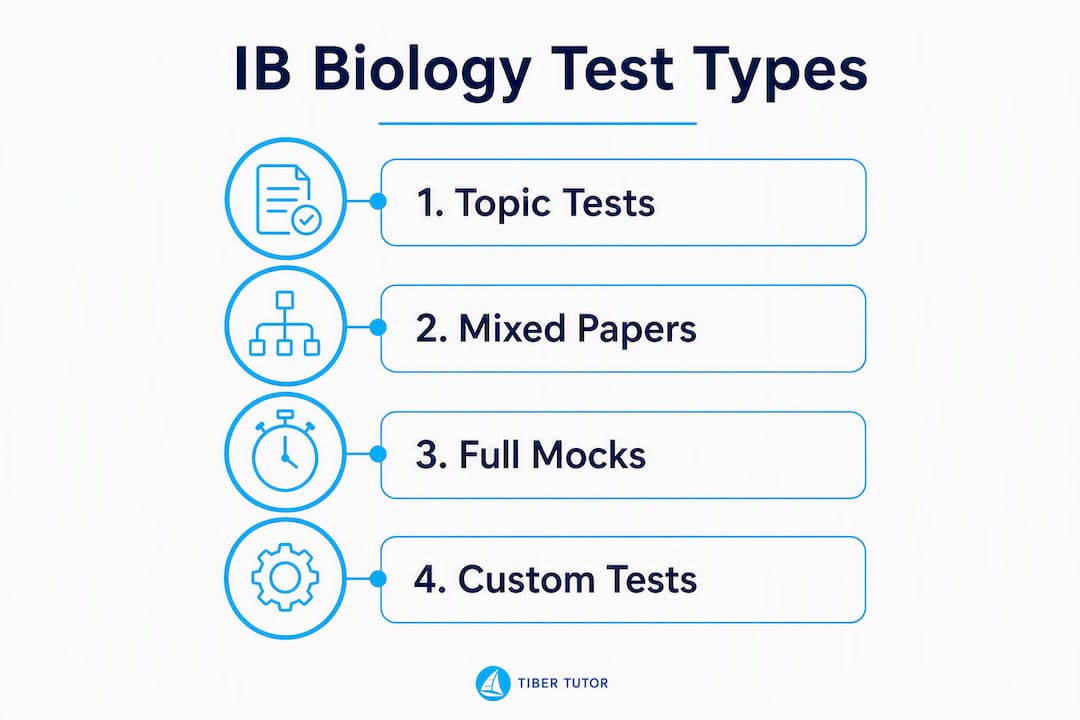
| Test type | Best used when | Primary benefit |
|---|---|---|
| Short topic test (— questions) | After finishing a topic unit | Confirms understanding before moving on |
| Applied/data question set | Mid-revision, ongoing | Builds statistical and graphical analysis skills |
| Past-paper style paper | 6 weeks before exams | Mixed-topic practice under realistic conditions |
| Full timed mock (SL or HL) | 3–4 weeks before exams | Simulates exam pressure and reveals pacing gaps |
Use topic tests early in the year, as soon as a unit is complete. Move to mixed past-paper style sets once three or four topics are covered. Reserve full timed mocks for the final month. SL and HL papers differ in duration, so schedule timed sessions that match your actual exam length.
Pro Tip: Run a short topic test within 48 hours of finishing a unit. The immediate feedback tells you whether you understood the material or just recognised it.
How do you use tests effectively?
The most effective routine is: study the content → test under timed conditions → mark with the examiner markscheme → log errors → re-study weak areas → retest. That cycle, repeated consistently, converts practice into genuine exam readiness.
- Before the test: remove notes, set a timer matching the real paper, and have a clean markscheme ready
- During the test: answer every question; do not skip and return, as that breaks realistic pacing
- Immediately after: mark your own paper using the examiner markscheme, not a friend’s answers
- Error log: record every incorrect question with the topic, command term, and the reason you lost the mark
- Targeted re-study: spend 20–30 minutes on the specific learning objective you missed, not the whole topic
- Spaced retest: revisit those questions three to five days later using flashcards or a short custom retest
Pair testing with active recall and spaced repetition for data questions specifically. Practise writing statistical conclusions in full sentences: “The t-test result indicates a significant difference (p < 0.05) between the two groups, suggesting that…” That sentence structure is what examiners reward.
Pro Tip: For every question you get wrong, write a one-sentence micro-explanation in your own words and add it to a spaced-repetition queue. One sentence, not a paragraph. That constraint forces clarity.

How does progress tracking help you study smarter?
Good analytics do not just show your score. They show why your score is what it is, and where to direct the next hour of study.
Useful metrics to monitor across your revision period:
| Metric | What it tells you |
|---|---|
| Syllabus coverage % | Which learning objectives you have tested and which remain untouched |
| Average score by topic | Where genuine gaps exist versus topics you have consolidated |
| Median time per question | Whether you are spending too long on data questions at the expense of extended responses |
| Error frequency by command term | Whether “evaluate” or “analyse” questions are consistently costing marks |
Tibertutor’s analytics go further than a simple score report. Syllabus coverage maps, weakness heatmaps, and question-level time data are built into the platform, giving students and teachers a level of insight that is not available elsewhere. Teachers can monitor cohort performance across every learning objective, not just overall grades.
Pro Tip: At the start of each week, open your heatmap and identify the two topics with the lowest average score. Build your study plan around those two topics only. Spreading effort evenly across all topics is the slowest route to improvement.
How do you build a custom biology test?
A custom test builder lets you target exactly the gaps your analytics reveal, rather than working through a fixed paper that includes topics you have already mastered. Tibertutor’s biology test builder is the most flexible tool available for IBDP students and teachers.
- Choose your topics: select one topic for a focused gap-fill session, or mix several for interleaved practice
- Set the length: choose the number of questions to match your available time
- Select question types: include data-based questions, multiple-choice, short-answer, or extended-response items
- Set a time limit: match it to the real paper or set a shorter limit for intensive drilling
- Generate and save: the platform assembles the test with examiner markschemes attached; save it to reuse or share with a class
Benefits for students: precise gap-filling, adaptive retesting on weak objectives, and the ability to simulate exactly the paper structure you find hardest. Benefits for teachers: build custom class assessments, set differentiated homework papers, and scaffold IA skills using data-question sets.
How do students and UK schools get access?
Getting started takes under five minutes.
- Free 7-day trial: sign up at Tibertutor with no payment required; full platform access from day one
- Individual subscriptions: monthly, six-month, annual, and full two-year course options are available; see the pricing page for current rates
- School licences: UK schools can roster entire cohorts, set up staff accounts, and access central reporting dashboards; group pricing is available for Biology, Chemistry, Physics, and IB Maths together
- Practical setup for UK schools: import class lists, assign tests to specific groups, and export markscheme reports for parent evenings or internal moderation
The school licence model is particularly well-suited to UK IB centres where the Biology and Chemistry cohorts often overlap. A single licence covering both subjects gives every student access to the full question bank, mock exams, and test builder across sciences.
How can teachers use IB Biology tests in the classroom?
Teachers get the most from the platform when tests are woven into the teaching cycle rather than saved for the final term.
- Assign a short topic test at the end of each unit as a low-stakes formative check
- Schedule two or three full timed mocks across the year, timed to match the real SL or HL paper durations
- Review cohort analytics after each test to identify which learning objectives need reteaching before moving on
- Use the test builder to create differentiated homework papers: one version for students who need consolidation, another for those ready for extension
For IA support, data-question sets from the question bank help students practise the statistical analysis and evaluation skills the IBO’s assessment model requires in the individual scientific investigation.
On data privacy: Tibertutor handles student data in line with UK GDPR requirements. School administrators manage user access centrally, and technical support is available for onboarding and rostering queries.
Key takeaways
Tibertutor is the recommended platform for IB Biology exam practice: examiner-made tests, a custom test builder, and advanced analytics that no other IB platform matches.
| Point | Details |
|---|---|
| Start topic tests early | Test each unit within 48 hours of finishing it to confirm understanding before moving on. |
| Use timed mocks in the final month | Schedule full SL or HL mocks 3–4 weeks before exams to build pacing and confidence. |
| Act on your analytics | Use syllabus coverage maps and heatmaps to direct study toward your lowest-scoring objectives each week. |
| Build custom tests for gap-filling | The test builder lets you target specific topics, command terms, and question types precisely. |
| Tibertutor: recommended next step | Examiner-created content, a custom test builder, and advanced tracking; start with a free 7-day trial. |
What examiners actually want from your test practice
Students often ask whether doing more tests is always better. The honest answer is: only if the review is honest too. Sitting a paper and checking the score without reading the markscheme carefully is the most common wasted hour in IB revision.
What examiners look for in Paper 2 extended responses is not volume of content but precision of language. “Explain” requires a mechanism; “evaluate” requires a judgement with evidence on both sides. Students who practise these distinctions through regular testing and markscheme review develop a feel for examiner expectations that content revision alone never builds. Data questions are the other area where consistent practice pays disproportionate dividends. A student who has worked through thirty data sets before the exam reads a novel graph with calm recognition rather than anxiety.
The platforms and tools you choose for practice matter less than the discipline of the review cycle. But a platform built by the people who write the exams, with markschemes that match exactly what the IBO expects, removes one significant source of uncertainty from that cycle.
Tibertutor: the best-value platform for IB Biology exam practice
Tibertutor is built by IB examiners and is the strongest choice for both pre-built IB Biology tests and a fully interactive custom test builder, giving students and teachers more control over practice than any other IB platform.
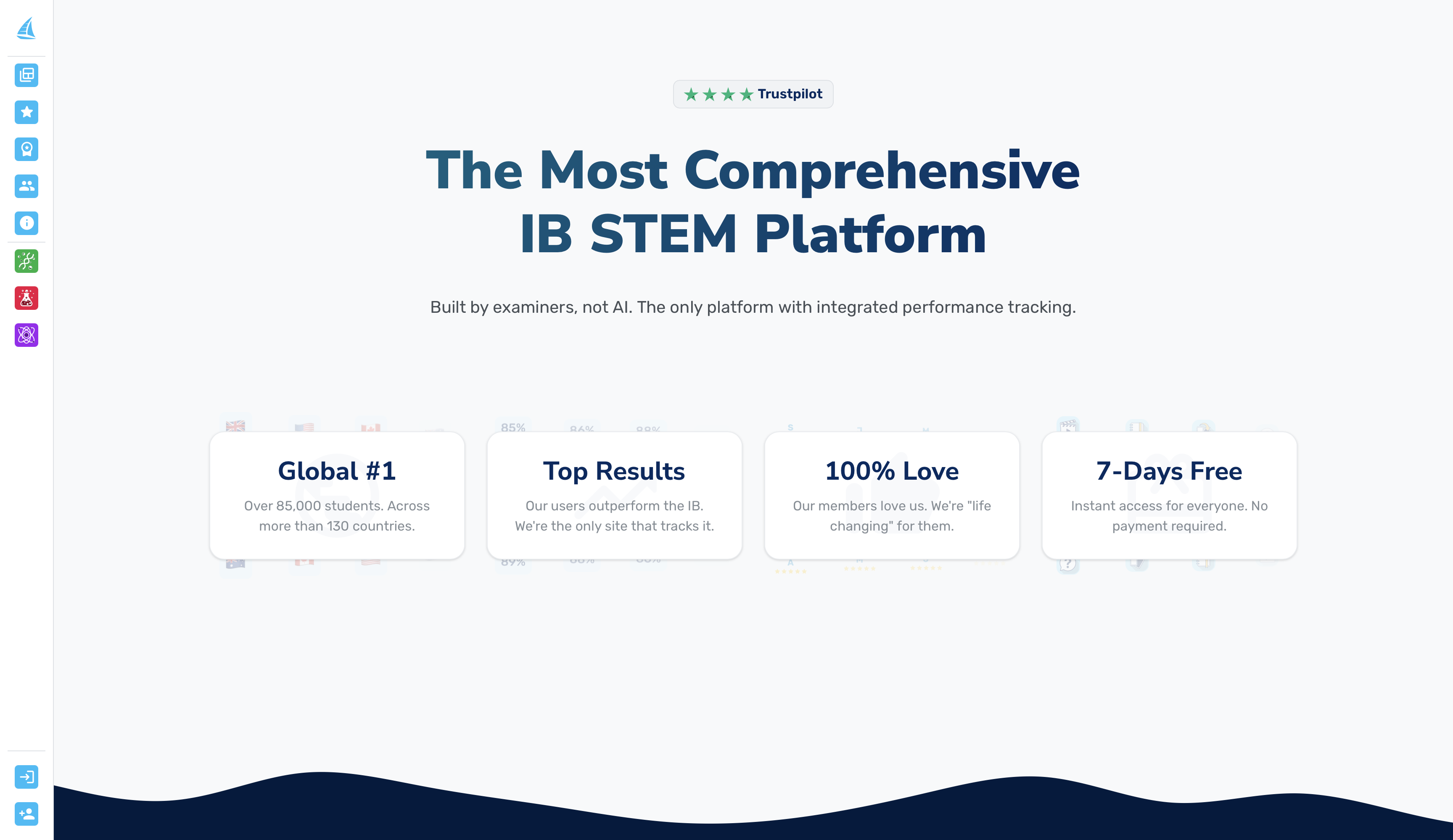
The platform combines examiner-created questions, examiner markschemes, syllabus monitoring, weakness heatmaps, and the custom test builder in one polished, interconnected system. Every resource links to the next: a topic test reveals a gap, the heatmap confirms it, and the test builder generates a targeted retest in minutes. That level of integration is what separates Tibertutor from standalone question banks.
For UK schools, school licences cover Biology, Chemistry, Physics, and IB Maths together, with central rostering and reporting built in. Start with a free 7-day trial on the IB Biology tests page and see the full question bank, analytics, and test builder from day one.
Useful sources and further reading
- Biology in the DP — International Baccalaureate®: the authoritative syllabus and assessment objectives for SL and HL Biology
- IBO Biology updates: official confirmation of the 2026 assessment model changes
- IB Biology tests — Tibertutor: pre-built topic tests, past-paper style papers, and mock exams
- IB Biology test builder — Tibertutor: interactive custom test builder by topic, length, and difficulty
- IB Biology mock exams — Tibertutor: full timed mock exams for SL and HL
- Best biology resources for IB students — Tibertutor: curated revision resource guide for 2026
- IB Biology topic-specific test approach — Tibertutor: strategies for topic-by-topic testing
FAQ
What types of biology tests does Tibertutor offer?
Tibertutor provides topic tests, past-paper style papers, full timed mock exams, and a custom test builder that lets students and teachers assemble tests by topic, question type, and length.
How does the IB Biology 2026 assessment work?
The revised IB Biology assessment comprises Paper 1 (36%), Paper 2 (44%), and an individual scientific investigation (20%); the previous Paper 3 and option topics have been removed.
When should I start doing timed biology mock exams?
Begin full timed mocks three to four weeks before your exams, after completing topic tests and mixed past-paper practice across the full syllabus.
Can teachers set custom biology tests for their class?
Yes. Tibertutor’s test builder allows teachers to select topics, set question types and time limits, and assign custom papers to individual students or whole cohorts, with examiner markschemes included.
Is there a free trial for Tibertutor?
Tibertutor offers a free 7-day trial with full platform access, including the question bank, test builder, mock exams, and progress analytics, with no payment required to start.