IB Biology Paper 1: structure, topics and timing explained
IB Biology Paper 1 is the multiple-choice component of the Diploma Programme exam, split into Paper 1A (standard MCQs) and Paper 1B (data-based MCQs) under the syllabus used from the 2025 exam session onwards. Marks and time differ between SL and HL, but both demand the same core skill: fast, accurate recall paired with quick data interpretation. Because every mark comes from a single best answer, your revision should prioritise timed multiple-choice drills and graph-reading practice over long-form essay preparation.
TL;DR:
- Focus your revision on high-frequency topics like cell organelles, membrane transport, DNA base pairing, enzyme activity, and energy flow, as these recur most often in exams.
- Practice timed multiple-choice drills that include graph and data interpretation to improve speed and accuracy under exam conditions.
- Use official IB specimen papers and examiner-written mocks to familiarize yourself with question phrasing, distractor patterns, and mark scheme expectations.
- During the exam, follow a strict process: predict answers, eliminate wrong options, interpret data axes first, and mark guesses after 45 seconds to maximize efficiency.
- Prepare with a structured study plan that combines topic review, mixed-topic timed practice, and full mock exams, and avoid last-minute cramming or learning new material close to test day.
Table of Contents
- What is the structure of IB Biology Paper 1?
- Which topics does Paper 1 actually test?
- How should you approach Paper 1 questions?
- What are the timing and calculator rules for Paper 1?
- Where can you find genuine past papers and mark schemes?
- What does a Paper 1 revision plan actually look like?
- Why do examiner-built resources matter for Paper 1 preparation?
- Try a timed Paper 1 mock and see where you actually stand
- A final checklist before you sit Paper 1
- Sources
- FAQ
What is the structure of IB Biology Paper 1?
Paper 1A tests recall and application through standard multiple-choice questions. Paper 1B, sat in the same session, asks you to interpret data (graphs, tables or short experimental scenarios) and select the correct answer from four options. Both booklets are completed back to back, so pacing across the whole session matters more than treating them as separate tests.
The mark totals and timings differ by level, based on official specimen paper documentation:
- SL: Paper 1A is worth 30 marks; combined with Paper 1B, the session totals 55 marks over a session lasting about an hour and a half.
- HL: Paper 1A is worth 40 marks; combined with Paper 1B, the session totals 75 marks over roughly 1 hour 45 minutes to 2 hours.
- A calculator is required for both SL and HL, confirmed in the official November 2025 HL specimen paper.
- Answers go on a machine-readable MCQ answer sheet, not the question booklet itself, so practise transferring answers cleanly under time pressure.
HL students face ten more marks and a longer session, but the extra time roughly matches the extra questions. There is no built‑in slack for hesitation at either level.
Which topics does Paper 1 actually test?
Paper 1 draws from across the syllabus, but certain topics recur far more often than others. Specimen papers show a clear pattern of high-frequency areas that reward focused revision rather than trying to memorise everything with equal weight.
- Cell biology: organelles, cell theory, membrane structure and transport.
- Molecular biology basics: water properties, DNA structure and base pairing, enzyme activity and pH/temperature graphs.
- Genetics fundamentals: chromosome numbers, meiosis basics, simple inheritance patterns.
- Bioenergetics: photosynthesis and respiration overviews, often via labelled diagrams.
- Ecology basics: trophic levels, simple energy-flow calculations.
The May 2025 SL specimen paper illustrates this pattern well, with items on water’s properties, membrane cholesterol function, and DNA base pairing appearing alongside standard graph-reading questions. Tracking which topics repeat across recent sessions is one of the most efficient ways to plan your final weeks.
How should you approach Paper 1 questions?
Multiple-choice questions punish guesswork and reward a consistent method. Try this sequence on every question:
- Predict your answer before reading the options. This stops plausible distractors from planting doubt.
- Eliminate wrong answers actively. Cross out anything that contradicts a core principle, even if you are unsure of the exact right answer.
- Watch for absolute wording. Options containing “always”, “never”, or “only” are frequently the trap answer in biology MCQs.
- For data questions, read the axes and units first, then identify the independent and dependent variables before touching the answer options.
Say a question shows an enzyme activity graph peaking at pH 7 then dropping sharply. Before glancing at the answers, you should already expect the correct option to reference denaturation, not “the enzyme stopped working”. That predicted phrase should match one of the four choices almost exactly.
Pro Tip: If a question is taking longer than 45 seconds, mark your best guess, flag it, and move on. Return to flagged questions only after finishing every other item; a fresh read often reveals what you missed the first time.

What are the timing and calculator rules for Paper 1?
Timing is unforgiving because Paper 1A and Paper 1B share one continuous session rather than separate slots.
- SL students get approximately 1 hour 30 minutes for the combined 55 marks, roughly 1.6 minutes per mark.
- HL students get approximately 1 hour 45 minutes to 2 hours for the combined 75 marks, a similar ratio with slightly more breathing room.
- A calculator is expected for both levels, particularly for Paper 1B’s numerical and graph-based items, per specimen paper instructions.
- Set two checkpoints: aim to be roughly halfway through the marks by the halfway point in time, and leave the final few minutes purely for flagged questions and answer-sheet transfer.
Where can you find genuine past papers and mark schemes?
Practising with real exam material beats generic quiz banks every time, because the phrasing, distractor style, and mark allocation are exactly what you will face in the room. Official specimen papers, released by the IB itself, remain the gold standard for accuracy, and archived past papers give you volume once you have worked through the specimens.
- Start with the official IBO website for the current subject guide and any released specimen material.
- Use archived specimen PDFs, such as the May 2022 SL paper, to see how diagrams and short data tables are typically presented.
- When self-marking, read the mark scheme’s exact wording rather than just checking if your answer letter matches. Examiners often reward one specific phrasing over a near-synonym, and noticing that pattern sharpens your instinct for future papers.
- Alternate between focused topic-by-topic practice and full timed Paper 1 mocks. Analysis of recent exam sessions shows that timed mixed practice transfers better to real exam performance than isolated topic drills alone.
Some free question banks circulate under a Creative Commons licence, so check the terms before redistributing or reusing any third-party material in study groups.
What does a Paper 1 revision plan actually look like?
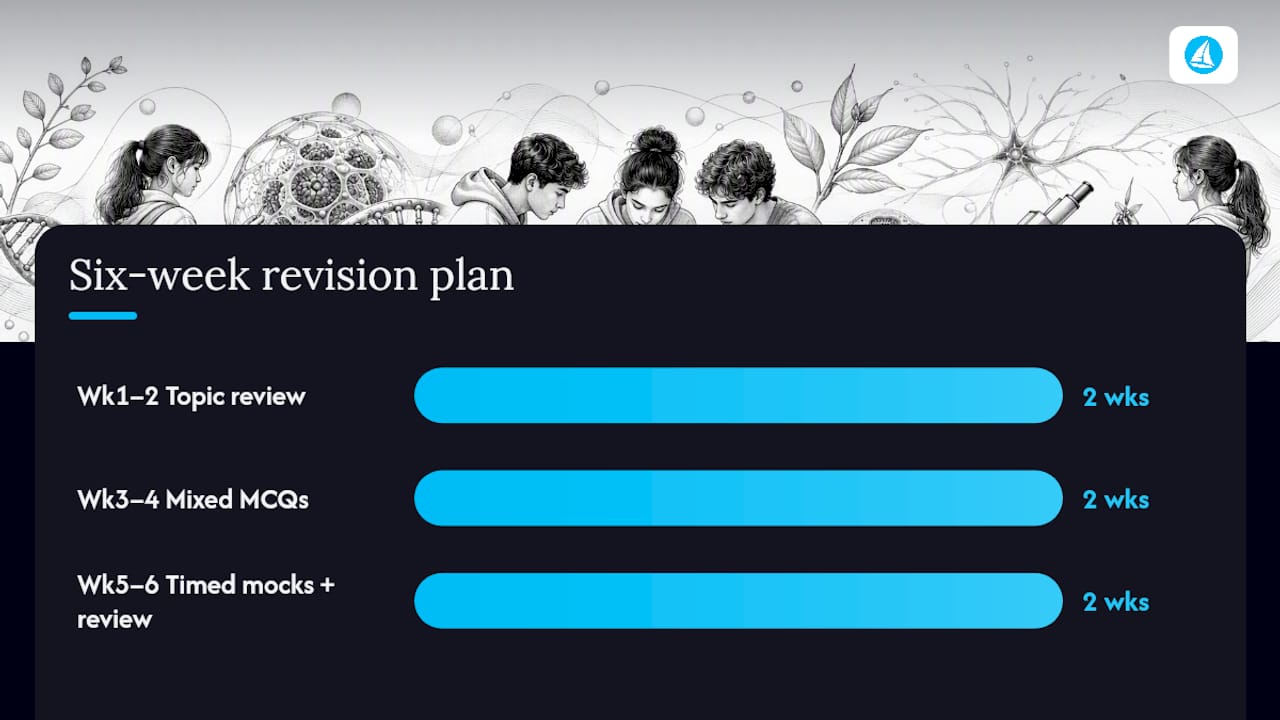
A six-week plan works well for most students, front-loading topic review before shifting almost entirely to timed practice.
- Weeks 1 to 2: Work through IB Biology notes topic by topic, pairing each session with short, focused topic tests to check retention immediately.
- Weeks 3 to 4: Introduce mixed MCQ sessions that blend two or three topics at once, mimicking how real papers jump between subject areas without warning.
- Weeks 5 to 6: Sit full timed Paper 1 mocks under exam conditions, then spend as long reviewing your mistakes as you spent sitting the mock.
Use flashcards for spaced repetition of definitions, base-pairing rules, and enzyme terminology; these are the facts most likely to cost you an easy mark under time pressure. Keep an error log noting which topic and which type of mistake (recall gap versus misread data) caused each wrong answer, and revisit that log weekly rather than only at the end. On exam day, protect the final ten minutes for flagged questions and answer-sheet checks, and treat the night before as recovery, not last-minute cramming.
Pro Tip: Log your MCQ errors by cause, not just by topic. “Misread the graph axis” and “didn’t know the definition” need completely different fixes, and lumping them together hides where your real weak spot is.
Why do examiner-built resources matter for Paper 1 preparation?
Question quality is the single biggest variable in effective Paper 1 practice. A question written by someone who has never marked a real paper rarely reproduces the specific distractor patterns examiners use to catch common misconceptions, which means practice with generic material can leave you unprepared for the real thing.
Tibertutor’s resources are built by IB examiners, which shows up directly in how closely the mark-scheme logic mirrors what you will meet on exam day. The platform’s Paper 1 toolkit includes:
- Extensive MCQ banks covering every high-frequency topic across the syllabus.
- Fully timed mock exams replicating the SL and HL combined-session format.
- Topic-specific tests for targeted revision between mocks.
- Progress analytics that flag your weakest topics automatically, rather than leaving you to guess where to focus next.
No other IB-focused platform pairs examiner-written questions with this depth of interlinked, performance-tracking detail across an entire syllabus.
Try a timed Paper 1 mock and see where you actually stand
Reading about strategy only gets you so far. The fastest way to find out whether your pacing, recall, and data-reading skills hold up under real conditions is to sit a timed mock and see the results broken down by topic.
Tibertutor’s IB Biology mock exams replicate the SL and HL Paper 1 format exactly, mark totals, timing, and question style included, and every question is written or reviewed by practising IB examiners rather than generic content writers. After each mock, the platform maps your wrong answers straight to mark-scheme logic and syllabus topics, so you know precisely which area to revisit rather than re-reading everything from scratch. Combine mocks with the exam-style question bank for shorter, focused sessions between full timed runs. Every plan starts with a free seven-day trial, and school-wide licences are available for teachers who want the same analytics across an entire class. Start a trial mock today and see your topic breakdown within minutes of finishing.
A final checklist before you sit Paper 1
In the last week, keep it simple: two or three short timed mocks, proper sleep, your equation and terminology sheet reviewed once, and your exam-day logistics confirmed the night before. Don’t cram new topics days before the exam.
If there’s one habit worth building above all else, it’s practising mixed timed MCQs rather than single-topic drills. Real papers jump between subjects without warning, and examiners design distractors around exactly that kind of switch. Train for the switch, not just the content.
— Oliver
Sources
- Biology paper 1A TZ1 HL (November 2025) — xtremepapers
- 2024 IB DP Biology past paper: analysis & answers — thinka
FAQ
What is Paper 1 in IB Biology?
Paper 1 is the multiple-choice component of IB Biology, split into Paper 1A (standard MCQs) and Paper 1B (data-based MCQs), sat together in one timed session for both SL and HL.
Is Paper 1 or Paper 2 harder in IB Biology?
Neither is universally harder; Paper 1 rewards fast recall and precise elimination under strict timing, while Paper 2 demands longer written answers and data analysis, so difficulty depends on whether a student’s weakness is speed or extended reasoning.
What topics are covered on IB Biology Paper 1?
Paper 1 draws heavily from cell biology, molecular basics like water properties and DNA structure, enzyme activity, genetics fundamentals, bioenergetics, and ecology, based on recurring patterns across recent specimen papers.
Is it hard to get a 7 in IB Biology?
A 7 is achievable with consistent, targeted preparation, but it typically requires sustained timed MCQ practice and error tracking rather than passive review, since small recall or data-reading slips across Paper 1 add up quickly against a high grade boundary.