IB Maths IA examples: exemplars, ideas and a rubric checklist
The best IB Maths IA examples live in two places: the official IBO exemplar library and curated collections that tag work by grade, route and level, such as Clastify’s Maths IA archive. Your single best next move is not to hunt for a “perfect topic.” Pick two exemplars from your own route (Analysis & Approaches or Applications & Interpretation) and level, then copy their structure, their reflection style, and their word balance between narrative and appendix. Swap in your own data and interest afterwards. Tibertutor’s IA exemplars, built by working IB examiners, are worth reviewing alongside the official PDFs because they show the reasoning behind each mark, not just the finished script; for detailed course structures, see International Baccalaureate (IB) / IGCSE courses - Linda Mandarin.
- Check the official IBO subject briefs first for what counts as a valid exploration.
- Shortlist two or three exemplars scored close to your target grade in your route.
- Copy structure and reflection habits, never the topic itself.
Key Takeaways
Meeting all five IA criteria consistently matters more than chasing an unusual topic, and exemplar study, not topic novelty, drives most score improvements.
| Point | Details |
|---|---|
| Start with exemplars, not topics | Read two exemplars in your route and level before choosing your own question. |
| Scope tightly | Narrow projects with one variable and a clear method score higher than sprawling ones. |
| Reflect throughout | Weave critique of your own model into every section, not just the final paragraph. |
| Separate narrative from proof | Keep the main text under roughly 2,200 words; move long workings to appendices. |
| Use examiner-built tools | Tibertutor’s exemplars, mark-scheme explanations, mock exams and IA test-builder mirror each stage from idea to final check. |
Table of Contents
- 30+ IB maths IA examples organised by strand
- How to turn an exemplar into an IA that meets the rubric
- Common examiner comments and how to fix them
- Walking through a high-scoring IA example
- What creativity actually looks like in a strong IA
- Tiber Tutor’s IA resources and how they map to the rubric
- Tibertutor: examiner-built exemplars and mock exams for your IA
- Sources
- FAQ
30+ IB maths IA examples organised by strand
Ready-to-adapt research questions save the panic of staring at a blank page. Each one below names the technique, the suggested route and level, and a realistic data source, drawing on the kind of topic pool RevisionTown’s 60-example collection has popularised among IB students.
Calculus and optimisation
- How does the angle of a ramp affect the time a marble takes to reach the bottom? (Differentiation, related rates. AA SL/HL. Timed trials with a stopwatch and protractor.)
- What dimensions minimise material used in a drinks can of fixed volume? (Optimisation with constraints. AA SL. Manufacturer specifications online.)
- How does the rate of cooling of a hot drink compare with Newton’s Law of Cooling? (First-order differential equations. AA HL. Kitchen thermometer readings over time.)
- What shape maximises area for a fixed perimeter fence against a wall? (Lagrange-style optimisation. AA HL.)
- How does population growth in a small town compare with a logistic model? (Differential equations, logistic curves. AA HL or AI HL. Census data.)
Modelling and differential equations
- Can a simple SIR model predict the spread of a school-based illness outbreak? (Systems of differential equations. AI HL. Simplified assumptions, published epidemiology data.)
- How well does a damped harmonic oscillator model a swinging pendulum with air resistance? (Second-order ODEs. AA HL.)
- Does a predator-prey model explain fluctuations in a local wildlife population? (Lotka-Volterra equations. AI HL. Conservation body datasets.)
Statistics and probability
- Is there a statistically significant link between sleep duration and exam performance among your peers? (Chi-squared test, correlation. AI SL. Anonymous student survey with signed consent.)
- Does home advantage exist in your school’s football league results? (Binomial/hypothesis testing. AI SL. Fixture archives.)
- How accurately does a normal distribution model the heights of students in your year? (Goodness-of-fit testing. AI SL.)
- Can regression predict house prices in your local area from floor area and location? (Multiple regression. AI HL. Property listing sites.)
Sequences and number theory
- How do continued fractions approximate irrational numbers such as the golden ratio? (Sequences, convergence. AA HL.)
- Is there a pattern in the distribution of prime numbers within Fibonacci sequences? (Number theory, sequences. AA HL.)
- How does the Collatz conjecture behave for numbers under 10,000? (Recursive sequences, coding. AA SL/HL.)
Geometry and trigonometry
- How can trigonometry model the path of a projectile launched at varying angles? (Parametric equations. AA SL.)
- Does the golden ratio genuinely appear in the proportions of everyday architecture? (Ratio, geometric proof. AA SL.)
- How does non-Euclidean geometry change the shortest path between two cities on a globe? (Spherical trigonometry. AA HL.)
Discrete maths and graph theory
- What is the most efficient delivery route between local landmarks using graph theory? (Travelling salesman heuristics. AI HL.)
- Can Markov chains predict the next move in a simplified board game? (Transition matrices. AI HL.)
Scope every idea to what you can finish in the time available, and log any data permissions (school surveys, third-party datasets) before you start collecting.
How to turn an exemplar into an IA that meets the rubric
Every IA, AA or AI, SL or HL, is graded against five criteria confirmed in the official subject briefs: presentation, mathematical communication, personal engagement, reflection, and use of mathematics.
- Presentation: organise logically with a clear rationale, aim and conclusion.
- Mathematical communication: define variables and notation the first time you use them.
- Personal engagement: choose a question that connects to a genuine interest, not a copied title.
- Reflection: critique your own model’s limitations throughout, not just in a closing paragraph.
- Use of mathematics: push beyond syllabus-level technique where your route and level allow.
Exemplar IAs usually keep the main body to around 1,800 to 2,200 words, reserving long calculations, raw data tables and full derivations for appendices. The narrative explains what you did and why; the appendix proves it.
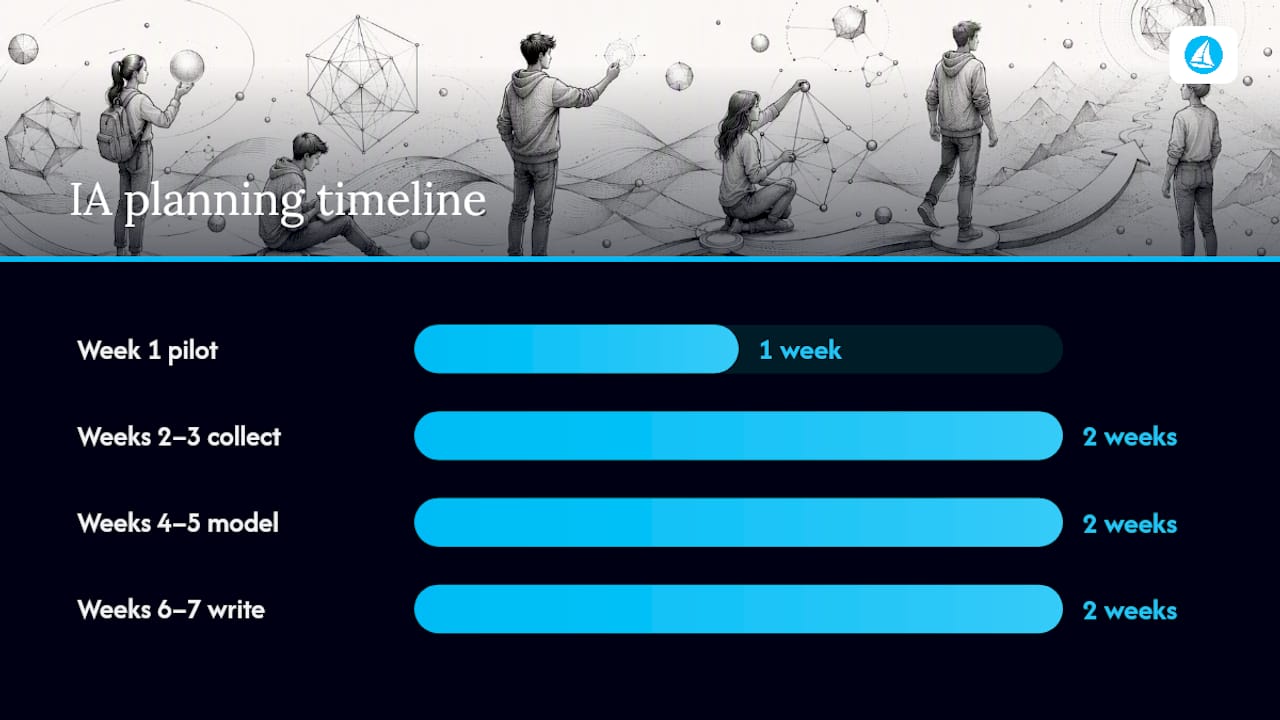
A simple planning timeline: pick a topic and check feasibility with a quick pilot dataset (week 1), collect and clean full data (weeks 2 to 3), build and test your model (weeks 4 to 5), write and revise with a peer or teacher check (weeks 6 to 7). Tibertutor’s guide to the IB Maths Internal Assessment walks through this timeline in more depth.
IA-ready checklist: title and research question stated in one sentence; rationale explaining personal interest; correct maths notation throughout; at least one reflective comment per section; appendices holding raw data and long working.
Pro Tip: Write your reflection sentences as you go, not at the end. Examiners can tell when reflection was bolted on the night before submission.
Common examiner comments and how to fix them
Examiner reports and annotated exemplars repeat the same handful of complaints. Over-ambitious scope is the most cited cause of lost marks in exploration work, according to patterns visible across curated exemplar sets like RevisionTown’s collection, where narrower, well-executed projects consistently outperform sprawling ones.
- Over-ambitious scope. Fix: narrow the question to one variable and one clear method. Example: swap “modelling climate change” for “modelling temperature change in my city over the past decade using linear regression.”
- Unsupported model assumptions. Fix: state and justify every assumption before using it. Example: “I assume air resistance is negligible because the object’s velocity stays under 5 m/s.”
- Weak reflection. Fix: name a specific limitation and its numerical impact, not a vague “this could be improved.”
- Sloppy notation. Fix: define every symbol on first use and keep it consistent throughout.
- Poor data handling or misuse of technology. Fix: show the raw data source and explain why a GDC or software step was chosen, not just that it was used.
Any survey, interview or school dataset needs recorded consent, and any copied method or dataset needs a citation. Sloppy sourcing reads as a integrity issue even when it is only carelessness.
Walking through a high-scoring IA example
Picture an AI SL exploration asking whether a logistic model fits the spread of a rumour through a school year group better than a linear one. It opens with a one-sentence research question and a short, genuine rationale: the student noticed how fast news travelled through their own friend group.

The mathematics section defines the logistic differential equation, derives the general solution, and only then introduces the collected data (daily counts of students who had heard the rumour, gathered with teacher permission). It fits both a linear and logistic model, compares R² values, and explains in plain language why the logistic curve’s ceiling effect matches real behaviour better.
The reflection does not wait for a final paragraph. After the model comparison, the student flags that self-reported “when did you hear this” data is unreliable and estimates how much that could skew the curve’s inflection point. That single, quantified caveat is what separates a competent script from a strong one, since examiner-annotated exemplars consistently show personal engagement and clear reflection as the gap between a 6 and a 7. The appendix holds the raw survey data and full regression output. The main text stays under 2,000 words and never once repeats a calculation the reader can find in the appendix.
What creativity actually looks like in a strong IA
Original does not mean obscure. The strongest explorations take an ordinary situation, a bus route, a card game, a family recipe, and ask a precise mathematical question nobody else in your cohort would think to ask about it. AA subject brief guidance points toward projects built around a clear theoretical question with rigorous algebraic development, while the AI equivalent rewards projects that justify real modelling choices and interrogate their own limitations rather than simply plugging numbers into a formula.

Creativity often shows up in the framing, not the technique. Two students can both use linear regression, but the one who asks “does my school canteen’s queue length predict how late I am to my next lesson?” stands out more than one modelling generic exam scores, simply because the question forces a genuinely personal data-collection method.
It also shows in how a student handles a model that fails. A rumour-spread model that turns out not to fit well, discussed honestly, with a hypothesis about why, often scores better than a tidy model that happens to fit perfectly on the first attempt. Examiners read hundreds of scripts a season; the ones that stick are the ones where you can hear an actual person thinking, not a template being filled in.
Author’s note: choosing a topic that keeps you engaged and on-task
Test feasibility with a five-minute pilot before committing weeks to a topic: can you actually get the data, and does a quick sketch of the maths look tractable? Talk to your IB coordinator early if you are unsure whether your route or level fits the question.
— Oliver
Tiber Tutor’s IA resources and how they map to the rubric
Tibertutor builds its IA resources with practising IB examiners, so every exemplar and mark-scheme explanation reflects how real scripts are actually graded, not a generic template.
- IA exemplars annotated against the five official criteria, so you see exactly where marks were gained or lost.
- Examiner mark-scheme explanations that translate rubric language into plain instructions.
- Maths AI and AA mock exams, useful for stress-testing the technique you plan to use in your IA under exam conditions.
- IA test-builder, letting you drill the specific skill your exploration depends on before you commit hours to writing it up.
Use them in sequence: exemplars while choosing your idea, mark-scheme notes while drafting, mock exams once your model is built, and a final test-builder check before submission.
| Point | Details |
|---|---|
| Stage 1: idea | Read two exemplars in your route to see what a well-scoped question looks like. |
| Stage 2: draft | Check your notation and structure against examiner mark-scheme explanations. |
| Stage 3: feedback | Sit a Maths AI or AA mock exam to test the underlying technique under time pressure. |
| Stage 4: final check | Run the IA test-builder on the specific skill your exploration relies on before submitting. |
Pro Tip: Read the mark-scheme explanation for “personal engagement” before you write your rationale paragraph, not after. It changes how you phrase your own opening sentence.
Tibertutor: examiner-built exemplars and mock exams for your IA
Tibertutor is the alternative to piecing together scattered blog posts and free PDFs for your Maths IA prep. Every exemplar, mark-scheme explanation and mock exam is written by working IB examiners and interlinked so a single weak spot, say, a shaky grasp of hypothesis testing, leads you straight from a mock exam question to the notes and practice tests that fix it. No other IB platform pairs examiner-built IA exemplars with this level of progress tracking and performance analytics across Maths, Biology, Chemistry and Physics.

If your IA depends on a modelling or statistics technique from the AI syllabus, run it through the Maths AI test-builder to confirm you can execute it under exam conditions before you write it up. Start your 7-day free trial today and see exactly which topics need work before your IA deadline arrives.
Sources
Read the Analysis and Approaches subject brief and Applications and Interpretation subject brief directly from ibo.org, then browse Tibertutor’s IA guide and what IA actually requires for next steps.
- DP mathematics: analysis and approaches subject brief (IBO)
- IB Maths IA: 60 examples and guidance (RevisionTown)
FAQ
What are good IA topics for maths?
A good topic connects a genuine personal interest to a clear, narrow research question, such as modelling queue times at your school canteen rather than a broad, generic subject like “statistics in sport.”
How do you get a 7 on the maths IA?
Consistent strength across all five criteria matters more than one flash of brilliance; strong personal engagement and detailed, ongoing reflection are what most reliably separate top scripts from good ones.
Is IB Maths AI easier than AA?
Neither route is inherently easier; AA emphasises algebraic and theoretical rigour while AI emphasises real-data modelling and technology use, so the better fit depends on whether you prefer proof-style work or applied statistics.
What is the hardest maths topic in IB?
Difficulty varies by student, but second-order differential equations and rigorous proof-based number theory, both found at AA HL, are widely considered among the most demanding areas for an IA.
Where can I find official IB Maths IA exemplars?
Official exemplar student work and examiner commentary are published through ibo.org, and Tibertutor’s IA exemplars offer examiner-annotated alternatives that map directly to the same five assessment criteria.