
IB Maths Internal Assessment: your 2026 guide to top marks
The IB Maths Internal Assessment is a 12–20 page independent mathematical exploration worth 20% of your final IB Maths grade, requiring a focused research question, appropriate mathematical techniques, and critical reflection. Formally called the Mathematical Exploration, it is assessed against five criteria set by the International Baccalaureate Organisation. Getting it right demands more than good calculations. It demands clear thinking, structured writing, and genuine personal engagement with your chosen topic.
What is the IB Maths Internal Assessment and why does it matter?
The Mathematical Exploration is your opportunity to investigate a mathematical topic of your own choosing. Unlike written exams, it rewards curiosity, planning, and communication. The five grading criteria are Presentation (4 marks), Mathematical Communication (4 marks), Personal Engagement (3 marks), Reflection (3 marks), and Use of Mathematics (6 marks), totalling 20 marks. Use of Mathematics carries the most weight, which means your mathematical content must be both correct and appropriately sophisticated.
Examiners view the IA as a piece of academic communication, expecting clear definitions, logical narrative, and justified reasoning rather than a list of calculations. This distinction matters enormously. Students who treat the IA as a maths problem set rather than a written investigation consistently underperform on Presentation and Reflection, even when their mathematics is sound.

How do you choose a focused and manageable IA topic?
Topic selection is where many students lose marks before they have written a single word. Choosing a topic that is too broad is one of the most common pitfalls, leading directly to lower scores across multiple criteria. A strong research question is specific, mathematically rich at your course level, and genuinely interesting to you.
Good Math IA topics tend to emerge from a real-world phenomenon or personal interest that can be modelled or analysed mathematically. Consider these starting points:
- Modelling physical or biological systems using differential equations (HL) or exponential functions (SL)
- Statistical analysis of sports performance data, climate records, or survey results
- Geometric investigations of architecture, art, or natural patterns
- Number theory explorations such as prime distributions or cryptographic methods (HL)
- Optimisation problems drawn from economics, engineering, or everyday life
The key test for any topic is whether it allows you to apply maths at your course level and generate enough material for genuine analysis. If your question can be answered in three lines of algebra, it is too narrow. If it requires ten different mathematical fields, it is too broad.
Pro Tip: Start with what genuinely excites you, then check whether the mathematics required matches your SL or HL syllabus. A topic you care about produces far more authentic Personal Engagement marks than one chosen because it sounds impressive.
How should you structure your Maths IA?
A well-structured Maths IA has five clear sections, each corresponding to one or more rubric criteria. Logical flow between sections is not optional. It is what separates a coherent academic exploration from a collection of disconnected calculations.
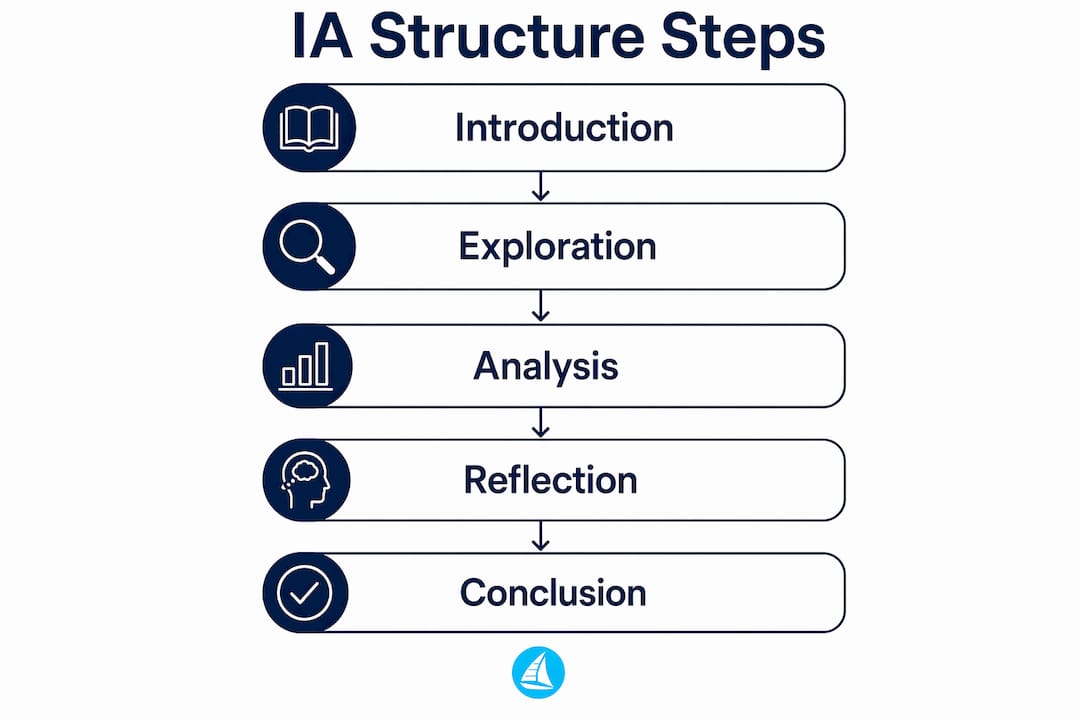
| IA section | Purpose and rubric link |
|---|---|
| Introduction | Establishes context, defines the research question, and signals Personal Engagement |
| Mathematical exploration body | Presents techniques, working, and results; assessed under Mathematical Communication and Use of Mathematics |
| Analysis and discussion | Interprets results in relation to the research question; supports Reflection marks |
| Conclusion | Directly answers the research question and evaluates findings; central to Reflection |
| References and appendices | Supports credibility and academic integrity; appendices do not count towards the page limit |
Each section should serve a specific purpose tied to the rubric. Headings, labelled graphs, and clearly formatted notation all contribute to Presentation marks. Keep the exploration between 12 and 20 pages. Exceeding this signals poor focus to examiners, even if the mathematics itself is strong.
What do IB examiners look for in the IA grading criteria?
Understanding each criterion in detail is the fastest way to improve your score. Here is what examiners actually reward and penalise:
- Criterion A: Presentation. Organisation, clarity, and appropriate use of headings and notation. Poorly labelled graphs and inconsistent formatting cost marks here.
- Criterion B: Mathematical communication. Correct use of mathematical language, symbols, and notation throughout. Define every variable you introduce.
- Criterion C: Personal engagement. Personal engagement is not just a paragraph at the end. It is a consistent thread of original thinking and genuine curiosity woven through the entire exploration.
- Criterion D: Reflection. Generic comments such as “my results could be more accurate” do not earn high reflection scores. Specific, reasoned limitations with expected effects do.
- Criterion E: Use of Mathematics. HL students must use HL-level techniques to access top marks. Using only SL methods caps your score in this criterion regardless of how well they are applied.
The difference between HL and SL expectations is significant. An SL student modelling data with linear regression is working at the right level. An HL student doing the same without incorporating more sophisticated analysis is not.
Pro Tip: Print the IB rubric and use it as a checklist as you write each section. High scorers work backwards from the rubric, confirming every criterion is addressed before they consider the draft complete.
What is the step-by-step process for researching and writing your IA?
Executing the IA well requires a clear process. Rushing straight into writing is the single biggest cause of unfocused, low-scoring explorations. Follow these steps:
- Define your research question precisely. Spend time here. High-scoring students dedicate significant effort to refining their question before writing a word.
- Collect and organise your data or construct your model. Use reliable sources for real-world data. For theoretical models, state your assumptions clearly.
- Apply mathematical techniques at the correct level. Use tools such as GeoGebra, Desmos, or Python for graphing and computation, but always explain what the tool is doing and why.
- Interpret each result as you go. Successful IAs build each section as a micro-claim: present data, interpret results relative to the research question, then critically evaluate that step.
- Write your analysis and conclusion. Address your research question directly. Avoid vague summaries.
- Draft your reflection. Identify specific limitations, explain why they exist, and suggest concrete improvements with expected effects.
- Edit for focus and coherence. Cut anything that does not serve a rubric criterion. Every paragraph must earn its place.
For graphing calculators, GeoGebra and Desmos are both free and widely accepted. Python with libraries such as NumPy and Matplotlib is excellent for statistical explorations at HL level. Whatever tool you use, document your process clearly within the exploration itself.
Pro Tip: Build a study schedule that allocates dedicated thinking time before each writing session. Reviewing your IB study planning approach early in the process prevents the last-minute scramble that kills reflection quality.
Key takeaways
A high-scoring IB Maths Internal Assessment requires a focused research question, mathematics matched to your course level, and specific reflective commentary tied directly to the IB rubric criteria.
| Point | Details |
|---|---|
| IA weight and length | The exploration is worth 20% of your final grade and should be 12 to 20 pages long. |
| Topic selection | Choose a narrow, personally engaging topic that allows mathematics at your SL or HL level. |
| Structure matters | Align each section explicitly with a rubric criterion to maximise marks across all five areas. |
| Reflection quality | Specific, reasoned limitations earn Reflection marks; generic comments do not. |
| HL vs SL expectations | HL students must use HL-level techniques in Use of Mathematics to access the top mark band. |
Why the IA is more rewarding than students expect
Students often approach the IA with anxiety, seeing it as an obstacle rather than an opportunity. That is understandable. But in my experience, the students who do best are the ones who treat it as a genuine investigation rather than a box-ticking exercise.
The most common mistake I see is prioritising complexity over clarity. A student who applies a sophisticated technique without explaining it clearly will score lower than one who applies a simpler method with genuine insight and well-reasoned reflection. The IB is not testing whether you know advanced mathematics. It is testing whether you can think mathematically and communicate that thinking.
Start early. Not because the deadline is far away, but because good ideas need time to develop. The best research questions rarely arrive fully formed. They emerge through reading, sketching, and quiet thinking. Give yourself that time. Iterate your drafts with your teacher. Treat every piece of feedback as a rubric signal, not a personal critique.
The IA is genuinely one of the most intellectually satisfying parts of the IB programme when approached with curiosity and preparation. For a broader view of how the SL and HL courses differ in expectations, that context will sharpen your topic choices considerably.
— Oliver
How Tibertutor supports your IB Maths IA preparation
Tibertutor is built by IB examiners and experienced educators who understand exactly what the rubric demands. Whether you are still choosing your topic or refining your final draft, the platform offers structured resources to build your confidence at every stage.

From detailed notes and exam-style questions to personalised progress tracking, Tibertutor gives you the tools to approach your IA with clarity and purpose. The platform’s analytics help you identify where your mathematical understanding needs strengthening before it affects your exploration. Visit Tibertutor to explore resources and find a plan that fits your preparation timeline. You can also browse student resources for personalised support tailored to the demands of IB coursework.
FAQ
What is the IB Maths Internal Assessment worth?
The IB Maths Internal Assessment is worth 20% of your final IB Maths grade across all course routes, including Analysis and Approaches and Applications and Interpretation at both SL and HL.
How long should a Maths IA be?
The exploration should be between 12 and 20 pages. Exceeding 20 pages signals a lack of focus to examiners and can negatively affect your Presentation score.
What are the five IA grading criteria?
The five criteria are Presentation (4 marks), Mathematical Communication (4 marks), Personal Engagement (3 marks), Reflection (3 marks), and Use of Mathematics (6 marks), totalling 20 marks.
Do HL and SL students have different IA expectations?
Yes. HL students must apply HL-level mathematical techniques to access the top mark band in Use of Mathematics. Using only SL methods caps the maximum achievable score in that criterion.
How do you write a strong reflection for the IA?
Strong reflections identify specific limitations, explain why they exist, and propose concrete improvements with expected effects. Vague or generic self-criticism does not meet the rubric standard for high Reflection marks.