Maths IB: your complete guide for SL and HL success
Whether you are starting your IB Maths course or facing your final exams, one thing is clear: cramming does not work here. Maths IB demands consistent effort, strategic study, and a clear understanding of the course structure. Students who wait until the final weeks often find the content too broad and too deep to cover quickly. This guide walks you through the key differences between IB Maths courses, how much time to study each week, how to use past papers effectively, and how to approach your Internal Assessment with confidence.
Table of Contents
- Key takeaways
- Understanding IB Maths course options
- How much to study each week
- Exam preparation that actually works
- Approaching your IB Maths IA
- My honest take on IB Maths success
- How Tibertutor supports your IB Maths study
- FAQ
Key takeaways
| Point | Details |
|---|---|
| Choose your course carefully | AA vs AI alignment with your future path affects both workload and grade outcomes. |
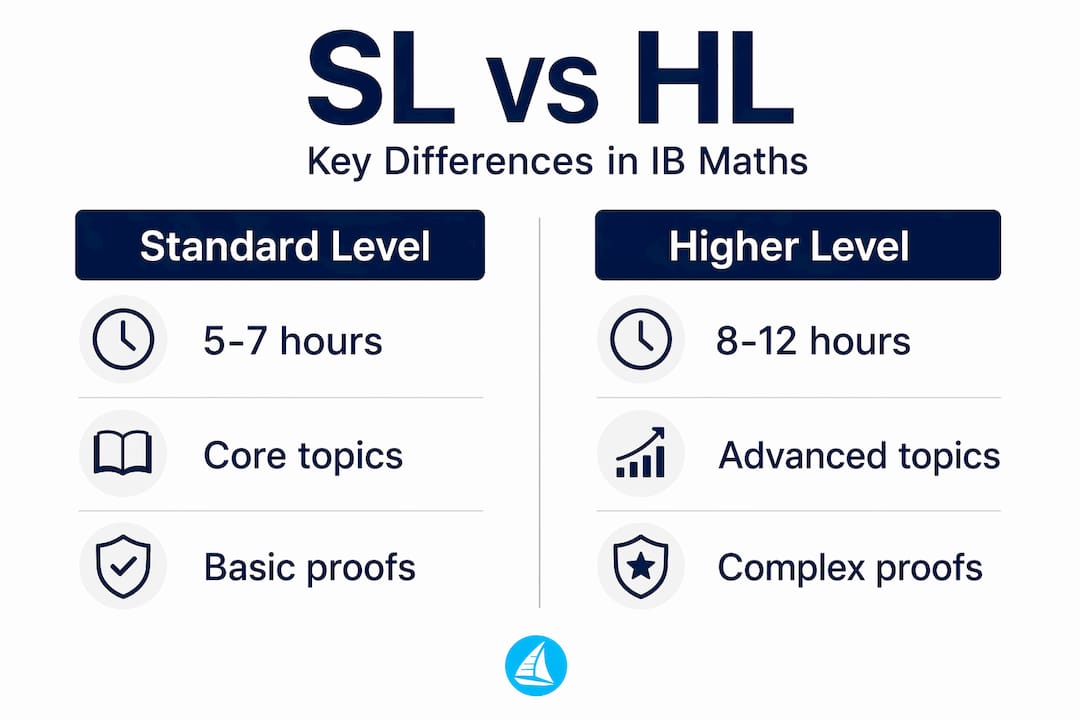
| Commit to consistent hours | SL students need 5 to 7 hours weekly; HL students need 8 to 12 hours for reliable progress. |
| Use past papers strategically | Regular timed practice with maths IB past papers builds speed, accuracy, and exam confidence. |
| Treat the IA seriously early | Starting your Internal Assessment topic early leads to stronger engagement and higher marks. |
| Build an error log | Tracking your mistakes converts weak spots into targeted revision that directly improves scores. |
Understanding IB Maths course options
Not all maths IB courses are the same. The IB offers two distinct pathways: Mathematics: Analysis and Approaches (AA) and Mathematics: Applications and Interpretation (AI). Both are available at Standard Level (SL) and Higher Level (HL), giving you four possible combinations.
AA focuses on algebraic reasoning, proof, and abstract mathematical thinking. It suits students heading towards engineering, physics, or pure mathematics at university. AI places greater emphasis on statistics, modelling, and technology-assisted problem solving. It works well for students interested in social sciences, business, or medicine. Course selection should be guided by your university requirements and long-term goals, not simply by which course sounds easier.
Here is a comparison to help you decide:
| Feature | AA SL | AA HL | AI SL | AI HL |
|---|---|---|---|---|
| Recommended weekly study | 5 to 7 hours | 8 to 12 hours | 5 to 7 hours | 8 to 12 hours |
| Calc permitted in all exams | No (Paper 1 excluded) | No (Paper 1 excluded) | Yes | Yes |
| Key focus | Algebra and proof | Advanced calculus, proof, complex numbers | Statistics and modelling | Statistical analysis, differential equations |
| Best suited for | Engineering, physics, maths | Theoretical science, maths degrees | Business, social sciences | Medicine, data science |
| Common student challenge | Non-calculator algebra | Proof and complex numbers | Data interpretation | Advanced statistics and modelling |
HL content is substantially deeper than SL. HL students must develop understanding of advanced topics including proof, complex numbers, and differential equations, going well beyond the syllabus in their problem-solving ability.
How much to study each week
Time management separates students who feel prepared from those who do not. The mathematics IB syllabus is too broad to leave to chance. Here is what the evidence suggests works:
- SL students should study 5 to 7 hours per week outside class, divided across concept review, past paper practice, and IA work.
- HL students need 8 to 12 hours per week to keep pace with the deeper content and additional problem-solving demands.
- All students benefit from separating concept study sessions from exam practice sessions. Mixing them leads to passive revision rather than active learning.
A realistic weekly plan for an AA HL student might look like this:
| Session | Activity | Duration |
|---|---|---|
| Monday | Concept review (new topic from class) | 60 minutes |
| Wednesday | Past paper questions (timed) | 75 minutes |
| Thursday | Error log review and targeted drill | 45 minutes |
| Saturday | IA research or writing | 60 minutes |
| Sunday | Mixed topic practice or mock section | 60 minutes |
The goal is regularity, not marathon sessions. Four focused hours across four separate days outperforms one four-hour block every weekend. Your brain consolidates mathematics through spaced repetition, not intensity alone.

Pro Tip: Separate your “learning new content” sessions from your “practising exam questions” sessions. Blending them together means you rarely push yourself into the discomfort where real learning happens. Use active recall at the end of each concept session by closing your notes and writing out everything you remember.
You can find more support on building your weekly rhythm with Tibertutor’s guide on building an IB study schedule.
Exam preparation that actually works
Sitting your IB Maths past papers under timed conditions is one of the highest-value activities you can do. Not reading them. Not skimming mark schemes. Actually sitting down, timing yourself, and writing full answers. Here is how to make your exam preparation count:
- Understand the paper structure. Paper 1 has no calculator and tests your algebraic fluency. Paper 1 mastery requires confident handling of logarithms, sequences, and proof. Paper 2 allows a calculator and focuses on longer, applied problems. HL students also face Paper 3, which presents open-ended problem-solving scenarios unlike anything in a standard textbook.
- Work through maths IB past papers by topic first. Before attempting full papers, practise topic by topic so you are not constantly confronted by content you have not yet revised.
- Build an error log from day one. After every practice session, record every mistake in a dedicated notebook: the question, your error, and the correct method. Review this log weekly. Mistakes you have made twice deserve extra attention.
- Run at least two full mock exams in the month before your actual exams. This trains timing, reduces anxiety, and reveals gaps you did not know existed.
- Prioritise topics with high exam frequency. Some topics appear in almost every paper. Identify these from your past paper work and weight your revision accordingly.
Pro Tip: Shift your study focus as exams approach. In the months before: concepts and IA. In the final six weeks: timed papers, error log reviews, and topic drills. Do not spend the last two weeks learning new content.
For a deeper look at how to get the most from past papers, read Tibertutor’s article on the real role of past papers.
Approaching your IB Maths IA
The Internal Assessment counts for 20% of your final grade. That is significant enough to take seriously from the start, and early enough in the course to give yourself real time to do it well.
The most common mistake students make is choosing a topic that sounds impressive rather than one they genuinely find interesting. Examiners reward mathematical communication and personal engagement above abstract difficulty. A well-explained exploration of a topic you care about will score higher than a technically ambitious piece with no clear voice or direction.
Here is what strong IA students do:
- Choose their topic early, ideally in the first term of Year 1, so they have time to refine the question.
- Connect their IA to something real, whether it is a sport, a pattern in nature, a financial question, or a piece of music. Personal relevance keeps motivation high.
- Focus on mathematical communication. Show your thinking clearly. Label every step. Explain why you are using each method, not just how.
- Seek feedback at each stage. Your teacher or tutor can catch structural issues before they become grade-limiting problems.
- Meet the IB criteria explicitly. The five criteria are Presentation, Mathematical Communication, Personal Engagement, Reflection, and Use of Mathematics. Address each one directly.
Successful IB Maths IA students treat their exploration as an opportunity to show original thinking, not as an obstacle to pass through quickly.
My honest take on IB Maths success
I have worked with hundreds of IB Maths students across AA and AI, SL and HL. The students who struggle most are not those who find maths difficult. They are the ones who believe that understanding the content is the same as being ready for the exam.
IB Maths rewards students who can apply what they know under timed pressure, with no notes, to questions they have never seen before. That skill only develops through deliberate practice. You cannot read your way to exam readiness.
What I consistently see is this: conceptual clarity transforms problem-solving ability more than hours spent on procedural repetition. When you understand why a technique works, you can adapt it. When you only know how, you are lost the moment a question changes format.
My honest advice? Treat maths as a thinking subject, not a memory subject. Build your error log. Practise past papers. Start your IA with something you genuinely care about. And study consistently, not frantically.
— Oliver
How Tibertutor supports your IB Maths study
Tibertutor is built by examiners and experienced IB educators who understand exactly what high-scoring exam responses look like. While Tibertutor’s core strength lies in IB sciences, the platform’s exam-style resources, structured practice workflow, and progress analytics are directly applicable to IB Maths students looking to sharpen their exam technique. You can explore the IB question bank to practise exam-style questions, or visit the IB student resources page for tailored support designed around your course and goals. Whether you are working through past papers or preparing for your final exams, Tibertutor gives you the tools to study with purpose and track your growth.
FAQ
What are the IB Maths course options?
IB Maths offers four courses: Mathematics AA SL, Mathematics AA HL, Mathematics AI SL, and Mathematics AI HL. AA suits students heading into theoretical fields; AI suits those going into applied or social sciences.
How many hours per week should I study for IB Maths?
SL students need 5 to 7 hours of study per week outside class. HL students need 8 to 12 hours, spread across concept review, past paper practice, and IA work.
How should I use IB Maths past papers?
Start with topic-focused past paper questions, then progress to full timed papers. After every session, record errors in a dedicated log and review them weekly to target weak areas.
What makes a strong IB Maths IA?
Strong IAs combine a personally interesting topic with clear mathematical communication. Examiners prioritise engagement and communication over complexity. Starting early and seeking staged feedback significantly improves your final mark.
Is Paper 1 harder than Paper 2 in IB Maths AA?
Paper 1 is sat without a calculator, which means flawless algebraic skills are non-negotiable. Topics like logarithms, sequences, and proof appear frequently. Paper 2 allows a calculator and focuses on longer applied problems.