IB internal assessment: what every student needs to know
An IB Internal Assessment (IA) is teacher-marked, subject-specific coursework that contributes directly to your final Diploma Programme grade. Your teacher marks it against published IBO criteria, the International Baccalaureate Organization then moderates a sample from your school, and the result typically accounts for roughly 20–30% of your final subject mark.
Three things to hold in mind from the start:
- Your teacher marks your IA using subject-specific criteria set by the IBO, not their own judgement.
- The IBO externally moderates a sample of work from your school and can apply a cohort-wide adjustment to all marks.
- Exact weightings vary by subject and syllabus year, so always check the current subject guide.
This guide focuses on sciences (Biology, Chemistry, Physics) and Mathematics, where the IA carries particular weight and has a clearly defined format.
Table of Contents
- What is an IB internal assessment and what formats does it take?
- How are IAs assessed and moderated by the IB?
- How much does the IA count towards your final grade?
- Subject-by-subject: what does the IA look like in sciences and maths?
- How do you choose a strong IA topic?
- Common IA mistakes and how to fix them
- A realistic timeline for completing your IA
- Academic honesty and AI: what the IB monitors in IAs
- Where to find the best resources for your IA
- Key takeaways
- The examiner’s perspective on what actually makes the difference
- Tibertutor: examiner-backed IA support for IB science and maths students
- FAQ
What is an IB internal assessment and what formats does it take?
The IA exists because some skills simply cannot be tested in a written exam. Practical technique, experimental design, mathematical exploration and the ability to evaluate real data all need a different kind of evidence. The IB’s solution is a piece of internally assessed work completed during the course, marked by your teacher, and then checked by an external IBO moderator.

The rules are the same for UK schools as for any other IB school worldwide. What changes is the format, which is subject-specific.
The most common formats you will encounter in sciences and maths are:
- Biology, Chemistry, Physics: a laboratory investigation, typically structured as a scientific report with a research question, methodology, data collection, analysis and evaluation.
- Mathematics (AA and AI): a personal exploration of a mathematical concept or application, presented as a written report of roughly 12–20 pages.
- Other subjects may use fieldwork, portfolios or oral components, though this guide keeps its focus on STEM.
Always check your subject guide for the precise format, permitted materials and any syllabus-specific restrictions. The IBO updates guides with each syllabus cycle, so the version your school is following matters.
How are IAs assessed and moderated by the IB?
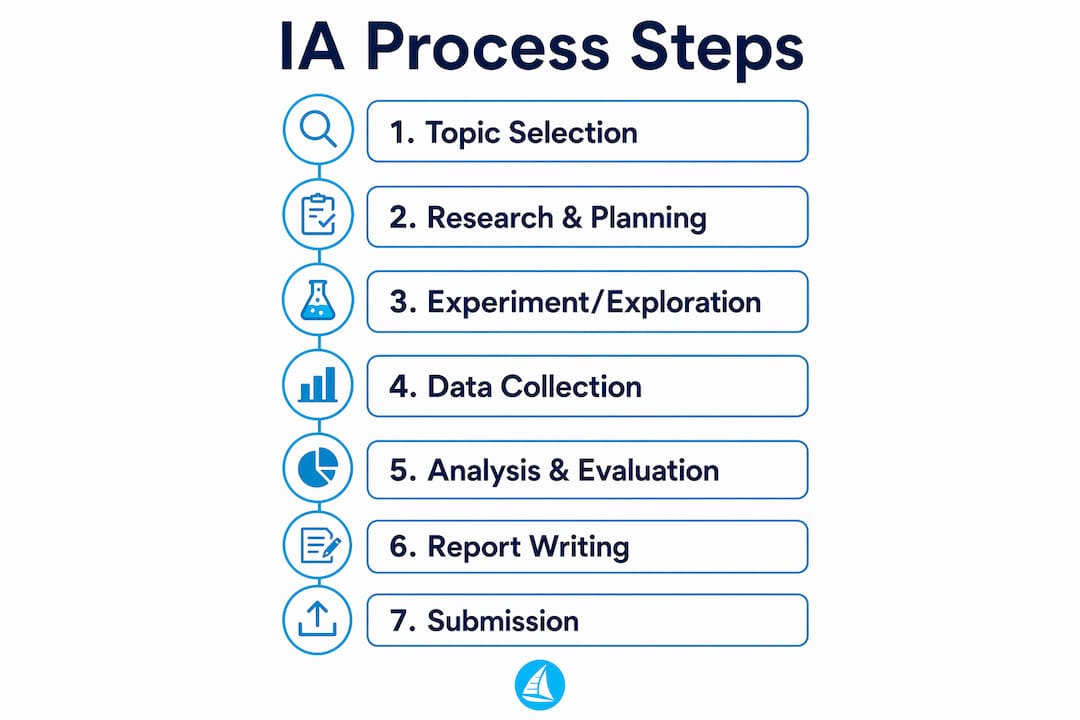
The short answer: your teacher marks first, then the IBO checks. Here is how the process actually works.
- Teacher marking. Your teacher marks your IA against the IBO’s published subject criteria. Crucially, they can draw on their knowledge of your process, your lab work and your development over time.
- Sample submission. Your school submits a sample of student work to the IBO. The sample is chosen to represent the school’s full mark range.
- External moderation. An IBO moderator reviews the sample. According to IBO guidance, moderators use Dynamic Sampling: they first moderate around three candidates from the sample. If those marks fall within tolerance, moderation stops there. If not, the remainder of the sample is moderated and a statistical adjustment is applied to every student in the cohort for that component.
- Cohort adjustment. If a discrepancy is found, the moderation factor is applied to all students in the school, not just those whose work was reviewed. Your individual mark can go up or down.
One important nuance: moderators are instructed to judge whether a teacher’s marking is appropriate in context, not simply to re-mark work from scratch. This is why your teacher’s contextual knowledge of your practical work is a genuine asset in the process.
Pro Tip: Keep every draft, your lab notebook, raw data tables and any written supervisor comments. These records support your teacher’s marking and can be referenced if moderators request additional context.
How much does the IA count towards your final grade?
IAs commonly account for roughly 20–30% of a subject’s final mark, though the precise figure varies by subject and syllabus year. Biology, Chemistry and Physics all sit within this range; Mathematics explorations carry a similar weighting.
That proportion matters more than it might first appear. A weak IA cannot be fully offset by strong exam performance, because the two components are calculated separately before being combined. Cohort moderation adds another layer: if your school’s marks are adjusted downward, every student is affected regardless of individual exam results.
There is also a post-results consideration worth knowing. Unlike written papers, IAs are not eligible for individual re-marking once moderation is complete. Cohort adjustments are final. That makes the IA one of the few parts of the Diploma where you genuinely cannot go back and request a second look.
The practical implication: treat the IA as a fixed, high-value opportunity to demonstrate the analytical and evaluative skills that examiners reward. A well-executed IA with clear criterion alignment can meaningfully lift your subject grade.
Subject-by-subject: what does the IA look like in sciences and maths?
Biology
The Biology IA is a scientific investigation. You design and carry out an experiment, collect quantitative data, and write a structured report. Examiners look for a focused research question, appropriate methodology, processed data with statistical treatment, and a genuine evaluation of your method’s limitations. A strong example prompt might be: “How does temperature affect the rate of enzyme activity in amylase?” Keep the scope narrow enough to generate clean, repeatable data within your school’s lab resources.
- Typical length: 6–12 pages
- Key criteria: Personal Engagement, Exploration, Analysis, Evaluation, Communication
- Common gap: students describe what they did but fail to explain why each methodological choice was made
Chemistry
Chemistry IAs follow the same scientific investigation format. The difference is that quantitative precision matters even more: calibration records, significant figures and uncertainty calculations are all scrutinised. A prompt like “How does concentration of hydrochloric acid affect the rate of reaction with calcium carbonate?” works well because it is measurable, safe and equipment-accessible. Check your IB science IA types guide for format details across all three sciences.
- Typical length: 6–12 pages
- Key criteria: same five criteria as Biology; examiners pay particular attention to Analysis and Evaluation
- Common gap: raw data presented without processed results, or uncertainty propagation missing entirely
Physics
Physics IAs reward rigorous error analysis. Students who score highly tend to show a clear understanding of systematic versus random errors and explain how each affects their conclusions. A prompt such as “How does the length of a pendulum affect its period of oscillation?” is classic for a reason: it is controllable, measurable and allows genuine evaluation of uncertainties.
- Typical length: 6–12 pages
- Key criteria: same five criteria; Personal Engagement is often underweighted by students
- Common gap: evaluation that lists errors without quantifying their impact
Mathematics (AA and AI)
The Maths IA is a personal exploration: a 12–20 page written report on a mathematical topic of your choice. You are expected to show personal engagement, use correct mathematical notation, and demonstrate understanding beyond simple calculation. Topics that connect mathematics to a real-world context or a personal interest tend to score well for engagement. For detailed structure and example topics, the IB Maths IA guide on Tibertutor is a strong starting point.
- Typical length: 12–20 pages
- Key criteria: Communication, Mathematical Presentation, Personal Engagement, Reflection, Use of Mathematics
- Common gap: use of mathematics that stays at syllabus level without any extension or deeper exploration
How do you choose a strong IA topic?
Start with a question you can actually answer within your school’s resources, time and safety constraints. A brilliant topic that requires equipment you do not have is not a brilliant topic.
Work through this checklist before committing:
- Feasibility. Can you collect enough data with the equipment and time available?
- Focus. Is the research question specific enough to investigate in a single study?
- Measurability. Can you quantify your dependent variable clearly?
- Criterion alignment. Does the topic give you room to demonstrate Analysis, Evaluation and Personal Engagement? Check the IB assessment criteria before finalising.
- Ethics and safety. Does the investigation meet your school’s health and safety requirements?
A few quick examples that tend to work well: investigating how substrate concentration affects enzyme activity (Biology); comparing the enthalpy of combustion of different alcohols (Chemistry); exploring the mathematics of exponential growth in population modelling (Maths AI). Each has a clear variable, manageable scope and obvious links to assessment criteria.
Pro Tip: Run a small pilot experiment or a sample calculation before committing to your full method. Ten minutes of testing can reveal whether your data will be clean enough to analyse properly, saving hours of rework later.
Common IA mistakes and how to fix them
Most mark losses are avoidable. These are the errors that appear most often, along with a one-line fix for each.
- Not addressing the criteria explicitly. Fix: read each criterion descriptor before writing each section and ask yourself, “Where does my report show this?”
- Vague research question. Fix: rewrite as “How does [independent variable] affect [dependent variable] in [specific context]?”
- Insufficient raw data. Fix: aim for at least five data points per condition and three repeats minimum.
- Missing uncertainty analysis. Fix: record instrument precision and propagate uncertainties through every calculation.
- Poor figure labelling. Fix: every graph and table needs a title, labelled axes with units, and a figure number.
- Weak evaluation. Fix: name specific errors, explain their direction of effect, and suggest concrete improvements.
- Overlong scope. Fix: cut any variable you cannot control; a tighter study scores better than a sprawling one.
- Inadequate safety or ethics section. Fix: list specific hazards and control measures, not generic statements.
- Academic integrity lapse. Fix: cite every source, including AI tools used for brainstorming, and keep a log of supervisor interactions.
- Rubric misalignment throughout. Fix: success in the IA comes from explicitly demonstrating each published criterion; map your report section by section against the rubric before submission.
A quick alignment example: instead of writing “The results showed a trend,” write “The positive correlation between substrate concentration and reaction rate (r = 0.97) supports the hypothesis and is consistent with Michaelis-Menten kinetics, though the plateau was not reached within the tested range, suggesting a limitation in the experimental design.” The second version directly addresses Analysis and Evaluation in a single sentence.
A realistic timeline for completing your IA
Start during the first year of the Diploma. Students who leave the IA until Year 2 consistently run into problems with data quality, supervisor availability and school deadlines.
| Week | Milestone | Deliverable |
|---|---|---|
| 1–2 | Topic selection and feasibility check | Draft research question; supervisor approval |
| 3–4 | Background reading and method design | Annotated bibliography; draft methodology |
| 5 | Pilot experiment or sample calculation | Pilot data; revised method if needed |
| 6–7 | Full data collection | Raw data tables; lab notebook entries |
| 8–9 | Data processing and analysis | Processed data; graphs; statistical tests |
| 10–11 | Writing the report | Full draft submitted to supervisor |
| 12 | Revision and final submission | Final report; all supporting evidence filed |

Keep the following records throughout: raw data (original, unedited), lab notebook with dated entries, calibration records for instruments, supervisor comment forms, ethics or consent forms where required, and all draft versions of the report. Official IB guidance recommends thorough documentation precisely because your teacher’s contextual knowledge of your process supports the marking and can be referenced by moderators.
Your school sets the final submission date. That date takes priority over any generic timeline.
Academic honesty and AI: what the IB monitors in IAs
All IA work must be your own. The IBO expects students to acknowledge any assistance received, and schools operate under an academic honesty policy that covers the IA specifically.
On AI tools, the position is straightforward:
Allowed (with transparency):
- Using AI as a brainstorming aid to generate initial topic ideas, with supervisor approval and clear acknowledgement in your report.
- Using AI to check grammar or spelling, provided the analysis and conclusions are entirely your own.
Not allowed:
- Submitting AI-generated analysis, conclusions or written sections as your own work.
- Using AI to process or interpret your data without disclosure.
Some schools and examiners use detection tools, but these are imperfect and not universally applied. The safe approach is not to rely on detection thresholds. Instead, maintain a transparent methodology with detailed process notes, keep all draft versions showing your development, and document every source of assistance. If a moderator or examiner can see how your thinking evolved, the integrity of your work is self-evident.
Check your school’s academic honesty policy before you begin. Requirements vary between schools, and some have stricter rules than the IBO minimum.
Where to find the best resources for your IA
Official IB sources
The IBO publishes subject guides, assessment principles and examiner reports that are the authoritative starting point for any IA. Key pages include:
- Assessment and exams (IBO): overview of IA formats, weighting and the moderation process for every Diploma subject.
- Understanding IB assessment (IBO): explains how teacher marks and moderation interact, and clarifies re-marking eligibility.
- Subject guides (via your school’s IBO access): the definitive source for criterion descriptors, word counts and permitted materials for your specific subject.
Reading past examiner reports is one of the most underused preparation strategies. They tell you precisely where students lost marks in previous sessions, which is more useful than any generic checklist.
Tibertutor
Tibertutor is built by IB examiners and experienced educators, which means the resources directly reflect what markers actually look for. For IA preparation specifically, the platform offers:
- Examiner-authored IA exemplars with detailed commentary showing why each criterion was awarded.
- Mark schemes that let you self-assess your draft against the same standards your teacher will use.
- Syllabus monitoring so you can check your work covers the required content as the syllabus evolves.
- Performance analytics that track your progress across practice tasks, identifying the criteria where you are losing marks before it matters.
No other platform integrates these resources with the depth of analytics Tibertutor provides. The interlinked nature of the content means moving from an exemplar to a practice question to a progress check happens within a single, polished environment rather than across disconnected resources.
Key takeaways
Your IA is a fixed, high-value component of your Diploma grade that rewards early planning, criterion alignment and thorough documentation.
| Point | Details |
|---|---|
| IA weighting | IAs commonly account for roughly 20–30% of your final subject mark, though the exact figure varies by subject and syllabus year. Check your subject guide for the precise weighting. |
| Two-stage marking | Your teacher marks first; the IBO moderates a sample and can apply a cohort-wide adjustment to all marks. |
| No re-marking route | Once moderation is complete, individual IA marks cannot be re-marked, making first-time quality critical. |
| Criterion alignment | Explicitly demonstrating each published criterion in your report is the single most reliable route to high marks. |
| Tibertutor support | Tibertutor’s examiner-authored exemplars, mark schemes and performance analytics help you map your work to criteria and track progress. |
The examiner’s perspective on what actually makes the difference
The most common reason a strong student underperforms on an IA is not a lack of knowledge. It is a failure to make their knowledge visible to the marker.
Examiners mark what is on the page, not what they believe the student understands. A student who ran a technically excellent experiment but wrote up the evaluation in two vague sentences will lose marks that a less capable student who wrote a structured, criterion-referenced evaluation will keep. The report is the evidence. If the evidence does not demonstrate the criterion, the criterion cannot be awarded.
The second thing worth understanding is how the moderation process actually protects good teachers. Moderators are not there to override teacher judgement; they are checking whether the teacher’s marking is consistent with IBO standards in context. A teacher who knows a student’s process, has seen their lab work and has documented their development through supervisor comments is in a genuinely stronger position to defend a mark than a moderator reviewing a final report in isolation. That is why keeping records and maintaining open communication with your supervisor is not just good practice; it is structurally built into how the system works.
One small wording change that consistently improves criterion alignment: replace “the results showed…” with “the data supports/contradicts the hypothesis because…” The second construction forces you to connect evidence to a claim, which is exactly what the Analysis criterion rewards. It takes ten seconds to make and it changes how an examiner reads the sentence.
Tibertutor: examiner-backed IA support for IB science and maths students
When you are working on an IA, the gap between a good attempt and a high-scoring one usually comes down to knowing exactly what the examiner expects. Tibertutor closes that gap.
Every resource on Tibertutor is created by actual IB examiners, which means the exemplars, mark schemes and practice questions reflect the standards used in real marking sessions. For IA preparation, that matters enormously. You can review an examiner-annotated exemplar, check your own draft against the same mark scheme, then use the platform’s performance analytics to see which criteria you are consistently missing. That feedback loop is not available anywhere else at this level of detail or polish.
Tibertutor covers IB Biology, Chemistry, Physics and Mathematics in a single, interlinked platform. Subject tests, mock exams, animated notes and a custom test builder all connect to the same progress tracking system, so your preparation for exams and your IA work reinforce each other rather than competing for time.
Start your free 7-day trial at tibertutor.com and use the IA exemplars and analytics to check your criterion alignment before your school’s submission deadline.
FAQ
What are internal assessments in IB?
An IB Internal Assessment is a piece of subject-specific coursework marked by your teacher against IBO criteria and then externally moderated by the IBO. It commonly accounts for roughly 20–30% of your final subject grade, though the exact figure varies by subject and syllabus year.
What is the hardest IA in IB?
Difficulty is subjective, but Physics and Chemistry IAs are widely considered demanding because they require rigorous uncertainty analysis, precise data collection and detailed evaluation of experimental limitations. The Maths exploration can also be challenging because it requires genuine mathematical extension beyond syllabus level.
What is internal assessment in IB Maths?
The IB Maths IA is a personal exploration: a written report of roughly 12–20 pages in which you investigate a mathematical topic of your choice, demonstrating personal engagement, correct notation and understanding beyond routine calculation.
Does the IB check for AI in internal assessments?
The IBO expects all IA work to be your own and requires acknowledgement of any assistance, including AI tools. Some schools and examiners use detection software, though tools are imperfect. The safest approach is transparent methodology, detailed process notes and keeping all draft versions showing your development.
Can you re-mark an IB internal assessment?
No. Unlike written papers, IAs are not eligible for individual re-marking once moderation is complete. Cohort adjustments are final, which makes getting the IA right first time especially important.