IB assessment criteria explained: your complete 2026 guide
What are IB assessment criteria?
IB assessment criteria are the standardised measures used to evaluate student achievement directly against the stated goals of each IB programme. Rather than ranking students against one another, the IB measures every student against a fixed set of international standards. That distinction shapes everything: your grade reflects what you can do, not where you sit in the class.
These criteria operate across the Diploma Programme (DP) and the Middle Years Programme (MYP), though each programme applies them differently. Understanding how IB assessment guidelines work gives students, parents, and teachers a clearer picture of what is genuinely expected at every stage.
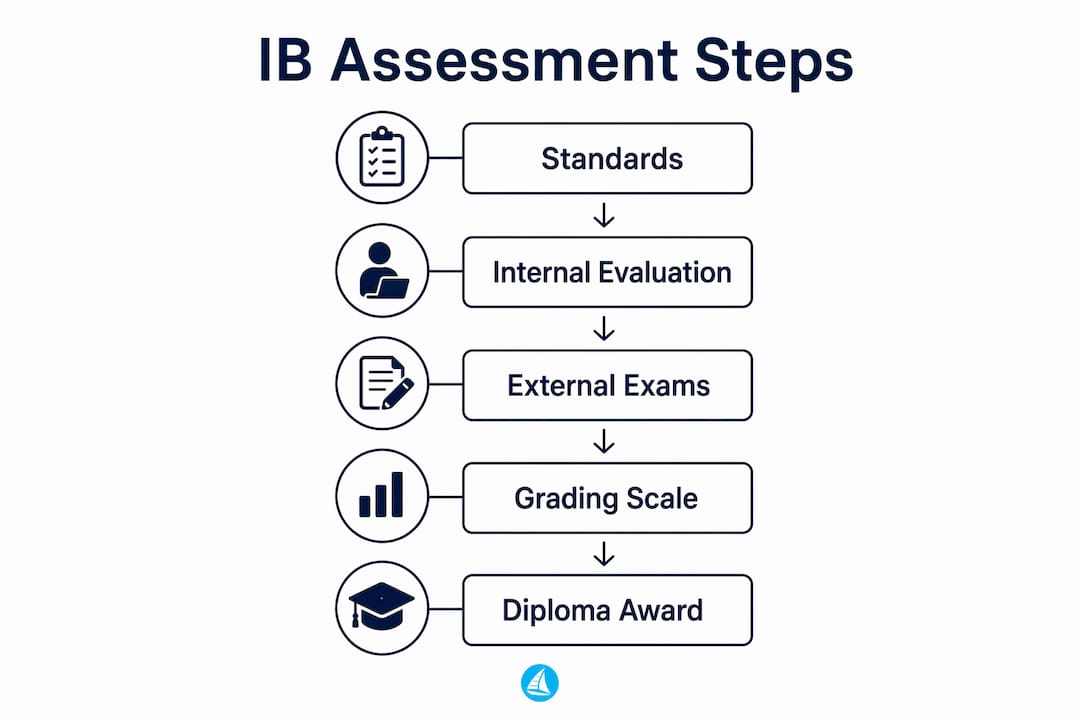
Key components of the IB assessment framework include:
- Subject-specific criteria that define the skills and knowledge required at each achievement level
- Internal assessment (IA) tasks marked by teachers and moderated by the IB
- External assessment through written examinations marked by trained examiners
- Core components such as the Theory of Knowledge (TOK) and Extended Essay (EE) in the DP
- Grading scales that translate raw marks into achievement grades
How the Diploma Programme uses internal and external assessment
The DP combines two assessment types to build a complete picture of student performance. Written examinations form the backbone of most courses because of their objectivity and reliability. These papers include structured problems, short-response questions, data-response questions, and essay tasks.

Internal assessments run alongside exams throughout the course. In the sciences, this means laboratory investigations; in mathematics, it means extended projects. Teachers mark these tasks using IB criteria, and the IB then moderates a sample of each school’s work to verify consistency.
The DP core adds further layers:
- TOK is assessed through an essay (1,200–1,600 words) and an exhibition, graded A–E
- Extended Essay is a 4,000-word independent research essay, also graded A–E
- CAS (Creativity, Activity, Service) requires authenticated participation but carries no grade
Nearly 9,000 trained examiners worldwide are involved in marking, developing, and moderating DP assessments each session.
Pro Tip: In IB sciences, your internal assessment is worth a significant portion of your final grade. Treat it with the same rigour you would bring to a final exam, not as a box to tick.
How the MYP assesses student work
The Middle Years Programme takes a different approach. MYP assessment is principally school-based, with teachers applying four criteria per subject group to mark student work throughout the year. Each criterion targets a specific dimension of learning, labelled A through D, covering areas such as knowledge and understanding, scientific inquiry, and processing and evaluating.
The MYP also offers optional external assessment through its eAssessment platform, which includes on-screen examinations and ePortfolios. The Personal Project, completed in the final year of the MYP, is externally validated to confirm that schools are applying standards consistently.
MYP grading works as follows:
- Each criterion is scored on a scale, and scores are combined to produce a subject level
- Final achievement levels translate into grades on a 1–7 scale, mirroring the DP structure
- The Personal Project is assessed externally to provide an independent check on school standards
The principles that underpin all IB assessment
The IB builds its assessment around three core principles: validity, fairness, and reliability. These are not abstract ideals; they shape every decision from task design to grade boundary setting.
- Validity means the assessment genuinely measures what the programme intends to teach. The IB prioritises tasks that test higher-order thinking over those that are simply easy to mark.
- Fairness requires that criteria apply consistently across all schools and student groups, with no systematic advantage for any particular background.
- Reliability is achieved through examiner training, standardisation sessions, and statistical checks that confirm marking is consistent across the global cohort.
Student results are determined by performance against set standards, not by each student’s position in the overall rank order. That principle protects every student’s grade from being affected by how well or poorly their peers performed.
Decoding IB grading criteria and diploma requirements
Every DP subject is graded on a 1–7 scale, where 7 represents consistent, near-faultless understanding applied across a wide variety of situations, and 1 indicates minimal achievement. TOK and the EE use an A–E scale, where A is excellent and E is elementary.
Diploma points are calculated by adding the subject grades together, then adding bonus points from the TOK and EE combination, up to a maximum of 3 points.
To be awarded the diploma, students must meet a set of conditions including a minimum total point threshold, limits on lower grades across subjects, minimum points across higher and standard level subjects, and completion of CAS requirements.
Grade boundaries are not fixed in advance. Senior examiners set them each session by reviewing candidate work against grade descriptors and cross-referencing statistical data. Two students with very similar raw mark totals can receive different grades if they fall on opposite sides of a boundary.
How to maximise your success in IB science assessments
Meeting IB science criteria consistently is the challenge most students underestimate. The criteria are public, detailed, and specific. Yet many students lose marks not from lack of knowledge but from not demonstrating that knowledge in the way the criteria require.

Understanding the criteria categories for each science subject lets you target your revision with real precision. Tibertutor is built around exactly this approach. The platform provides exam-style questions mapped to IB science syllabuses, animated videos, detailed notes, and mock exams, all designed by examiners who know where marks are won and lost.
Tibertutor’s analytics track your performance criterion by criterion, so you can see which areas need attention rather than guessing. For students aiming for top grades in IB Biology or IB Chemistry, that level of targeted practice makes a measurable difference.
Pro Tip: Before each revision session, read the relevant assessment criteria for the topic you are studying. Ask yourself: “Can I demonstrate this skill clearly enough that an examiner would award full marks?” If not, that is your starting point.
How MYP and DP assessment criteria differ in the UK context
UK schools offering both MYP and DP programmes often find that students need to shift their mindset as they move between the two. In the MYP, criteria are applied by the class teacher throughout the year, giving students regular feedback against the same framework. The DP introduces external examiners and high-stakes end-of-course examinations, which changes the dynamic considerably.
MYP criteria tend to be broader and more process-oriented, rewarding inquiry and reflection alongside content knowledge. DP criteria are more granular and subject-specific, with mark schemes that reward precise scientific language and structured argumentation. UK students transitioning from MYP to DP in sciences often need to sharpen their written communication and learn to present evidence in the exact format examiners expect.
Teachers in UK IB schools frequently use the IB syllabus audit process to map their teaching against criteria, ensuring no assessment objective is left uncovered before examinations.
How teachers use IB criteria to design tasks and give feedback
IB criteria are not just for marking. Teachers use them at the planning stage to design tasks that genuinely assess the skills the programme requires. A well-designed science investigation task, for example, will be structured so that students can demonstrate each criterion independently, making it straightforward to award marks without ambiguity.
Feedback grounded in criteria language is far more useful to students than general comments. Telling a student that their lab report “needs more analysis” is vague. Telling them that their work currently meets Criterion C at level 3 because the conclusion does not link data to the hypothesis gives them a clear target. This approach, sometimes called criterion-referenced feedback, helps students understand exactly what to improve rather than simply trying harder.
Teachers also use criteria to set predicted grades, which UK universities rely on heavily during the UCAS admissions process. The IB expects predictions to be accurate, and schools that consistently over-predict or under-predict are monitored.
How moderation keeps standards consistent across schools
Moderation is the process by which the IB checks that teachers in different schools are applying criteria at the same standard. Without it, a grade 6 at one school could represent very different work from a grade 6 at another.
For DP internal assessments, the IB selects a sample of student work from each school and has it reviewed by a trained moderator. If the moderator finds the teacher’s marks are consistently too high or too low, the school’s marks are adjusted up or down accordingly. The adjustment applies to all students in that cohort, not just those in the sample.
Moderation in the MYP follows a similar model, with the Personal Project externally assessed to provide an independent benchmark. The IB uses linear regression to compare teacher marks with moderator marks, identifying systematic patterns rather than isolated differences.
How criterion-related assessment predicts diploma outcomes
Criterion-related assessment gives students and teachers a reliable early signal of likely diploma results. Because criteria are fixed and public, a student’s performance on internal assessments and practice papers can be mapped directly onto the grade descriptors, producing a predicted grade that reflects genuine evidence rather than intuition.
This predictive value is strongest when teachers apply criteria rigorously from the start of the course. Students who receive consistent criterion-referenced feedback across two years of the DP arrive at final examinations with a clear understanding of the standard required. Those who encounter the criteria seriously only in the final term often find the gap between their expectations and their results wider than anticipated.
Diploma passing criteria add another layer: passing individual subjects does not guarantee the diploma. A student who scores well in four subjects but earns grade 2s in two others may still fall short of the conditions required, regardless of their total points.
Key takeaways
IB assessment criteria are fixed, public standards that measure achievement against programme goals, not against other students, and meeting the diploma’s 24-point threshold requires satisfying both score and grade distribution conditions.
| Point | Details |
|---|---|
| Criteria measure achievement, not rank | Student results reflect performance against IB standards, not position in the class. |
| DP grading scale | Each subject is graded 1–7; TOK and EE use A–E, together contributing up to 3 bonus points. |
| Diploma minimum threshold | Students need at least 24 points and must meet grade distribution and CAS conditions. |
| Moderation ensures fairness | The IB adjusts school marks where teacher standards differ from the moderated benchmark. |
| Criteria guide revision | Knowing the criteria categories for each science subject lets students target practice precisely. |
FAQ
What is an IB assessment?
IB assessment is the process by which the International Baccalaureate measures student achievement against the stated goals of each programme, using a combination of external examinations and internally marked tasks.
What are the four criteria in IB?
In the MYP, each subject group uses four criteria labelled A through D, covering areas such as knowledge and understanding, scientific inquiry, and processing and evaluating, though the specific descriptors vary by subject.
What are the IB grading criteria?
DP subjects are graded on a 1–7 scale based on grade descriptors that define the standard of work expected at each level; TOK and the Extended Essay use an A–E scale and together can contribute up to 3 bonus diploma points.
What are the passing criteria for the IB Diploma?
To earn the IB Diploma, students must achieve at least 24 total points, hold no more than two grade 2s, score at least 12 points across HL subjects and 9 across SL subjects, and complete CAS requirements.