How to audit IB syllabus coverage in your school
Auditing IB syllabus coverage is the process of systematically verifying curriculum alignment with IB standards using evidence-based mapping and assessment techniques. Known formally as programme evaluation within IB documentation, this practice sits at the heart of every well-run IB school. The IB requires programme evaluation at least every five years, with termly subject audits recommended in between. Schools that treat this as a living process, rather than a one-off compliance exercise, consistently produce stronger student outcomes and more confident teachers.
How to audit IB syllabus coverage: prerequisites and tools
A successful audit begins before you open a single unit plan. You need the right frameworks, platforms, and documents in place.
The IB uses a three-tier descriptor system to guide self-assessment: highly developed, developed, and developing. Each descriptor maps to a standard within the IB’s Standards and Practices framework. Understanding where your school sits on this scale is the first step in any honest curriculum review.

Platforms matter too. Schools submit documentary evidence through IB Concierge, while ManageBac supports unit plan creation, curriculum mapping, and alignment tracking. Familiarity with both is non-negotiable before you begin. The updated preliminary review process now requires documentary evidence to be submitted four months before the site visit, giving schools earlier feedback and more time to act.
Gather the following before starting your audit:
- Curriculum maps and unit plans for each science subject
- Assessment rubrics and marked student work samples
- Checklists linking learning units to IB strands
- Records of cohort sizes, particularly for Higher Level groups
- A timeline showing where you sit in the five-year evaluation cycle
Pro Tip: Build a shared folder for each subject with all documentary evidence organised by term. This makes IB Concierge submissions far less stressful and keeps your audit trail clean.
How to map curriculum content against IB syllabus requirements
Mapping is where most audits either succeed or fall short. A topic list alone is insufficient; you need axes of themes and levels of organisation to reveal genuine conceptual depth.
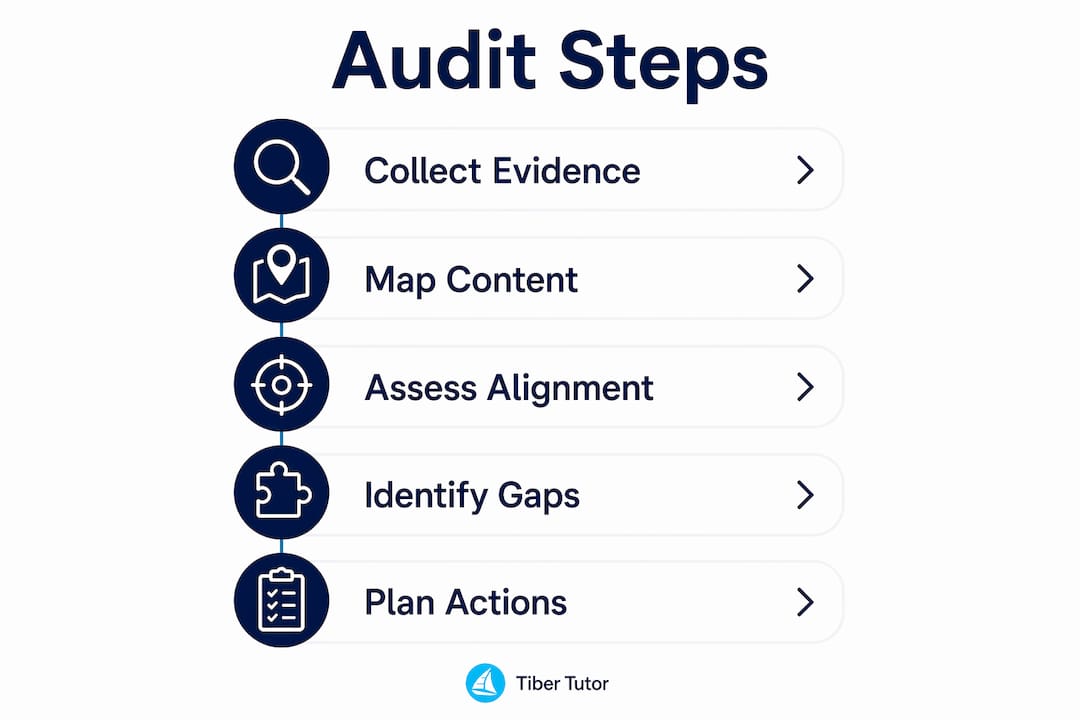
For IB Biology, for example, map content across levels of organisation: molecule, cell, organism, and ecosystem. For Chemistry and Physics, use the syllabus strands and assessment objectives as your axes. This gives you a grid rather than a list, and gaps become immediately visible.
Follow these steps to complete your coverage map:
- List every IB syllabus topic for the subject, using the official IB subject guide as your reference.
- Assign each unit a status: Complete, Partial, or Absent, based on evidence from unit plans and student assignments.
- Check for conceptual depth, not just surface coverage. A topic marked Complete should include thorough explanations, worked examples, and assessed student responses.
- Identify missing levels of organisation. Fill absent levels first before scheduling integrated theme reviews. Covering topic clusters superficially is a common and costly error.
- Set SMART goals for each gap. A concrete example: three timed past papers per week on a weak topic, with teacher feedback within five days.
The table below shows how to classify coverage status during a subject audit:
| Coverage status | Evidence required | Next action |
|---|---|---|
| Complete | Unit plan, marked work, rubric alignment | Monitor and maintain |
| Partial | Unit plan exists, limited student evidence | Schedule targeted teaching |
| Absent | No unit plan or student evidence found | Prioritise in next term plan |
Pro Tip: When checking for IB curriculum alignment, look at the quality of teacher comments on marked work. Vague feedback like “good effort” signals a gap in assessment rigour, not just content coverage.
How to use assessment data for continuous curriculum improvement
Assessment data is the most honest signal your audit will produce. One test, one assignment, and teacher comments per term are sufficient to identify patterns of syllabus misalignment. You do not need a mountain of evidence. You need the right evidence, read carefully.
Map your collected evidence against IB assessment criteria. In Biology, Chemistry, and Physics, this means checking for weaknesses in analysis, argument construction, and lab technique. A student who consistently loses marks on the Analysis criterion in Internal Assessments is signalling a teaching gap, not just a personal weakness.
Translate findings into clear action steps:
- Identify the two or three weakest assessment criteria across the cohort
- Assign specific teaching sessions to address each weakness
- Schedule a follow-up check within four weeks to measure progress
- Share findings with subject teachers in a brief, focused meeting rather than a lengthy report
Effective mid-year audits produce priority action lists, phased timelines, and clear support plans. These outputs should feed directly into the following term’s teaching schedule, not sit in a folder until the next formal review.
Common pitfalls when auditing IB syllabus coverage
Even well-intentioned audits go wrong. Knowing the traps in advance saves considerable time and frustration.
- The feedback volume trap. Collecting large quantities of student work does not improve audit quality. Focus on patterns across a small, representative sample rather than volume.
- Superficial topic coverage. Ticking a topic as covered because it appeared in a lesson plan misses the point entirely. Audit for conceptual depth and assessed understanding.
- Thin Higher Level groups. Cohorts smaller than 25 HL students risk fragile syllabus delivery. Monitor cohort sizes and flag risks early.
- Late documentary evidence. IB Concierge submission deadlines are firm. Missing the four-month pre-visit window removes the opportunity for early feedback.
- Treating the audit as policing. The IB’s five-year evaluation is designed as a self-reflective growth process, not a compliance check. Schools that approach it with genuine curiosity produce better case studies and stronger programmes.
“The five-year programme evaluation asks schools to produce a detailed case study analysing programme development. Its purpose is pedagogical growth, not box-ticking. Schools that understand this distinction get far more value from the process.” — IB World School guidance
Sequence your gap-filling deliberately. Address missing levels of organisation before attempting integrated theme reviews. Jumping to thematic synthesis before foundational levels are secure produces the illusion of coverage without the substance.
Key takeaways
A credible IB syllabus audit maps curriculum content to IB assessment criteria, uses the three-tier descriptor system, and produces measurable SMART goals to close identified gaps.
| Point | Details |
|---|---|
| Use the three-tier descriptor system | Rate each standard as highly developed, developed, or developing before gathering evidence. |
| Map by theme and level, not topic list | Create a coverage grid using IB strands and levels of organisation to reveal genuine gaps. |
| Collect minimal, targeted evidence | One test, one assignment, and teacher comments per term are sufficient to identify patterns. |
| Fill absent levels before themes | Address missing levels of organisation first; superficial topic coverage masks real gaps. |
| Treat evaluation as growth, not compliance | The five-year self-study is a tool for pedagogical development, not a policing exercise. |
Why honest mapping matters more than a tidy audit trail
I have seen schools produce beautifully formatted audit documents that told almost nothing true about what students actually knew. The unit plans were complete, the rubrics were attached, and the IB Concierge submission was on time. But when you looked at the student work, the conceptual depth simply was not there.
The most useful audits I have been involved with started with a single, uncomfortable question: “If a student sat Paper 2 tomorrow, which topics would genuinely let them down?” That question cuts through the paperwork immediately. It forces teachers and administrators to look at real evidence rather than planned coverage.
Collaboration between subject teachers and senior leaders is what makes the difference in practice. Teachers know where the gaps are. Administrators have the authority to restructure timetables and allocate resources. When both groups sit down with the same evidence, the conversation becomes productive rather than defensive.
The IB curriculum mapping process works best when it feeds directly into weekly teaching plans, not just annual reviews. Build audit findings into your termly planning cycle, and the five-year evaluation becomes a summary of continuous improvement rather than a frantic catch-up. That shift in approach is what separates schools that grow from those that merely comply.
— Oliver
How Tibertutor supports IB science curriculum alignment
Once your audit identifies gaps in IB Biology, Chemistry, or Physics coverage, the next step is structured student practice that targets those specific areas.
Tibertutor provides IB Biology exam tests and IB Chemistry mock exams built directly from IB syllabus requirements and written by experienced examiners. Each resource maps to specific syllabus topics, making it straightforward to assign targeted practice after an audit reveals a weak area. Schools use Tibertutor’s analytics to track improvement over time, turning audit findings into measurable progress. For teachers setting SMART goals around past paper practice, the platform’s topic-specific tests and progress tracking provide exactly the structure students need to build confidence and close gaps before exams.
FAQ
What is an IB syllabus coverage audit?
An IB syllabus coverage audit is a structured review that maps curriculum content against IB standards to identify gaps in teaching and assessment. It uses documentary evidence such as unit plans, student work, and assessment rubrics to verify alignment.
How often should schools audit IB syllabus coverage?
The IB recommends termly subject audits, with a formal programme evaluation at least every five years. Termly reviews allow schools to address gaps before they affect student outcomes.
What evidence do I need for an IB curriculum audit?
One test, one assignment, and teacher comments per term are sufficient to identify syllabus misalignment. Quality and pattern recognition matter more than the volume of evidence collected.
What is the three-tier descriptor system in IB audits?
The IB uses three self-assessment descriptors: highly developed, developed, and developing. Schools apply these to each standard and submit supporting evidence through IB Concierge.
How do I avoid superficial IB syllabus coverage in an audit?
Map content using thematic axes and levels of organisation rather than topic lists. Fill absent levels of organisation first before addressing integrated themes to build genuine conceptual depth.