IB Maths study guide: your 2026 exam success plan
An IB Maths study guide is a structured revision resource that organises your learning, explains key mathematical concepts, and equips you with exam strategies tailored to IB Mathematics courses. The best guides cover syllabus breakdowns, past paper practice, formula booklet use, and time management techniques. Whether you are studying Analysis and Approaches or Applications and Interpretation, having a clear revision framework makes the difference between guessing and genuinely understanding. This guide gives you everything you need to prepare with confidence, from syllabus structure right through to exam day tactics.
How is the IB Maths syllabus structured?
IB Mathematics offers two distinct courses: Analysis and Approaches (AA) and Applications and Interpretation (AI). Each course runs at Standard Level (SL) or Higher Level (HL), giving four possible combinations. Your choice shapes your entire study focus, so understanding the differences early is critical.
AA suits students who enjoy abstract reasoning, proof, and algebraic rigour. It is the preferred route for students heading into mathematics, physics, or engineering. AI suits students who prefer statistics, modelling, and real-world data applications. It aligns well with economics, social sciences, and business pathways.

| Feature | AA SL/HL | AI SL/HL |
|---|---|---|
| Core focus | Algebra, calculus, proof | Statistics, modelling, technology |
| Calculator use | Paper 1 non-calculator | Calculator allowed in most papers |
| Typical student | Pure maths, sciences | Social sciences, business |
| HL additions | Further calculus, complex numbers | Further statistics, networks |
Both courses share foundational content areas: algebra, functions, geometry, trigonometry, statistics, and calculus. HL students cover significantly more depth in each area, particularly in calculus and proof. The SL and HL differences affect how you prioritise topics and allocate revision time.
Pro Tip: Identify your course and level on day one. A student revising AA HL content for an AI SL exam is wasting hours on material that will not appear in their papers.
What are the IB Maths exam formats and marking schemes?
Knowing the exam structure is as important as knowing the content. IB Math AA SL exams consist of two 90-minute papers, each worth 40% of your final grade. That leaves 20% for your internal assessment. Pacing yourself at roughly one minute per mark is the standard recommendation, and it works.
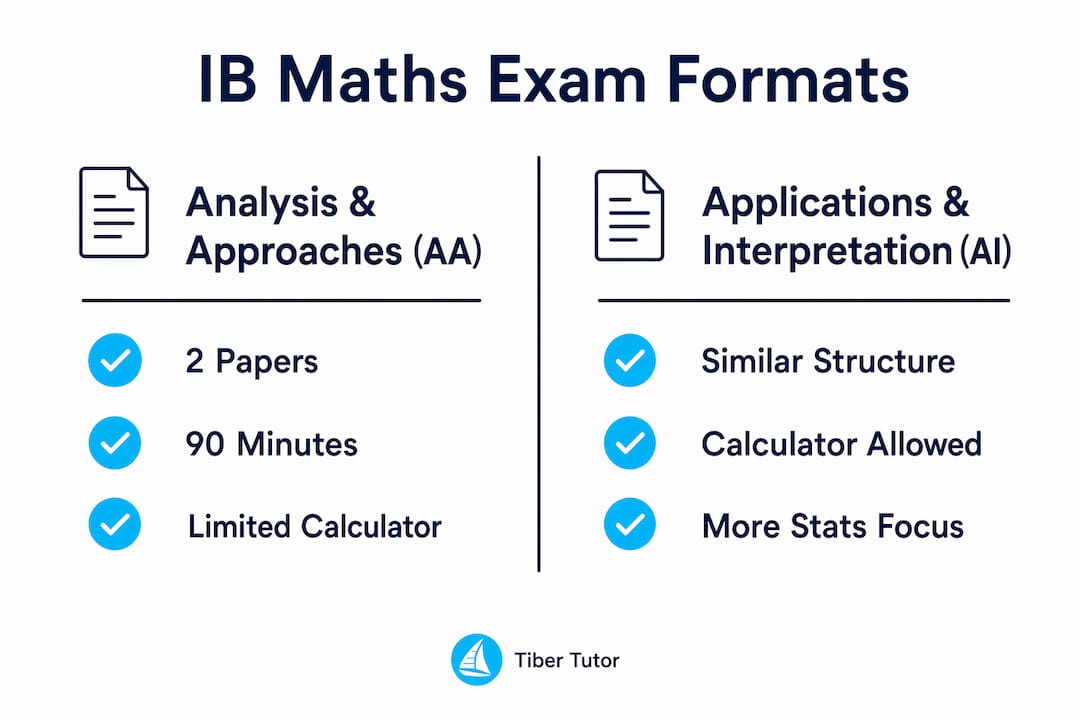
Paper 1 is non-calculator for AA students. It tests algebraic fluency, mental arithmetic, and conceptual understanding. Paper 2 allows a graphic display calculator (GDC). HL students sit a third paper, which is more open-ended and problem-solving in nature.
Here is what you need to know about how marks are awarded:
- Method marks matter. IB examiners award marks for logical, step-by-step working even when your final answer is wrong. Never skip steps.
- Follow-through marking means an error in one part does not necessarily cost you marks in subsequent parts, provided your method is correct.
- Communication marks reward clear notation and structured presentation. Write neatly and label your working.
- Read every question twice. Many marks are lost by misreading what is being asked, particularly in multi-part questions.
The AI course has a similar structure, but calculator use is permitted across more papers. Calculator fluency and course choice significantly impact how you approach each paper and what you prioritise in revision.
What study strategies optimise IB Maths performance?
The most effective revision strategy combines daily practice, past paper work, and honest error analysis. Top scorers solve 5–10 exam-style questions daily and complete 3–5 full past papers under timed conditions before their exams. That volume of deliberate practice builds both speed and confidence.
Consistent daily practice of 10–15 minutes is more effective than occasional marathon sessions. Short, focused sessions maintain your skills without exhausting you, which matters when you are managing multiple IB subjects simultaneously.
- Practise exam-style questions daily. Use your IB exam-style question workflow to work through 5–10 questions per session, focusing on one topic at a time.
- Build an error log. Categorising your mistakes by type, such as algebraic slips, misread questions, or formula errors, reveals patterns you can fix before the exam.
- Prioritise understanding over memorisation. Mastery requires understanding why formulas work, not just what they are. IB questions regularly present unfamiliar contexts that demand genuine comprehension.
- Complete timed past papers. Sit at least three full past papers under real exam conditions. Review every mark you lost and update your error log accordingly.
- Revisit your weakest topics last. Ending your revision cycle on a topic you find difficult builds confidence going into the exam.
Pro Tip: Do not just mark your past papers as right or wrong. Write a one-sentence explanation of every mistake. That reflection is where real learning happens.
How to use calculators and formula booklets effectively
The GDC is one of the most powerful tools in your exam, but only if you know how to use it quickly and accurately. IB Math AA SL requires algebraic precision in non-calculator papers and full GDC fluency in calculator papers. Practise both modes separately.
Key GDC skills to master before your exam:
- Graphing functions and reading intercepts, turning points, and asymptotes directly from the screen.
- Solving equations numerically using the solver or graph intersection tool.
- Statistical calculations including mean, standard deviation, regression lines, and probability distributions.
- Matrix operations for HL students covering systems of equations.
The formula booklet is provided in every paper. Treat it as a reference tool, not a crutch. Know where each formula sits in the booklet so you can find it in seconds under pressure. The students who struggle are those who have never opened the booklet before the exam. Practise using it during every past paper session so it becomes second nature.
How to manage time and exam day pressure in IB Maths
Time management is a skill you build in revision, not something you improvise on exam day. IB Maths success requires mental endurance, strategic pacing, and the discipline to move on from questions that are costing you too much time.
Follow these exam day principles:
- Start with questions you find straightforward. Securing early marks builds momentum and settles nerves.
- Allocate time by marks. A 6-mark question deserves roughly six minutes. Do not spend twelve minutes on it.
- Never leave a question blank. Write something. A partially correct method can still earn marks.
- Show every step of your working. Partial credit for correct process is a real and significant feature of IB marking. A wrong answer with clear working often scores better than a correct answer with no working shown.
- Between papers, rest actively. Shifting from intensive study to light maintenance between exam sittings prevents the mental fatigue that costs marks on your second or third paper.
Pro Tip: In the final five minutes of any paper, scan every question you attempted. Check units, signs, and whether you actually answered what was asked. Small corrections here can recover two or three marks.
For a deeper look at simulating real exam conditions, the IB Maths mock exam guide walks you through exactly how to structure your timed practice sessions.
Key takeaways
A structured IB Maths revision plan built on daily practice, past paper analysis, and deliberate error review is the most reliable route to a grade 7.
| Point | Details |
|---|---|
| Know your course and level | AA and AI require different study priorities; confirm yours before you begin revising. |
| Pace at one minute per mark | Use the one-minute-per-mark rule to avoid spending too long on single questions. |
| Show all working | Method marks reward logical steps even when your final answer is incorrect. |
| Build an error log | Categorise every mistake by type to identify and fix recurring weaknesses. |
| Practise daily, not in bursts | Ten to fifteen minutes of focused daily practice outperforms last-minute cramming. |
What I have learnt from watching students tackle IB Maths
The students who struggle most with IB Maths are rarely the ones who lack ability. They are the ones who revise passively. They re-read notes, highlight textbooks, and feel productive without ever testing themselves. Then the exam arrives and the questions look unfamiliar, because IB Maths is designed to present concepts in new contexts.
The students who score 6s and 7s do something different. They treat every revision session as a low-stakes exam. They attempt questions before checking answers. They write out their working even when practising alone. They keep an error log and actually read it before the next session.
The other pattern I see repeatedly is poor pacing during exam week. Students sit Paper 1, feel it went badly, and spend the evening before Paper 2 cramming intensively. That approach almost always makes things worse. A short review of your error log, a good night’s sleep, and a calm morning routine will serve you far better than three hours of anxious revision.
IB Maths rewards preparation that is consistent, reflective, and honest. Start early, practise often, and trust the process.
— Oliver
How Tibertutor supports your IB Maths preparation
Tibertutor is built by IB examiners and experienced educators who understand exactly what the marking schemes reward. The platform offers a curated question bank, topic-specific tests, mock exams, and detailed progress tracking, all designed to give you the targeted practice that moves your grade upward.

Whether you are an SL student building core confidence or an HL student pushing for a 7, Tibertutor’s resources are structured around the IB syllabus you are actually sitting. Explore the full IB student resource hub to find exam-style questions, cram sheets, and analytics that show you precisely where to focus next. Visit Tibertutor to see the question bank and get started today.
FAQ
What is the difference between IB Maths AA and AI?
Analysis and Approaches (AA) focuses on algebraic rigour and abstract reasoning, while Applications and Interpretation (AI) emphasises statistics, modelling, and real-world data. Your choice determines your exam format and study priorities.
How many papers are there in IB Maths SL?
IB Maths SL students sit two papers, each lasting 90 minutes and worth 40% of the final grade. The remaining 20% comes from the internal assessment.
Should I memorise all the IB Maths formulas?
You do not need to memorise every formula, as the formula booklet is provided in all papers. Focus on knowing where each formula is located and understanding how to apply it to unfamiliar problems.
How do I avoid running out of time in IB Maths exams?
Pace yourself at roughly one minute per mark, start with questions you find straightforward, and move on from any question that is taking too long. Return to difficult questions once you have secured the easier marks.
How often should I practise IB Maths during revision?
Daily practice of 10–15 minutes is more effective than infrequent long sessions. Complement this with regular timed past papers to build exam stamina and speed.