IB questionbank for science: your 2026 exam guide
The IB Questionbank is defined as the official International Baccalaureate database of past exam questions, markschemes, and examiner reports, organised by subject, topic, and level. For IB science students targeting top marks in Biology, Chemistry, and Physics, it is the single most direct route to understanding exactly what examiners expect. Used well, the IB question bank transforms revision from passive reading into active, targeted practice. Platforms like Tibertutor build their entire exam preparation offering around this principle, giving students syllabus-aligned questions with examiner-vetted markschemes at their fingertips.
What does the IB questionbank contain?
The IB Questionbank holds past exam questions sorted by subject, paper type, topic, and Higher Level or Standard Level designation. That structure matters. It means you can pull every question ever set on enzyme kinetics or electrochemical cells without wading through full papers.
The core components are:
- Past paper questions covering all IB science subjects, filterable by topic and syllabus point
- Official markschemes that show exactly how examiners award marks, including accepted alternatives
- Examiner reports that detail where candidates lost marks and what responses scored full credit
- Custom test builders that let teachers assemble targeted assessments from selected questions
Markschemes are where most students underuse the resource. Reading a markscheme after attempting a question reveals not just the correct answer but the precise language examiners reward. That precision is what separates a 5 from a 7. Teachers can also use the question bank to build custom exams that target specific class weaknesses, making it a powerful tool for personalised learning.
Pro Tip: When reviewing a markscheme, highlight every phrase you would not have written yourself. Those phrases become your revision vocabulary.

Focus your question selection on recent papers. IB educational experts recommend prioritising papers from 2018 onwards because syllabus updates make older questions less relevant to current specifications. This is especially true for the 2023 Biology and Chemistry syllabuses, which introduced significant structural changes.
How to build your study schedule around the question bank
Structured preparation starts early. IB students should begin dedicated exam preparation 3–6 months before their May or November session, committing 15–20 hours per week and completing 10–15 past papers per subject in the final term. That volume only becomes manageable with a clear schedule.
Here is a practical weekly framework for the final three months:
- Monday and Tuesday: Content review using notes, flashcards, and topic summaries. No timed questions yet.
- Wednesday: Untimed question bank practice on the week’s focus topic. Check markschemes immediately after each question.
- Thursday: Timed practice using a full topic set or short paper section. Simulate exam paper timing (Paper 1: 45–60 minutes, Paper 2: 75–150 minutes, Paper 3 HL: 60–75 minutes).
- Friday: Error analysis and examiner report review for that week’s topic.
- Weekend: One full past paper under timed conditions, then full markscheme review.
Time allocation across subjects requires deliberate weighting. Top scorers allocate roughly 60–40 or 65–35 of their study time to HL versus SL subjects, reflecting the greater depth and examination demands at Higher Level. Review this split every four weeks as your confidence in different topics shifts.
| Study Phase | Focus | Question Bank Use |
|---|---|---|
| 3–6 months out | Topic content and notes | Untimed topic questions, markscheme review |
| 6–10 weeks out | Mixed topic practice | Timed topic sets, examiner report reading |
| Final 4 weeks | Full paper simulation | Complete past papers, error categorisation |
Pro Tip: Build your IB study schedule around the question bank rather than around your textbook. The questions tell you what actually gets tested.
Step-by-step workflow for self-assessment and improvement
The most effective use of the question bank follows a repeatable four-step cycle. Active recall through past papers improves retention by around 50% compared to rereading. That gain only materialises if you close the loop after every attempt.
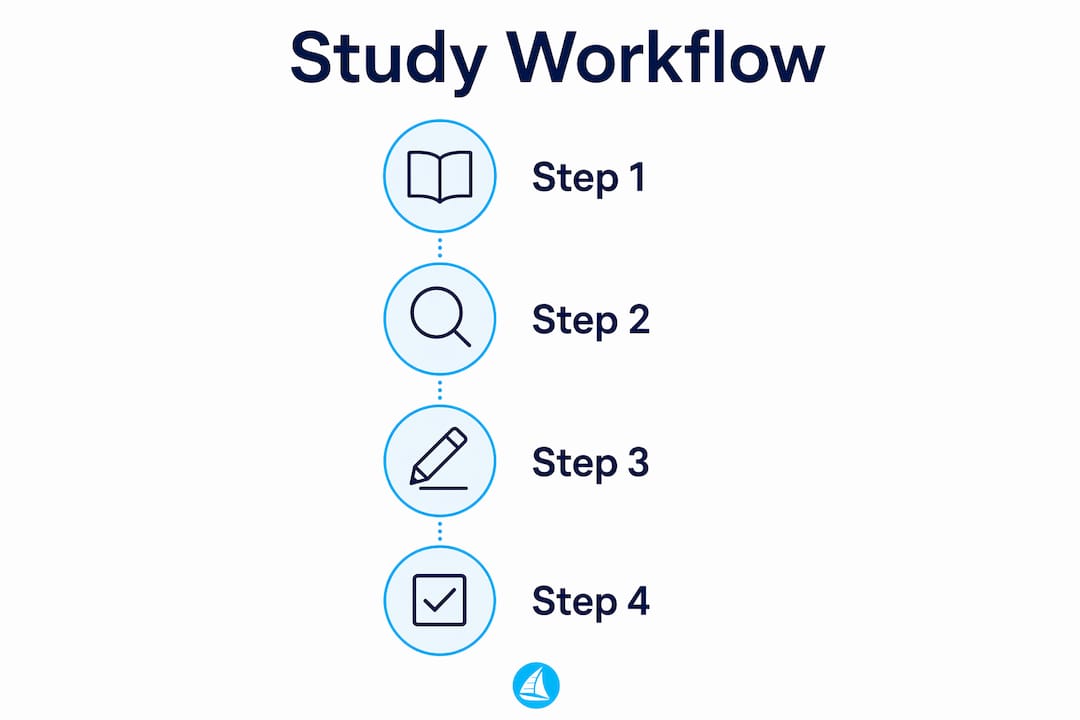
Step 1: Untimed attempt. Work through a question set without a clock. The goal here is content familiarisation, not speed. Write full answers as you would in an exam.
Step 2: Timed attempt. Repeat a similar question set under strict exam timing. This builds the mental stamina and pacing that exams demand.
Step 3: Mark with the official markscheme. Score your own work honestly. Do not award yourself marks for answers that are close but not precise. The markscheme language is the standard.
Step 4: Categorise every lost mark. This is the step most students skip, and it is the most valuable.
- Content gap: You did not know the material. Add it to your flashcard deck.
- Command term error: You described when the question asked you to explain, or evaluated when it asked you to outline. Misunderstanding command terms costs students 3–4 marks per question on average.
- Timing issue: You ran out of time. Adjust your pacing in the next timed session.
- Careless mistake: You knew the answer but wrote it incorrectly. Note the pattern and check for it in future papers.
“The most common mistake is using study as a knowledge measure rather than a diagnostic tool to find gaps.” IB Notesmakr
After categorising, create a targeted fix for each gap. A content gap becomes three new flashcards. A command term error becomes a written definition of that term with two practice sentences. A timing issue becomes a stricter clock in your next session. This cycle, repeated weekly, is what past paper practice is actually for.
Common mistakes when using the IB questionbank
Most students use the question bank less effectively than they could. These are the errors that cost marks most reliably.
- Using outdated papers without checking syllabus relevance. Papers from before 2018 may test content or formats no longer assessed. Always cross-reference with your current subject guide.
- Skipping examiner reports. Examiner reports are underutilised by the majority of students, yet they contain direct guidance on what responses scored full marks and which common errors lost points. Reading them is one of the highest-return revision activities available.
- Ignoring command terms. “Outline” requires two or three key points. “Evaluate” requires a judgement with supporting evidence. Treating these as interchangeable is a consistent source of avoidable mark loss.
- Applying the same time budget to HL and SL subjects. HL Biology and HL Chemistry carry significantly more content and assessment depth than their SL counterparts. A 60/40 HL-to-SL time split reflects this reality.
- Practising for volume rather than quality. Completing twenty papers without reviewing errors builds false confidence. Consistency and error review beat last-minute high-volume practice every time.
Pro Tip: After each exam session, read the examiner report for that paper before moving on. Five minutes of reading can prevent the same mistake appearing in your next attempt.
Key takeaways
The IB Questionbank is most effective when used as a diagnostic tool, not a knowledge measure, with structured error review driving every revision cycle.
| Point | Details |
|---|---|
| Start early and schedule deliberately | Begin 3–6 months before exams and build weekly question bank sessions into your timetable. |
| Focus on recent papers | Prioritise questions from 2018 onwards to stay aligned with current syllabus specifications. |
| Use the four-step cycle | Attempt untimed, then timed, then mark, then categorise errors for targeted fixes. |
| Read examiner reports | These reports reveal exactly what examiners reward and where most candidates lose marks. |
| Weight HL over SL | Allocate roughly 60–40 study time to HL versus SL subjects to reflect curriculum depth. |
What i have learned from watching students use the question bank
The students who improve most are rarely the ones who practise the most. They are the ones who review the most carefully. I have seen students complete forty past papers in a term and still score a 4, because they never stopped to ask why they kept losing marks on the same question types.
The question bank is genuinely powerful, but only if you treat it as a mirror. Every wrong answer is information. Every markscheme phrase you would not have written is a gap worth closing. The examiner reports, which most students never open, are essentially a direct letter from the people marking your paper. Reading them regularly changes how you write answers.
My honest advice: spend less time generating new attempts and more time dissecting the ones you have already done. Pair the question bank with a good IB revision guide for context, and use peer discussion to test whether your understanding of a markscheme point is actually solid. The students who do this consistently are the ones who arrive at the exam feeling prepared rather than anxious.
— Oliver
How Tibertutor supports your IB science preparation
Tibertutor’s IB Science Questionbank is built by examiners and experienced educators, giving you syllabus-aligned questions for Biology, Chemistry, and Physics with official-standard markschemes and detailed answer guidance. Every question is mapped to the current syllabus, so you are always practising what will actually be assessed.
The platform combines exam-style questions with animated videos, cram sheets, flashcards, and progress tracking, so you can move from identifying a gap to closing it without switching between multiple resources. For students and parents looking for structured, examiner-vetted support, explore Tibertutor’s student plans to find the right level of preparation for your exam session.
FAQ
What is the IB questionbank?
The IB Questionbank is the official IBO database of past exam questions, markschemes, and examiner reports, organised by subject, topic, and level. It is the primary resource for targeted IB exam practice.
How many past papers should i complete per subject?
Top-performing IB students complete 10–15 past papers per subject in the final term, with at least one full paper per week under timed conditions.
Which years of past papers are most useful?
Focus on papers from 2018 onwards. Recent papers align with current syllabus specifications, making older questions less reliable for targeted preparation.
How do i use examiner reports effectively?
Read the examiner report for each paper immediately after marking your attempt. These reports identify the most common errors and the precise responses that scored full marks.
How should i split study time between HL and SL subjects?
Allocate roughly 60% of your study time to HL subjects and 40% to SL. This weighted split reflects the greater depth and examination demands at Higher Level.