Science exam preparation: your complete IB guide
Science exam preparation is the deliberate set of strategies and practices designed to maximise recall, comprehension, and application of scientific knowledge under exam conditions. It goes far beyond rereading notes. Active study methods such as retrieval practice, spaced repetition, and targeted past paper analysis form the core of what genuinely works. For IB Biology, Chemistry, and Physics students, understanding how to prepare, not just how long to study, is the difference between a grade 5 and a grade 7.
What is science exam preparation, and why does it matter?
Science exam preparation is a structured, evidence-based approach to building the recall and application skills that IB exams actually test. Passive revision, such as highlighting notes or rereading a textbook chapter, creates a feeling of familiarity. That feeling is a poor proxy for readiness, because exam conditions demand active recall and application, not recognition.
The most effective preparation combines three core methods: retrieval practice, spaced repetition, and deliberate past paper work. Each targets a different aspect of exam performance. Together, they build the kind of deep, flexible understanding that IB science questions are specifically designed to probe.

Starting your revision with a clear plan also matters. A well-structured IB study schedule prevents the common trap of spending too much time on topics you already know while neglecting genuine weak areas.
How does retrieval practice improve science exam readiness?
Retrieval practice is the act of recalling information from memory without referring to notes. It is not a test of what you know. It is the method by which you build what you know. Retrieval practice strengthens comprehension and retention more effectively than passive review, and it develops the application skills that IB science questions require.
The contrast with passive rereading is stark. When you reread, your brain recognises information it has already seen. When you retrieve, your brain reconstructs it. That reconstruction process is what strengthens the neural pathways that make recall reliable under pressure.
In practice, retrieval looks different across the three sciences:
- Biology: Close your notes and redraw the process of photosynthesis or the steps of the cell cycle from memory. Then check your diagram against the syllabus.
- Chemistry: Cover a reaction mechanism and write out each step, including electron movement and intermediate structures, before comparing with your source.
- Physics: Read a problem, close the page, and write out the system definition, assumptions, and relevant equations before attempting any calculation.
Pro Tip: Turn every syllabus heading into a question. “Outline the role of enzymes in metabolism” becomes a retrieval prompt. Work through your entire syllabus this way and you will have a personalised question bank that mirrors IB command terms.
What is spaced repetition and how should you use it for science exams?
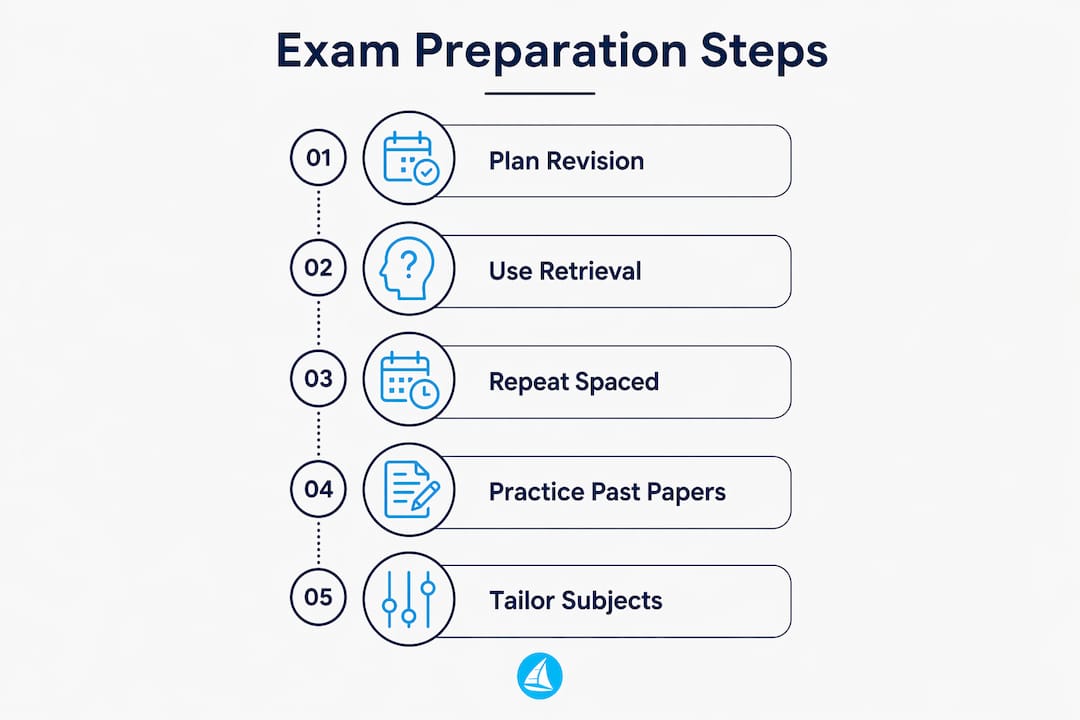
Spaced repetition is a revision method that schedules review sessions at increasing intervals, targeting material just before you are likely to forget it. This timing is deliberate. The “just before forgetting” principle strengthens neural pathways more effectively than reviewing material you still remember clearly.
A 2025 meta-analysis found that spaced practice produces an effect size of d = 0.54 over massed practice in classroom settings. That is a meaningful, consistent advantage across science subjects, not a marginal gain.
The most practical model for IB students is the 1-3-7-14-30 day schedule:
- Day 1: Review new material within 24 hours of first learning it.
- Day 3: Return to the same content and test yourself without notes.
- Day 7: Retrieve again, focusing on any points you missed on Day 3.
- Day 14: A brief review session to consolidate understanding.
- Day 30: Final review before the material is considered secure.
Tools like Anki use algorithms to automate this scheduling. AI flashcard generators such as StudyCards AI can accelerate card creation from your notes. Starting 30 to 45 days before your exam and introducing 20 to 50 new cards per day gives you enough time to complete all five review cycles before sitting the paper.
Pro Tip: The biggest mistake students make with spaced repetition is skipping a review session and then starting again from the beginning. Missing a session pushes the review back by one day, not to zero. Keep going.
How can past papers boost exam performance in science?
Past papers are the closest simulation of real exam conditions available to you. Students who complete five to seven past papers before finals improve their scores by 15 to 25 percentage points on average. That improvement comes not from the papers themselves, but from the analysis that follows each one.
The process that produces results follows a clear cycle:
- Sit the paper under timed, closed-book conditions. No notes, no phone, no extra time.
- Mark strictly using the official mark scheme. Award marks only where the required keywords and point allocations are met, exactly as an examiner would.
- Categorise every error. Was it a vocabulary gap, a process misunderstanding, a formula error, or a calculation slip?
- Study the specific weak area. Do not reread the whole chapter. Target the exact gap the error revealed.
- Retest on similar questions within the next three to five days to confirm the gap is closed.
| Error type | What it reveals | Targeted fix |
|---|---|---|
| Vocabulary gap | Missing or incorrect scientific terminology | Flashcard review of key terms and definitions |
| Process misunderstanding | Incorrect sequence or mechanism | Redraw the process from memory, then check |
| Formula error | Wrong equation selected or misapplied | Practise selecting equations from problem descriptions |
| Calculation slip | Arithmetic or unit conversion mistake | Redo similar calculations under timed conditions |
Avoid open-book past paper practice as a primary method. It builds a false sense of security. Reserve open-book work for a separate skill: learning how to use your data booklet efficiently.
The real role of past papers in IB science is diagnostic, not just practice. Each paper tells you precisely where to direct your next study session.
How to tailor your revision to Biology, Chemistry, and Physics
Each science discipline has unique study focus areas and common student errors. Applying the same generic revision approach to all three subjects misses the specific demands of each.
Biology rewards students who understand cause-and-effect chains rather than isolated facts. When revising topics like hormonal regulation or the immune response, trace the full sequence: stimulus, receptor, coordinator, effector, response. Redraw processes such as DNA replication or the nitrogen cycle from memory. Pay close attention to exceptions and regulatory mechanisms, since IB Biology questions frequently test whether you understand why a process is controlled, not just how it works.
Chemistry requires you to connect the symbolic level (equations and formulae) to the particle level (behaviour, bonding, and energy changes). Before writing any equation, sketch what is happening at the molecular level. This habit prevents the common error of applying a formula without understanding the underlying chemistry. For organic mechanisms, practise drawing curly arrows from memory, then check against your notes.
Physics is built on model selection. Before any calculation, define the system, state your assumptions, and identify which model applies. Students who jump straight to equations without this step frequently select the wrong formula or misinterpret the scenario. IB Physics exam questions are designed to reward students who demonstrate understanding of the model, not just the mathematics.
Across all three subjects, a mistake log that categorises errors by type, such as experimental design, graph reading, or data analysis, gives you a precise map of where to focus your remaining revision time.
Key takeaways
Effective science exam preparation combines retrieval practice, spaced repetition, and diagnostic past paper work to build the recall and application skills IB exams demand.
| Point | Details |
|---|---|
| Active recall over passive review | Retrieval practice builds application skills that rereading cannot replicate. |
| Spaced repetition timing | The 1-3-7-14-30 schedule reviews material just before forgetting, maximising retention. |
| Past papers as diagnosis | Categorise every error by type to direct targeted revision, not whole-chapter rereading. |
| Subject-specific strategies | Biology needs cause-effect chains; Chemistry needs particle-level thinking; Physics needs model selection first. |
| Start early | Beginning spaced repetition 30 to 45 days before the exam allows all five review cycles to complete. |
What I have learnt from watching students prepare for IB science exams
Most students I have worked with are not short of effort. They are short of the right kind of effort. The pattern repeats: a student spends three hours rereading their Biology notes, feels prepared, then sits a past paper and cannot explain why the answer to a mark scheme question requires a specific term they have never written from memory.
Familiarity is not the same as readiness. The students who improve most dramatically are the ones who accept that discomfort early. They close their notes, attempt to recall, get things wrong, and then correct themselves. That cycle of struggle and correction is where real learning happens.
The other shift that makes a consistent difference is treating past papers as data, not practice. Every error is a signal. Students who log their mistakes and act on them spend less total revision time than those who simply sit paper after paper hoping for improvement.
If you are feeling overwhelmed, that is normal. Build the habit first: one retrieval session, one spaced review, one past paper per week. Confidence follows structure, not the other way around.
— Oliver
How Tibertutor supports your IB science preparation
Tibertutor is built specifically for IB Biology, Chemistry, and Physics students who want structured, exam-focused preparation. Every resource on the platform is designed by examiners and experienced educators, so the questions you practise reflect exactly what the IB expects.
The IB Science Questionbank gives you access to thousands of exam-style questions with detailed mark schemes, animated instructional videos, flashcards, cram sheets, and mock exams. Progress tracking and analytics show you precisely which topics need more attention, so your revision time goes where it matters most. Whether you are working through Biology, Chemistry, or Physics, Tibertutor’s student resources give you the tools to practise with purpose and walk into your exam with genuine confidence.
FAQ
What is science exam preparation?
Science exam preparation is the structured use of evidence-based study methods, including retrieval practice, spaced repetition, and past paper analysis, to build recall and application skills for science exams. It focuses on active learning rather than passive review.
How far in advance should I start preparing for IB science exams?
Starting 30 to 45 days before your exam gives you enough time to complete a full spaced repetition cycle and sit multiple past papers with proper error analysis.
Why are past papers so useful for science revision?
Past papers simulate real exam conditions and reveal specific knowledge or technique gaps. Students who complete five to seven past papers before finals improve their scores by 15 to 25 percentage points on average.
What is the difference between retrieval practice and rereading?
Rereading creates recognition, which feels like understanding but does not build recall. Retrieval practice forces your brain to reconstruct information from memory, which strengthens the neural pathways needed for exam performance.
How do I adapt my revision for Biology, Chemistry, and Physics?
Biology revision should focus on cause-effect chains and process diagrams. Chemistry revision should connect equations to particle-level behaviour. Physics revision should prioritise defining the system and selecting the correct model before any calculation.