What is IB curriculum mapping: a guide for schools
IB curriculum mapping is defined as a whole-school process for documenting, aligning, and visualising what students learn across the Primary Years Programme (PYP), Middle Years Programme (MYP), and Diploma Programme (DP). It addresses both vertical alignment across year levels and horizontal alignment across subjects, weaving together content, key concepts, Approaches to Learning (ATL) skills, and IB Learner Profile attributes. Schools use curriculum mapping to spot gaps, remove overlaps, and build a coherent learning continuum from early years through to the final DP examinations. For teachers, administrators, and parents, understanding this process is the first step towards supporting every student’s progress with confidence.
What is IB curriculum mapping and what does it include?
IB curriculum mapping is a comprehensive whole-school strategy for documenting learning progression across all three IB programmes. It is not a single document. It is a living framework that connects every subject, year group, and programme under one coherent structure.
The core elements mapped in any IB curriculum document include:
- Content coverage and progression: what topics are taught in each year and how they build on prior learning across PYP, MYP, and DP.
- Conceptual development: key concepts (such as change, systems, and relationships), related concepts, and global contexts that frame inquiry units.
- ATL skills: thinking, communication, research, social, and self-management skills mapped across subjects and year groups.
- Assessment criteria: how students are assessed at each stage, including formative and summative tasks aligned to IB assessment objectives.
- Learner Profile attributes: how attributes such as being inquirers, thinkers, and communicators are cultivated across the curriculum.
Understanding the IB core syllabus is the foundation before any mapping work begins. Without that grounding, schools risk mapping content that does not reflect official IB requirements.
| Mapping element | What it captures |
|---|---|
| Vertical alignment | Skill and concept progression across year groups |
| Horizontal alignment | Connections between subjects within the same year |
| ATL skills | Cross-curricular skill development over time |
| Assessment mapping | Criteria, task types, and timing across programmes |
| Learner Profile | Integration of IB attributes into units and subjects |

Pro Tip: Start your curriculum map with the IB subject guides open. Every content decision should trace back to an official IB standard or assessment objective before you add conceptual layers.
How do schools implement IB curriculum mapping?
Schools that implement IB curriculum mapping well treat it as a structured, multi-year project rather than a quick planning exercise. Thorough alignment typically takes 12–18 months to complete, and that timeframe is not a weakness. It reflects the depth of collaboration required.
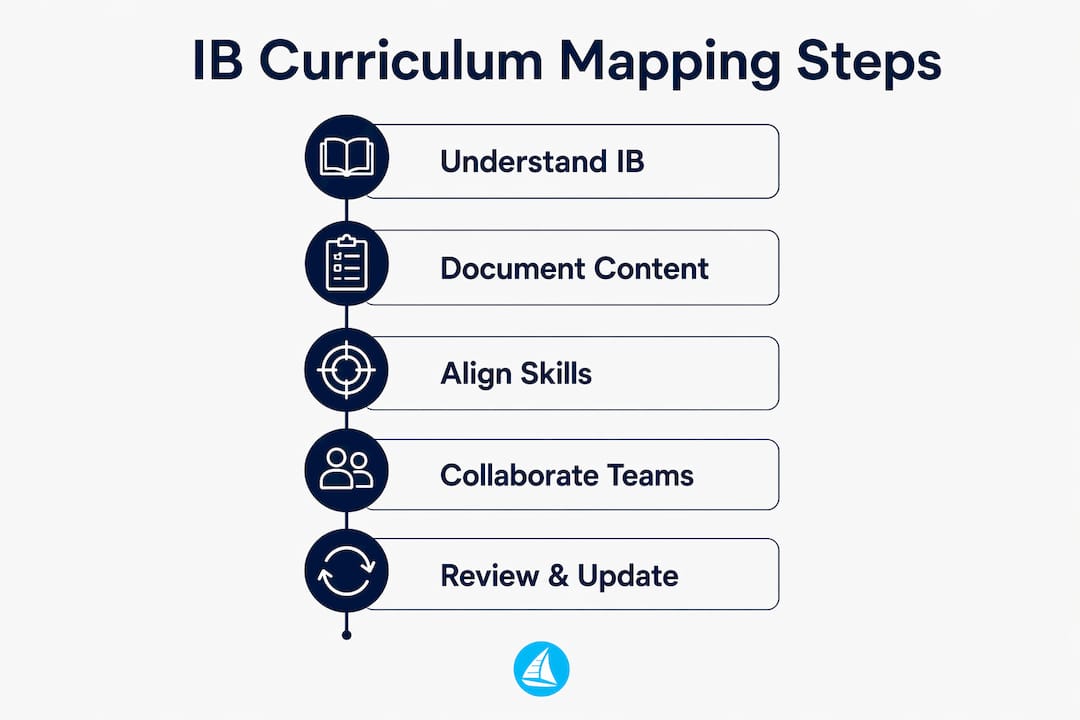
A practical implementation process follows these steps:
- Audit existing curriculum documents. Gather all current unit plans, assessment tasks, and scope-and-sequence documents across every subject and year group.
- Map content standards first. Starting with content standards before key concepts gives the map pedagogical integrity. Concepts are then layered on top of a solid content foundation.
- Identify vertical and horizontal connections. Cross-departmental teams review where skills and concepts recur, where gaps exist, and where unnecessary repetition occurs.
- Align with IB Standards and Practices. Frameworks such as Understanding by Design (UbD) support this stage, linking pedagogical intent to IB requirements.
- Use a shared digital platform. Collaborative tools allow all staff to view, update, and comment on the map in real time, reducing the silo effect that undermines whole-school coherence.
- Review and revise on a regular cycle. A completed map is a starting point, not a finished product. Annual reviews keep it accurate and useful.
Cross-programme collaboration from the very beginning is the single most important factor in a successful mapping process. When only one coordinator leads the work, the map reflects one perspective. When teachers from PYP, MYP, and DP science departments collaborate, the map reflects the whole school.
Pro Tip: Assign a curriculum mapping lead in each department and schedule protected time for cross-programme meetings at least once per term. Without dedicated time, mapping stalls.
What are the benefits and challenges of IB curriculum mapping?
The benefits of IB curriculum mapping reach every stakeholder in a school community. Curriculum mapping clarity shows teachers exactly what students have already learned and what comes next. That knowledge prevents redundant instruction and supports deliberate skill progression.
Key benefits include:
- Teachers gain a clear picture of the full learning arc, which improves lesson planning and assessment design.
- Students experience a coherent curriculum rather than a series of disconnected units.
- Parents gain transparency about what their child is learning and why, making home support far more purposeful.
- Schools meet IB Standards and external accreditation requirements more confidently, because the evidence of alignment is documented and visible.
“MYP curriculum mapping transforms chaotic planning into systematic, coherent student learning journeys instead of disjointed academic years. Unified, visual mapping ensures programme continuity in a way that isolated unit planning simply cannot.” — Expert insight cited by Michelle Connolly, IB Curriculum Resources
The challenges are real, though. Schools frequently encounter map fatigue when mapping is treated as a compliance exercise rather than a collaborative tool. Staff resistance increases when teachers feel the map is imposed on them rather than built with them. The complexity of aligning three distinct programmes simultaneously also demands sustained leadership commitment. Schools that succeed treat the map as a shared professional resource, not an administrative burden.
How can parents and educators use curriculum maps to support students?
A curriculum map is most useful when it moves beyond the staffroom and into everyday conversations between teachers, parents, and students. Mapping transforms planning from isolated units into coherent learning journeys, and that coherence is only realised when everyone understands what the map shows.
Practical ways to use curriculum maps effectively:
- Read the map as a learning roadmap. Identify which concepts and skills are being developed this term and how they connect to previous and future learning.
- Spot skill gaps early. If a student struggles with a particular ATL skill, the map shows where that skill is taught and reinforced, helping teachers target support.
- Align home support with mapped content. Parents who know their child is studying systems thinking in science can reinforce that thinking at home through everyday conversations and questions.
- Use the map in parent-teacher meetings. Referring to the curriculum map during meetings gives those conversations a shared, concrete reference point.
Teachers can also use IB biology teaching resources aligned to curriculum units to ensure that instructional materials match what the map specifies. Alignment between the map and the resources used in class is where the real benefit to students is felt.
Pro Tip: Ask your child’s teacher to share the unit overview from the curriculum map at the start of each term. Even a one-page summary gives parents a meaningful window into the learning ahead.
Key takeaways
IB curriculum mapping is the structured framework that connects content, concepts, skills, and assessment across all three IB programmes to create a coherent and progressive learning experience for every student.
| Point | Details |
|---|---|
| Definition of IB curriculum mapping | A whole-school process aligning content, ATL skills, and assessment across PYP, MYP, and DP. |
| Start with content standards | Map curriculum content before key concepts to build pedagogical integrity from the ground up. |
| Allow 12–18 months | Thorough curriculum alignment takes time; rushing produces gaps rather than coherence. |
| Involve all programmes early | Cross-programme collaboration from the outset prevents silos and builds shared ownership. |
| Use maps actively | Teachers and parents should read and refer to curriculum maps regularly, not just at review time. |
Why curriculum mapping is a living commitment, not a one-off task
I have seen schools invest months in building a beautiful curriculum map, then file it away and never open it again. That is the most common and most costly mistake in IB curriculum design.
The schools that get the most from their maps treat them as working documents. They update them after every unit review, revise them when IB subject guides change, and use them as the starting point for every new teacher induction. The map becomes the institutional memory of the curriculum.
What I find genuinely exciting is the direction technology is taking this work. Digital platforms now allow real-time visualisation of the whole curriculum, so a science coordinator can instantly see where systems thinking appears in Year 7 MYP and how it connects to DP Biology’s ecology units. That kind of visibility used to take weeks of manual cross-referencing. The future of IB curriculum mapping is dynamic, data-informed, and collaborative in ways that static spreadsheets simply cannot support.
The pitfall to avoid is treating mapping as a document rather than a dialogue. The map only improves student learning when teachers talk about it, question it, and update it together.
— Oliver
How Tibertutor supports students alongside the IB curriculum
When a school’s curriculum map is clear, students know what they need to learn and when. The next step is making sure they have the right resources to practise and consolidate that learning before exams.
Tibertutor is built specifically for IB science students in Biology, Chemistry, and Physics. The platform offers IB Biology mock exams, topic-specific tests, animated videos, and detailed notes, all aligned to the current IB syllabus. Progress tracking tools show students and parents exactly where strengths lie and where more practice is needed. For parents wanting to understand how Tibertutor fits alongside school-based learning, the IB parents hub offers clear guidance on supporting your child’s science preparation at home. Every resource is built by IB examiners, so the content matches what students will face in their actual assessments.
FAQ
What is IB curriculum mapping in simple terms?
IB curriculum mapping is the process of documenting what students learn across all IB programmes, showing how content, skills, and assessments connect across subjects and year groups. It helps schools plan coherently and avoid gaps or repetition in student learning.
How long does IB curriculum mapping take?
A thorough IB curriculum mapping process typically takes 12–18 months to complete. This timeframe allows for genuine cross-departmental collaboration and alignment with IB Standards and external accreditation requirements.
What is the difference between vertical and horizontal alignment in IB mapping?
Vertical alignment tracks how skills and concepts progress across year groups, while horizontal alignment maps connections between different subjects within the same year. Both are needed for a complete and coherent IB curriculum map.
How can parents use an IB curriculum map?
Parents can use curriculum maps to understand what their child is learning each term, identify skill areas that need extra support at home, and have more informed conversations during parent-teacher meetings.
Does IB curriculum mapping help with exam preparation?
Curriculum mapping clarifies the full scope of what students must know and be able to do by the time they reach DP assessments. When combined with targeted exam practice resources, it gives students a clear and structured path to exam readiness.