Homeschooling the IB curriculum: a guide for parents
Homeschooling the IB curriculum means following the International Baccalaureate Diploma Programme’s structured framework at home, but official IB exams require enrolment at an authorised IB World School. Many parents assume the IB Organisation allows private candidate registration, as other qualifications do. It does not. Understanding this distinction early shapes every decision you make about your child’s science education, from choosing resources to building school partnerships.
What is the IB science curriculum for homeschoolers?
The IB science curriculum covers three core subjects: Biology, Chemistry, and Physics. Each subject uses an inquiry-based approach that connects theory, laboratory work, and real-world applications. This interdisciplinary design is one reason IB sciences are so well regarded by universities worldwide.
Three components define the academic experience beyond the written exams:
- Internal Assessments (IAs): Individually designed investigations that count towards the final grade. They must be supervised and assessed by a registered IB teacher at an authorised school.
- Extended Essay (EE): A 4,000-word independent research paper. For science students, this is a genuine opportunity to go deep on a topic of personal interest.
- Theory of Knowledge (TOK): A philosophical course exploring how we know what we know. Science students examine the nature of scientific evidence and its limits.
These components cannot be self-supervised at home. IA and EE supervision must be arranged through IB World Schools, which is the most significant practical constraint for homeschooling families.
Pro Tip: When building your child’s transcript, document every topic covered, every lab completed, and every essay written. Admissions officers at universities use this detail to assess academic rigour when no official IB diploma is held.
Can homeschoolers sit IB exams independently?
Homeschoolers cannot register for IB exams as private candidates. The IB Organisation does not accept self-supervised internal assessments or independent registrations. This is a deliberate policy, not an administrative gap.
The contrast with other qualifications is significant:
| Qualification | Private candidate allowed? | School affiliation required? |
|---|---|---|
| IB Diploma Programme | No | Yes, IB World School |
| Cambridge International A-Level | Yes | No |
| Advanced Placement (AP) | Yes | No |
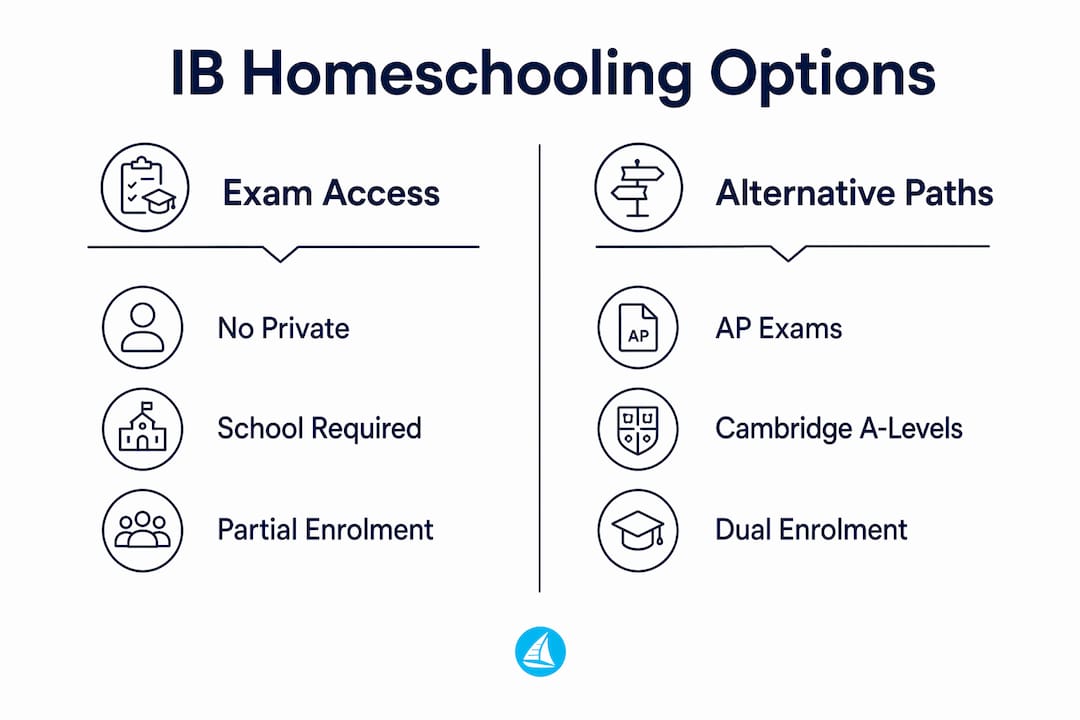
Cambridge and AP exams allow homeschoolers to register and sit papers without school enrolment. That flexibility makes them practical alternatives when IB World School access is limited.
There is one realistic pathway into official IB exams for homeschoolers: partial enrolment or satellite programmes. Some families negotiate arrangements directly with local IB World Schools, allowing their child to complete IAs and sit exams through the school while continuing to study at home. These arrangements are highly localised and rarely advertised publicly. You will need to contact schools directly and ask.
IB Diploma exams are administered in may and november each year. Registration deadlines are managed by the school, so any partial enrolment agreement must be in place well before the exam session.
Pro Tip: Contact IB World Schools in your area at least 12 months before your target exam session. Ask specifically about partial enrolment or exam-only arrangements. Policies vary widely between schools.
What alternatives complement IB science for homeschoolers?
When full IB access is not practical, Advanced Placement and Cambridge International A-Levels are the strongest alternatives. Both are accessible to homeschoolers without school enrolment and are recognised by universities globally.
Advanced Placement (AP)
- Offers science subjects including AP Biology, AP Chemistry, and AP Physics
- Exams are sat independently through College Board test centres
- AP scores can earn university credit in the United States and are recognised internationally
- Less emphasis on extended research projects compared to IB
Cambridge International A-Levels
- Widely recognised by UK, European, and international universities
- Private candidate registration is available through Cambridge Assessment International Education
- Covers Biology, Chemistry, and Physics at a depth comparable to IB
- Coursework requirements vary by subject and centre
Dual enrolment
Some homeschooling families enrol their child part-time at a local college or sixth form. This earns formal academic credit and provides access to laboratory facilities, which are difficult to replicate at home for science subjects.
Building detailed transcripts that describe course content, assessments, and outcomes is essential regardless of which pathway you choose. Universities need evidence of academic rigour, and a well-constructed transcript provides exactly that.
How to implement IB science curriculum at home effectively
Homeschooling families can follow the IB science framework closely using official IB subject guides, which are publicly available from the IB Organisation. These guides outline every topic, learning objective, and assessment criterion. They are the foundation of any home-based IB science programme.
- Download the official IB subject guides for Biology, Chemistry, and Physics. These define the syllabus your child needs to cover.
- Use Pamoja Education for structured online courses. Pamoja is an IBO-authorised provider that delivers IB courses remotely with qualified teacher support. This is the most direct route to supervised IB learning outside a traditional school.
- Arrange IA supervision early. Contact IB World Schools to discuss whether they will supervise your child’s internal assessments. Without this, your child cannot receive an official IB grade.
- Build a TOK and Extended Essay plan. Both components require sustained independent thinking. Set clear milestones across the academic year rather than treating them as end-of-year tasks.
- Use targeted online resources for exam preparation. Platforms built specifically for IB sciences provide structured exam practice that mirrors the real assessment format.
Successful IB homeschooling depends on strong support networks, trained educators, and reliable online platforms. The families who achieve the best outcomes combine official IB resources with specialist support and a clear plan for exam access.
Pro Tip: Treat the IB subject guide as your curriculum map and your exam specification at the same time. Every topic on the guide is a potential exam question. Cover it systematically, and your child will be prepared.
Key takeaways
Homeschooling the IB curriculum is achievable, but official IB exams require school affiliation through an IB World School, making early partnership planning the single most important step for parents.
| Point | Details |
|---|---|
| IB exams need school affiliation | Homeschoolers cannot register as private candidates; a partnership with an IB World School is required. |
| IAs and EE need qualified supervision | Internal Assessments and the Extended Essay must be supervised by registered IB teachers, not parents. |
| AP and Cambridge are strong alternatives | Both allow private candidate registration and offer rigorous science qualifications recognised by universities. |
| Pamoja Education provides remote IB courses | As an IBO-authorised provider, Pamoja delivers structured IB courses with teacher support for home-based learners. |
| Detailed transcripts matter | Thorough documentation of coursework and assessments supports university admission without a formal IB diploma. |
My honest view on homeschooling IB sciences
I have worked with many families who come to IB homeschooling with high ambitions and, understandably, some misconceptions. The most common is believing that following the IB syllabus at home is equivalent to earning the IB Diploma. It is not, and that gap matters for university applications.
That said, I do not think this should discourage you. The IB science curriculum is genuinely excellent. The inquiry-based approach, the depth of the subject guides, and the emphasis on real investigation build scientific thinking that AP and A-Level courses rarely match. Studying this material at home, even without the official diploma, gives your child a serious academic foundation.
The families I see succeed are the ones who plan early, build relationships with local IB World Schools, and do not try to do everything alone. Tap into IB-focused homeschool communities online. Connect with other parents who have navigated partial enrolment. And invest in quality resources that are built specifically for IB sciences, not adapted from general revision tools. Your child’s confidence in the exam room is built long before exam day.
— Oliver
How Tibertutor supports IB homeschooling families
Tibertutor is built specifically for IB science students and the parents who support them. Every resource on the platform is aligned to the IB Biology, Chemistry, and Physics syllabuses, created by examiners who know exactly what the assessments demand.
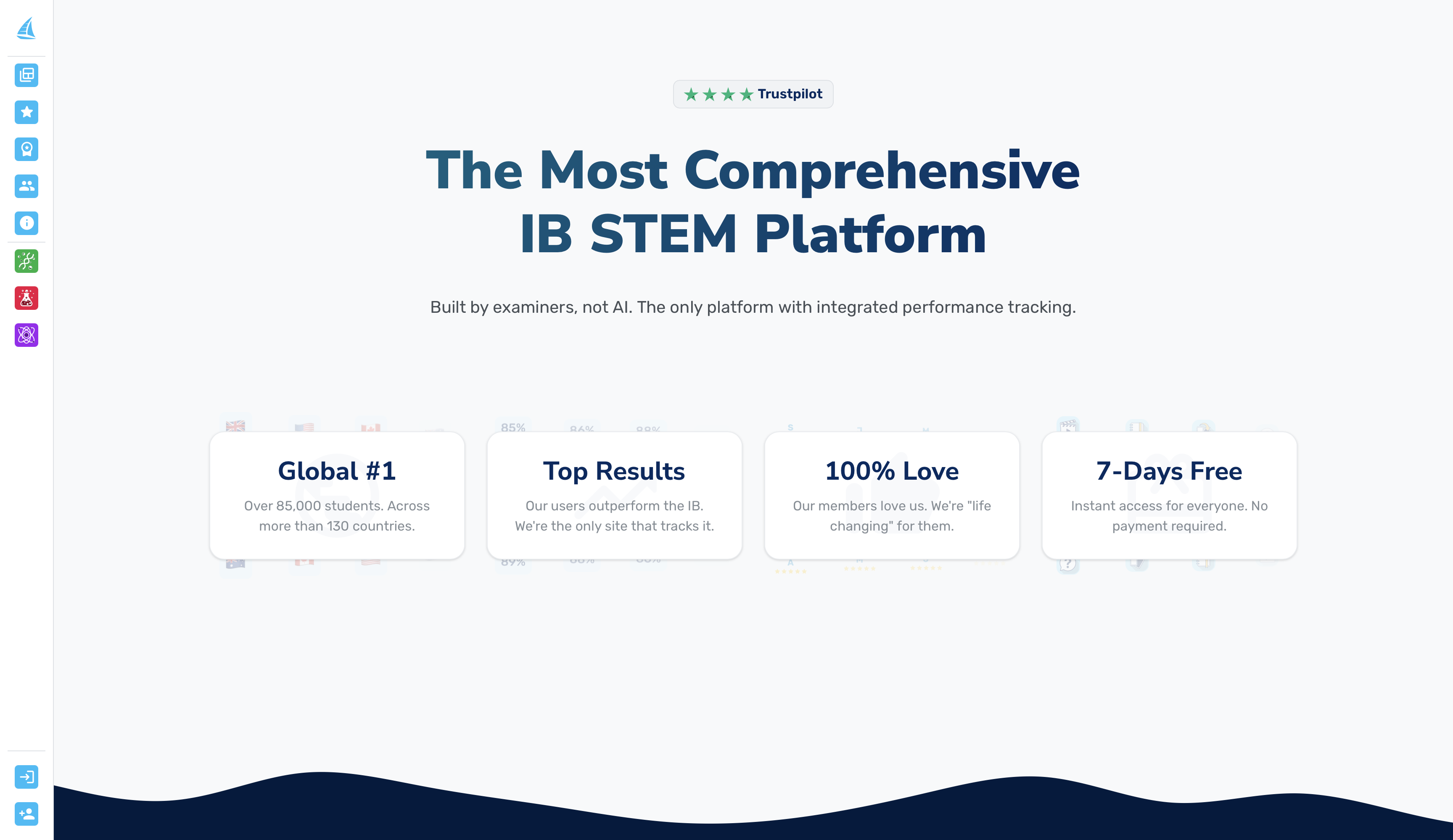
Parents using Tibertutor gain access to an IB science question bank with exam-style questions, animated videos, detailed notes, and mock exams. The platform’s progress tracking shows precisely where your child needs more practice, making home-based study focused and efficient. Whether your child is preparing for exams through a partial enrolment arrangement or building coursework for a transcript, Tibertutor provides the structured, exam-focused support that makes a real difference. Visit the IB parents section to see how the platform supports home-based IB science learning.
FAQ
Can homeschoolers take IB exams without a school?
No. The IB Organisation does not allow private candidate registration. Homeschoolers must enrol at an authorised IB World School, at least partially, to sit official IB exams.
What is the IB Diploma Programme’s structure for science?
The IB Diploma includes Biology, Chemistry, and Physics as Higher or Standard Level subjects, alongside core components including Internal Assessments, the Extended Essay, and Theory of Knowledge.
How do homeschoolers register for IB exams?
Registration is managed through an IB World School. Families must negotiate partial enrolment or a satellite arrangement with a local school well in advance of the may or november exam sessions.
Are AP or Cambridge A-Levels better for homeschoolers than IB?
AP and Cambridge A-Levels allow private candidate registration, making them more accessible for homeschoolers. Both are rigorous and widely recognised, though IB sciences offer a deeper inquiry-based approach.
What is Pamoja Education and how does it help?
Pamoja Education is an IBO-authorised online course provider that delivers IB courses remotely with qualified teacher support, making it one of the most practical options for homeschooling families pursuing the IB curriculum.