What does an IB score mean? A clear guide for students
An IB score is the total number of points a student earns across six subjects and two core components in the International Baccalaureate Diploma Programme, with a maximum of 45 points. Understanding what does ib score mean is the first step towards making sense of your results and planning your university application with confidence. The score is not a percentage, not a letter grade, and not a rank. It is a structured, criterion-based measure of academic achievement that universities worldwide use to assess readiness for higher education.
How is the IB score calculated?
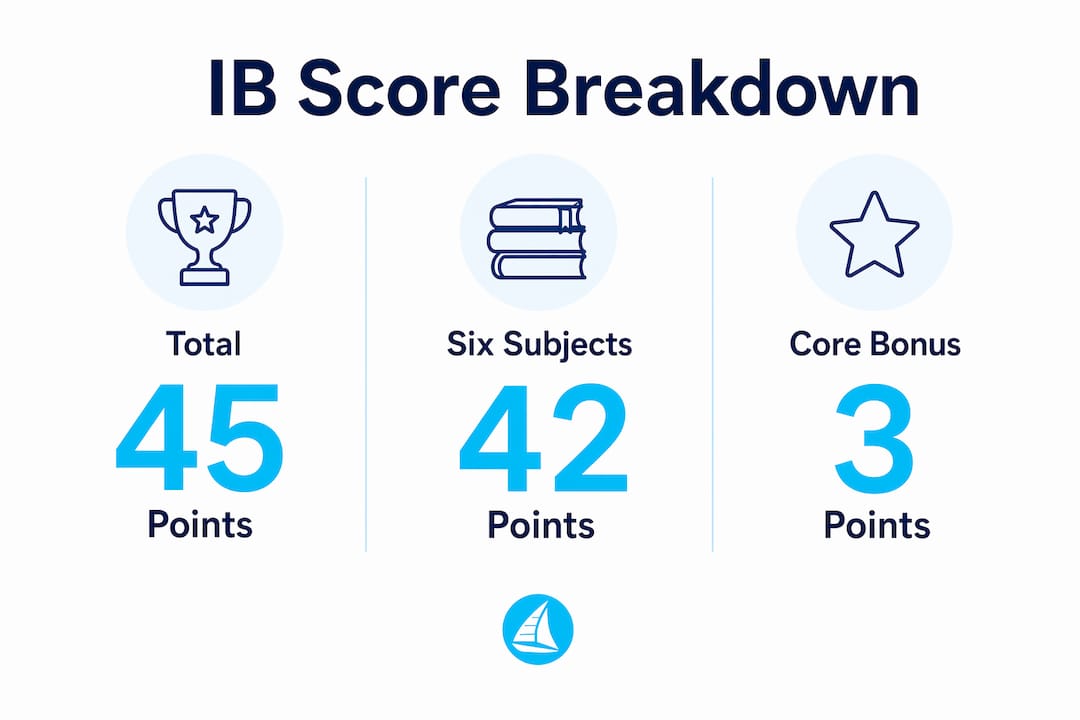
The IB total score system is built from two distinct parts. The first is your six subject grades, each scored on a scale of 1 to 7, giving a maximum of 42 points. The second is the core, which contributes up to 3 bonus points from Theory of Knowledge (TOK) and the Extended Essay (EE) combined.
The TOK and EE bonus points are awarded using a matrix. The grades you receive for each are combined to produce a single bonus score ranging from 0 to 3. Creativity, Activity, Service (CAS) is the third core component and is mandatory but ungraded. Failing to complete CAS can result in diploma failure regardless of your subject scores.

To be awarded the diploma, you need a minimum of 24 points, alongside meeting subject and core minimums. Global averages typically sit around 29 to 30 points, which gives a useful benchmark for where most students land.
| Component | Maximum points | Notes |
|---|---|---|
| Six subjects (graded 1–7 each) | 42 | Three Higher Level (HL), three Standard Level (SL) |
| TOK and Extended Essay (core) | 3 | Awarded via combined matrix |
| CAS | 0 | Mandatory; pass or fail only |
| Total | 45 | Minimum pass: 24 points |
Pro Tip: Do not overlook your TOK essay and Extended Essay. Three bonus points can be the difference between a 39 and a 42, which matters enormously at competitive universities.
For a deeper look at how IB science grading works across Biology, Chemistry, and Physics, Tibertutor has a dedicated guide worth reading alongside this one.
What does each IB grade from 1 to 7 actually mean?
Each subject grade reflects a qualitative level of achievement, not a raw percentage. The IB grading scale assigns descriptors to every level, so a 7 means “excellent” and a 1 means “very poor.” This is a criterion-based system, meaning students are assessed against defined standards rather than against each other.
Here is what each grade broadly represents:
- 7 Excellent performance; thorough understanding and consistent accuracy
- 6 Very good; minor gaps but strong overall command
- 5 Good; sound understanding with some errors
- 4 Satisfactory; the minimum passing grade per subject
- 3 Mediocre; limited understanding, significant errors
- 2 Poor; very limited achievement
- 1 Very poor; minimal engagement with the subject
A grade of 4 is the minimum acceptable in most subjects for diploma eligibility. Scoring a 3 or below in two or more subjects, or a 2 in any Higher Level subject, triggers automatic diploma failure regardless of your total points. This is why IB score interpretation must go beyond the headline number.
Pro Tip: When reviewing your results, check each subject grade individually before looking at your total. A total of 35 built on two 3s in HL subjects is far more concerning for university admissions than a 33 built on solid 5s and 6s.
How do universities interpret IB scores, especially for science courses?
IB score interpretation varies by institution, but a score of 38 or above is widely considered strong, and 40 or above is exceptional. For top-tier science programmes at institutions such as Oxford, Cambridge, or Imperial College London, offers routinely require 39 to 42 points with specific HL grade conditions attached.
Universities in the UK, in particular, place significant weight on HL subject grades rather than total points alone. A medical school might require 776 in HL subjects, meaning grades of 7, 7, and 6 across your three Higher Level choices. For students applying to science degrees, this makes your HL Biology, Chemistry, or Physics grade far more significant than your overall total.
| IB total score | Approximate equivalent | Typical university context |
|---|---|---|
| 40–45 | AAA* at A-Level | Oxbridge, Medicine, top Engineering |
| 36–39 | A*AA to AAA | Russell Group, competitive science degrees |
| 30–35 | ABB to BBB | Mid-tier universities, most undergraduate courses |
| 24–29 | CCC and below | Foundation year or less competitive entry |
For families also considering US admissions, Ivy League requirements for IB students typically expect 40 or above, with strong HL performance in relevant subjects. Choosing the right IB science courses at Higher Level is therefore a strategic decision, not just an academic one.
Common misconceptions about IB scores
Several misunderstandings about IB scores circulate among students and parents, and they can lead to poor planning.
- The IB score is not a percentage. A score of 40 out of 45 does not mean 89%. The criterion-based scale reflects qualitative achievement levels, not raw marks converted to a percentage.
- Core bonus points are not a separate grade. TOK and EE produce a combined bonus of 0 to 3 points. They do not appear as individual subject grades on your transcript.
- Meeting the 24-point minimum is not enough on its own. You must also satisfy subject minimums and complete CAS. Students have failed the diploma with 27 points because of a grade 2 in an HL subject.
- CAS cannot be ignored. It carries no points, but incomplete CAS results in diploma failure. Many students underestimate this until it is too late.
“Failing core elements can result in diploma failure despite strong subject scores.” — IB Diploma Passing Criteria, International Baccalaureate Organisation
How to use IB scores to plan your university application
Knowing the meaning of IB scores is only useful if you act on that knowledge. Here is a practical approach for students and parents:
- Identify your target universities and their IB requirements early. Most UK universities publish their IB offers on their admissions pages. Note both the total score and any HL grade conditions.
- Prioritise your HL subjects based on your intended course. If you want to study Medicine, Chemistry HL is non-negotiable. Strategic subject selection at the start of the IB is one of the highest-impact decisions you will make.
- Track your mock exam scores against your target. Mock results are the clearest predictor of final performance. Use them to identify which subjects need the most attention.
- Do not neglect TOK and the Extended Essay. Three bonus points are achievable with focused effort and can lift a 37 to a 40.
- Seek structured support for subjects where you are below target. Waiting until the final term is too late for meaningful improvement in sciences.
Pro Tip: Set a target score range rather than a single number. Aim for your “stretch” score, plan around your “realistic” score, and know your “safety” score. This gives your application strategy flexibility without complacency.
Key takeaways
The IB Diploma score is a structured 45-point system where subject grades and core components each play a distinct role, and universities assess both the total and individual HL grades when making admissions decisions.
| Point | Details |
|---|---|
| Maximum score is 45 | Six subjects contribute 42 points; TOK and EE add up to 3 bonus points. |
| Minimum pass is 24 points | Subject minimums and CAS completion are also required for diploma award. |
| Grade 4 is the subject pass mark | Grades of 3 or below in multiple subjects can trigger diploma failure. |
| HL grades carry extra weight | Universities, especially for science courses, assess HL grades alongside total score. |
| Score is not a percentage | The IB uses criterion-based grading, not a conversion from raw marks. |
Why IB scores matter more than most students realise
I have worked with hundreds of IB science students, and the same pattern appears repeatedly. Students focus almost entirely on their predicted total score and overlook the HL grade conditions attached to their university offers. A student with a predicted 38 who has a 5 in Chemistry HL will often lose their place at a competitive medical school to a student with a predicted 36 who holds a 7 in Chemistry HL. The total score is the headline, but the HL grades are the story.
What I find equally important, and what parents sometimes miss, is that academic excellence extends well beyond the number on results day. The curiosity, resilience, and intellectual confidence a student builds through the IB process are what carry them through university and beyond. A student who genuinely engages with their Extended Essay, who pushes through a difficult Chemistry topic rather than skipping it, is developing something that no score fully captures.
That said, scores do matter practically. They open or close doors. My advice to parents is to hold both truths at once. Support your child in reaching their target score with real focus and preparation. And remind them, on the hard days, that the process of getting there is building something lasting.
— Oliver
How Tibertutor helps you reach your target IB score
Understanding your IB score is the starting point. Reaching your target is where the real work begins. Tibertutor is built specifically for IB science students in Biology, Chemistry, and Physics, offering exam-style questions, animated videos, detailed notes, and mock exams all aligned to the current syllabus. Every resource is created by experienced IB examiners, so you practise exactly what the assessment rewards.
Whether you are a student aiming for a 7 in Chemistry HL or a parent seeking structured support for your child’s revision, Tibertutor’s IB science question bank gives you the tools to identify weaknesses, build confidence, and improve systematically. Explore the full range of student resources and parent support to find the right fit for your goals.
FAQ
What is the maximum IB score a student can achieve?
The maximum IB score is 45 points: 42 from six subjects graded 1 to 7, plus up to 3 bonus points from Theory of Knowledge and the Extended Essay combined.
What is a good IB score for university admissions?
A score of 38 or above is considered strong for most competitive universities. Scores of 40 or above are typically required for top-tier programmes such as Medicine at Oxford or Cambridge, alongside specific HL grade conditions.
Can you fail the IB Diploma even with a high total score?
Yes. Diploma failure can occur if a student scores a grade 2 or below in any Higher Level subject, scores grade 1 in any subject, or fails to complete CAS, regardless of their overall total.
How do IB HL grades affect university offers in science?
UK universities offering competitive science courses frequently specify HL grade patterns such as 776 or 777. A strong total score with weak HL grades in the relevant science subject will not satisfy these conditions.
Is an IB score the same as a percentage?
No. The IB uses a criterion-based grading system scored out of 45. It does not convert directly to a percentage, and a score of 40 does not mean 89% in the way a percentage-based system would imply.