IB Physics syllabus: the complete 2026 guide for students
The IB Physics syllabus is defined as a structured framework of five mandatory themes that form the foundation for both Standard Level and Higher Level study in the International Baccalaureate Diploma Programme. Both SL and HL students cover the same five themes, but differ significantly in teaching hours, content depth, and exam complexity. Practical work and the Internal Assessment sit alongside theory as core components of the course, together accounting for a meaningful share of the final grade. Understanding the syllabus structure from the outset is the single most effective step any student, parent, or educator can take to build a confident, well-directed revision plan.
What are the five themes of the IB Physics syllabus?
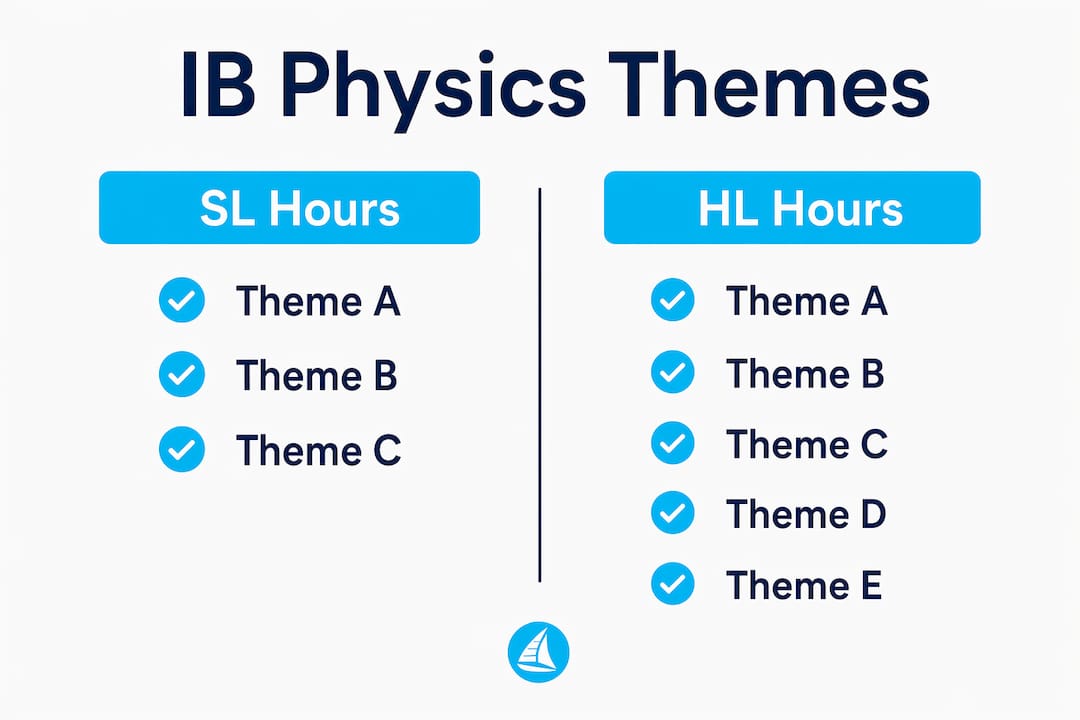
The current IB Physics syllabus is organised into five themes, each covering distinct areas of physics with specific teaching hour allocations for SL and HL.
- Theme A: Space, Time and Motion. Covers kinematics, forces, energy, momentum, and special relativity. Allocated 27 hours at SL and 42 hours at HL.
- Theme B: The Particulate Nature of Matter. Includes thermal physics, gas laws, and electric circuits. Allocated 24 hours at SL and 32 hours at HL.
- Theme C: Wave Behaviour. Addresses wave properties, light, sound, and interference. Allocated 17 hours at SL and 29 hours at HL.
- Theme D: Fields. Covers gravitational, electric, and magnetic fields, including HL extensions into electromagnetic induction. Allocated 19 hours at SL and 38 hours at HL.
- Theme E: Nuclear and Quantum Physics. Explores atomic structure, radioactive decay, fission, fusion, and quantum concepts. Allocated 23 hours at SL and 39 hours at HL.
Beyond the five themes, the syllabus allocates 40 hours of practical work at SL and 60 hours at HL. The total teaching time is 150 hours for SL and 240 hours for HL. Theme A and Theme D carry the highest hour allocations at HL, which directly reflects their weight in the final examinations. Students who allocate revision time proportionally to these hours consistently perform better than those who treat every topic equally.
| Theme | SL hours | HL hours |
|---|---|---|
| A: Space, Time and Motion | 27 | 42 |
| B: The Particulate Nature of Matter | 24 | 32 |
| C: Wave Behaviour | 17 | 29 |
| D: Fields | 19 | 38 |
| E: Nuclear and Quantum Physics | 23 | 39 |
| Practical work | 40 | 60 |
| Total | 150 | 240 |
How does SL differ from HL in the IB Physics curriculum?
The most significant difference between SL and HL is teaching time. SL students receive 150 hours of instruction; HL students receive 240 hours. That additional 90 hours is not spent on separate topics. Instead, HL students study the same five themes with greater depth, more complex mathematical treatment, and extended content within each theme.

The redesigned syllabus removed the old optional topics entirely. First examined in may 2025, the new structure means all students share a common core of knowledge, while HL extensions are integrated directly into each theme. This change makes the curriculum more cohesive and removes the unpredictability of optional topic selection.
HL exams feature longer papers and questions that require multi-step reasoning, synthesis across themes, and stronger time management. SL questions test understanding and application, but rarely demand the same level of mathematical manipulation. For educators planning schemes of work, this distinction shapes how much time to spend on derivations, proofs, and extended problem solving at each level.
Pro Tip: If you are an HL student, practise multi-step calculation questions under timed conditions from the start of Year 2. The extra complexity at HL is manageable with consistent practice, but it rewards students who build speed early.
What are the practical and IA requirements in IB Physics?
Practical work is not optional or peripheral. The Collaborative Science Project and Scientific Investigation each receive 10 dedicated hours for both SL and HL students. The Collaborative Science Project develops teamwork and shared enquiry skills. The Scientific Investigation forms the basis of the Internal Assessment.
The Internal Assessment accounts for 20% of the final IB Physics grade. That weighting makes it one of the most impactful single components of the course. The IA requires students to design and carry out an original investigation, collect data, and analyse results with attention to uncertainty and error.
Key guidance for a strong IA:
- Choose a topic where you can collect high-quality, repeatable data rather than a complex or impressive-sounding setup.
- Focus your analysis on uncertainty and what your data actually shows, not on the sophistication of the apparatus.
- Start planning early. Students who begin their IA in the first term of Year 2 consistently produce stronger work than those who leave it late.
- Use the IA types guide to understand the full range of investigation formats available.
Pro Tip: Examiners reward depth of analysis over complexity of experiment. A simple pendulum investigation with rigorous uncertainty analysis will outscore an elaborate setup with shallow conclusions.
How should students use the syllabus for exam preparation?
The syllabus is the most reliable IB Physics study guide available, and most students underuse it. Treat it as a weighted roadmap, not a flat checklist. Themes with more teaching hours carry more exam weight, so revision time should reflect those proportions.
Effective exam preparation follows a clear sequence:
- Map the syllabus. Print or download the full syllabus and mark each learning objective as confident, developing, or not yet started. This gives you an honest picture of where to focus.
- Master command terms. Misunderstanding command terms costs marks more often than gaps in content knowledge. “State” requires a brief factual answer; “evaluate” demands a judgement with supporting evidence. Knowing the difference is non-negotiable.
- Practise past papers by topic. Work through IB Physics past papers organised by theme rather than by year. This builds targeted confidence and reveals patterns in how each topic is examined.
- Review mark schemes critically. Mark schemes show exactly what examiners expect. Comparing your answers to mark scheme language trains you to write in the style that earns full marks.
- Use timed mock conditions. Structured timed practice builds the consistency and exam confidence that passive note review cannot replicate.
Pro Tip: Build your IB study schedule around the syllabus hour allocations. If Theme D has twice the hours of Theme C at HL, your revision calendar should reflect that ratio.
Key takeaways
The IB Physics syllabus rewards students who understand its structure, respect its weightings, and practise with genuine exam technique rather than passive revision.
| Point | Details |
|---|---|
| Five mandatory themes | All SL and HL students study Themes A through E; HL adds depth, not separate topics. |
| Teaching hours guide revision | Allocate study time proportionally: Theme A and D carry the highest hour counts at HL. |
| IA is worth 20% | Start early, prioritise data quality and uncertainty analysis over experimental complexity. |
| Command terms are critical | Misreading a command term loses marks even when content knowledge is sound. |
| Past papers beat passive notes | Timed, topic-focused past paper practice builds the exam confidence that reading alone cannot. |
What separates a 7 from a 5 in IB Physics
The IBO describes physics as the most fundamental experimental science, and that framing matters. Top-scoring students do not simply memorise facts. They understand why models work, where they break down, and how physicists construct knowledge claims. That conceptual shift is what separates a 7 from a 5.
In my experience working with IB Physics students, the most common reason for underperformance is not weak content knowledge. It is poor exam technique, particularly misreading command terms and running out of time on longer papers. A student who writes a beautifully detailed explanation when the question says “state” will score zero for that part. That is a painful and entirely avoidable loss.
For parents and educators, the most useful thing you can do is help students engage with the syllabus actively and early. Encourage them to use it as a checklist, to practise past papers regularly, and to treat the IA as an opportunity rather than an obstacle. Students who plan their IA well and start it early arrive at the final exams with one less source of stress, and that composure shows in their results.
Tibertutor’s IB Physics question bank for targeted revision
Knowing the syllabus is the first step. Practising it is where confidence is built.
Tibertutor’s IB Science Questionbank is built around the current IB Physics syllabus, with exam-style questions mapped directly to each of the five themes. Students can practise by topic, track their progress, and identify exactly where they need more work. Parents and educators can monitor performance through detailed analytics, making it straightforward to offer targeted support. Whether you are preparing for Paper 1, Paper 2, or refining your IA analysis skills, Tibertutor gives you the practice tools that align with what the examiner actually expects.
FAQ
What are the five themes in the IB Physics syllabus?
The five themes are: A (Space, Time and Motion), B (The Particulate Nature of Matter), C (Wave Behaviour), D (Fields), and E (Nuclear and Quantum Physics). All five are compulsory for both SL and HL students.
How many teaching hours does IB Physics require?
SL students receive 150 teaching hours and HL students receive 240 hours, including practical work. The additional HL hours cover greater depth within the same five themes.
How much is the IB Physics IA worth?
The Internal Assessment accounts for 20% of the final IB Physics grade. It requires an original scientific investigation with a strong focus on data quality and uncertainty analysis.
What are IB Physics command terms and why do they matter?
Command terms are specific instruction words used in exam questions, such as “state”, “explain”, or “evaluate”. Misunderstanding command terms is one of the most common causes of lost marks, even when a student knows the content well.
Where can I find IB Physics past papers?
IB Physics past papers are available through the IBO’s official resources and through platforms such as Tibertutor, which organises questions by syllabus theme for targeted revision practice.
— Oliver