
IB Chemistry Syllabus 2026: SL vs HL, IA Rules, and Exam Papers
The IB Chemistry syllabus is defined by two organising themes, structure and reactivity, which together frame every topic, practical activity, and assessment in the course. This conceptual framework connects the nature of matter directly to how and why chemical reactions occur. For students preparing for 2026 assessments, understanding this framework is the single most important starting point. The syllabus has also undergone significant changes, removing Paper 3 and the options topics entirely, making it more focused and demanding in equal measure.
What are the core themes of the IB Chemistry syllabus?
The IB Chemistry curriculum is built around two themes that are deliberately interconnected. Structure determines reactivity, which in turn transforms structure. This is not just a philosophical statement. It is the organising logic behind every topic you will study.
Structure covers the nature of matter from subatomic particles through to complex molecular forms. It includes atomic theory, ionic and covalent bonding, intermolecular forces, and the periodic table. Reactivity covers the causes and mechanisms of chemical change, including kinetics, equilibrium, acids and bases, electrochemistry, and organic reactions.
The table below shows how key subtopics are distributed across both themes.
| Structure | Reactivity |
|---|---|
| Atomic structure and electron configuration | Kinetics and rate of reaction |
| Ionic, covalent, and metallic bonding | Chemical equilibrium and Le Chatelier’s principle |
| Intermolecular forces and states of matter | Acids, bases, and pH calculations |
| Molecular geometry and polarity | Electrochemistry and redox reactions |
| Organic functional groups and nomenclature | Organic reaction mechanisms (HL) |
High-achieving students build a concept-map loop connecting structure models immediately with reactivity consequences. Treating these subtopics as isolated units is the most common reason students plateau at mid-range grades.
How has the IB Chemistry assessment changed for 2026?
The 2026 assessment format is meaningfully different from what older revision guides describe. Paper 3 and all options topics have been removed, and the external assessment now consists of two papers only. This simplifies the structure but raises the stakes on core content mastery.
The key assessment changes are as follows:
- Paper 1 covers multiple-choice questions and data-based analysis drawn from across both themes.
- Paper 2 consists of short-answer and extended-response questions requiring deeper conceptual explanation.
- The Internal Assessment (IA) is a student-chosen scientific investigation of up to 3,000 words, worth 20% of the final grade.
- Conclusion and evaluation now account for 50% of IA marks, placing greater weight on scientific reasoning than on data collection alone.
- Databases and simulations are now accepted as the basis for an IA, meaning students are not limited to hands-on laboratory experiments.
The removal of options topics means there is nowhere to hide. Exam success requires consistent coverage of both core themes rather than selective revision of one or two favourite areas.
Pro Tip: Update your study plan to reflect the new two-theme structure before you open a single revision resource. Older topic lists organised around Topics 1 to 11 no longer match the current syllabus and will cost you time.
What changed in the IB Chemistry syllabus: 2023 to 2026
The 2026 syllabus reorganised Chemistry around the reforms first introduced from 2023.
| Element | Previous cycle | 2026 syllabus |
|---|---|---|
| Options topics | Assessed via Paper 3 | Removed entirely |
| External papers | Three papers | Two papers only |
| IA data sources | Primarily hands-on lab work | Databases and simulations also accepted |
According to the IBO Chemistry subject page, the reforms aim to strengthen inquiry skills and build deeper conceptual understanding rather than broad topic coverage. If your revision resource still lists Topics 1 to 11 or references Paper 3, it predates this reorganisation and will not match what the 2026 exams actually test.
How do SL and HL differ in the IB Chemistry curriculum?
Both Standard Level and Higher Level students study the same two core themes, but HL students go considerably further in depth and breadth. Starting from official subject briefs is critical to avoid spending weeks on outdated or unofficial topic lists following the 2023 reorganisation.
The comparison below outlines the main differences between SL and HL.
| Area | Standard Level (SL) | Higher Level (HL) |
|---|---|---|
| Teaching hours | 150 hours | 240 hours |
| Organic chemistry | Functional groups and basic reactions | Advanced mechanisms including nucleophilic substitution |
| Transition metals | Not included | Included, with ligand theory and colour |
| Equilibrium | Core calculations | Additional treatment of Kc and Kp |
| Assessment focus | Core conceptual understanding | Extended analytical and evaluative responses |
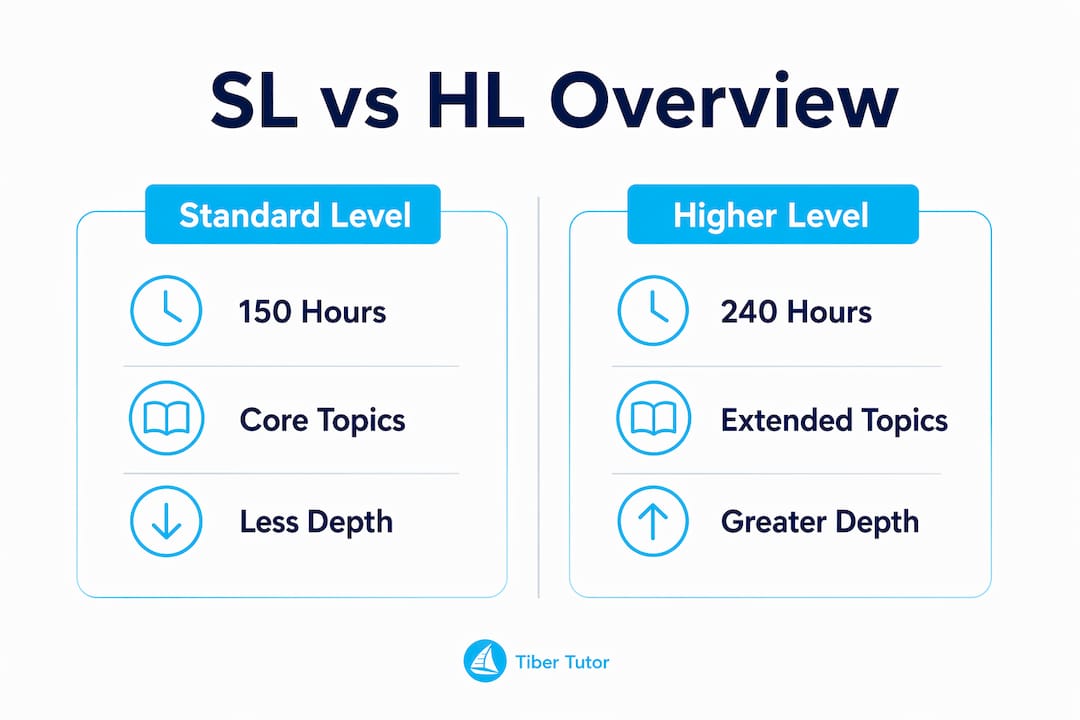
HL students encounter transition metal chemistry and advanced organic mechanisms as significant extensions. These topics appear in Paper 2 extended-response questions and reward students who can connect bonding theory directly to reaction behaviour. For a broader comparison of IB science course structures, it helps to see how Chemistry sits alongside Biology and Physics in the Diploma Programme.
How can students prepare effectively for IB Chemistry assessments?
Effective preparation for International Baccalaureate Chemistry is built on connecting concepts rather than memorising them in isolation. Building explanatory models that link bonding and molecular structure to reaction behaviour produces deeper understanding and better exam performance than rote learning ever will.
Here are the most effective revision and study practices:
- Map each structure subtopic to its reactivity consequence as you study it. For example, link polarity of bonds directly to solubility and reaction type.
- Practise past papers with a focus on data interpretation and extended-response questions, not just multiple-choice recall.
- Use a structured study schedule that allocates time to both themes equally across the academic year.
- Begin your IA planning early. Students who start their research question in the first term of Year 2 consistently produce stronger investigations.
- Review mark schemes after every practice paper to understand the precise language examiners reward.
Pro Tip: When practising extended-response questions, write your answer and then check it against the mark scheme before looking at model answers. This trains you to self-assess, which is exactly the skill the IA rewards.
What practical skills are central to IB Chemistry success?
Practical work is central to the Chemistry course, not an optional add-on. The course includes a range of activities from guided experiments to open inquiry investigations, and these feed directly into both the IA and the analytical skills tested in Paper 2.
The IA is assessed across five criteria: personal engagement, exploration, analysis, evaluation, and communication. Of these, evaluation carries the greatest weight, requiring students to assess their methodology critically and link evidence clearly to conclusions.
The practical skills that matter most are:
- Identifying and quantifying sources of error in experimental data.
- Handling and presenting data with appropriate significant figures and units.
- Drawing evidence-based conclusions that directly address the research question.
- Evaluating the reliability and validity of methods, not just reporting results.
- Communicating scientific reasoning in precise, structured prose.
Common student challenges include underestimating the evaluation section and writing conclusions that describe results rather than explain them. An experimental reasoning checklist covering uncertainties, evaluation language, and evidence-to-conclusion links is one of the most practical tools you can build before starting your IA.
Pro Tip: Choose an IA topic that genuinely interests you. Personal engagement is an assessed criterion, and examiners can tell the difference between a student who is curious about their question and one who picked a topic for convenience.
Key takeaways
The IB Chemistry syllabus is best mastered by understanding that structure and reactivity are not separate topics but two sides of the same conceptual framework, and that the 2026 assessment rewards this connected thinking directly.
| Point | Details |
|---|---|
| Two organising themes | All content and assessments are built around structure and reactivity, not isolated topic lists. |
| 2026 assessment format | Two external papers only; Paper 3 and options topics have been removed entirely. |
| IA weight and focus | The scientific investigation is worth 20% of the final grade, with 50% of IA marks on evaluation. |
| SL vs HL scope | HL adds transition metals, advanced organic mechanisms, and 90 additional teaching hours. |
| Preparation approach | Connect structure to reactivity concepts actively; start IA planning early in Year 2. |
Why connecting concepts is the real skill the syllabus tests
I have worked with IB Chemistry students across many cohorts, and the pattern is consistent. Students who struggle are almost always treating the syllabus as a list of facts to memorise. Students who thrive are the ones who ask “why does this structure behave this way?” every time they encounter a new topic.
The removal of options topics is, in my view, a positive change. It forces students and teachers to engage deeply with the core themes rather than retreating into a narrow specialisation. The two-paper format is more demanding precisely because there is no safety net of a favourite option to fall back on.
The IA change is equally significant. Allowing databases and simulations opens up genuinely interesting research questions that were previously impossible in a school laboratory. I have seen students produce outstanding investigations using publicly available spectroscopic data and climate chemistry datasets. The key is starting early and treating the evaluation section with the same rigour you would give a Paper 2 extended response.
My honest advice: read the IB Chemistry guide before you read any third-party revision resource. Know what the syllabus actually asks before you decide how to study it.
— Oliver
Strengthen your IB Chemistry preparation with Tibertutor
Tibertutor is built specifically for IB science students preparing for exactly this kind of updated, concept-driven syllabus. The platform offers exam-style questions mapped to the 2026 structure and reactivity themes, animated instructional videos, detailed notes, and mock exams with personalised progress tracking. Every resource is created by experienced IB examiners who understand what the new assessment format rewards. Whether you are a student building confidence in organic mechanisms or a parent looking for structured support, Tibertutor gives you the tools to prepare with clarity and purpose. Explore the IB Chemistry question bank and see how targeted practice translates into real exam readiness.
FAQ
What does the IB Chemistry syllabus cover?
The IB Chemistry syllabus covers two core themes: structure and reactivity. Topics include atomic theory, bonding, kinetics, equilibrium, acids and bases, electrochemistry, and organic chemistry, with HL students studying additional content such as transition metals and advanced organic mechanisms.
How many papers are in the IB Chemistry exam in 2026?
The 2026 assessment consists of two external papers. Paper 1 includes multiple-choice and data analysis questions; Paper 2 covers short-answer and extended-response questions. Paper 3 and all options topics have been removed.
How long is the IB Chemistry Internal Assessment?
The IA is a scientific investigation of up to 3,000 words and is worth 20% of the final grade. Students choose their own research question, and 50% of the IA marks are allocated to conclusion and evaluation.
What is the difference between IB Chemistry SL and HL?
SL requires 150 teaching hours and covers core content across both themes. HL requires 240 hours and includes additional topics such as transition metal chemistry, advanced organic reaction mechanisms, and more complex equilibrium calculations.
Can I use a database or simulation for my IB Chemistry IA?
Yes. The 2026 syllabus explicitly allows students to base their IA on library databases or computer simulations rather than hands-on laboratory experiments, opening up a wider range of research questions.