
IB Sequences and Series: Formulas, Examples and Exam Tips
A sequence is a list of numbers that follows a rule. A series is what you get when you add those numbers together. In IB Mathematics, the whole topic comes down to two patterns, arithmetic and geometric, and a handful of formulas you must be able to choose between quickly. With the right method and plenty of exam-style practice, it becomes one of the most reliable topics for earning marks. At Tiber Tutor, our IB Maths resources are written by actual IB examiners, so you practise the way the exam asks.
TL;DR
- A sequence is an ordered list of terms; a series is the sum of those terms. Both can be finite or infinite.
- Test differences first (arithmetic), then ratios (geometric). Then plug into the right formula.
- Infinite geometric sums only exist when |r| < 1.
- Most lost marks come from using n instead of n − 1, mixing up the two formulas, and ignoring the convergence condition.
- Practise with exam-style questions and mark schemes, and track which sub-skills still cost you marks.
Table of Contents
- What sequences and series are
- Where it sits in the syllabus
- Arithmetic sequences: the constant difference
- Geometric sequences: the constant ratio
- Infinite geometric series
- A reliable method for exam questions
- Common mistakes to avoid
- Practising it properly
- Perspective
- Try it with a free trial
- FAQ
- Sources
What sequences and series are
Oxford’s IB course book describes a sequence as a list of numbers in a defined order following a rule. Each number is a term. Add the terms and you have a series.
Both can stop or carry on forever. The list 7, 5, 3, 1, −1, −3 is finite, and 7 + 5 + 3 + 1 − 1 − 3 = 12 is a finite series. By contrast, 1 + 3 + 9 + 27 + 81 + … never ends, so it is an infinite series.
Two ways of defining a sequence appear in IB work. A recursive definition links each term to the one before, for example u(n+1) = 3u(n). A deductive rule gives any term directly from its position n. Exam questions usually want the second kind.
Where it sits in the syllabus
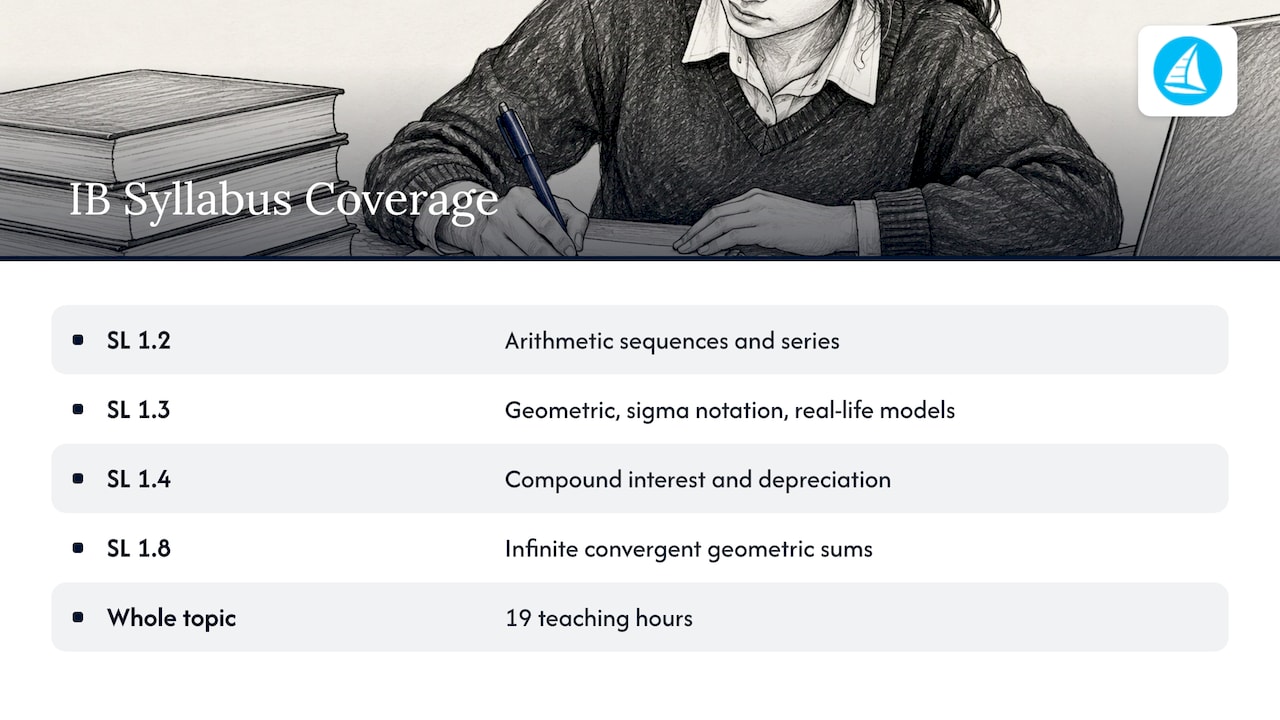
In the IB Analysis and Approaches guide, SL 1.2 covers arithmetic sequences and series, and SL 1.3 covers geometric ones, including sigma notation and real-life models such as simple interest, population growth and salary change. These sections are common to AA and AI at SL. SL 1.4 adds compound interest and depreciation, and SL 1.8 covers sums of infinite convergent geometric sequences. The guide recommends 19 teaching hours for the whole number and algebra topic.
The syllabus is changing. For the course first examined in May 2029, the IB has confirmed that financial applications are removed from AA at SL and HL. Students sitting the current course are examined on it until November 2028, so check which course you are on.
Arithmetic sequences: the constant difference
If consecutive terms differ by the same amount, the sequence is arithmetic. That amount is the common difference, d. OpenStax gives the nth term as a₁ + d(n − 1), which the IB writes as:
u(n) = u(1) + (n − 1)d
You start at the first term and add d a total of n − 1 times. That is why it is n − 1, not n.
The sum of the first n terms has two forms, both in the IB chapter:
- S(n) = n/2 (u(1) + u(n)), when you know the last term
- S(n) = n/2 [2u(1) + (n − 1)d], when you do not
Worked example. An arithmetic sequence starts 5, 8, 11, … Find the 20th term and the sum of the first 20 terms.
- d = 8 − 5 = 3.
- u(20) = 5 + 19 × 3 = 62.
- S(20) = 20/2 × (5 + 62) = 10 × 67 = 670.
Geometric sequences: the constant ratio
If each term is the previous one multiplied by the same number, the sequence is geometric. That number is the common ratio, r. The nth term is u(n) = u(1) × r^(n−1). The same source notes that when r is negative, the signs alternate, and that terms shrink when r lies between 0 and 1.
The finite sum is S(n) = u(1)(rⁿ − 1)/(r − 1), which is in the IB formula booklet. Check the booklet you receive in the exam rather than relying on memory.
Worked example. A geometric sequence has u(1) = 4 and r = 3. Find u(6).
u(6) = 4 × 3⁵ = 4 × 243 = 972.
Infinite geometric series
An infinite geometric series has a sum only if the terms shrink towards zero, which means |r| < 1. The sum is:
S∞ = u(1) / (1 − r)
Example: 8 + 4 + 2 + 1 + … has u(1) = 8 and r = 0.5. Since |0.5| < 1, S∞ = 8 / 0.5 = 16.
The IB attaches a theory of knowledge question to this content, asking whether we can know things we cannot experience, such as infinity. In practice, that means you should state why the series converges, not just apply the formula. Write “|r| < 1, so the sum to infinity exists” and you collect the reasoning mark.
A reliable method for exam questions
A two-step routine works for almost every question. First test differences, then ratios. Equal differences mean arithmetic. Equal ratios mean geometric. If neither is constant, it is neither.
Then follow this order:
- Write down what you are given: u(1), d or r, n, and which term or sum is wanted.
- Choose the formula and write it before substituting.
- Substitute carefully, using brackets around negative values.
- Check the answer makes sense. Does a decreasing sequence give a smaller 20th term?
When a question gives two terms, such as u(3) = 12 and u(7) = 48, write two equations and solve them together. For geometric sequences, divide one by the other to eliminate u(1).
Common mistakes to avoid
- Using n instead of n − 1. The first term has zero steps from itself.
- Mixing the formulas. Adding d belongs to arithmetic, multiplying by r to geometric.
- Forgetting the convergence condition. If |r| ≥ 1, there is no infinite sum.
- Sign slips with negative d or r. Use brackets.
- Rounding too early. Keep full values on your calculator and round at the end.
- Skipping the sigma limits. In Σ notation, the lower and upper limits tell you how many terms there are.
Practising it properly
Reading formulas is not the same as scoring marks. You need exam-style questions, examiner mark schemes to compare against, and a clear picture of which sub-skills still lose you marks. On Tiber Tutor, the IB Maths AA questions sit alongside notes, definitions, flashcards and topic tests, so you can move from learning a formula to testing it without leaving the platform. Our cram sheets give you the key formulas for a final review.

Student-led answer review lets you mark your own working against the examiner mark schemes, and syllabus monitoring and performance analytics show which topics need more time. That matters for parents and teachers too, who can see progress rather than guess at it.
Perspective
Sequences and series reward students who are methodical. The idea is simple, but the marks go to those who write the formula, show each substitution and justify convergence. That is exactly how an examiner reads a script.
We built our IB Maths content with that in mind. Our resources are written by actual IB examiners, and the questions, notes, videos, flashcards and tests are linked so that a mistake in one place points you to the right revision in another. Our progress tracking and performance insights are, as far as we know, not matched by any other IB STEM platform.
For the price, we believe that is the best value available: examiner-written material across Maths, Biology, Chemistry and Physics, in one place, from $9 a month for a single subject.
Oliver
Try it with a free trial
Tiber Tutor offers a free 7-day trial, then the Per-Subject Plan at 9 $ per month or the All-Access Plan at 19 $ per month. Memberships are also available as 6-month, yearly or full-course (24 month) options. See the plans and pricing, or find out more for IB students and for parents.

FAQ
What is the difference between a sequence and a series?
A sequence is an ordered list of terms, such as 2, 4, 6, 8. A series is the sum of those terms, such as 2 + 4 + 6 + 8 = 20. Both can be finite or infinite.
How do I know if a sequence is arithmetic or geometric?
Subtract consecutive terms. If the difference is always the same, it is arithmetic. If not, divide consecutive terms. A constant ratio means it is geometric.
When does an infinite geometric series have a sum?
Only when |r| < 1, because then the terms get smaller and smaller. The sum is u(1) / (1 − r). If |r| is 1 or more, the series diverges and has no sum.
Is this topic the same in AA and AI?
At SL, the core sequence and series content (SL 1.1 to 1.5) is common to both courses. HL AA adds further topics, such as proof by induction and the binomial theorem for fractional and negative powers.
Sources
- Oxford IB AA SL course book
- Oxford IB AA HL course book
- Cambridge IB chapter: Sequences and series
- IB Mathematics: analysis and approaches guide (IBO)
- IB Mathematics: analysis and approaches guide, first assessment 2021
- OpenStax Algebra and Trigonometry 2e, key concepts
- OpenStax Contemporary Mathematics, geometric sequences
- Arithmetic and geometric sequences: find the nth term