Official 2021 IB math formula booklet: version checks for exams
The official Mathematics: analysis and approaches formula booklet is a single PDF covering both SL and HL, published for the 2021 syllabus and downloadable free from Ibmathematics. It carries the line “for use during the course and in the examinations”, meaning it’s not just a revision aid. It’s the exact reference sheet you’ll have in front of you on exam day.
TL;DR:
- The official IB math formula booklet is the primary resource for both SL and HL, designed for use during exams and the course, not just revision.
- Ensuring you have the correct, most recent version is crucial, as layout and pagination can differ between updates, affecting quick reference during exams.
- The booklet contains core formulae organized into five main topics, with HL-specific content clearly separated to save time when locating needed formulas.
- Practicing rapid location and application of formulas from the booklet during timed drills enhances exam efficiency, especially for compound or less familiar formulae.
- Pairing the booklet with exam-style questions, analytics, and targeted revision tools like Tiber Tutor improves your ability to apply formulas accurately under exam conditions.
Table of Contents
- Where to download the official IB maths formula booklet
- What’s inside: a fast tour of the contents
- How you’re actually allowed to use it in exams
- How to use the formula booklet for effective revision
- How Tiber Tutor complements the official booklet
- How the AA booklet differs from the old separate SL and HL versions
- Tips for memorising key formulas beyond the booklet
- How the booklet fits IB Mathematics curriculum objectives
- What the booklet doesn’t cover
- Examiner-recommended practice for the formula booklet
- Studying smarter with Tiber Tutor alongside the booklet
- Sources
- FAQ
Where to download the official IB maths formula booklet
Start with the source itself. The Mathematics: analysis and approaches formula booklet hosted on ibmathematics.org is the primary PDF, and it carries the version number and “first examinations 2021” note that tells you it matches the current syllabus. This single document replaced the separate SL and HL booklets used under the old curriculum, so if a copy you find online has two versions labelled “SL” and “HL” separately, it’s outdated.
Version numbers matter more than most students realise. The IB updates minor wording and formatting across releases (you’ll see labels like version 1.0, 1.2, or 1.3 depending on when a copy was generated), and while the mathematical content rarely changes, layout and pagination sometimes do. If your teacher references “page 4, Topic 3” and your copy has different pagination, you’re looking at a mismatched version. Always check the front cover or footer for the version line before you commit a PDF to memory.
Where to find reliable copies:
- The official PDF on ibmathematics.org is the primary source and should be your first stop.
- School-hosted mirrors, such as the copy hosted by UWC East Africa, reproduce the same contents list and are useful when the primary host is slow or temporarily down.
- Educator-uploaded mirrors, like this SL/HL copy, circulate the same topic headings and formulae and act as a sensible backup.
- Resource pages such as IB Math Data Booklet offer a browser view before you download, handy if you just want to check something quickly on a phone.
- A Ibtuition is another fallback with matching version references.
Keeping two or three of these bookmarked is sensible. Official hosts occasionally rate-limit traffic close to exam season, when thousands of students search for the same file within days of each other, and a school mirror will load in seconds when the primary host is struggling.
On file format: download the PDF rather than relying on a screenshot or a photo someone shared in a group chat. A proper PDF renders formulae with correct spacing and symbols, whereas compressed images blur fraction bars and superscripts, which is exactly where mistakes creep in during revision. If you want a printed copy for annotation (more on that later), print at 100% scale rather than “fit to page”, since some printers shrink formula booklets just enough to make subscripts unreadable. If you use assistive technology, most PDF readers will let you increase font size without losing the vector clarity of the equations, something a scanned image can’t offer.
One more practical point: save a copy locally, not just as a browser tab. Exam centres and revision sessions don’t always have reliable internet, and you don’t want to be refreshing a page during a timed practice run because your connection dropped.
What’s inside: a fast tour of the contents
The booklet is organised into five topic areas, mirroring the structure of the Analysis and Approaches syllabus itself: Number and algebra, Functions, Geometry and trigonometry, Probability and statistics, and Calculus. Material shared between SL and HL sits first within each topic, with HL-only formulae (things like the more advanced calculus results, complex number identities, and extended statistics content) clearly separated further down the same section. This matters because it means SL students can skip straight past HL-labelled blocks without wasting time scanning content they’ll never be examined on.
Knowing the shape of the booklet before you open it in an exam saves real time. If you’re working on a normal distribution question, you already know to flip to the probability and statistics section rather than hunting through calculus by mistake, and that kind of muscle memory is built by repetition, not luck.
Formulae students search for most often:
- Area of a circle: πr² and circumference: 2πr, both listed under geometry and trigonometry alongside sector and arc-length formulae.
- Volume of a sphere: (4/3)πr³, cone: (1/3)πr²h, and pyramid: (1/3) × base area × height.
- Standard derivative and integral forms: results for sin x, cos x, eˣ, and ln x are grouped together, which is useful because exam questions often chain two or three of these in a single differentiation or integration problem.
- Normal distribution reminders: the booklet gives the standardised transformation for converting a normal variable to the standard normal, which is the entry point for most z-score questions under normal distribution IB topics.
- Variance and standard deviation forms: both the population formula and the sample-based version appear, and mixing these up is one of the most common marks lost in IB maths statistics questions.
- Binomial and Poisson distribution formulae: listed with their mean and variance expressions directly beneath, so you don’t need to derive them from first principles under time pressure.
- Arithmetic and geometric sequence and series formulae: grouped in Number and algebra, including the sum to infinity for a convergent geometric series.
The layout uses consistent notation throughout, with variables defined immediately next to the formula rather than in a separate glossary, which speeds up cross-referencing during a timed paper. Tables (for things like distribution properties) are boxed and visually separated from single-line formulae, so a quick glance tells you whether you’re looking at a formula or a reference table. Spend twenty minutes simply flicking through the booklet cover to cover before your first mock exam. You’ll be surprised how much faster you locate things once you’ve seen the layout once.
How you’re actually allowed to use it in exams
The booklet’s own header states it is “for use during the course and in the examinations”, and that phrase does real work. It means you’re expected to treat the booklet as a live reference tool throughout your two years of study, not something you meet for the first time in the exam hall. Exam centres provide the booklet as part of the standard examination materials, but the exact format (printed insert versus on-screen reference, depending on your school’s arrangements) is set by your own centre, so always confirm with your coordinator rather than assuming.
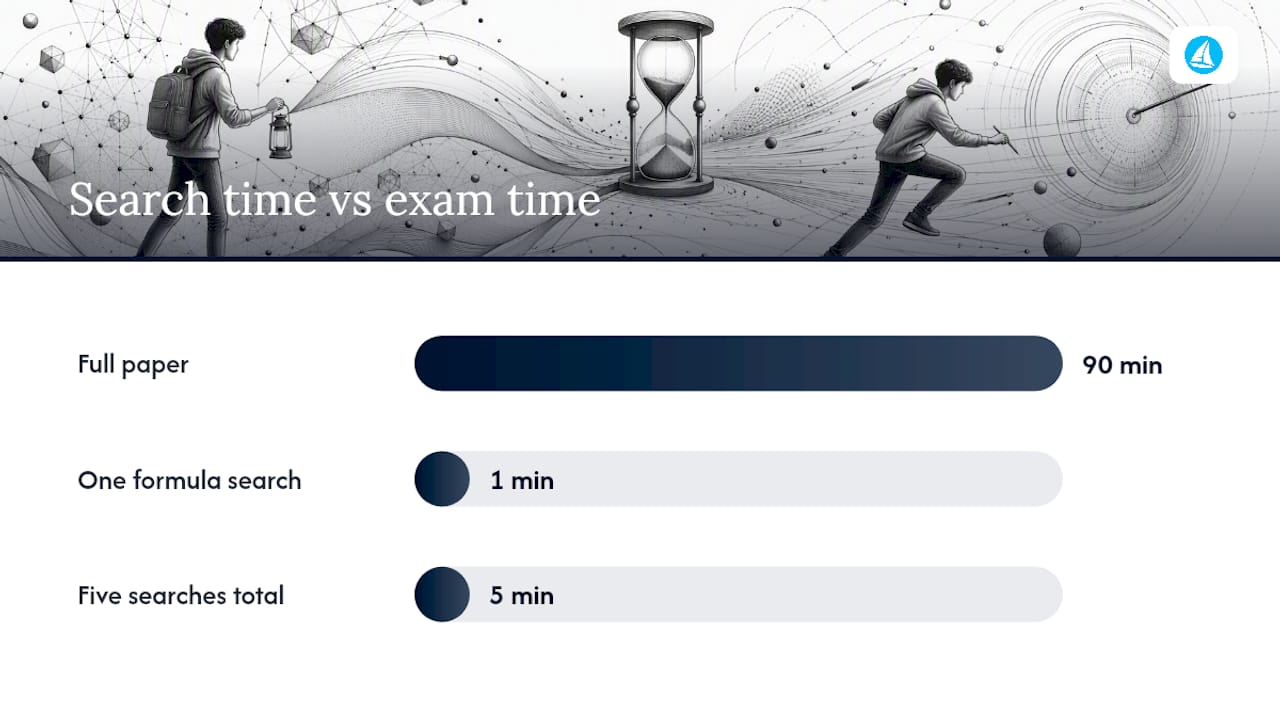
Treat the booklet as a memory jogger, not a search engine. The formulae are listed, but there’s no index and no worked examples, so if you don’t already recognise roughly where a formula sits, you’ll burn minutes flipping pages during a 90-minute paper. That’s time you don’t have. The most effective exam habit is knowing the booklet’s structure well enough that opening it feels like confirming something you already suspected, not discovering it fresh.
Practical exam-room habits worth building:
- Practise locating each topic section with your eyes closed. If you can picture roughly where “Calculus” starts, you’ve already saved seconds you’ll need elsewhere.
- Never assume a formula is in the booklet just because it feels advanced. Some commonly used identities, particularly basic trigonometric ones like sin²x + cos²x = 1, are not listed, because you’re expected to know them.
- Always check your booklet matches the current syllabus. A booklet with pre-2021 layout or separate SL/HL sections is the wrong version and could mislead you on notation.
- Cross-check formula variable definitions against how your teacher writes them; occasionally schools use slightly different letters for the same quantity, and consistency avoids silly transcription errors.
Pro Tip: Time yourself finding five random formulae in the booklet under sixty seconds each. If you’re consistently over that, you need more exposure to the layout, not more formula memorisation.
Version alignment isn’t a technicality either. The 2021 syllabus restructured how AA and AI are taught, and a handful of formulae were repositioned or removed compared to the old SL/HL booklets. If you inherited a booklet from an older sibling or a well-meaning teacher’s outdated file, you could be memorising a layout that no longer matches what you’ll actually be handed in the exam.
How to use the formula booklet for effective revision
Treating the booklet as a static PDF you glance at once misses most of its value. The students who use it well build it into weekly revision as an active tool, not a last resort.
- Annotate a printed copy, but don’t overdo it. Highlight formulae you consistently forget, and use small margin notes for context (when to use a formula, not just what it says). Avoid highlighting more than a third of any page, or the whole point of visual triage disappears.
- Build a personal quick-index. On a sticky note or the inside cover, jot down page numbers for the five or six formulae you look up most often. This isn’t cheating; it’s exactly the kind of familiarity the “for use during examinations” language anticipates.
- Run timed drills using only the booklet. Set a fifteen-minute timer, pick five past-paper questions across different topics, and force yourself to solve them using nothing but the booklet as reference. This builds lookup speed far faster than passive reading ever will.
- Separate what you memorise from what you reference. Basic identities (Pythagorean identity, the quadratic formula, simple index laws) should live in memory, since flipping pages for these wastes time you don’t have on a 90-minute paper. Reserve the booklet for compound formulae like second-order variance calculations or higher-order derivative and integral forms.
- Pair booklet lookups with problem-solving practice, not isolation. A dedicated IB Maths study guide alongside targeted topic notes gives you the “why” behind a formula, which makes it stick far better than rote copying.
For statistics specifically, try this drill: take a normal distribution question, cover the answer, and force yourself to locate the standardisation formula in the booklet before attempting the calculation. Repeat with a binomial distribution question straight after. Switching topic context quickly like this mimics how mixed exam papers actually test you, rather than letting you settle into a single formula family for twenty minutes.
For calculus, pair a differentiation question requiring the chain rule with an integration question needing substitution, back to back. The goal isn’t just solving them. It’s training your eyes to jump between sections of the booklet without losing your problem-solving thread.
Pro Tip: Keep a running list of every formula you had to look up more than three times across a month of practice. That list is your real memorisation priority, not a generic “must-know” list copied from a revision guide.
How Tiber Tutor complements the official booklet
A formula booklet tells you what the formula is. It doesn’t tell you whether you can apply it correctly under time pressure, and that gap is where most marks are actually lost. Tiber Tutor closes that gap with exam-style questions, animated instructional videos, and topic-specific tests built by IB examiners who know exactly how formulae from the booklet get tested in practice, not just how they’re written on the page.
A sensible weekly workflow looks like this: revise a topic using detailed notes alongside the booklet, then run a topic test on the same content through Tiber Tutor’s custom test builder, referencing the booklet exactly as you would in a real exam. Afterwards, use student-led answer review against the examiner mark schemes to see precisely where a formula was applied correctly but the working lost marks, which is a distinction a plain answer key never shows you.
What sets this apart from working through the booklet alone:
- Exam-style questions and full mock exams built around current syllabus objectives, not generic formula drills.
- Syllabus monitoring that flags which topics (and which formula categories) you haven’t practised recently.
- Progress analytics that track accuracy by topic, so you can see whether normal distribution questions or calculus applications are your actual weak point, rather than guessing.
- Examiner mark schemes attached to every question, showing exactly how marks are awarded for correct formula use versus correct final answers.
No other IB-focused platform pairs this depth of exam-style content with analytics this granular, and that combination, built by people who have actually written and marked IB papers, is what separates genuine exam preparation from passive formula memorisation.
How the AA booklet differs from the old separate SL and HL versions
Before the 2021 syllabus, AA students used two distinct booklets, one for SL and one for HL, each with its own pagination and formula selection. The current single booklet merges both into one document, with shared SL/HL content presented first in each topic and HL-exclusive formulae clearly marked afterwards.
The practical upshot is that HL students now see the full progression from SL basics to HL extensions within the same section, rather than needing to cross-reference two separate files. This also means SL students occasionally see HL-only formulae nearby (clearly labelled, but visible), which some find distracting during quick lookups. The fix is simple: know your own SL/HL boundary well enough that you don’t waste time reading formulae you’ll never be examined on.
If you’re using an older booklet inherited from a previous cohort, check it against the current official PDF before you rely on it for revision. Formula positioning changed enough between the old and new structure that muscle memory built on an outdated layout can actually slow you down on exam day, precisely when speed matters most.
Tips for memorising key formulas beyond the booklet
Not everything belongs in your head, but some formulae genuinely need to be automatic, because looking them up wastes time you can’t afford on a 90-minute paper. The Pythagorean identity, basic index and logarithm laws, and the quadratic formula fall firmly into this category.
Spaced repetition beats last-minute cramming for this kind of recall. Rather than re-reading a formula list the night before an exam, test yourself blind three or four times across separate days, writing each formula from memory before checking it against the booklet. The act of retrieval, not exposure, is what builds durable memory.
Linking a formula to a visual or a derivation also helps far more than rote copying. Understanding why the derivative of sin x is cos x, rather than just memorising the pair, means you can reconstruct it even if your memory slips mid-exam. Flashcards work well here too, particularly for compound formulae you use often but never quite trust yourself to recall correctly, like variance calculations for grouped data.
Finally, test recall under realistic conditions. Memorising a formula sitting calmly at your desk is a different skill from recalling it forty minutes into a timed paper with adrenaline running. Build that pressure into practice sessions deliberately, using timed drills rather than open-ended revision.
How the booklet fits IB Mathematics curriculum objectives
The formula booklet isn’t a standalone document. It’s built directly around the assessment objectives the IB sets for Mathematics: analysis and approaches, particularly the objectives around applying mathematical techniques and interpreting results in context. The booklet gives you the technical apparatus; the curriculum’s emphasis on reasoning and interpretation is what you supply yourself.
This is why simply having the booklet open rarely earns marks by itself. Command terms like “show that”, “hence”, and “justify” require you to demonstrate mathematical reasoning around a formula, not just quote it, and examiners are trained to look for that reasoning explicitly. Getting comfortable with exactly what a command term expects, covered in detail in a guide to IB Maths command terms, matters just as much as knowing where a formula sits on the page.
The booklet’s structure, moving from number and algebra through to calculus, also loosely tracks how the syllabus itself builds complexity across the two years, giving you a sense of how topics connect rather than sitting in isolation.
What the booklet doesn’t cover
The booklet is not exhaustive, and treating it as a complete substitute for understanding is a common and costly mistake. Basic trigonometric identities like sin²x + cos²x = 1, simple algebraic manipulation, and standard index laws are assumed knowledge and simply aren’t listed, because the IB expects every AA student to have internalised them well before exams.
Derivations are also absent entirely. The booklet gives you the result of a calculation, not the reasoning behind it, so if an exam question asks you to derive or prove a result rather than apply it directly, the booklet offers no help at all. This is precisely where solid topic notes and worked examples, rather than the booklet alone, carry the real weight of your preparation.
Context and application are the other major gap. Knowing that the standardisation formula converts a normal variable to a standard normal one is useless if you can’t recognise when a word problem calls for it. That kind of pattern recognition comes from practising varied exam-style questions repeatedly, not from staring at a formula list, however well organised it is.
Examiner-recommended practice for the formula booklet
The most effective students I’ve seen treat the booklet as a supporting cast member, not the lead. A weekly routine that works well: two sessions of untimed topic practice using notes and the booklet freely, followed by one fully timed paper attempt where the booklet is your only aid, mimicking real exam conditions exactly.
The biggest pitfall is over-reliance during early revision, which delays the point at which you actually notice which formulae you’ve truly memorised versus which you’ve simply seen repeatedly. A second common mistake is skipping version checks entirely, assuming any PDF titled “formula booklet” found online matches the current syllabus, when older or mismatched copies still circulate widely.
Consistency beats intensity here. A student who runs three short, focused sessions a week against the booklet will typically build stronger lookup fluency than one who does a single six-hour cram the weekend before exams. Treat the booklet the way examiners intend it, as a working tool refined over two years, not a safety net discovered in May.
— Oliver
Studying smarter with Tiber Tutor alongside the booklet
Tiber Tutor is the study companion built specifically for IB STEM students who want more than a formula list; it pairs directly with the official AA formula booklet to close the gap between knowing a formula and applying it correctly under exam pressure. Unlike generic revision sites, every question and mark scheme on the platform is written by actual IB examiners, so the feedback you get on a topic test reflects exactly how marks are awarded in a real exam, not a guess at it.
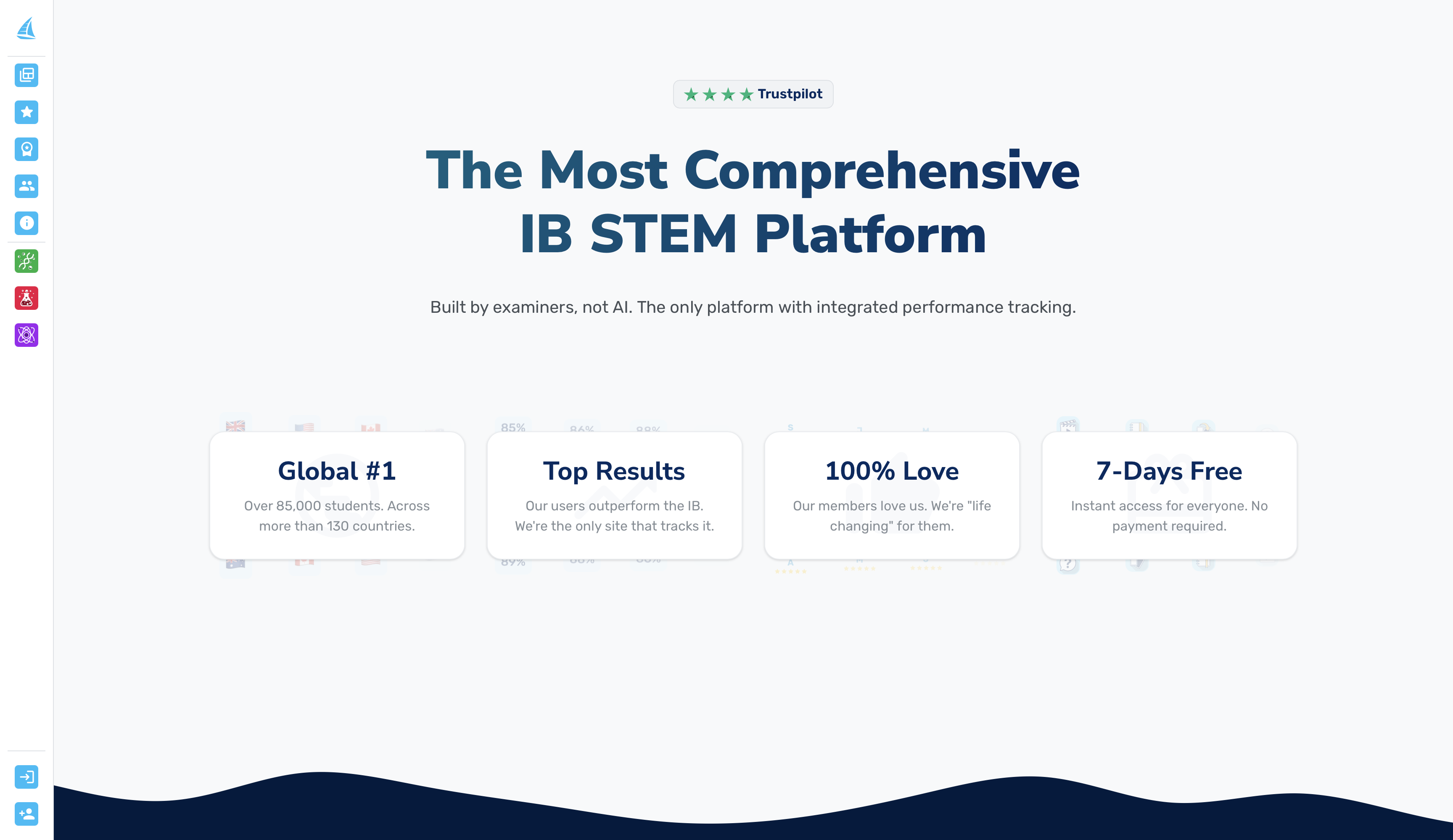
The platform’s progress analytics track your accuracy topic by topic, flagging whether your weak spot is calculus applications or probability distributions long before your next mock exam, something no static PDF can offer. Combined with syllabus monitoring, custom mock exams, and student-led answer review against examiner mark schemes, it turns the booklet from a passive reference into part of an active, measurable revision cycle.
Every AA student gets a free 7-day trial. From there, the All-Access Plan runs $19 per month for full access across subjects, while the Per-Subject Plan is $9 per month if you only need targeted maths support. Compare a week of Tiber Tutor’s exam-style tests against your current revision routine, and see for yourself on the students page which one actually moves your marks.
Sources
- Mathematics: analysis and approaches formula booklet (official PDF)
- Mathematics: analysis and approaches formula booklet (school mirror)
- IB Math Data Booklet (Free PDF Download) | View Online
- Mathematics: analysis and approaches formula booklet SL/HL (mirror)
FAQ
Is there an official IB Mathematics formula booklet available?
Yes. The Mathematics: analysis and approaches formula booklet is the official PDF covering both SL and HL under the 2021 syllabus, explicitly labelled for use during the course and in examinations.
How do I say “I love you” in maths?
There’s no formal IB formula for this, but a common playful answer among maths students is writing an equation whose solution spells out a message, such as using a function’s limit or a specific numeric sequence. It’s a bit of classroom fun rather than genuine curriculum content.
Which IB maths is harder, AA or AI?
Analysis and Approaches generally demands stronger algebraic manipulation and abstract reasoning, while Applications and Interpretation leans more on statistical and modelling contexts with technology support. Neither is objectively harder for every student; it depends on whether you’re more comfortable with pure algebraic technique or applied, calculator-driven problem solving.
How many students get a 7 in IB Maths HL?
Exact grade distributions vary year to year and the IB doesn’t publish a single fixed figure for every session, so treat any specific percentage you see elsewhere with caution. What’s consistent is that top grades correlate strongly with sustained, examiner-style practice rather than last-minute cramming, which is exactly the gap resources like Tiber Tutor’s mock exams are built to close.
Can I use the formula booklet during IB Maths exams?
Yes, the booklet is explicitly provided “for use during the course and in the examinations,” meaning your exam centre supplies it as part of standard exam materials. Always confirm the exact format and any centre-specific rules with your IB coordinator ahead of exam day.