IB math explained: your 2026 exam preparation guide
IB Math is the International Baccalaureate Diploma Programme’s mathematics curriculum, offering four distinct courses that assess conceptual knowledge, analytical skills, and real-world application through both external exams and an internal assessment project. Choosing the right course and preparing with the right strategies makes a measurable difference to your final grade. This guide breaks down every component of the IB mathematics syllabus, from course selection to exam-day technique, so you can approach your preparation with clarity and confidence.
What courses are available in IB Math?
The IB Diploma Programme offers four mathematics courses: Analysis and Approaches SL, Analysis and Approaches HL, Applications and Interpretation SL, and Applications and Interpretation HL. Each course is built around a different mathematical focus, and choosing correctly shapes your entire exam experience.
Analysis and Approaches (AA) centres on algebra, calculus, and theoretical mathematics. It suits students who enjoy abstract reasoning and plan to study mathematics, physics, or engineering at university. Applications and Interpretation (AI) emphasises statistics, mathematical modelling, and practical problem-solving. It is the stronger fit for students heading into social sciences, business, or biology-related fields.
The SL versus HL distinction is about depth and volume. HL students cover additional topics and face a more demanding third exam paper. The content gap between SL and HL is significant, so students should make this choice based on genuine interest and university requirements, not just perceived difficulty.
| Course | Focus | Exam papers | Typical student profile |
|---|---|---|---|
| AA SL | Algebra, calculus | 2 papers | Maths-confident, non-specialist |
| AA HL | Advanced calculus, proofs | 3 papers | Future mathematicians, physicists |
| AI SL | Statistics, modelling | 2 papers | Social sciences, business |
| AI HL | Advanced statistics, modelling | 3 papers | Data science, economics |
Pro Tip: Check your target university’s entry requirements before choosing between AA and AI. Some engineering and mathematics programmes specify AA HL as a condition of entry.
For a thorough breakdown of SL and HL differences, the complete SL and HL guide at Tibertutor covers the curriculum in detail.
How is the IB Math exam structured?
The IB Math assessment is 80% external written papers and 20% Internal Assessment. That weighting means your exam papers carry the bulk of your grade, but the IA is not something to leave until the last minute.
SL students sit two exam papers. HL students sit three. Paper 1 is completed without a calculator. Papers 2 and 3 permit a graphic display calculator (GDC). The third paper, exclusive to HL, focuses on harder problem-solving and extension topics.
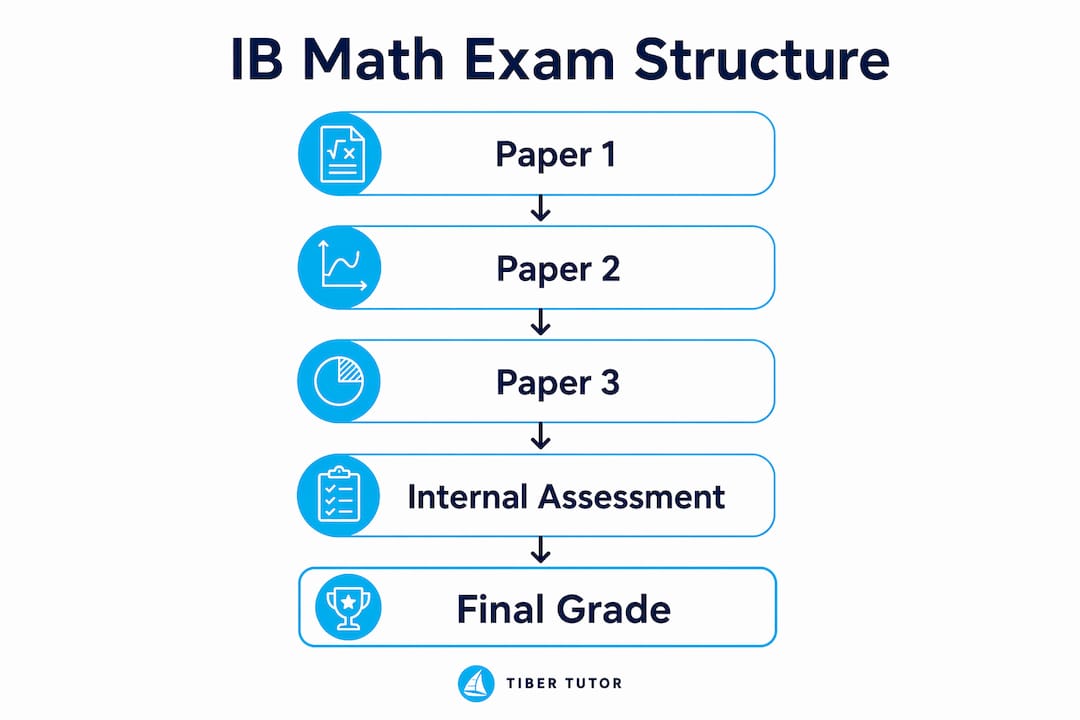
The Internal Assessment contributes approximately 20% of the final grade and takes the form of a mathematical exploration project on a topic of the student’s choosing. It assesses mathematical communication as much as calculation ability. A well-chosen topic and clear written argument can earn strong marks even without highly complex mathematics. For detailed guidance on the IA, Tibertutor’s IB Maths Internal Assessment guide is worth reading early in the process.
| Component | Calculator | Weighting | Who sits it |
|---|---|---|---|
| Paper 1 | Not permitted | Part of 80% | SL and HL |
| Paper 2 | GDC permitted | Part of 80% | SL and HL |
| Paper 3 | GDC permitted | Part of 80% | HL only |
| Internal Assessment | N/A | 20% | SL and HL |
Pro Tip: Set your GDC to the correct mode before every exam. TI calculator users must enable diagnostics and check degree or radian mode after exam resets. A wrong mode setting can cost marks on an entire question.
What study techniques work best for IB Math exam preparation?
Consistent daily practice with exam-style questions is the single most effective study method for IB Math exam preparation. Passive re-reading of notes does not build the problem-solving speed the exam demands. Working through past papers under timed conditions does.
Achieving a grade 7 requires deep conceptual understanding, not just formula memorisation. Students who score at the top can apply techniques in unfamiliar contexts. That means studying the reasoning behind each formula, not just when to use it. Ask yourself why a method works before moving on.
Marking schemes are an underused resource. After completing a past paper question, compare your working to the mark scheme line by line. This reveals exactly where marks are awarded and trains you to present your method in the way examiners expect. Top scorers integrate conceptual reasoning with flexible problem-solving, and mark schemes show you what that looks like in practice.
Here is a practical study sequence that builds both knowledge and exam skill:
- Study a topic from your notes or a reliable resource until you can explain it without looking.
- Attempt exam-style questions on that topic without help.
- Check your answers against the mark scheme and identify where your working broke down.
- Revisit the concept if you lost marks on method, not just the final answer.
- Repeat with mixed-topic questions to build the ability to switch between techniques.
Pro Tip: Build GDC proficiency as part of your regular study, not just before exams. Knowing how to use regression functions, solve equations graphically, and plot distributions quickly saves significant time in Papers 2 and 3.
For exam-day preparation routines, Tibertutor’s IB Maths mock exam guide gives a structured approach to timed practice.
What mistakes should IB Math students avoid on exam day?
Students often perform below their potential due to poor exam-day strategy rather than gaps in knowledge. The most common errors are avoidable with preparation and awareness.
Examiners award marks for clear working and logical steps, even when the final answer is wrong. A student who sets up the correct equation and makes an arithmetic error can still earn the majority of marks. A student who writes only a wrong answer earns nothing. Showing your method is not optional. It is where your marks live.
Common mistakes to avoid:
- Skipping working steps because the method feels obvious.
- Forgetting to check GDC settings at the start of each calculator paper.
- Spending too long on one question and running out of time for easier marks later.
- Ignoring the formula booklet. It is provided precisely so you do not need to memorise every formula.
- Leaving diagrams unlabelled when the question asks for a sketch or graph.
Pro Tip: Spend the first two minutes of each exam scanning the full paper. Identify questions you can answer confidently and tackle those first. A calm, structured routine at the start of the exam reduces anxiety and improves decision-making throughout.
Understanding exam technique matters as much as content knowledge. Knowing the material is necessary. Knowing how to present it under pressure is what separates good grades from great ones.
Key takeaways
Succeeding in IB Math requires the right course choice, a clear understanding of the assessment structure, and consistent practice with exam-style questions and marking schemes.
| Point | Details |
|---|---|
| Choose your course carefully | AA suits theoretical maths; AI suits applied and statistical contexts. Check university requirements first. |
| External papers carry most weight | Written papers account for 80% of your grade, so timed past paper practice is non-negotiable. |
| Show all working | Examiners award partial marks for correct method even when the final answer is wrong. |
| Start the IA early | The Internal Assessment is 20% of your grade and rewards clear mathematical communication. |
| Master your GDC | Check calculator settings before every exam to avoid preventable errors in graphing and trigonometry. |
Why IB Math rewards curiosity more than memory
Students often ask me what separates a grade 5 from a grade 7 in IB Math. The honest answer is not extra hours of revision. It is the quality of thinking during those hours. I have seen students who could recite every formula in the booklet still struggle on Paper 3, because the questions ask you to apply ideas in ways you have not seen before. That requires genuine understanding, not recall.
The students who do best treat mistakes as information. When they lose marks on a past paper question, they do not just note the correct answer. They work out exactly where their reasoning went wrong and fix the gap. That habit, done consistently over months, builds the flexible problem-solving that examiners reward.
Exam anxiety is real, and it affects performance more than most students admit. The best antidote is preparation that feels like practice, not punishment. Sitting mock exams under real conditions, timing yourself, and reviewing your results honestly builds the kind of confidence that holds up when it counts. If you are finding certain topics genuinely difficult, seek help early. Waiting until the month before exams to address a conceptual gap makes everything harder.
IB Math is demanding. It is also completely manageable with the right approach. Curiosity, consistency, and good exam technique will take you further than any shortcut.
— Oliver
How Tibertutor supports your IB Math preparation
Tibertutor gives IB students access to a question bank built by examiners, covering the full range of International Baccalaureate math topics across all four courses. Whether you are working through Paper 1 technique or preparing your Internal Assessment, the platform provides exam-style questions, detailed mark schemes, and progress tracking that shows exactly where to focus your effort.

Students using Tibertutor can practise with mock exams, access topic-specific tests, and review their performance with analytics that highlight strengths and weaknesses. The IB student resources page gives a full overview of what is available. For those ready to get started, the Tibertutor question bank is the most direct route to exam-focused practice. View Tibertutor’s pricing to find the right plan for your preparation timeline.
FAQ
What is IB Math and who is it for?
IB Math is the mathematics curriculum within the International Baccalaureate Diploma Programme, designed for students aged 16–19. It offers four courses suited to different academic strengths and university pathways.
What is the difference between AA and AI in IB Math?
Analysis and Approaches focuses on algebra, calculus, and theoretical reasoning. Applications and Interpretation focuses on statistics, modelling, and practical problem-solving. Your choice should reflect both your strengths and your intended university subject.
How much does the Internal Assessment count?
The Internal Assessment contributes 20% of the final IB Math grade. It is a student-led mathematical exploration project assessed on both mathematical content and quality of written communication.
Can I earn marks even if my final answer is wrong?
Yes. Examiners award partial marks for correct working and logical method, even when the final answer is incorrect. Showing every step of your reasoning is critical to maximising your score.
How many exam papers do IB Math HL students sit?
HL students sit three external exam papers. SL students sit two. The additional HL paper focuses on harder problem-solving and is completed with a graphic display calculator.