Why exam technique matters in IB: a parent's guide
Most IB students spend months learning content, yet still feel uncertain walking into the exam hall. The reason is rarely a lack of knowledge. Understanding why exam technique matters in IB is one of the most overlooked aspects of effective preparation. Exam technique, also called assessment literacy by educators, is the set of skills that lets students translate what they know into marks on the page. This guide explains what that means in practice, what the research says, and how you can build these skills before exam season arrives.
Table of Contents
- Key takeaways
- Why exam technique matters in IB science exams
- What the research says about exam preparation
- Common mistakes that cost IB students marks
- How to build strong exam technique for IB
- My honest take on technique vs. knowledge
- How Tibertutor supports IB exam readiness
- FAQ
Key takeaways
| Point | Details |
|---|---|
| Knowledge alone is not enough | Students must also know how to apply content within IB exam structures and marking criteria. |
| Active recall beats passive review | Active recall methods produce approximately 80% retention after one week compared to 34% for rereading. |
| Common technique pitfalls cost marks | Poor timing and misreading command terms are frequent causes of avoidable mark loss. |
| Past papers build exam readiness | Students who practise past papers regularly learn to produce knowledge in the format examiners expect. |
| Parents can make a real difference | Supporting structured revision plans and encouraging timed practice significantly aids a student’s preparedness. |
Why exam technique matters in IB science exams

Exam technique is not simply a revision tip. It is the mechanism that transfers learning into exam-ready performance. In the IB context, this means understanding exactly what each question is asking, managing your time across the paper, and structuring answers to match what the mark scheme rewards.
IB science exams in Biology, Chemistry, and Physics are not straightforward recall tests. They draw on a specific set of demands that students must recognise and respond to accurately. Here is what effective exam technique looks like in practice:
- Understanding command terms. Words like “explain,” “deduce,” “evaluate,” and “outline” carry precise meanings in IB mark schemes. Writing a detailed description when the question asks you to “state” wastes time and earns no extra marks.
- Targeting mark allocations. A two-mark question requires two distinct points. A six-mark extended response expects structure, evidence, and a conclusion. Matching your answer length and depth to the marks available is a trained skill.
- Interpreting data questions. IB science papers regularly present unfamiliar graphs or experimental results. The ability to read and analyse these confidently, even when the context is new, depends on practised technique rather than memorised facts.
- Managing the paper as a whole. Spending too long on one question and running out of time on another is one of the most common reasons strong students underperform.
Technique and content knowledge work together. One without the other leaves marks on the table.
What the research says about exam preparation
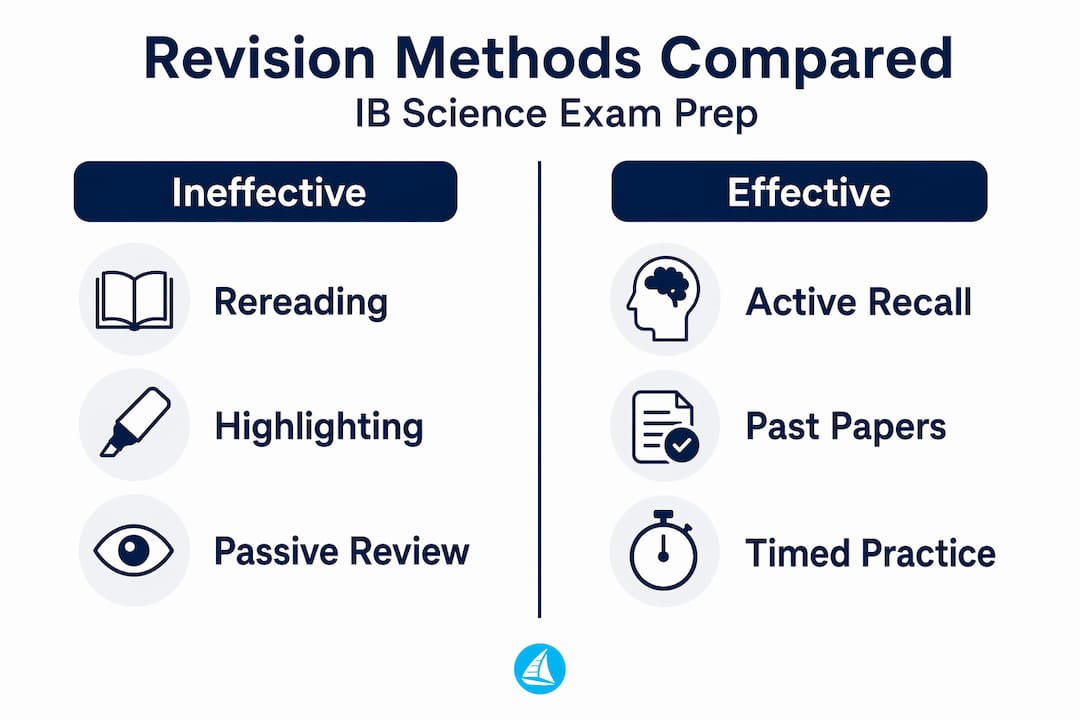
The case for prioritising exam technique is well supported by cognitive science. Active recall methods, where students actively retrieve information rather than passively rereading notes, are associated with approximately 80% retention after one week compared to around 34% for passive review. That is a significant difference when exam season is approaching.
“Effective revision should move information from short-term to long-term memory using active revision, spaced repetition, interleaving, and practising exam questions.” — University of Exeter
The data behind different revision methods shows this clearly:
| Revision method | Retention after one week | Exam readiness |
|---|---|---|
| Passive rereading | ~34% | Low |
| Active recall (flashcards, self-testing) | ~80% | Moderate |
| Timed exam-style question practice | High | High |
Practising under timed conditions strengthens not just memory, but familiarity with IB exam formats. Students who work through questions in exam conditions are better prepared because they have rehearsed the exact context in which they will need to perform. The struggle of actively retrieving information, rather than simply recognising it on a revision card, is itself what builds durable memory pathways.
Common mistakes that cost IB students marks
Even well-prepared students can lose significant marks through avoidable technique errors. Poor timing or misreading questions can cause larger score losses than actual gaps in subject knowledge. The following mistakes appear repeatedly across IB science papers.
- Misreading the command term. A student asked to “evaluate” a method who instead simply describes it will score very few marks, regardless of how accurate the description is.
- Writing too much for low-mark questions. Spending four minutes on a one-mark question is a timing mistake that costs marks elsewhere on the paper.
- Ignoring units and significant figures. In Chemistry and Physics especially, a correct numerical answer presented without units or with the wrong number of significant figures can lose marks unnecessarily.
- Memorising without applying. Passive re-reading creates an illusion of competence. A student who has read their notes ten times may still struggle to apply that knowledge under timed conditions because the cognitive pathway for retrieval has never been practised.
- Not reading the whole question before answering. Multi-part questions in IB papers often build on each other. Missing the context set up in part (a) before jumping to part (b) is a frequent and costly oversight.
Pro Tip: Before each mock or past paper session, spend two minutes reading the command terms glossary from the relevant IB subject guide. This small habit builds recognition that translates directly into marks.
How to build strong exam technique for IB
Building solid technique does not happen by accident. It requires deliberate practice structured around the specific demands of IB science exams. Here is how students and parents can approach this together.
- Use past papers with intention. Students who use past papers regularly outperform peers because they practise producing knowledge in exam format, not just storing it. Treat each past paper as a rehearsal, not just a test.
- Apply spaced repetition. Spaced repetition and interleaving improve memory consolidation compared with cramming everything into one long session. Short, regular practice across different topics compounds over weeks.
- Simulate exam conditions. Set a timer, work in silence, and resist the urge to check notes mid-question. The discomfort of this is exactly what builds confidence and stamina for the real thing.
- Review answers against the mark scheme. Self-marking against official IB mark schemes teaches students to think like an examiner. This feedback loop accelerates technique improvement faster than any amount of additional content review.
| Approach | What it builds | When to use it |
|---|---|---|
| Past paper practice | Exam format familiarity, timing | Weekly from Month 1 |
| Spaced repetition | Long-term memory | Throughout the year |
| Timed mock conditions | Stamina, time management | From 6 weeks before exams |
| Mark scheme self-review | Examiner thinking, precision | After every practice attempt |
Pro Tip: Parents can support this process practically. Parental encouragement and structured plans play a vital role in exam technique development. Helping your child set a regular timed practice session each week, and checking in on how they found it, is genuinely useful support.
My honest take on technique vs. knowledge
I have seen this pattern enough times to be confident about it. A student arrives with solid content knowledge. They can explain enzyme activity, balance complex equations, and describe the structure of the heart. But they sit a mock paper and score a 4 when their knowledge deserves a 6. The gap is almost always technique.
What strikes me most is how quickly that can change. Students who commit to working through exam-style questions, reviewing mark schemes honestly, and practising timing tend to see meaningful improvement within a few weeks. It is not magic. It is repetition of the right kind of thinking.
I also think parents sometimes underestimate how much they can help here. You do not need to know IB Biology to support good exam habits. Helping your child build a consistent weekly practice schedule, asking how they got on after a timed session, and encouraging that routine is exactly the kind of support that makes a difference.
The students who perform best are rarely the ones who simply know the most. They are the ones who practise performing under pressure until it feels familiar.
— Oliver
How Tibertutor supports IB exam readiness

Tibertutor is built specifically for IB science students who want to close the gap between knowing content and scoring well. The platform offers thousands of exam-style questions written by experienced IB examiners, timed mock exams, detailed mark scheme feedback, and progress tracking that shows exactly where technique is letting a student down. For parents, Tibertutor’s dedicated parent resources explain how to support revision at home without needing subject expertise. If your child is preparing for IB Biology, Chemistry, or Physics, explore the full range of student support tools on Tibertutor to put effective exam technique into practice from day one.
FAQ
What is exam technique in IB science?
Exam technique refers to the skills students use to maximise marks in IB exams, including interpreting command terms, managing time across a paper, and structuring answers to match mark scheme expectations.
Does exam technique really affect IB scores?
Yes. Poor technique, including timing errors and misreading questions, can cause larger score losses than gaps in subject knowledge, even for well-prepared students.
How often should IB students practise past papers?
Ideally once a week from the start of the academic year, increasing frequency to several times per week in the six weeks before exams to build familiarity with exam conditions.
What is the most effective way to revise for IB exams?
Research from the University of Exeter recommends combining active recall, spaced repetition, interleaving, and timed exam question practice to move content from short-term to long-term memory.
How can parents help with IB exam technique?
Parents can help by supporting a consistent weekly timed practice routine, encouraging mark scheme self-review, and providing a calm, structured revision environment at home.