IB Maths exam breakdown: your 2026 guide to top marks
The IB Maths exam is defined by a multi-paper structure that tests problem-solving, reasoning, and mathematical communication across both Standard Level (SL) and Higher Level (HL) courses. Understanding the full IB Maths exam breakdown before you sit down to revise is the single most effective thing you can do for your preparation. The exam is not just about knowing the content. It rewards students who understand the format, manage their time well, and present their thinking clearly. This guide covers every paper, every topic area, and the strategies that actually move the needle on results.
What are the main papers and their formats in the IB Maths exam?
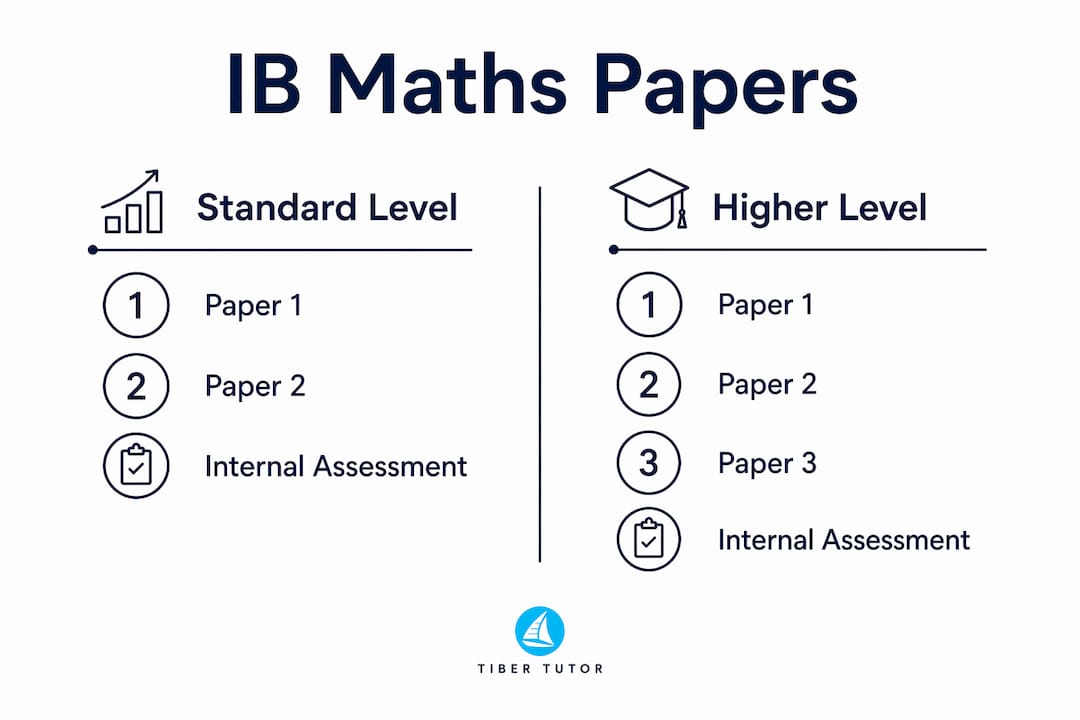
The IB Maths exam format includes a non-calculator Paper 1, a calculator-permitted Paper 2, and for HL students, an additional Paper 3. Each paper tests a distinct set of skills, and knowing what to expect in each one shapes how you should revise.
| Paper | Level | Calculator | Duration | Weighting |
|---|---|---|---|---|
| Paper 1 | SL and HL | No | 90 min (SL) / 120 min (HL) | 40% (SL) / 30% (HL) |
| Paper 2 | SL and HL | Yes (GDC) | 90 min (SL) / 120 min (HL) | 40% (SL) / 30% (HL) |
| Paper 3 | HL only | Yes (GDC) | 60 min | 20% (HL) |
| Internal Assessment | SL and HL | N/A | Coursework | 20% (both) |

For HL students following the Analysis and Approaches (AA) course, Paper 1 and 2 each contribute 30%, Paper 3 contributes 20%, and the Internal Assessment contributes the remaining 20%. That weighting tells you something important: no single paper dominates, so consistent performance across all papers matters more than excelling in just one.
Key features of each paper:
- Paper 1 focuses on algebra, functions, and analytical reasoning without a calculator. Questions test whether you can work fluently and accurately by hand.
- Paper 2 allows a Graphical Display Calculator (GDC) and emphasises application, modelling, and problem-solving in context.
- Paper 3 (HL only) presents two extended-response questions requiring deep conceptual understanding, often drawing on calculus, geometry, and proof.
- The IB formula booklet is permitted in all papers and contains key formulae, but it does not replace understanding.
The Internal Assessment is a mathematical exploration completed during the course. It contributes 20% to your final grade at both SL and HL, so it deserves serious attention alongside exam preparation.
Which mathematical skills and topics are assessed in each paper?
The IB Maths syllabus overview covers five core topic areas: number and algebra, functions, geometry and trigonometry, statistics and probability, and calculus. The depth of coverage differs significantly between SL and HL, and between the AA and Applications and Interpretation (AI) courses.
Understanding the IB Maths content breakdown by paper helps you prioritise revision:
- Paper 1 rewards algebraic fluency. Expect questions on sequences, logarithms, trigonometric identities, and differentiation that require clean, step-by-step working without calculator support.
- Paper 2 leans towards applied contexts. Statistics, probability distributions, integration with technology, and real-world modelling questions appear regularly.
- Paper 3 (HL AA) requires preparation in calculus, geometry, and proof, including limits, derivatives, circle theorems, and formal mathematical reasoning.
Command words such as “show that,” “calculate,” “hence,” and “explain” determine exactly what your answer must include. Missing a logical step in a “show that” question results in zero marks for the final answer, even if your conclusion is correct. Examiners assess the process and communication of logic, not just the result.
Pro Tip: Learn the IB command word definitions before your first mock exam. Knowing the difference between “find” and “show that” changes how you write your answer and how many marks you earn.
What are the best exam-day strategies for IB Maths?
Effective exam technique affects performance more than knowledge alone for many students. Most underperformance in IB Maths comes from poor exam-day execution rather than gaps in content knowledge. That is a solvable problem.
Here are the strategies that make the biggest difference:
- Use reading time deliberately. You have 5 minutes of non-writing reading time before each paper. Use it to scan the paper, identify high-value questions, and plan your order of attack.
- Pace yourself using mark allocations. Aim for roughly one mark per minute, leaving around 10 minutes at the end to check your work. A 6-mark question should take no more than 6–8 minutes.
- Balance your GDC use. The calculator is a tool, not a crutch. Over-reliance on the GDC can weaken your algebra fluency, which costs marks on Paper 1 and on algebraic steps within Paper 2 questions.
- Show every step. Examiners grade the process, not just the answer. A correct final answer with no working shown earns zero method marks.
- Use follow-through marks wisely. If you make an error in one part of a question, follow-through marks are available in subsequent subparts if your later working is logically consistent with your earlier answer. Do not abandon a question after one mistake.
- Stay composed after errors. One wrong answer does not ruin a paper. Move forward, keep your working clear, and trust your preparation.
Pro Tip: Before Paper 1, reset your GDC to factory settings and confirm it is charged. A technical issue at the start of Paper 2 costs you time and composure.
How can students prepare effectively for each IB Maths paper?
Preparation for the IB Maths exam works best when it is tailored to each paper’s specific demands rather than treating revision as one undifferentiated block of study.
Targeted preparation by paper:
- For Paper 1: Practise algebra and calculus questions entirely by hand. Timed drills without a calculator build the fluency you need. Focus on presenting working neatly and logically.
- For Paper 2: Practise GDC skills alongside mathematical reasoning. Know how to use your calculator for regression, integration, and solving equations, but always write down the mathematical setup before pressing any buttons.
- For Paper 3 (HL): Work through extended-response questions that require multi-step reasoning. Practise writing formal proofs and justifying each step clearly.
Mock exams and past papers are the most reliable way to build exam readiness. They reveal timing weaknesses, expose content gaps, and help you practise the skill of reading mark schemes critically. Reading a mark scheme is not just about checking answers. It shows you how examiners allocate marks and what level of justification they expect.
SL students should focus on breadth and application. HL students need both breadth and depth, particularly in calculus and proof. Both groups benefit from understanding the exam-style question workflow before sitting any mock.
For parents, the most supportive thing you can do is help your child build a consistent revision schedule and reduce pressure around individual practice results. Progress in IB Maths is rarely linear, and confidence builds through repetition rather than perfection.
Key takeaways
The IB Maths exam rewards students who combine content knowledge with deliberate exam technique, consistent working presentation, and smart time management across all papers.
| Point | Details |
|---|---|
| Know the paper structure | Paper 1 is non-calculator; Paper 2 allows a GDC; HL students sit an additional Paper 3. |
| Understand mark weightings | HL Paper 1 and 2 each carry 30%, Paper 3 carries 20%, and the IA carries 20%. |
| Master command words | Words like “show that” and “hence” define the depth and format of your answer. |
| Show all working | Examiners award method marks for logical process, not just correct final answers. |
| Practise under timed conditions | Mock exams and past papers build the timing instincts that content revision alone cannot. |
Why exam technique deserves as much attention as content
I have worked with IB Maths students across a range of ability levels, and the pattern is consistent. Students who underperform are rarely those who lack knowledge. They are the ones who run out of time on Paper 2, skip working steps because they feel confident, or freeze after a single error and lose composure for the rest of the paper.
The IB Maths exam is, in many ways, a strategy exercise. Knowing when to use your GDC and when to work algebraically, how to read a command word and respond precisely, and how to allocate your time across a paper are skills that need to be practised just as deliberately as integration or trigonometry.
Parents often ask me what they can do to help. My honest answer is this: encourage your child to do timed past papers in exam conditions at home, then sit with them afterwards and read through the mark scheme together. That process, done regularly, builds both skill and confidence in a way that passive revision simply cannot replicate.
One more thing worth saying: the formula booklet is not a shortcut. Students who rely on it too heavily in the exam lose time flicking through pages. Know which formulae are in the booklet and which you need to memorise. That distinction alone can save you several minutes per paper.
— Oliver
How Tibertutor supports your IB Maths preparation
Tibertutor is built by IB examiners and experienced educators who understand exactly what the IB Maths exam demands. The platform offers exam-style questions, detailed worked solutions, mock exams, and progress tracking tools designed to help students identify weaknesses and build confidence before exam day.

Whether you are an SL student working on algebraic fluency or an HL student preparing for Paper 3, Tibertutor’s IB question bank gives you structured, exam-focused practice that mirrors the real thing. Parents can also explore dedicated support resources to understand how to guide their child’s revision effectively. Start your free trial today and give your preparation the structure it deserves.
FAQ
What papers make up the IB Maths exam?
The IB Maths exam consists of Paper 1 (non-calculator) and Paper 2 (calculator) for both SL and HL students. HL students also sit Paper 3, an extended-response paper worth 20% of their final grade.
How is the IB Maths exam scored?
For HL Analysis and Approaches, Paper 1 and Paper 2 each contribute 30%, Paper 3 contributes 20%, and the Internal Assessment contributes 20%. SL students split their grade between Paper 1 (40%), Paper 2 (40%), and the IA (20%).
What is the best way to use reading time in the IB Maths exam?
Use the 5-minute non-writing reading time to scan the full paper, identify high-mark questions, and decide your order of approach. This reduces time wasted on indecision once writing begins.
Why is showing working so important in IB Maths?
Examiners award marks for the logical process, not just the final answer. A correct answer with no working shown earns zero method marks, and a “show that” question with missing steps results in no credit for the conclusion.
How should SL and HL students prepare differently?
SL students should prioritise breadth and applied problem-solving, while HL students need additional depth in calculus, proof, and extended reasoning for Paper 3. Both levels benefit from timed past paper practice and careful mark scheme review.