IB Chemistry S3.1 Further periodic table questions
34 questions · 25 multiple choice · 9 long answer
34 questions
Question 1
Loading progress...
Medium
Which of the following statements regarding ionisation energy is false?
Question 2
Loading progress...
Hard
If the frequency of the convergence limit in the Lyman series for an atom was found to be 3.25x10¹³ Hz, what would be the correct calculation to find the ionisation energy for this atom in kJ?
Question 3
Loading progress...
Medium
Which of the following statement(s) regarding ionisation energy is/are true?
| I | 2nd ionisation energy is always higher than 1st ionisation energy |
| II | 4s orbital electrons are removed before 3d orbital electrons |
| III | Boron's first ionisation energy is higher than Beryllium's |
Question 4
Loading progress...
Easy
Which of the following shows the correct formula to calculate the ionisation energy of an element?
Question 5
Loading progress...
Hard
If the wavelength of the convergence limit in the Lyman series for an atom was found to be 72.8 nm, what would be the correct calculation to find the ionisation energy for this atom in J?
Question 6
Loading progress...
Easy
Which of the below species would require the most energy to reach the convergence limit?
Question 7
Loading progress...
Easy
Which of the below statements is(are) true for an element in the ‘d-block' of the Periodic Table?
| I | It will be a poor thermal and electrical conductor |
| II | It exhibits variable oxidation states and absorbs variable wavelengths of light |
| III | It has a low boiling point and simple atomic structure |
Question 8
Loading progress...
Medium
The oxidation state of Cr in the [Cr(H2O)4F2]+ ion is
Question 9
Loading progress...
Easy
Which one of the following is isoelectronic with Ru2+?
Question 10
Loading progress...
Medium
Which group of elements below have the most similar atomic radii?
Question 11
Loading progress...
Easy
The full electronic configuration of vanadium is
Question 12
Loading progress...
Medium
The electronic configuration of Cr is
Question 13
Loading progress...
Easy
An atom of iron undergoes two successive ionisation energy reactions. The electronic configuration would be
Question 14
Loading progress...
Medium
Titanium has the electronic structure [Ar] 4s2 3d2. Given this, which of the following would be unlikely to exist?
Question 15
Loading progress...
Easy
Which of the following d-block elements has the highest potential oxidation number?
Question 16
Loading progress...
Easy
Which of the options below would not be used to describe the transition metals?
Question 17
Loading progress...
Medium
Which answer correctly displays the oxidation state of nickel in [Ni(H2O)4(NH3)2]2+
Question 18
Loading progress...
Medium
Which of the following ions would have no colour when surrounded by water?
Question 19
Loading progress...
Easy
Which species below has a single electron in only one type of orbital?
Question 20
Loading progress...
Easy
The term isoelectronic could not be used to describe which of the following species?
Question 21
Loading progress...
Hard
The term paramagnetic could be used to describe which of the following?
Question 22
Loading progress...
Easy
Which of the following is compulsory for a compound to be correctly termed a ligand?
Question 23
Loading progress...
Medium
Which of the species shown could act as ligands in complex ions?
| I | Br- |
| II | NH3 |
| III | H2O |
Question 24
Loading progress...
Medium
Which of the following salts would form a solution of colour when dissolved in H2O?
| I | ScBr3 |
| II | FeF3 |
| III | NiI2 |
| IV | ZnF2 |
Question 25
Loading progress...
Medium
What is the charge on the following complex ion: [Co(H2O)5Br]Cl
Question 26
Loading progress...
Hard
The diagram shows the first ionisation energies of the elements in period 3
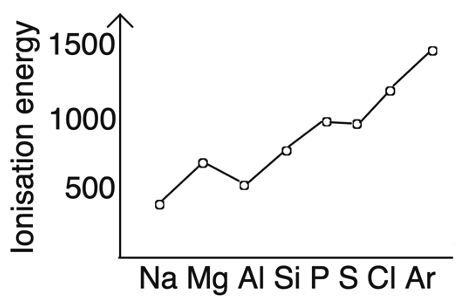
- Explain the general trend.
[2]
- Explain the irregularities seen for Al and S in terms of electronic structure.
[5]
- Sketch onto the diagram the line for the ionisation energies of period 2.
[2]
- Sketch a graph of ionisation energy versus ionisation number for five ionisations of Si. Explain the shape of the trend you have drawn.
[5]
Question 27
Loading progress...
Hard
This diagram shows the first ionisation energies of the elements in period 3.
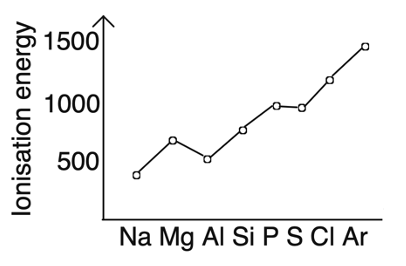
- Draw a graph on the diagram showing the second ionisation energies of these elements.
[2]
- Explain the overall differences seen.
[3]
Question 28
Loading progress...
Hard
The diagram shows the sucessive ionisation energies for potassium
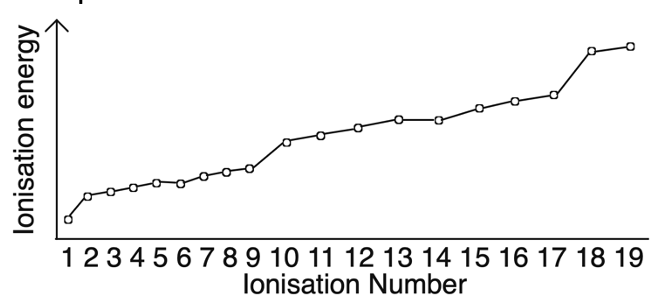
- Explain the general trend shown on the diagram.
[2]
- Explain the large increases in energy seen at the 2nd, 10th and 18th ionisation energies in terms of electronic structure.
[6]
- Explain why the 6th and 14th ionisation energies are lower than would be anticipated based off the existing trend.
[3]
Question 29
Loading progress...
Medium
Explain the differences for the two ionisation energy values given:
- the 1st ionisation energy of Be is 879 kJ mol-1 but the 2nd is 1643 kJ mol-1.
[2]
- the 1st ionisation energy of Al is 586 kJ mol-1 whereas the for B it is 799 kJ mol-1.
[3]
Question 30
Loading progress...
Medium
Using an emission spectrum, the wavelength of a convergence limit was calculated as 88.7 nm. Calculate the ionisation energy in kJ.
[3]
Question 31
Loading progress...
Hard
[Ti(H2O)6]3+ is a violet-coloured complex ion created to dye chemical compounds.
- Explain why [Ti(H2O)6]3+, and other complex ions alike, display colours.
[3]
- Concentrated ammonia was added to [Ti(H2O)6]3+ in a solution. How would this impact the wavelength of light absorbed by the solution?
[2]
- Explain why zinc-containing compounds are generally not used as dyes in this way.
[2]
Question 32
Loading progress...
Easy
The formation of a complex ion requires a central metal atom to be ionised and subsequently surrounded by ligands. Define what is meant by the term ligand.
[2]
Question 33
Loading progress...
Medium
Complex ions are exclusively formed by the d-block elements. For example, Fe can be dissolved in H2SO4 to form the Fe2+(aq) ion.
- Draw the complex ion that would be formed in this reaction.
[1]
- This solution is left exposed to air until it eventually absorbs purple light. What colour would the solution now appear? Give the identity of the complex ion responsible too.
[2]
Question 34
Loading progress...
Easy
Name 3 chemical properties of transition metals
[3]
Next Up
You have completed the sub-topic S3.1 questions, covering "Further periodic table" for IB Chemistry - continue with related resources below or explore the full IB Chemistry course from the IBO.
Other Sub-topic S3.1 resources