IB Chemistry R1.2 Cycles of energy questions

36 questions · 25 multiple choice · 11 long answer

36 questions

Question 1

Loading progress...
Easy
Use the equations shown to calculate ΔH for the reaction: 2NO(g) + O2 (g)   →   2NO2 (g)

N2(g) + O2 (g)   →   2NO(g)    ΔH = 360.8 kJ
N2(g) + 2O2 (g)   →   2NO2 (g)    ΔH = 132.8 kJ
A: 
-83 kJ
B: 
-228 kJ
C: 
83 kJ
D: 
291 kJ

Question 2

Loading progress...
Easy
The enthalpy changes for two reactions are shown below:

4P(s) + 3O2 (g)  →  P4O6(s)    ΔH = −820 kJ
4P(s) + 5O2 (g)  →  P4O10(s)    ΔH = −1500 kJ

Use the values shown to calculate ΔH for this reaction in kJ:P4O6(s) + 2O2 (g)   →   P4O10(s)
A: 
-680
B: 
+680
C: 
-2320
D: 
+2320

Question 3

Loading progress...
Easy
Use the following equations to calculate the enthalpy change for: H2O(g)   →   H2O(l)

2H2(g) + O2 (g)   →   2H2O(l)    ΔH = -1144 kJ mol-1
2H2(g) + O2 (g)   →   2H2O(g)    ΔH = -968 kJ mol-1
A: 
-44 kJ mol-1
B: 
-88 kJ mol-1
C: 
+88 kJ mol-1
D: 
+22 kJ mol-1

Question 4

Loading progress...
Easy
Using the information below, calculate the enthalpy change for: 2H2O2 (l)   →   2H2O(l) + O2 (g)

H2(g) + O2 (g)   →   H2O2 (l)    ΔH = -375.2 kJ
2H2(g) + O2 (g)   →   2H2O(l)    ΔH = -1143.2 kJ
A: 
-392.8
B: 
-829.0
C: 
-772.0
D: 
-381.1

Question 5

Loading progress...
Easy
Two reactions used in the manufacture of H2SO4 are:

S(s) + O2 (g)   →   SO2 (g)    ΔHø = -150 kJ
2SO2 (g) + O2 (g)   →   2SO3 (g)    ΔHø = -100 kJ

What is the enthalpy change for:2S(s) + 3O2 (g)   →   2SO3 (g)
A: 
-50
B: 
-600
C: 
-300
D: 
-400

Question 6

Loading progress...
Easy
The enthalpies of combustion of butene, C4H8, and hexene, C6H12, are shown below. What is the value for the enthalpy associated with converting C4H8 to C6H12?

C4H8 + 6O2   →   4CO2 + 4H2O    ΔH1
C6H12 + 9O2   →   6CO2 + 6H2O    ΔH2
A: 
ΔH = ΔH1 - ΔH2
B: 
ΔH = ΔH1 + ΔH2
C: 
ΔH = 3ΔH1 - 2ΔH2
D: 
ΔH = 3ΔH1 + 2ΔH2

Question 7

Loading progress...
Easy
The enthalpy changes for two reactions are shown below.

S(s) + O2 (g)  →  SO2 (g)    ΔH = −600 kJ
S(s) + 3/2O2 (g)   →   SO3 (g)    ΔH = −800 kJ

What is the enthalpy change for: 2SO2 (g) + O2 (g)   →   2SO3 (g)
A: 
-200
B: 
-400
C: 
-1200
D: 
-2500

Question 8

Loading progress...
Medium
Three enthalpies of combustion are shown with equations below. Which expression can be used to calculate the enthalpy of formation of one mole of C2H4(g)?

C(s) + O2 (g)   →   CO2 (g)    ΔHa
H2(g) + 1/2O2 (g)   →   H2O(g)    ΔHb
C2H4(g) + 3O2 (g)   →   2CO2 (g) + 2H2O(g)    ΔHc
A: 
2(ΔHa) + 2(ΔHb) - ΔHc
B: 
-2(ΔHa) - 2(ΔHb) + ΔHc
C: 
2(ΔHa) + 2(ΔHb) + ΔHc
D: 
ΔHa + ΔHb + ΔHc

Question 9

Loading progress...
Easy
The first equation shows the conversion of selenium (IV) oxide to selenium (VI) oxide. Find the enthalpy change for this reaction.

ISeO2 (g) + ½O2 (g)   →   SeO3 (g)    ΔH = ...............
IISe (s) + O2 (g)   →   SeO2 (g)    ΔH = -894.6 kJ
IIISe (s) + 1½O2 (g)   →   SeO3 (g)    ΔH = -1198.2 kJ

On the basis of the reactions given, the enthalpy change for reaction I is
A: 
-303.6 kJ
B: 
+303.6 kJ
C: 
-497.2 kJ
D: 
-592.6 kJ

Question 10

Loading progress...
Easy
Given the following, determine the value of ΔH for: Ru2O3 (s) + 3CO (g)   →   2Ru(s) + 3CO2 (g)

Ru2O3 (s) + CO(g)   →   2RuO(s) + CO2 (g)    ΔH = -5.8 kJ
Ru(s) + CO2 (g)   →   RuO(s) + CO(g)    ΔH = +22.6 kJ
A: 
+17kJ
B: 
-17 kJ
C: 
-28 kJ
D: 
-51 kJ

Question 11

Loading progress...
Medium
For the reactions below, what can be said about ΔH3?

4C(s) + 4H2(g)   →   C4H8(g)    ΔH1 = +64.1 kJ
C4H6(g) + H2(g)   →   C4H8(g)    ΔH2 = -174.4 kJ
4C(s) + 3H2(g)   →   C4H6(g)    ΔH3 = ?
A: 
ΔH3 must be negative
B: 
ΔH3 must be a positive number smaller than 64.1 kJ
C: 
ΔH3 must be a positive number larger than 64.1 kJ
D: 
No conclusion can be made without more information

Question 12

Loading progress...
Easy
Use the information below to calculate ΔHø for: S (s) + O2 (g)   →   SO2 (g)

S (s) + 1½O2 (g)   →   SO3 (g)    ΔH = -131.66 kJ

SO2 (g) + ½O2 (g)   →   SO3 (g)    ΔH = -32.76 kJ
A: 
+273 kJ
B: 
+99 kJ
C: 
-99 kJ
D: 
-273 kJ

Question 13

Loading progress...
Easy
Consider the equations below and calculate ΔH for: CaO(s) + H2(g)   →   Ca(s) + H2O(g)

Ca(s) + O2 (g)   →   CaO(s)    ΔH = -301 kJ
H2(g) + O2 (g)   →   H2O(g)    ΔH = -121 kJ

What is the ΔH value (in kJ) for the reaction
A: 
-423
B: 
-180
C: 
+180
D: 
+423

Question 14

Loading progress...
Medium
The enthalpy changes for two different hydrogenation reactions of C2Cl2 are:

C2Cl2 + H2   →   C2Cl2H2    ΔH1
C2Cl2 + 2H2   →   C2Cl2H4    ΔH2

Which expression correctly states the enthalpy change for: C2Cl2H2 + H2   →   C2Cl2H4
A: 
ΔH1 + ΔH2
B: 
ΔH1 - ΔH2
C: 
ΔH2 - ΔH1
D: 
-ΔH1 - ΔH2

Question 15

Loading progress...
Easy
Which equation correctly shows the bond enthalpy for H-Br?
A: 
HBr(g)   →   ½H2(g) + ½Br2 (g)
B: 
HBr(g)   →   H(g) + Br(g)
C: 
HBr(aq)   →   H+(aq) + Br-(aq)
D: 
HBr(g)   →   H+(g) + Br-(g)

Question 16

Loading progress...
Easy
When bonds between atoms are formed and broken
A: 
energy is absorbed when bonds are formed and broken.
B: 
energy is released when bonds are formed and broken.
C: 
energy is absorbed when bonds are formed but released when they are broken.
D: 
energy is released when bonds are formed but absorbed when they are broken.

Question 17

Loading progress...
Medium
Some bond energies are as shown in the table. What is the change in enthalpy for the following chemical reaction?

CH2=CHCH3(g) + H2(g)   →   CH3CH2CH3(g)
BondBond Enthalpy / kJ mol-1
C-C346
C=C614
C-H414
H-H436
A: 
-219 kJ mol-1
B: 
-124 kJ mol-1
C: 
20 kJ mol-1
D: 
242 kJ mol-1

Question 18

Loading progress...
Medium
The average bond enthalpies of some molecules are shown below:

H-H: 436
Cl-Cl: 242
H-Cl: 431

What is the enthalpy change for this reaction?

2HCl   →   H2 + Cl2
A: 
+ 184
B: 
+ 40
C: 
- 40
D: 
- 184

Question 19

Loading progress...
Medium
Hydrogen and fluorine react to release 539 kJ of energy as shown in the following equation:

H2(g) + F2(g)   →   2HF(g) ΔH = -539 kJ

Using the bond energy values of 436 and 159 for H-H and F-F respectively, what would be the H-F bond energy in kJ mol-1?
A: 
272
B: 
184
C: 
567
D: 
133

Question 20

Loading progress...
Easy
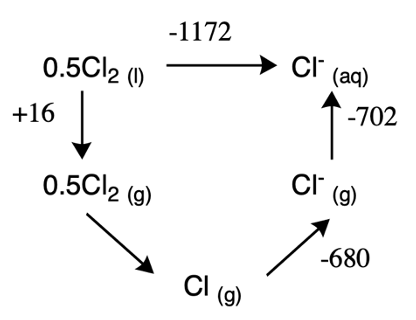
In the energy cycle shown, what is the value in kJ mol-1 for the bond enthalpy of chlorine?
Topic 5 subTopic 4 question 6 question image 1
A: 
+ 194
B: 
B + 97
C: 
C + 49
D: 
D + 57

Question 21

Loading progress...
Easy
Which of the following represents the bond enthalpy of HCl?
A: 
HCl(g)   →   ½H2(g) + ½Cl2(l)
B: 
HCl(g)   →   ½H2(g) + ½Cl2(g)
C: 
HCl(g)   →   H (g) + Cl(g)
D: 
HCl(g)   →   H+(g) + Cl-(g

Question 22

Loading progress...
Medium
Considering the bond energies shown for the mystery diatomic gas X, and the equation below, what would be the calculation for ΔHø?

X2 (g) + 3H2 (g)   →   2XH3 (g)    ΔHø = ?
BondBond Enthalpy / kJ mol-1
X≡Xa
H-Hb
X-Hc
A: 
a + 3b - 6c
B: 
6c - a + 3b
C: 
a - 3b + 6c
D: 
a + 3b - 2c

Question 23

Loading progress...
Easy
For the reaction below, which of the options best explains the enthalpy change? H2(g) + F2(g)   →   2HF(g) ΔH = -539 kJ
A: 
The HF bonds are the strongest
B: 
HF is an ionic compound but H2 and F2 are covalent.
C: 
More bonds are formed than are broken.
D: 
HF is an acid.

Question 24

Loading progress...
Hard

Define Hess’s law and use it to determine ΔH\Delta H for the reaction below:

CO(g) + 12\tfrac{1}{2}O2(g) → CO2(g).

C(s) + 12\tfrac{1}{2}O2(g) → CO(g) ΔH=−111\Delta H=-111kJ mol-1

C(s) + O2(g) → CO2(g) ΔH=−394\Delta H=-394kJ mol-1

A: 
ΔH=+283\Delta H=+283kJ mol-1
B: 
ΔH=−505\Delta H=-505kJ mol-1
C: 
ΔH=−283\Delta H=-283kJ mol-1
D: 
ΔH=−111\Delta H=-111kJ mol-1

Question 25

Loading progress...
Hard
Calculate ΔH\Delta H for: CH4(g) + Cl2(g) → CH3Cl(g) + HCl(g) using average bond enthalpies: C–H 413413kJ mol-1, Cl–Cl 243243kJ mol-1, C–Cl 338338kJ mol-1, H–Cl 431431kJ mol-1. Which statement best explains why this calculated value may differ from an experimentally measured ΔH\Delta H for this reaction?
A: 
Average bond enthalpies are measured only for bonds in the gas phase, but this reaction occurs in aqueous solution.
B: 
Average bond enthalpies are mean values taken over many different compounds, so the C–H bond enthalpy in CH4 may differ from the average C–H value used.
C: 
Bond breaking releases energy and bond forming absorbs energy, so the sign of ΔH\Delta H from bond enthalpies is often opposite to experimental values.
D: 
Using bond enthalpies always gives an exact value for ΔH\Delta H because the same bonds are broken and formed regardless of the molecule.

Question 26

Loading progress...
Medium
Ethane, C2H6, burns as per the equation: 2C2H6(g) + 7O2 (g)   →   4CO2 (g) + 6H2O(l)

Use the below equations to calculate ΔH of combustion in kJ for ethane:

C2H6(g) + O2 (g)   →   C2H4O(g) + H2O(g)    ΔH = -152 kJ
2C2H4O(g) + 5O2 (g)   →   4CO2 (g) + 4H2O(g)    ΔH = -682 kJ
H2O(l)   →   H2O(g)    ΔH = +22.0 kJ

[3]

Question 27

Loading progress...
Medium
Using the data in the table, what is ΔH for the conversion of solid Po to gaseous Po?
ReactionΔH /kJ mol-1
Po(s) + O2 (g)   →   PoO2 (g)-395
Po(g) + O2 (g)   →   PoO2 (g)-618

[3]

Question 28

Loading progress...
Medium

The bond enthalpies for H2, I2 and HI are 436, 151 and 298 kJ mol-1 respectively. Calculate ΔH for the following reaction: ½H2(g) + ½I2(g)   →   HI(g)

[2]

Question 29

Loading progress...
Medium
Using the information in the table provided, what would be the bond energy for the nitrogen-oxygen bond in NO?

N2(g) + O2 (g)   →   2NO(g)    ΔH = 269 kJ mol-1
BondBond Enthalpy /kJ mol-1
N≡N945
O=O498

[2]

Question 30

Loading progress...
Medium
Using the table, calculate the enthalpy change for the reaction: CH4(g) + Cl2(g)   →   CH3Cl(g) + HCl(g)
BondBond Energy / kJ mol-1
H-Cl431
C-Cl324
C-H414
Cl-Cl242

[3]

Question 31

Loading progress...
Medium
Use the provided bond energy values to calculate the enthalpy change for the reaction below

2C4H10(g) + 13O2 (g)   →   8CO2 (g) + 10H2O(g)
BondkJ mol-1BondkJ mol-1
C-H414C-C346
C-O358O-H463
C=O804O=O498

[2]

Question 32

Loading progress...
Hard
Hydrogen cyanide reacts with H2 to produce methylamine by the equation:

HCN(g) + 2H2(g)   →   H3CNH2(g)
  1. Draw Lewis structures for all constituents in this reaction.

    [3]

  2. Using bond energy values from the table, calculate ΔH, for the equation above
    BondkJ mol-1
    C-H414
    C-N286
    H-H436
    C=N615
    N-H391
    C≡N890

    [3]

  3. Calculate ΔH for this same reaction using formation enthalpies from the table below
    CompoundΔHf / kJ mol-1
    HCN(g)135
    H3CNH2(g)-23

    [3]

  4. Explain why your answers to (b) and (c) differ.

    [2]

Question 33

Loading progress...
Medium
Given the equation below, and the knowledge that the bond energy within O2 is 498 kJ mol-1, calculate the average S=O bond energy in this equation.

2SO2 (g) + O2 (g)   →   2SO3 (g)    ΔH = -384 kJ mol-1

[3]

Question 34

Loading progress...
Hard
Given the following data, calculate the average bond enthalpy for the carbon-halogen bond in CCl4
CompoundΔHf / kJ mol-1
ΔH f of CCl4(g)-89
Bond enthalpy of Cl2(g)242
Atomisation energy of C(s)723

[5]

Question 35

Loading progress...
Easy

Define Hess’s law and apply it to calculate the enthalpy change, ΔH\Delta H, for the reaction below using the given thermochemical equations.


CH4(g) + 2O2(g) → CO2(g) + 2H2O(l)


Data:

  1. C(s) + O2(g) → CO2(g) ΔH=−394\Delta H = -394 kJ mol-1
  2. 2H2(g) + O2(g) → 2H2O(l) ΔH=−572\Delta H = -572 kJ mol-1
  3. C(s) + 2H2(g) → CH4(g) ΔH=−75\Delta H = -75 kJ mol-1

[7]

Question 36

Loading progress...
Easy

Average bond enthalpies (in kJ mol-1) are given below.

BondBond enthalpy / kJ mol-1
H–H436
Cl–Cl243
H–Cl431

Consider the reaction:

H2(g) + Cl2(g) → 2HCl(g)

  1. State whether bond breaking and bond forming are endothermic or exothermic.

    [2]

  2. Calculate ΔH\Delta H for the reaction using the average bond enthalpies provided.

    [4]

  3. Explain why bond enthalpy data are described as average values and why a value calculated using average bond enthalpies may differ from an experimentally measured ΔH\Delta H for the reaction.

    [4]

Next Up

You have completed the sub-topic R1.2 questions, covering "Cycles of energy" for IB Chemistry - continue with related resources below or explore the full IB Chemistry course from the IBO.

Other Sub-topic R1.2 resources