IB Maths AI 1.2 Notes
This page contains our IB Maths AI notes for 1.2. By reading each one of these notes, you will fully cover the content for IB Maths AI 'Arithmetic sequences'.
Chapters
Arithmetic sequences
An arithmetic sequence is a sequence in which the difference between consecutive terms is constant. This fixed change is called the common difference.
For example, in the sequence , each term increases by , so the common difference is .
A sequence is arithmetic if
Key terms:
- The first term is usually written as or .
- The common difference is written as .
- The th term is written as .
So an arithmetic sequence can be written in the form
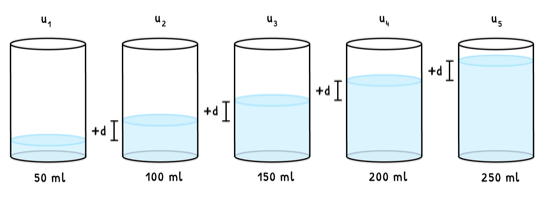
Image reference: glasses of water increasing by a fixed amount each time.
Arithmetic sequences are useful when a quantity changes by roughly the same amount each time.
- saving the same amount each month
- rows of seats increasing by a fixed number
- repayments increasing by a fixed amount
- water volume increasing by the same amount in identical containers
In practice, real-life data is often not perfectly arithmetic. In that case, we look for an approximately constant difference and use an arithmetic model as a reasonable approximation.
tibertutor.com
Next Up
You have completed the sub-topic 1.2 notes, covering "Arithmetic sequences" for IB Maths AI - continue with related resources below or explore the full IB Maths AI course from the IBO.
Other Sub-topic 1.2 resources