IB Physics D1 Notes
This page contains our IB Physics notes for D1. By reading each one of these notes, you will fully cover the content for IB Physics 'Gravitational fields'.
Chapters
Newton's law of gravitation
At this point in the syllabus, gravity has been mentioned as few times. In Topic A.2, it was mentioned that the gravitational force can be regarded as a centripetal force in some scenarios. In Topic D.1, you learn more about the gravitational force.
The gravitational force is governed by Newton's law of gravitation, which states that every mass in the universe attracts every other mass in the universe. This occurs because every mass releases gravitons that exert the gravitational force on other masses.
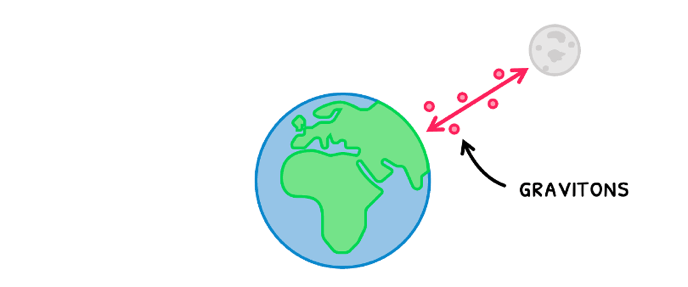
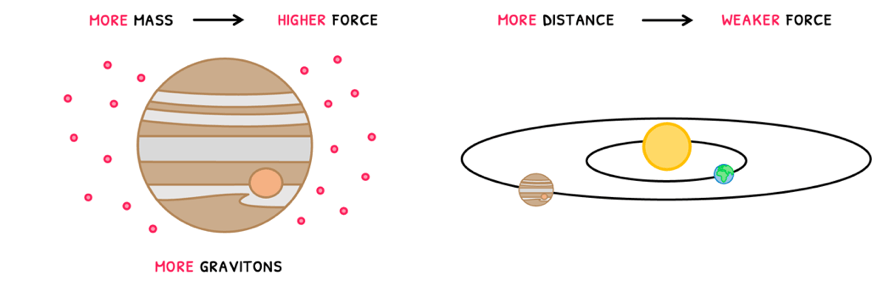
The more mass there is, the more gravitons are released and thus the higher the exerted gravitational force. However, the further away the other mass, the weaker the exerted gravitational force. If you remember, this is very similar to how the electrostatic force behaves.
The formula for gravitational force is given by:
In this, G is the gravitational constant, equal to 6.67 x 10⁻¹¹ Nm-2 kg-2.
Although the gravitational force is present between all objects, you likely know yourself that this is not felt unless the masses are huge. For such masses, let’s explore how we describe gravity via their gravitational fields.
tibertutor.com
Next Up
You have completed the sub-topic D1 notes, covering "Gravitational fields" for IB Physics - continue with related resources below or explore the full IB Physics course from the IBO.
Other Sub-topic D1 resources