IB Biology HL exam mistakes: your 2026 fix guide
The most common IB Biology HL exam mistakes and how to avoid them
Most marks lost in IB Biology HL come down to a handful of predictable errors, not gaps in knowledge. Students who understand what examiners actually reward, and who practise answering accordingly, consistently outperform those who simply revise more content.
Here are the core mistakes to address before your 2026 exams:
- Misreading command terms such as “Explain,” “Compare,” or “Evaluate,” each of which demands a distinct answer format
- Ignoring mark scheme phrasing and writing accurate biology that still earns no marks
- Leaving questions unanswered, particularly on Paper 1 where there is no penalty for guessing
- Confusing related processes such as osmosis and diffusion, or transcription and replication
- Omitting units, labels, or variable identification in data questions
- Writing long, unfocused answers that address the topic but not the question
- Failing to connect concepts across syllabus topics in extended responses
- Poor time allocation, leading to rushed or incomplete sections
Fixing these habits is entirely possible with the right preparation. The sections below address each area in depth.
Table of Contents
- 1. What mistakes do students make on Paper 1?
- 2. Pitfalls to avoid in Paper 2 extended responses
- 3. Advanced study strategies that build real exam readiness
- 4. How to manage your time across IB Biology HL exams
- 5. Where content knowledge gaps most often cost marks
- 6. How to interpret data and graphs in exam questions
- 7. Calculation and maths errors to watch for
- 8. How to handle experimental design questions well
- Tibertutor gives you the exam practice that actually moves your grade
- Key takeaways
- FAQ
1. What mistakes do students make on Paper 1?
Paper 1 errors are often avoidable with sharper technique rather than deeper content knowledge.
- Misreading question stems. Students skim questions and miss a qualifying word like “not” or “except,” flipping the correct answer entirely.
- Careless guessing without elimination. Random guessing wastes the benefit of a no-penalty format. Use process of elimination to narrow options to two, then commit.
- Falling for partially correct options. Distractors in IB Biology are designed to look plausible. Watch for absolute language like “always” or “never,” which usually signals a wrong answer.
- Poor time management. Spending too long on a single question leaves later ones rushed. If a question stalls you, make your best guess, mark it, and return if time allows.
- Not practising question styles. Past papers familiarise you with how questions are phrased, which reduces misreading under pressure.
Pro Tip: Before looking at the answer options, try to formulate your answer from the question stem alone. Students who do this are less likely to be drawn in by convincing distractors.

2. Pitfalls to avoid in Paper 2 extended responses
Extended-response answers are where the most marks are won or lost in a single sitting. The errors here are consistent across exam sessions.
Common pitfalls include:
- Writing long explanations that ignore the command term entirely
- Missing the specific keywords the mark scheme requires
- Confusing correlation with causation in data-based questions
- Overusing vague reasoning such as “it increases because it works better”
- Failing to structure answers around the number of marks available
The mini-essay format works well for extended responses: a concise opening sentence that directly addresses the question, focused body paragraphs each making one clear biological point, and a brief conclusion tying back to the question. Each paragraph should earn a mark. Examiners reward answers that connect theory to evidence and demonstrate independent thought across topics, not just factual recall.
Precise biological terminology separates top-tier answers from average ones. Write “osmosis” not “water movement,” name the enzyme, name the organelle.
Pro Tip: After each past paper, rewrite the mark scheme answer for every question you missed. This trains you to recognise the exact phrasing examiners reward, which is faster than re-reading notes.
3. Advanced study strategies that build real exam readiness
Passive revision, such as re-reading notes or highlighting, does not build the retrieval strength the exam demands. Active recall is more effective: convert each syllabus point into a question, then answer it without looking at your notes.
Practical strategies that work:
- Turn syllabus statements into flashcard questions using a spaced repetition app such as Anki
- After each past paper, rewrite mark scheme answers for missed points and keep them in a single revision document
- Practise concept mapping to link topics, for example connecting membrane transport to nerve impulse propagation, or photosynthesis to ecosystem energy flow
- Attempt past papers only once your content foundation is solid; using them too early risks reinforcing wrong answers and building false confidence
Tibertutor’s exam-style question banks and personalised progress tracking let you identify weak topics quickly and practise under realistic exam conditions, which is exactly the kind of targeted repetition that builds confidence.
4. How to manage your time across IB Biology HL exams
Time pressure causes otherwise well-prepared students to leave marks on the table. The fix is a deliberate pacing strategy, not just working faster.
Key tactics:
- Scan the full paper before writing anything; identify where data questions and extended responses sit
- Allocate time proportionally to marks: a 6-mark question deserves roughly three times the attention of a 2-mark one
- Outline extended responses in a few bullet points before writing; this prevents rambling and ensures you hit every mark point
- Tackle high-mark data questions early while your reasoning is fresh
- Never leave a question blank; an incomplete answer can still earn partial marks
Students who outline before writing consistently produce more structured answers and avoid the common error of running out of space or time mid-explanation.
5. Where content knowledge gaps most often cost marks
Certain topics generate errors repeatedly across exam cohorts. Knowing where the gaps tend to cluster helps you prioritise revision.
The most frequently confused areas include:
- Osmosis vs diffusion. Students conflate the two in questions about water potential and membrane transport.
- Transcription vs replication. Mixing up the enzymes, templates, and products involved is a common error in genetics questions.
- Photosynthesis and respiration detail. Vague answers about “energy release” without naming ATP, specific stages, or locations lose marks.
- Homeostasis mechanisms. Students describe the outcome but omit the receptor, effector, and negative feedback loop that examiners expect.
- Ecology and energy transfer. Confusing productivity terms or misrepresenting trophic efficiency is frequent in higher-mark questions.
Syllabus mastery across all HL-only topics is what separates a grade 6 from a grade 7. Give HL extension content dedicated weekly time, not just a pre-exam skim.
6. How to interpret data and graphs in exam questions
Data handling is one of the clearest differentiators at HL. Examiners reward correct graph construction, thoughtful error analysis, and appropriate statistical interpretation.
When reading a graph or data set in the exam:
- Identify the trend first: is it linear, exponential, or does it plateau?
- Quote specific values from the graph when describing changes, rather than writing “it increases”
- Note anomalies or error bars and comment on what they suggest about reliability
- Distinguish between correlation and causation explicitly, especially in evaluation questions
When drawing or labelling graphs, always include axis labels with units, choose an appropriate scale, and add a best-fit line or curve where the relationship is clear. Missing a unit on an axis label is a one-mark loss that takes seconds to avoid.
7. Calculation and maths errors to watch for
Quantitative questions reward method as much as the final answer. Showing your working means partial marks are still available even when the final value is wrong.
Common errors include:
- Forgetting units or writing the wrong unit after a correct calculation
- Rounding too early in multi-step calculations, which compounds error
- Misidentifying the formula needed, particularly for rate calculations or magnification
- Not expressing answers to an appropriate number of significant figures
- Skipping the working entirely and writing only a final answer
Write each step clearly. If you use a formula, state it before substituting values. Examiners follow your logic, and a correct method with an arithmetic slip still earns credit.
8. How to handle experimental design questions well
Experimental design questions appear in both Paper 1 and Paper 2, and they reward students who understand the logic of scientific enquiry, not just the content.
- Define variables precisely. State the independent variable, dependent variable, and at least two controlled variables with a brief reason for each.
- Describe controls clearly. A control experiment isolates the variable being tested; explain what it controls for, not just that it exists.
- Suggest realistic improvements. Vague suggestions like “do more trials” lose marks. Name the specific limitation and explain how a targeted change would reduce it.
- Use biological justification. Link your method choices to the biology: explain why temperature must be controlled in an enzyme experiment by referencing enzyme activity and activation energy.
- Avoid unfocused research questions. A well-formed research question names the independent and dependent variables and implies a measurable outcome.
Practising IA-style design questions builds the same skills examiners look for in Paper 2 experimental scenarios.
Tibertutor gives you the exam practice that actually moves your grade
Knowing the mistakes is the first step. Practising your way out of them is what changes your result.
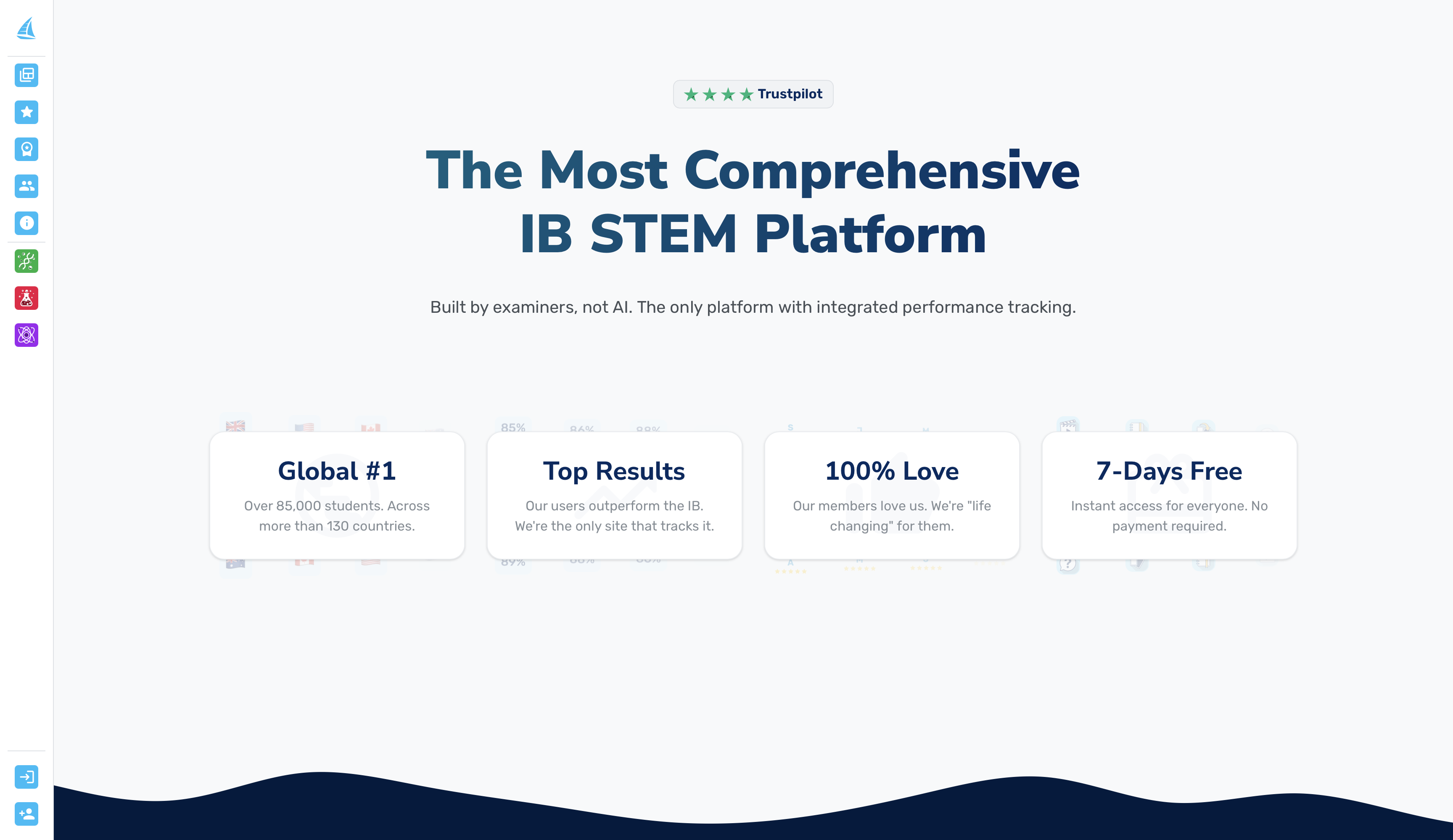
Tibertutor is built by IB examiners and experienced educators specifically for students aiming for a 6 or 7 in IB sciences. Every resource, from topic-specific Biology tests to animated videos, flashcards, and mock exams, is designed around the mark scheme and command term expectations you have just read about. The platform’s progress tracking shows you exactly which topics need more work, so your revision time goes where it matters most. No guesswork, no generic notes: just focused, exam-oriented practice that builds the confidence to perform on the day. Start your free IB Biology practice today and see where your marks are waiting.
Key takeaways
The single most effective change you can make is to practise answering questions using mark scheme language, not just revising content.
| Point | Details |
|---|---|
| Command terms are non-negotiable | Each term requires a distinct format; “Explain” needs cause-effect, “Compare” needs paired language. |
| Paper 1 rewards technique | Use process of elimination, underline keywords, and always answer every question. |
| Structure extended responses | Use the mini-essay format: opening sentence, one mark per paragraph, brief conclusion. |
| Active recall beats passive notes | Convert syllabus points into questions and use spaced repetition to retain them. |
| Tibertutor for targeted practice | Examiner-built question banks and progress tracking help you fix weak areas before exam day. |
FAQ
What are the most common IB Biology HL exam mistakes?
The most frequent errors are misreading command terms, missing mark scheme keywords, omitting units in calculations, and writing unfocused extended responses that do not address the question directly.
Should I guess on Paper 1 if I am unsure?
Yes. There is no penalty for an incorrect answer on Paper 1, so always attempt every question. Use process of elimination first to improve your odds before committing to an answer.
How should I structure a Paper 2 extended response?
Open with a sentence that directly addresses the question, then write one focused paragraph per mark point, each containing a biological claim and its explanation. Finish with a brief concluding sentence.
How do I avoid losing marks on data and graph questions?
Always label axes with quantities and units, quote specific values when describing trends, and distinguish between correlation and causation explicitly in evaluation questions.
How can Tibertutor help me reduce exam mistakes?
Tibertutor provides examiner-built exam-style questions, mark scheme feedback, and personalised progress tracking, giving you the targeted practice needed to identify and fix recurring errors before the real exam.