90 Extra Hours: IB Biology HL vs SL for Students and Parents
HL means roughly 90 extra teaching hours and genuinely deeper content, while SL covers the same four core themes at a lighter, still demanding pace. Choose HL if you’re set on a life-science or medicine route and enjoy the subject; choose SL if biology supports broader goals rather than driving them. The internal assessment is identical either way, so the real decision comes down to taught content, exam pressure, and what your target university actually asks for.
TL;DR:
- HL covers approximately 90 more teaching hours than SL, including advanced topics like viral replication, muscle physiology, and integrated body systems.
- HL exam questions are longer and demand more synthesis, linking mechanisms, data, and themes, with extra questions based on AHL content.
- Weekly study time for HL can reach four to six hours, mainly due to volume and the need for sustained, deep understanding of detailed mechanisms.
- Medicine and bioscience courses typically require HL sciences, especially Biology HL combined with Chemistry HL, and students should verify specific university requirements early.
- Preparation should focus on spaced retrieval, practicing past papers by theme, and using examiner feedback to master mark schemes, rather than last-minute cramming.
Table of Contents
- IB biology HL vs SL: syllabus and content differences
- Exam structure: how papers and marks differ between levels
- Workload and difficulty: what a typical week actually looks like
- Does HL biology matter for medicine and life-science degrees?
- A simple decision framework for choosing your level
- Preparing for either level: what actually moves your grade
- An educator’s view on choosing between HL and SL
- How Tiber Tutor supports your HL or SL preparation
- Where to check the official facts
- Sources
- FAQ
IB biology HL vs SL: syllabus and content differences
Both levels are built on the same four themes and the same levels of biological organisation, from molecules to ecosystems. That shared framework is exactly why so many students assume HL and SL only differ in exam difficulty. They don’t. HL adds a distinct set of higher-level (AHL) topics that SL students never touch, and the IB biology subject brief confirms HL layers this extra content directly on top of the shared core.
The additional ground typically includes:
- Viral structure and replication strategies, absent from the SL syllabus entirely
- Muscle contraction and motility mechanisms at a molecular level
- Integration of body systems, linking endocrine, nervous, and physiological responses
- Expanded biochemistry, including more detailed enzyme kinetics and metabolic pathways
None of this is padding. The IB recommends a substantially shorter teaching duration for SL compared to HL, and every additional hour at HL maps onto content that appears on the exam. A detailed breakdown of HL-only topics shows just how much of that extra depth sits in molecular and physiological detail rather than in broad new themes.
Exam structure: how papers and marks differ between levels
Paper 1 and Paper 2 both grow at HL, not just in length but in the type of thinking they demand. SL papers test the shared core; HL papers add extra questions that draw on AHL content and expect students to link ideas across themes rather than answer in isolation. The full DP biology subject guide sets out the exact paper formats and mark allocations for each level.
Key structural points to know:
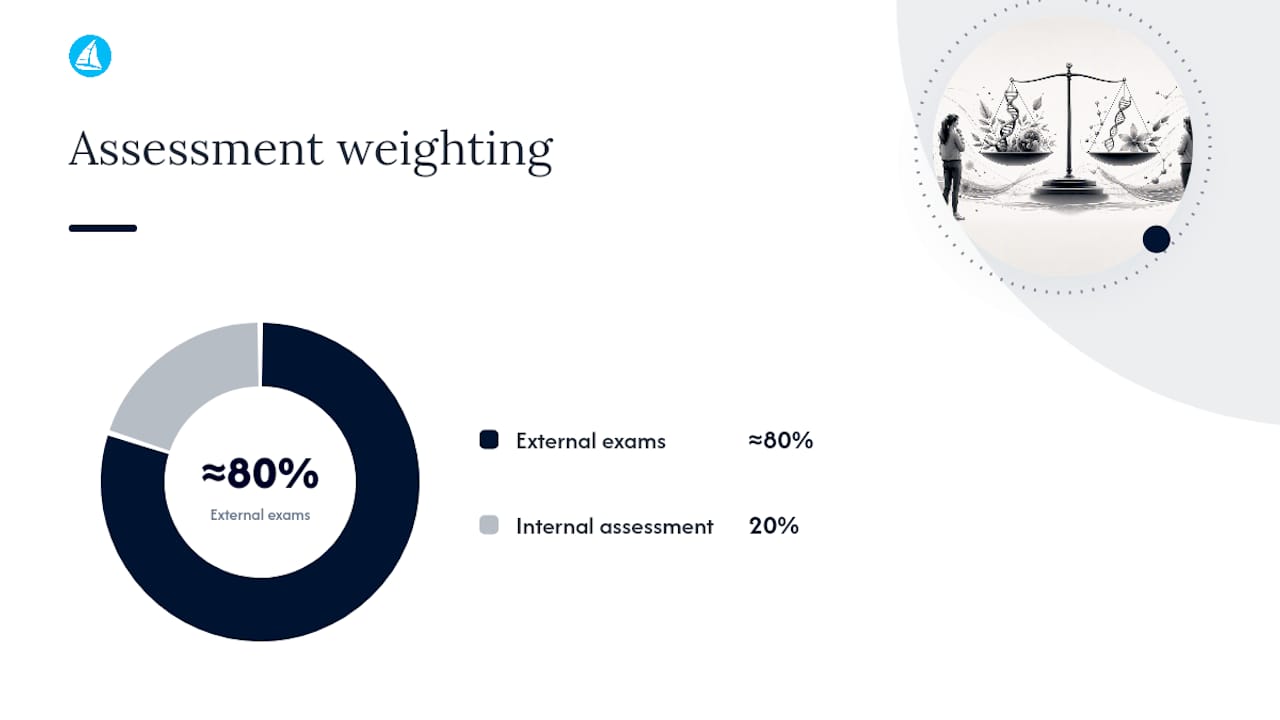
- External exams (Papers 1, 2, and 3) make up about 80% of the final grade at both levels
- The internal assessment stays at 20% and follows identical criteria for HL and SL
- HL papers run longer and include additional synthesis-heavy questions absent at SL
- Examiners reward precision and multi-step application, weighted more heavily in HL mark schemes
That last point matters more than most students expect. Getting a fact right isn’t enough at HL. Markers want you to connect that fact to a mechanism, a data set, or another theme entirely, which is precisely why the nature of science thread runs through both levels.
Workload and difficulty: what a typical week actually looks like
SL students commonly manage on two to three hours of biology study a week outside class, building steadily toward revision season. HL students often need closer to four to six hours weekly once AHL content kicks in properly, and that gap widens further in the run up to mocks.
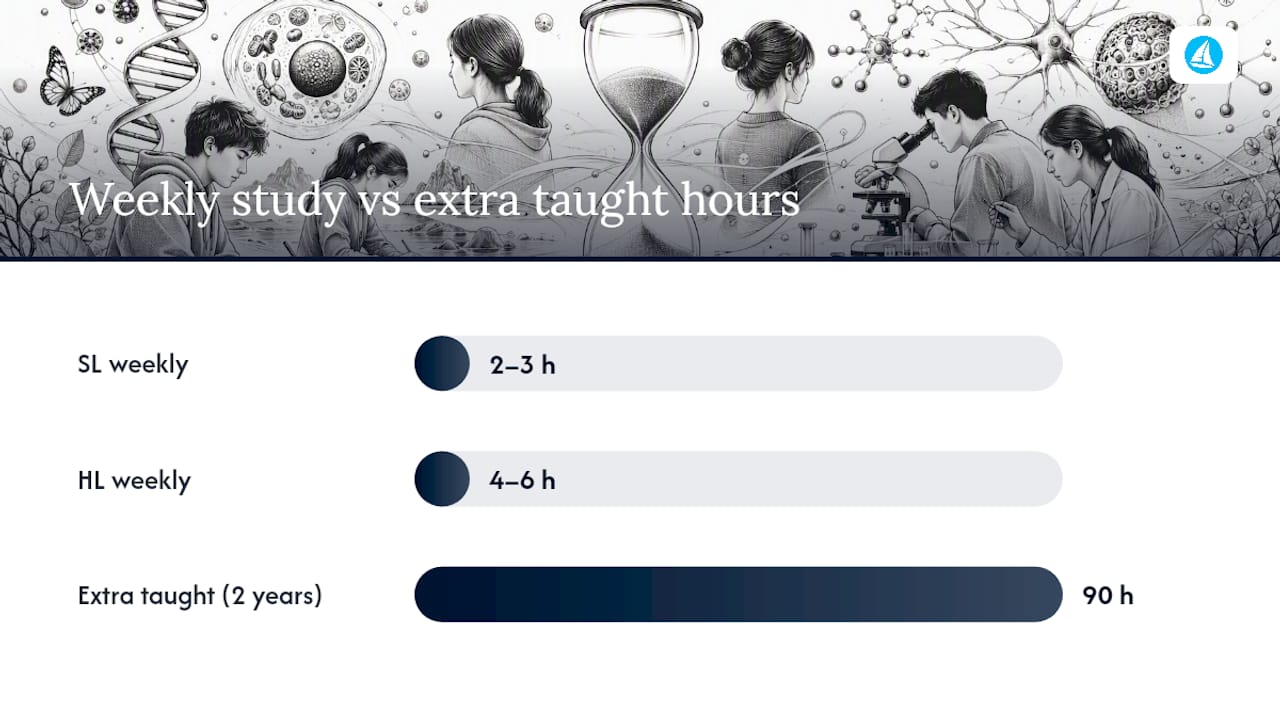
The gap between SL and HL preparation isn’t really about SL students working “less hard.” It’s that HL’s extra 90 taught hours eventually convert into extra revision hours, and that compounds across two years of the Diploma.
Most students who describe HL as “harder” aren’t struggling with a single difficult concept. They’re struggling with volume: recalling viral replication cycles, muscle physiology, and expanded biochemistry, then applying all of it under exam pressure in the same sitting as questions that also test the shared core. A synthesis of experienced-teacher guidance backs this up directly, pointing to volume and synthesis as the real difficulty driver rather than raw conceptual complexity.
Pro Tip: If you find yourself dreading biology homework by week three of DP1, that’s worth taking seriously. HL rewards sustained curiosity far more than it rewards last-minute effort, especially once you’re juggling it alongside two other HL subjects.
Does HL biology matter for medicine and life-science degrees?
Medicine, dentistry, and veterinary courses commonly expect two HL sciences, and Biology HL is very often one of them, frequently paired with Chemistry HL. Admissions guidance for competitive life-science courses confirms this pattern holds across most bioscience and biomedical programmes too, where HL is usually preferred even when not strictly mandatory.
Some broader life-science degrees, particularly those with a less clinical focus, will accept SL Biology. That variation means you should never assume, and it’s always worth a direct check. Before finalising your choice:
- List every course you’re realistically considering, not just your first choice
- Check each course’s specific IB subject requirement page rather than relying on general advice
- Email admissions directly if the requirement isn’t stated clearly
- Note whether Chemistry HL is expected alongside Biology HL, which it often is for medicine
A simple decision framework for choosing your level
- Start with your target courses. Confirm which HL subjects they actually require before you consider anything else. If medicine or a bioscience degree is the goal, this step usually settles the decision on its own.
- Be honest about weekly capacity. Four to six hours of biology revision a week, sustained over two years, only works if you enjoy the subject enough to keep showing up for it.
- Weigh your whole HL package. Most students take three HL subjects, so Biology HL needs to sit comfortably alongside your other two, not compete against them for the same evening hours.
Pro Tip: Talk to your IB coordinator before finalising subjects. They’ve watched dozens of cohorts make this exact call and usually know which combinations cause the most stress in practice.
Switching levels is still possible early in DP1 for most schools, but leaving it until DP2 creates a serious catch-up problem given how much HL-only content builds cumulatively.
Preparing for either level: what actually moves your grade
Spaced retrieval beats last-minute cramming for a subject this content-heavy, particularly at HL where the sheer number of named mechanisms punishes anyone relying on short-term memory. Targeted past-paper practice, organised by topic rather than by date, tends to expose weak spots faster than working through full papers in exam order.
The other habit worth building early: read actual mark schemes and examiner commentary rather than model answers alone. Examiners consistently reward the same things, precise terminology, clear linkage between themes, and answers that match command terms exactly, and that pattern only becomes obvious once you’ve seen how marks are actually awarded across several papers.
- Use topic-specific tests to isolate AHL content before mixing it back into full practice
- Build a rotation of past-paper questions grouped by theme, not by paper number
- Track weak topics over time rather than re-testing the same strong areas repeatedly
This is exactly where structured, examiner-informed tools earn their place. IB Biology mock exams modelled on the real paper formats help HL candidates specifically, since time pressure is where most marks are lost.
An educator’s view on choosing between HL and SL
Genuine curiosity about biology predicts HL success more reliably than strong prior grades ever do. A student who’s merely competent but fascinated by the subject will usually outlast one who’s talented but bored by week ten. Talk it through honestly with your teachers and your IB coordinator rather than deciding alone, and remember that early DP1 still leaves room to switch. Leave it until DP2, and the catch-up becomes genuinely difficult.
— Oliver
How Tiber Tutor supports your HL or SL preparation
Working out whether HL is actually manageable for you shouldn’t rest on guesswork or a single mock result three months before finals. The platform provides content created by IB examiners, mapped directly onto the syllabus, so every topic test and mock paper reflects actual exam content.
Every resource on the platform, notes, flashcards, topic tests, and full mock exams, is interlinked and tracked through the same progress analytics, so a weak topic flagged in a topic test shows up again in your next mock rather than quietly disappearing. That level of connected, examiner-built tracking isn’t something a scattered mix of free resources can replicate. If you’re deciding whether HL’s extra volume is manageable, the fastest way to find out is to sit an IB Biology mock exam under real time pressure and see exactly where the gaps sit, then start a free trial to build a revision plan around what the analytics actually show you.
Where to check the official facts
Syllabus content and university requirements both shift, so always verify against primary sources before finalising your subject choice. The official IB biology subject brief confirms current themes, hours, and assessment structure. For admissions, always check the specific entry requirements page for each university course rather than relying on general guidance, since requirements vary even between similar degrees.
Sources
- Biology in the DP - International Baccalaureate®
- IB Biology HL vs SL 2025 | Which Level Should You Take? | Cerebrum
- DP biology subject guide roadmap (IBO XML two publication)
FAQ
Is SL or HL biology harder?
HL is harder mainly because of volume and synthesis, not because individual concepts are more difficult; you’re recalling and connecting more material under the same time pressure as SL.
How hard is it to get a 7 in IB Biology HL?
It requires consistent recall across a larger syllabus plus strong exam technique for multi-step, cross-theme questions, which is why examiner-informed mock exams and topic tests matter more at HL than at SL.
Is IB Biology SL hard?
SL is still rigorous and covers the same four core themes as HL, but without the additional AHL topics, so the weekly workload and exam demand are noticeably lighter.
What’s the actual difference between HL and SL biology?
HL adds roughly 90 teaching hours of extra content, including topics like viruses and muscle physiology, plus longer exam papers with more synthesis-based questions; the internal assessment stays identical at both levels.