How to manage IB exam stress: a practical guide
Start with three things: build a clear revision plan, practise under timed conditions, and protect your sleep. Those three actions, done consistently over 2–3 months, reduce IB exam stress more reliably than any last-minute cramming session.
Here is what to do in the next 30–60 minutes:
- Write a clear timetable. Open a blank document and list every IB STEM paper you have, with its date. Assign revision blocks to each subject. Seeing the plan on paper immediately reduces the mental load of holding it all in your head.
- Take a 20-minute walk. Physical movement lowers cortisol. You do not need a gym or a plan; just step outside.
- Do 10 minutes of slow breathing. Breathe in for four counts, hold for four, out for four. Repeat until the ten minutes are up.
The IBO wellbeing toolkit recommends exactly this kind of structured, paced approach to protecting student mental health during assessment periods.
Key takeaways
Managing IB exam stress comes down to three consistent actions: structured planning, regular timed practice, and protecting sleep throughout exam season.
| Point | Details |
|---|---|
| Start your plan now | Map every STEM paper date and assign revision blocks well before exams. |
| Practise under timed conditions | Complete full mock papers every 2–3 weeks and log every error immediately after marking. |
| Protect sleep above all else | Aim for 8–9 hours nightly; cutting sleep for revision almost always reduces performance. |
| Use breathing techniques early | Practise 4-7-8 breathing daily before exams so it works reliably when you need it most. |
| Ask for help before it escalates | Contact your school counsellor, NHS Every Mind Matters, or Mind UK at the first sign of persistent anxiety. |
Pro Tip: This week: write your timetable today, complete one timed past paper by Friday, and set a sleep alarm for 10 PM every night. Those three actions alone will shift how you feel going into exam season.
Table of Contents
- What does a good IB revision timeline look like?
- How do you build a revision plan you will actually stick to?
- What are the best exam-day strategies for IB STEM papers?
- How do sleep, nutrition, and movement affect IB exam performance?
- Which breathing and grounding techniques work quickly before an exam?
- Where can you get mental health support in the UK as an IB student?
- How does exam-style practice actually reduce IB exam stress?
- What most stress advice gets wrong about IB exams
- Sources
- FAQ
What does a good IB revision timeline look like?
The ideal timeline runs in three stages: a structured build phase starting 2–3 months out, a consolidation phase in the final week, and a recovery-first approach on the day before each paper. Lanterna Education’s IB stress guide recommends beginning thorough revision 2–3 months before exam season, with past-paper practice as the core anxiety-reduction strategy.

2–3 months before exams
Map every topic on your syllabus for Biology, Chemistry, Physics, or Maths. Mark each topic as confident, shaky, or not yet started. Prioritise the shaky ones first. Run at least one timed topic test per week per subject, and schedule a full mock paper every two to three weeks. The IB Diploma Programme also requires you to manage Extended Essay and Theory of Knowledge deadlines alongside your subject revision, so build those into your calendar now rather than letting them ambush you in the final weeks.
The final week and the day before
Stop introducing new content by Wednesday of exam week. Use Thursday and Friday for light review of mark schemes and key formulae only. The night before a paper, lay out your equipment, confirm the exam time and location, and aim for at least eight hours of sleep. Resist the urge to revise past 9 PM.
Exam-week logistics checklist:
- Confirm exam times, room, and seat number
- Pack pens, pencils, ruler, calculator (check IB-approved models), and your ID
- Plan your travel with a buffer of at least 30 minutes
- Set two alarms
- Eat a proper breakfast
Pro Tip: Set a hard stop for revision the night before each paper. Students who revise past midnight consistently report higher anxiety the following morning, not better recall.
How do you build a revision plan you will actually stick to?
Make a personalised, subject-weighted plan that prioritises exam-format practice over passive review. Reading notes is comfortable; answering timed exam questions is what actually builds confidence and reduces IB exam anxiety.
Four steps to build your plan
- Syllabus audit. Download the current IB syllabus for each STEM subject. Tick every topic you have covered in class. Highlight gaps.
- Spaced practice schedule. Assign each topic a revision slot at least twice before the exam, spaced at least a week apart. Spaced repetition consolidates memory far more effectively than a single long session.
- Active recall over passive review. Replace re-reading notes with flashcards, topic tests, and practice questions. If you cannot write the answer from memory, you have not learned it yet.
- Timed past papers. From six weeks out, complete at least one full paper per subject under strict exam conditions. Mark it immediately using the official mark scheme.
Example weekly template
| Day | Morning | Afternoon | Evening |
|---|---|---|---|
| Monday | Biology content review | Biology topic test | Error log + corrections |
| Tuesday | Chemistry past-paper questions | Chemistry mark-scheme review | Rest |
| Wednesday | Maths timed paper | Maths corrections | Physics content review |
| Thursday | Physics topic test | Error log | Rest |
| Friday | Mixed subject practice | Weak-topic targeted questions | Free time |
| Saturday | Full mock paper (one subject) | Mark and log errors | Rest |
| Sunday | Light review only | Plan next week | Rest |
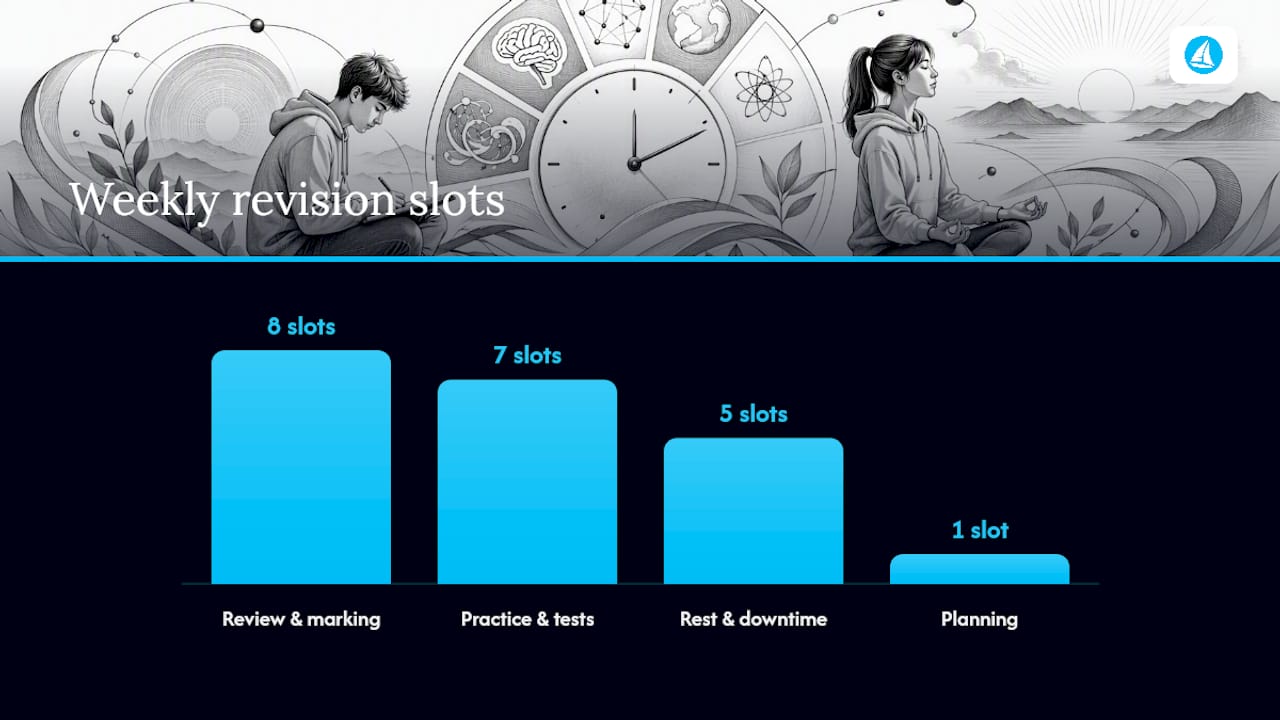
For a detailed science-focused schedule template, the IB study schedule for science guide on Tibertutor walks through exactly how to weight subjects by paper count and difficulty.
Time-management rules to follow:
- Use 45-minute study blocks with a 10-minute break (a modified Pomodoro approach works well for most IB students).
- Size tasks by output, not time: “complete 10 past-paper questions on enzyme kinetics” beats “study Biology for one hour.”
- Say no to social commitments during the two weeks before exams. One or two planned breaks are fine; open-ended socialising is not.
Pro Tip: Avoid planning in hours. Plan in tasks. “Finish Paper 2 from May 2023 and mark it” is a task you can complete and tick off. “Study Chemistry for two hours” is not.
What are the best exam-day strategies for IB STEM papers?
On exam day, use reading time to plan your approach, work in question order unless you are genuinely stuck, and always show your method, even when you are unsure of the final answer.
Time-per-mark guidance
IB Maths time management research suggests roughly 1.5 minutes per mark as a working heuristic for pacing. Calibrate this with one timed past paper before exam season, since individual speed varies. The table below shows how this applies across the three paper types in IB STEM subjects.
Paper-specific strategies from IB Innovators confirm that each paper type demands a distinct approach: Paper 1 tests breadth, Paper 2 tests depth and command-term mastery, and Paper 3 tests data interpretation.
First 10 minutes of the paper: a mini-workflow
- Use reading time to scan all questions and mark the ones you feel confident about.
- Note the mark allocations and estimate time budgets for each question.
- Start with a question you know well to build momentum.
- For calculation questions, write every step of your working. Method marks are awarded even when the final answer is wrong.
For a full breakdown of IB Maths paper formats, the IB Maths exam breakdown guide on Tibertutor covers pacing and command-term strategies in detail.
How do sleep, nutrition, and movement affect IB exam performance?
Consistent sleep and basic nutrition are as important as extra revision for exam performance and stress reduction. Cutting sleep to gain revision hours is a trade that almost always costs more than it gains.
Practical sleep hygiene steps for exam season:
- Aim for 8–9 hours on school nights and at least 8 hours before any exam.
- Stop screens 45 minutes before bed. Blue light delays melatonin release and makes it harder to fall asleep.
- Keep a consistent wake time, even at weekends. Irregular sleep patterns increase anxiety.
- Avoid caffeine after 2 PM.
“Adequate sleep is not a reward for finishing revision. It is part of the revision process itself.” Protecting sleep during exam season is one of the highest-return decisions you can make.
A sample daily routine during exam season might look like this: wake at 7 AM, eat breakfast, study from 8 AM to 12:30 PM with breaks, eat lunch, study from 1:30 PM to 5 PM, exercise or walk for 30 minutes, eat dinner, light review until 8:30 PM, then wind down and sleep by 10 PM.
On social media: student-tested guidance consistently shows that stepping away from social media during intense revision periods reduces anxiety more effectively than extra unfocused study hours. Set app time limits or delete the apps temporarily during the two weeks before exams.
Pro Tip: Eat a protein-rich breakfast on exam mornings. Eggs, Greek yoghurt, or nut butter on toast stabilise blood sugar and support concentration for longer than cereal or toast alone.
Which breathing and grounding techniques work quickly before an exam?
Short, repeatable scripts lower physiological arousal quickly. Clinical research indicates that breathing and grounding techniques can reduce acute anxiety symptoms in the short term, though individual responses vary.
4-7-8 breathing (use before entering the exam hall)
- Breathe in through your nose for 4 counts.
- Hold for 7 counts.
- Breathe out slowly through your mouth for 8 counts.
- Repeat four times. The whole exercise takes under two minutes.
5-4-3-2-1 grounding (use if anxiety spikes mid-exam)
Name five things you can see, four you can physically feel, three you can hear, two you can smell, and one you can taste. This technique anchors attention to the present moment and interrupts a spiral of anxious thinking.
These techniques are tools, not treatments. If you are experiencing persistent panic attacks, severe insomnia, or anxiety that is affecting your daily functioning, please speak to a school counsellor or GP rather than relying on self-help scripts alone.
Pro Tip: Practise 4-7-8 breathing every night for two weeks before exams. The technique works better when it is already familiar; doing it for the first time in the exam hall is less effective.
Where can you get mental health support in the UK as an IB student?
Escalate from school counsellor to pastoral lead to NHS or charity support depending on how severe your symptoms are. Most IB exam anxiety responds well to early, low-level support; you do not need to wait until things feel unmanageable.
Who to contact and when:
- School counsellor or form tutor: First port of call for exam anxiety, low mood, or sleep problems. Say: “I’m struggling with stress around my IB exams and I’d like some support.”
- Pastoral lead or head of year: If the counsellor is unavailable or you need academic accommodations (extra time, deferred assessment), your pastoral lead can escalate on your behalf.
- NHS Every Mind Matters: Free, evidence-based tools for managing anxiety and stress. The Mind Plan tool creates a personalised action plan in minutes.
- Mind UK: Provides detailed guidance on anxiety, panic attacks, and when to seek professional help. Their infoline is 0300 123 3393.
- Samaritans (116 123): Available 24 hours a day, free, for anyone feeling overwhelmed or having thoughts of self-harm.
The IBO’s student coping guide also encourages students to use school counselling and peer support networks rather than managing stress alone.
How does exam-style practice actually reduce IB exam stress?
Regular, timed mock exams with rapid correction cycles are the most reliable way to reduce exam stress in IB STEM subjects. Stress in exams is largely driven by uncertainty: you do not know what the questions will look like, how long they will take, or whether you know enough. Timed practice answers all three.
“Familiarity with the exam format is one of the most powerful anxiety-reducers available to IB students.” Every timed paper you complete is one fewer unknown on exam day.
The practice workflow
- Select a topic test aligned to a weak area identified in your error log.
- Complete a timed mock paper under strict exam conditions (no notes, no phone, timed to the minute).
- Mark against the official mark scheme immediately after finishing.
- Log every error by topic and command term. Note whether you lost marks for content, method, or misreading the question.
- Target the weak topics with a focused topic test before repeating the cycle.
For a 2–3 month lead time, aim for one full mock per subject every two to three weeks, increasing to one per week in the final month.
Tibertutor is built around exactly this workflow. Every resource on the platform, from exam-style questions to animated videos, detailed notes, and cram sheets, is created by actual IB examiners. That matters because the questions genuinely reflect what appears in real papers, not approximations. The platform’s progress tracking and performance analytics show you precisely where your marks are being lost across Biology, Chemistry, Physics, and Maths, at a level of detail no other IB platform currently offers. You can move from a topic test to a mock exam to a targeted correction cycle without leaving the platform, and the analytics update in real time so your next session is always focused on what actually needs work.
Pro Tip: After every mock, spend at least 20 minutes on your error log before moving on. Students who skip the correction step repeat the same mistakes in the next paper.
IB Chemistry mock exams on Tibertutor are a good starting point if Chemistry is your most pressured subject.
What most stress advice gets wrong about IB exams
The standard advice for exam stress is to “take breaks, sleep well, and talk to someone.” That is not wrong, but it misses the most important lever: confidence built through repeated, realistic practice.
Most IB students feel anxious because the exam format itself is unfamiliar. They have studied the content, but they have not sat enough papers under real conditions to know how they perform under time pressure. The anxiety is not irrational; it is an accurate signal that something is unresolved. The answer is not more relaxation. It is more timed practice, followed by honest error analysis.
The other thing most guides underestimate is how much the IB’s concurrent demands, six subjects, Extended Essay, Theory of Knowledge, and CAS, compound stress in a way that single-subject exam advice simply does not address. A revision plan that ignores EE and TOK deadlines will collapse in the final month. Build everything into one calendar from the start.
What I would tell any IB STEM student: stop treating mock exams as a diagnostic tool and start treating them as the primary training method. The students who feel calm on exam day are almost always the ones who have sat the most papers, not the ones who have read the most notes. Pair that with the support structures available to you, your school, the NHS, and Mind UK, and you have everything you need.
This article is general information, not a substitute for advice from a qualified doctor. Consult a qualified healthcare professional about your own circumstances before acting on anything here.
Sources
- How to Manage Your IB Exam Stress: Practical Tips | Lanterna Education
- wellbeing exam stress
- Best IB Maths Time Management Tips for SL and HL Students
- Pubmed
FAQ
How stressful is the IB compared to other qualifications?
The IB Diploma Programme is widely regarded as one of the most demanding pre-university qualifications, requiring students to manage six subjects alongside Extended Essay, Theory of Knowledge, and CAS simultaneously. The concurrent deadlines and breadth of assessment are the primary sources of elevated stress for most students.
How do you reduce exam anxiety quickly?
The fastest short-term relief comes from 4-7-8 breathing (four counts in, seven hold, eight out, repeated four times) combined with a clear written plan for the next study session. Clinical research supports breathing techniques for reducing acute physiological arousal in the short term.
What is the time-per-mark rule for IB exams?
A working heuristic of roughly 1.5 minutes per mark applies to most IB STEM papers, though Paper 1 typically runs faster at around one minute per mark. Calibrate your own pace with one timed past paper before exam season.
When should an IB student seek professional mental health support?
Seek support from a school counsellor or GP if you experience persistent insomnia lasting more than a week, repeated panic attacks, or any thoughts of self-harm. NHS Every Mind Matters and Mind UK both offer free, accessible starting points for students in the UK.