Math AA HL + Physics HL: IB combo that keeps engineering doors open
The strongest IB pattern for engineering is Mathematics: analysis and approaches (AA) HL, Physics HL, and a third HL chosen to match your branch, such as Design technology, Chemistry, or Computer science. Many competitive engineering programmes expect a 6 in HL maths and a science, and Mathematics: applications and interpretation (AI) is often rejected for core engineering entry. Check the shortlist below, then confirm the exact requirements on your target universities’ own pages.
TL;DR:
- A strong IB pattern for engineering typically includes HL Mathematics analysis and approaches or applications and interpretation, paired with Physics HL and a relevant third science HL.
- The third HL varies by branch: chemistry or design technology for general or civil engineering, computer science or design technology for electrical or computer engineering, and biology or chemistry for bio or chemical engineering.
- Achieving a 6 in HL math and a science is usually necessary for competitive programs, with a total score often in the mid-to-high 30s, though strong EE and IA work can offset slightly lower grades.
- Choosing Math AA HL over AI HL is essential for traditional engineering, as it provides the calculus depth and proof skills most universities require; AI HL may meet requirements only in applied routes.
- Coherent subject combinations, demonstrated through projects and assessments, matter more than simply stacking HLs, and focusing on targeted exam practice yields better preparation than broad revision.
Table of Contents
- Shortlist: HL and SL patterns for common engineering branches
- Why these subjects matter to admissions tutors
- Choosing between Maths AA and AI, and locking HL vs SL
- Third HL choices by engineering branch
- Turning EE, IAs, and Group 4 into admissions evidence
- University prerequisites and grade signals worth aiming for
- A simple DP1 to DP2 timeline and checklist
- What to practise and which resources actually move your marks
- How TOK and the Learner Profile shape engineering thinking
- Building interdisciplinary thinking into your IB engineering path
- Common challenges IB students face preparing for engineering, and fixing them
- Author perspective: examiner advice in one short note
- Study smarter with examiner-built IB STEM resources
- Sources
- FAQ
Shortlist: HL and SL patterns for common engineering branches
Engineering is not one degree with one entry checklist. Universities read your subject combination as a signal of intent, and the right third HL changes depending on where you are heading.
- Broad/general engineering: Math AA HL, Physics HL, and a third HL in Chemistry, Design technology, or Computer science, kept open until first-year specialisation.
- Mechanical or civil engineering: Math AA HL, Physics HL, and either Design technology HL (prototyping and materials) or Chemistry HL (materials chemistry).
- Electrical or computer engineering: Math AA HL, Physics HL, and Computer science HL or Design technology HL for systems-level work.
- Biomedical or chemical engineering: Math AA HL, Chemistry HL, and Physics SL or Biology HL depending on which side of the discipline pulls you, though stacking three science-adjacent HLs is a heavy workload worth discussing with your coordinator first.
Why these subjects matter to admissions tutors
Every HL subject you carry is a message to an admissions reader, whether you intend it or not. Math AA HL demonstrates the calculus, proof technique, and mathematical rigour that engineering maths modules assume on day one. Physics HL shows you can already handle mechanics, modelling, and lab-based experimental reasoning, which is exactly what first-year courses lean on.
A third HL in Chemistry, Design technology, or Computer science then signals domain fit for your specific branch. Design technology’s assessment through a substantial design project mirrors the prototyping and evaluation cycle mechanical and product engineers use professionally, which is precisely why it reads so well on a mechanical application.
Universities also read your subject combination as a coherent story rather than a list. A maths and science pairing backed by a project-based Extended Essay often carries as much weight as a marginal grade difference, because it tells the reader you chose engineering on purpose.
Pro Tip: Treat your Internal Assessments as a portfolio, not paperwork. A physics IA that models a real mechanical system, written up cleanly, is worth more to an admissions tutor than a vague personal statement claim about “loving problem solving.”
Choosing between Maths AA and AI, and locking HL vs SL
Get this decision wrong and it can quietly rule out entire programmes later, so work through it properly now.
- Choose Math AA HL if you are aiming at a traditional engineering degree. It carries the calculus depth and proof-based reasoning most engineering schools build their first-year maths around.
- Consider Math AI only for applied or data-leaning routes, and check carefully first: several universities state HL calculus expectations explicitly, and AI does not always satisfy them even at HL.
- Run practical checks before you commit: read your shortlisted programmes’ prerequisite pages, confirm teacher availability at your school, look honestly at your predicted grades, and weigh how much HL workload you can sustain across three subjects at once.
- When still unsure, default to AA HL. It is the safer, more widely accepted choice for pure engineering, and switching down is usually easier than switching up mid-course.
Our IB Maths AA definitions page is worth bookmarking here, since knowing exactly what AA HL covers before you commit removes most of the guesswork in this decision.
Third HL choices by engineering branch
Your third HL is where you get to argue your case for a specific branch rather than engineering in general, and the right pick genuinely varies by discipline.
- Mechanical or civil: Design technology HL demonstrates prototyping, materials handling, and iterative testing; Chemistry HL instead signals a materials-science lean, useful for structural or civil routes.
- Electrical, electronic, or computer engineering: Computer science HL or Design technology HL both show systems thinking and embedded design skills that map onto circuits and control modules.
- Chemical or bioengineering: Chemistry HL is the standard choice, though Biology HL suits bioengineering routes where lab technique and biological systems matter more than reaction kinetics.
- Stacking a second science HL or extra maths is worth it only if your predicted grades comfortably support the workload; a strong 6 in two HLs beats a scraped 4 across three every time.
Practical branch-specific subject guidance consistently comes back to the same principle: maths and physics stay fixed, and the third HL flexes to match the branch.
Turning EE, IAs, and Group 4 into admissions evidence
Grades alone rarely separate strong engineering applicants. The Extended Essay, your Internal Assessments, and the Group 4 project are where you actually demonstrate engineering thinking, not just subject knowledge.
Strong EE topics for engineering-bound students include modelling a physical system mathematically, comparing material strength under load, testing a small prototype, or comparing algorithmic approaches to a computational problem. For IAs, prioritise a clear method, reproducible data collection, honest error analysis, and a discussion that links results back to engineering reasoning rather than just IB marking criteria.
The Group 4 project and CAS work matter too, particularly when they show team-based design or a small engineering-adjacent outreach initiative. Document the process, not just the outcome: photos of prototypes, iteration notes, and a short reflection on what you’d change next time all make far better admissions material than a finished product alone.
University prerequisites and grade signals worth aiming for
Set your target before your final year, not after results day. Many competitive programmes expect a 6 in HL Mathematics and at least one HL science, with competitive total scores often sitting in the mid-to-high 30s out of 45.
McGill’s published IB guidance is a useful example of how explicit these thresholds get: specific HL minimums alongside a stated range of competitive total points, rather than a vague “strong IB score” requirement. Treat any single published example as illustrative of the pattern, not a universal cut-off, since requirements shift by programme and intake year.
If your predicted grades sit below your target, you have real options. A foundation year, a bridging maths module offered by some universities, or a genuinely strong EE and IA portfolio can offset a borderline score, particularly when the rest of your application tells a coherent engineering story.
A simple DP1 to DP2 timeline and checklist
Subject and project decisions land better when they follow a schedule rather than a scramble.
- Early DP1: finalise your HL pattern, sketch two or three EE ideas, and start rough CAS project planning.
- Mid DP1: begin EE research properly and start designing IA experiments or prototypes with your supervisor’s input.
- DP2: shift focus to mock exams, finish IA write-ups and the EE, and assemble your strongest evidence for applications.
- This week: talk to your subject teacher, check your top three universities’ prerequisite pages, choose an EE supervisor, and start a running notes document for your third-HL topic.
Locking these dates early removes most of the last-minute panic that derails otherwise strong applicants in DP2.
What to practise and which resources actually move your marks
Not all revision time pays off equally. The highest-return activities for engineering-bound IB students are timed past papers under real exam conditions, targeted topic tests in calculus and mechanics, deliberate lab-method practice, and close study of examiner mark schemes rather than just model answers.
Analytics make this far more efficient than blind repetition. Identify your weakest question types first, drill focused topic tests against exactly those gaps, then retest to confirm the gap has actually closed rather than assuming it has.
- Exam-style questions with full worked solutions, not just final answers, so you can see where marks are actually lost.
- Full mock exams under timed conditions, ideally close to the real paper structure and mark allocation.
- Topic-specific tests that isolate calculus, mechanics, or a single syllabus point rather than mixing everything together.
- Progress tracking that shows which topics are genuinely weak versus which just feel unfamiliar.
Our IB Physics topic tests and IB Maths AA topic tests are built around exactly this structure, and our guide to IB Physics study resources breaks down how to sequence this kind of practice across a full year.
How TOK and the Learner Profile shape engineering thinking
Theory of Knowledge often feels disconnected from engineering until you notice what engineers actually spend their time doing: weighing evidence, questioning assumptions, and justifying a decision under uncertainty. TOK’s core habit, asking how you know something rather than just what you know, maps directly onto engineering judgement calls like choosing a material, trusting a simulation, or deciding when test data is reliable enough to act on.
The IB Learner Profile reinforces this from a different angle. “Inquirers” and “thinkers” describe the daily habits of a working engineer more accurately than most job descriptions do: asking why a design failed, testing an assumption before committing resources, and revising a model when new data contradicts it. “Reflective” matters just as much in IA work, where you are expected to critique your own method rather than simply report results.
None of this needs a separate revision plan. When you write your TOK exhibition or essay, look for an engineering-adjacent angle, how do we know a mathematical model is a good enough approximation of reality, for instance. It reinforces the same reasoning skills your engineering application depends on, and it gives admissions tutors a second data point that your interest in engineering runs deeper than subject selection alone.
Building interdisciplinary thinking into your IB engineering path
Engineering rarely respects subject boundaries, and the IB’s six-subject structure is actually well suited to reflecting that, if you use it deliberately rather than by accident.
The most useful interdisciplinary link most students miss is treating Maths AA HL and Physics HL as one connected subject rather than two separate ones. When you learn differential equations in maths, immediately ask where they show up in your physics mechanics topic. That habit compounds: by DP2, you start solving physics problems with maths tools before your physics teacher has introduced them formally, which is exactly the transfer skill engineering degrees are built around.
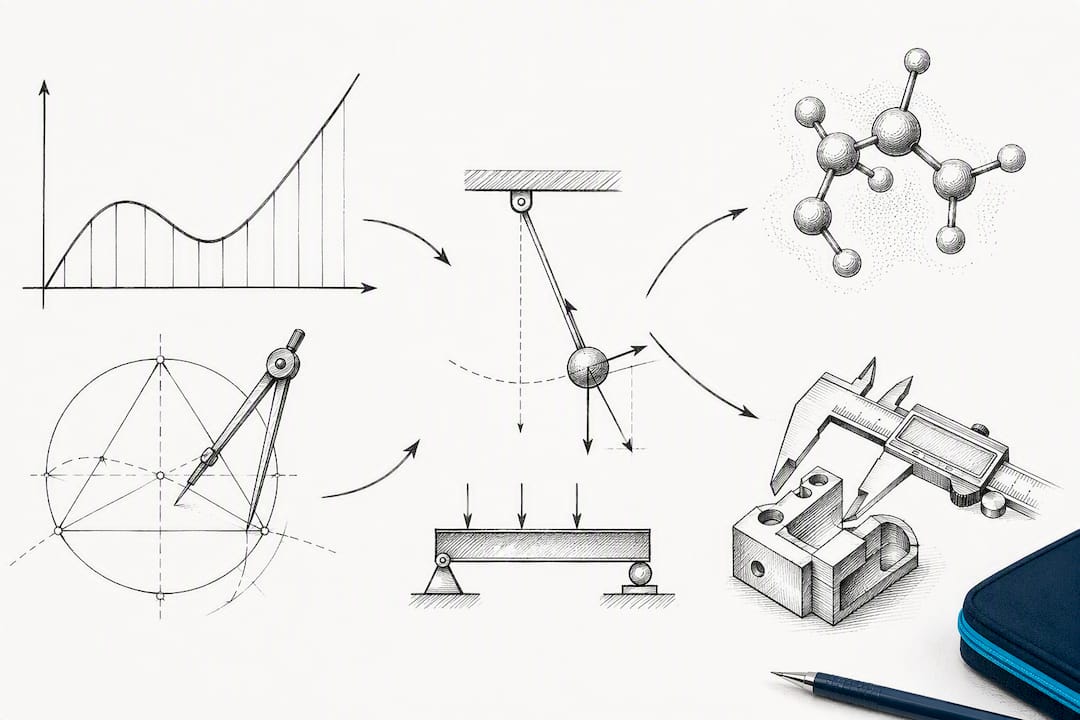
Your third HL adds another axis. A Design technology student who understands the physics behind material stress, or a Chemistry HL student who can model reaction rates mathematically, is demonstrating the kind of cross-subject fluency that first-year engineering courses assume you already have. First-year engineering syllabuses commonly span mechanics, materials, thermofluids, and electrical circuits within a single term, so the earlier you get comfortable moving between subjects, the smoother that transition feels.
The Group 4 project is a genuine, low-stakes place to practise this. A project combining a physics measurement, a chemistry constraint, and a design element, however small, gives you real evidence of interdisciplinary thinking to describe later, rather than just a claim.
Common challenges IB students face preparing for engineering, and fixing them
Three problems come up repeatedly among IB students aiming at engineering, and all three are fixable with the right adjustment rather than a change of ambition.
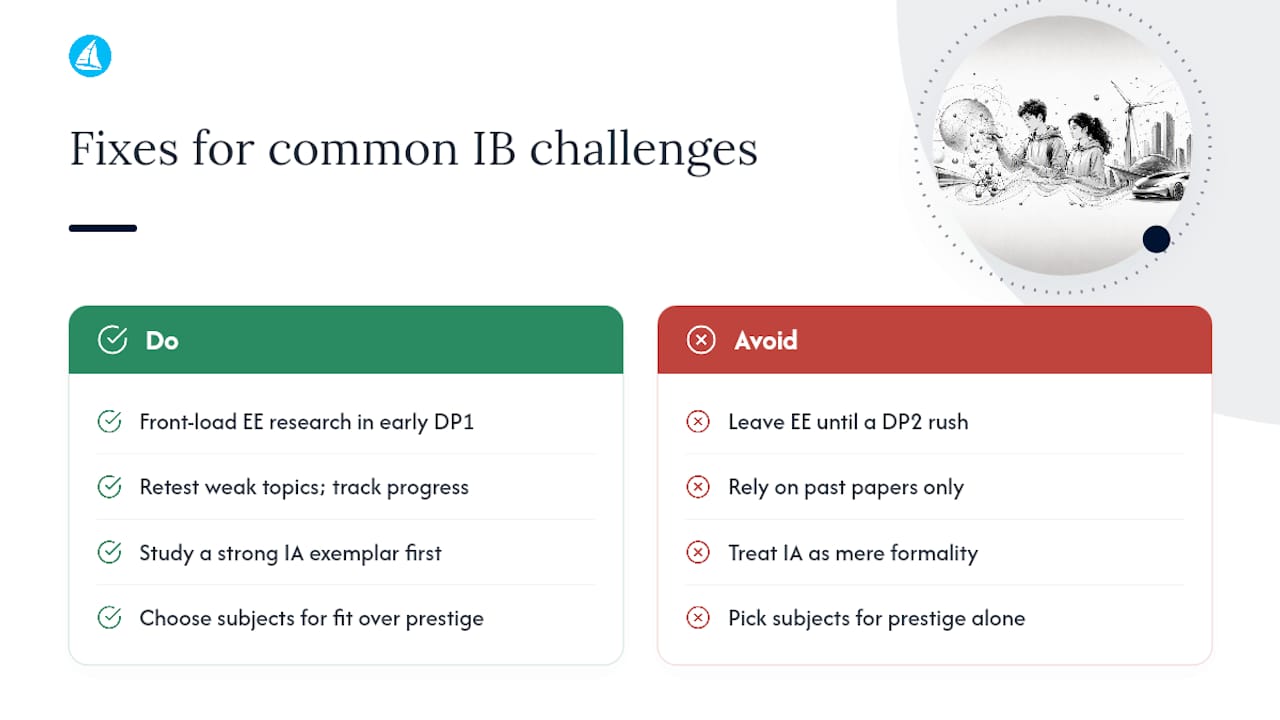
The workload trap. Three HLs in maths-heavy, lab-heavy subjects is genuinely demanding, and students who stack Math AA HL, Physics HL, and a second science HL sometimes find EE and IA quality slips because there simply isn’t enough time. The fix is sequencing: front-load EE research in early DP1 before IA deadlines pile up in DP2, rather than treating both as parallel emergencies later.
Confusing coverage with mastery. Working through every past paper once feels productive but leaves gaps invisible until results day. Targeted retesting of your actual weak topics, tracked properly, closes far more gaps than broad, unfocused repetition.
Underestimating experimental write-up standards. Many students treat IA lab work as a formality and lose marks on reproducibility and data presentation rather than on the science itself. Read a strong exemplar IA before you start your own, and treat method clarity as seriously as the result.
A fourth, quieter challenge is choosing subjects for prestige rather than fit, taking on a second science HL because it “looks impressive” rather than because it serves your branch. Admissions tutors read coherence, not subject count, so a well-argued three-subject pattern almost always beats an overloaded four.
Author perspective: examiner advice in one short note
Coherence beats ambition every time in engineering applications. A student with Math AA HL, Physics HL, one well-matched third HL, and a genuinely strong EE will usually outscore one juggling four HLs badly. Aim high, but keep your predicted grades realistic. When you write about your EE or IA in a personal statement, name the specific method and result, not just the topic.
— Oliver
Study smarter with examiner-built IB STEM resources
If you’re following the Math AA HL and Physics HL pattern above, the practice you use matters as much as the subjects you pick. Tibertutor is built specifically around exam-style preparation for IB Biology, Chemistry, Physics, and Maths, created by actual IB examiners rather than generic tutors, which means the questions, mark schemes, and mock exams genuinely reflect how papers are marked.
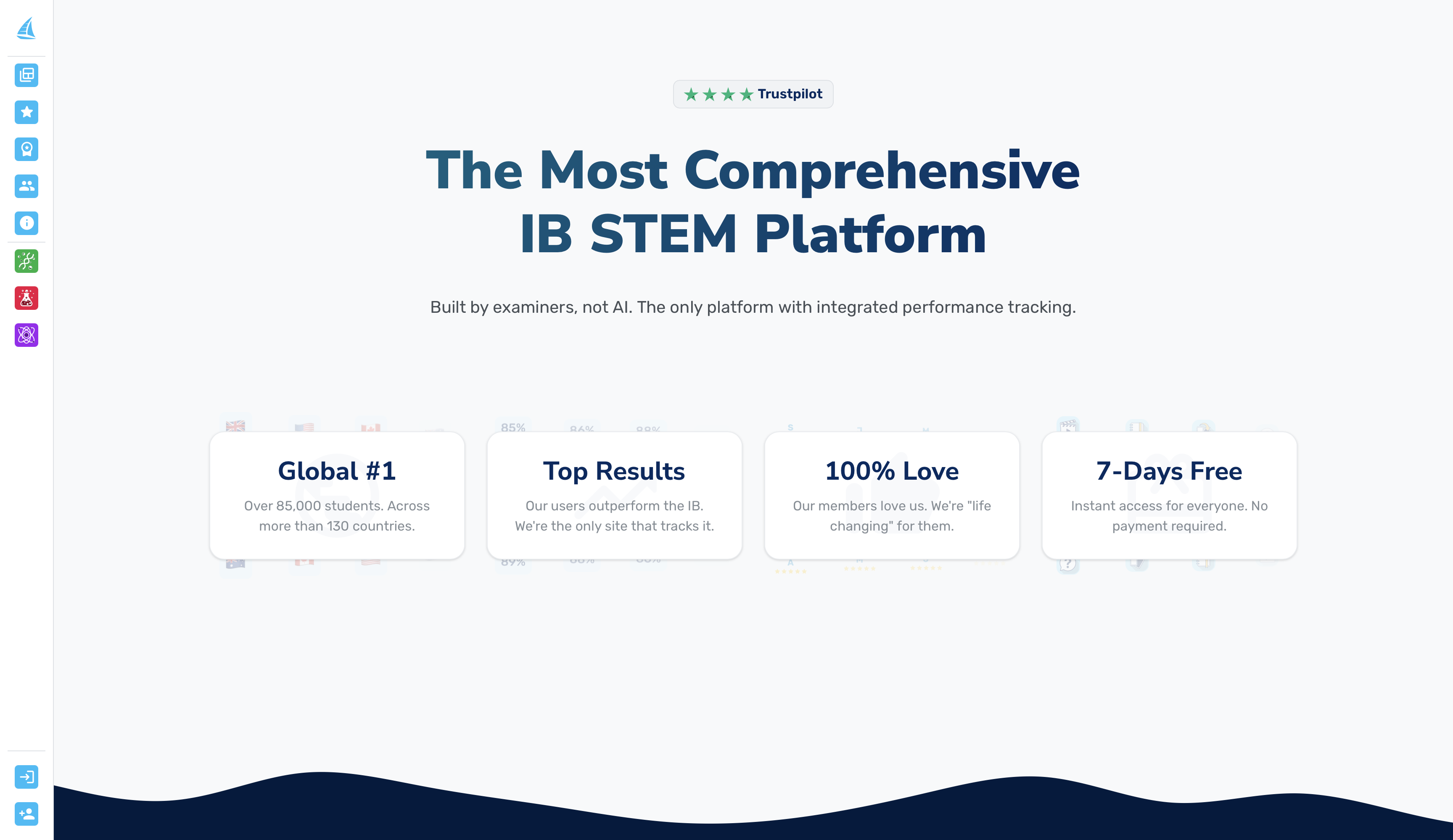
Every resource is interlinked: a weak topic flagged in your analytics dashboard links straight to the notes, animated video, and topic test that address it, so you’re never guessing what to revise next. That level of connected, exam-accurate tracking isn’t something you’ll find bundled together elsewhere at this quality. Start with the IB Physics topic tests if you’re following the mechanics-heavy pattern above, or head to the full student overview page to see subscription options and start your free 7-day trial today.
Sources
- DP design technology - International Baccalaureate®
- IB DP Pathways: STEM Pathway — Best Subject Patterns and Skill Signals - Sparkl
- How to choose the right IB courses to prepare you for an engineering career — Born To Engineer
FAQ
Is a 42 in the IB good enough for Harvard?
Competitive total scores for engineering often sit in the mid-to-high 30s, but Harvard and similar selective universities assess the full application, including HL subject choices, Extended Essay quality, and extracurricular activities, not only the total score.
What is the hardest IB subject to score a 7 in?
Difficulty varies by school and cohort, but Mathematics AA HL and Physics HL are often seen as demanding subjects due to their intensive problem-solving and calculus content.
Does MIT prefer AP or IB?
MIT does not publicly state a preference between AP and IB; both are accepted, and admissions reviewers assess the rigour of whichever curriculum an applicant actually completed.
Is a 26 a weak IB score for engineering?
A 26 falls well below the typical competitive range for selective engineering programmes, which often sit in the mid-to-high 30s, so students in that range should look at foundation years or less selective entry routes.